Canadian Thanksgiving history and traditions tell a story that is older, quieter, and in many ways more surprising than the American holiday most of the world knows. Ask a Canadian when they celebrate Thanksgiving and the answer — the second Monday of October — often catches visitors off guard. Yet this northern harvest celebration predates the famous Plymouth feast by more than four decades, survived centuries of colonial proclamations, shared a date with the national day of mourning for fallen soldiers, and only settled into its modern form in 1957. For anyone who loves holidays with genuine roots, Canada’s Thanksgiving is one of the most rewarding to understand, because every element of it — the date, the dinner, the long weekend — carries a piece of the country’s history.
Canadian Thanksgiving at a Glance
Before diving into the full story, here are the essentials for anyone planning around the holiday:
| Detail | Answer |
|---|---|
| Official name | Thanksgiving Day (Action de grâce in French) |
| Date | Second Monday of October, every year |
| Thanksgiving 2026 | Monday, October 12, 2026 |
| Thanksgiving 2027 | Monday, October 11, 2027 |
| Legal status | Statutory holiday in Alberta, British Columbia, Manitoba, Ontario, Quebec, Saskatchewan, Yukon, Northwest Territories, and Nunavut; an optional holiday in the Atlantic provinces (Prince Edward Island, Newfoundland and Labrador, New Brunswick, and Nova Scotia) |
| Core meaning | Gratitude at the close of the harvest season |
| Signature meal | Roast turkey with stuffing, gravy, mashed potatoes, squash, and pumpkin pie |
| Biggest traditions | Family dinners, long-weekend cottage trips, fall-color outings, the Kitchener-Waterloo Oktoberfest parade, and the CFL Thanksgiving Day Classic |
The October date is the single most important thing to grasp. Canada’s harvest simply ends earlier than America’s. By late November, much of the country is already dealing with snow; a harvest festival in November would be a celebration of winter, not of gathering crops. October, with its crisp air and blazing maple foliage, is when the harvest is genuinely in and thanks are genuinely due. For the full breakdown of upcoming dates, see our guide to when Canadian Thanksgiving falls in 2027.
The Earliest Thanksgivings on Canadian Soil
Long before any European set foot in North America, the Indigenous peoples of the land that would become Canada held ceremonies of thanksgiving tied to the seasons — for the return of the salmon, the ripening of corn and beans and squash, the successful hunt. The Haudenosaunee, for example, observe thanksgiving addresses that express gratitude for the natural world in an unbroken chain stretching back countless generations. Any honest telling of Canadian Thanksgiving history starts with acknowledging that giving thanks for the harvest is far older than the holiday’s official story.
The first European-recorded thanksgiving in what is now Canada took place in 1578, when the English explorer Martin Frobisher, searching for the Northwest Passage, held a ceremony of thanks in Newfoundland after surviving a brutal Arctic voyage. Frobisher’s men gathered on the shores of Frobisher Bay — in present-day Nunavut — for a communion service led by their chaplain, Robert Wolfall, giving thanks for their safe deliverance. It was a spare, windswept affair, nothing like a harvest feast, but it is documented and it predates the 1621 Plymouth gathering by 43 years.
A generation later, in 1606, Samuel de Champlain founded the Ordre de Bon Temps — the Order of Good Cheer — at the French settlement of Port-Royal in Acadia (now Nova Scotia). Through the long winter, the colonists took turns hosting elaborate feasts, sharing whatever game and fish could be found, with Mi’kmaq neighbors joining the table. Champlain later instituted harvest thanksgiving feasts in New France as well. These were community survival celebrations as much as religious observances, and they established a French-Canadian thread of autumn thanksgiving that runs parallel to the English one.
Colonial Proclamations: Thanksgiving Becomes Official
For more than a century, thanksgivings in British North America were declared as needed — to mark the end of a war, the recovery of a monarch from illness, a good harvest, or deliverance from some calamity. They were movable, occasional, and tied to specific events rather than to the calendar.
The turning point toward a regular, national holiday came after Confederation. In 1879, Governor General the Marquess of Lorne proclaimed Thursday, November 6, 1879, as a national day of Thanksgiving — the first officially designated Thanksgiving in the Dominion of Canada. From then on, Thanksgiving was proclaimed annually, though the date shifted from year to year, usually landing in October or November depending on the government’s choice.
The holiday’s date then became entangled with one of Canada’s most solemn observances. After the First World War, the federal government combined Thanksgiving with Armistice Day (now Remembrance Day), so that from 1921 to 1930, Canadians marked Thanksgiving and the commemoration of the war dead on the same Monday — the week of November 11. It was an awkward pairing: a day of feasting and gratitude yoked to a day of mourning. In 1931, Parliament finally separated the two, fixing Remembrance Day on November 11 and returning Thanksgiving to a movable autumn date chosen by annual proclamation.
The modern holiday arrived on January 31, 1957, when Parliament issued a proclamation fixing Thanksgiving permanently on the second Monday in October, describing it as “a Day of General Thanksgiving to Almighty God for the bountiful harvest with which Canada has been blessed.” That proclamation has governed the date ever since, and its language — gratitude for the harvest — remains the holiday’s official spirit.
Canadian vs. American Thanksgiving: What’s Actually Different
Americans visiting Canada in October are often startled to find turkey on the menu six weeks early, and Canadians visiting the United States in November face the reverse surprise. The two holidays share a name and a roast bird, but they are genuinely different celebrations:
- The date. Canada: second Monday of October. United States: fourth Thursday of November. The gap is about six weeks, driven by the earlier northern harvest.
- The origin story. America’s Thanksgiving is anchored to the Pilgrims and the 1621 Plymouth feast. Canada’s official lineage runs through Frobisher’s 1578 Arctic thanksgiving, Champlain’s feasts, and the 1879/1957 proclamations — a colonial-administrative story rather than a settler-myth story.
- The long weekend. Canadian Thanksgiving always creates a three-day weekend, since it falls on a Monday. American Thanksgiving creates a four-day weekend anchored on Thursday.
- The mythology. Canada never developed a single iconic “First Thanksgiving” narrative the way the United States did around Plymouth. Canadian schoolchildren learn about Frobisher and Champlain, but the holiday carries less national myth-making and more straightforward harvest gratitude.
- Football. American Thanksgiving is inseparable from NFL football. Canadian Thanksgiving has its own gridiron tradition: the CFL Thanksgiving Day Classic, with Monday afternoon games that are a staple of the holiday for football fans.
- Black Friday. The American shopping frenzy has bled across the border in recent years, with Canadian retailers now running Black Friday sales — but it sits a full six weeks after Canadian Thanksgiving, so it was never part of the holiday itself.
- The turkey. The bird is shared, but Canadian tables often lean into regional specialties alongside it — tourtière (meat pie) in Quebec, butter tarts for dessert, and Nanaimo bars at the holiday table in British Columbia.
How Canadians Celebrate Today
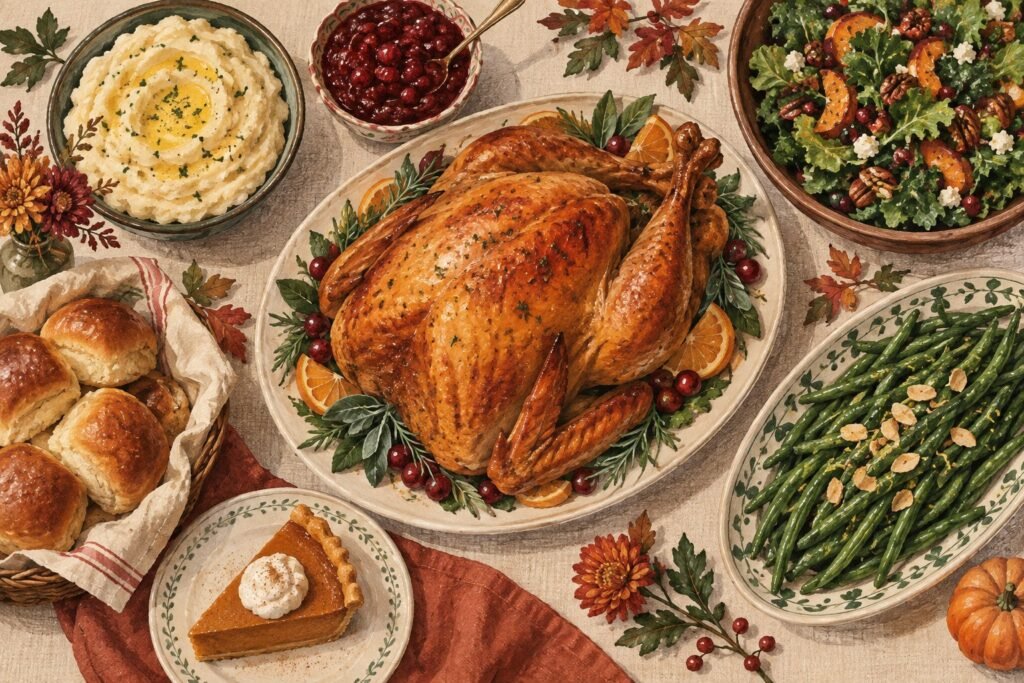
Modern Canadian Thanksgiving is a low-key, family-centered holiday — many Canadians describe it as their favorite precisely because it lacks the commercial frenzy of Christmas and the travel chaos of American Thanksgiving. The center of gravity is the Sunday or Monday dinner: roast turkey with bread stuffing, gravy, mashed potatoes, roasted root vegetables, Brussels sprouts, cranberry sauce, and pumpkin pie with whipped cream. Households that don’t eat turkey might serve ham, roast chicken, or a vegetarian harvest centerpiece, but the shape of the meal — abundant, autumnal, shared — stays constant.
The long weekend shapes the celebration as much as the dinner does. Because the holiday always falls on a Monday, millions of Canadians treat it as the last great weekend of the warm season. In Ontario, families “close the cottage” — winterizing their lake cabins in a ritual weekend of dock-pulling, leaf-raking, and one final bonfire. In the cities, the weekend is peak fall-color season, and parks and conservation areas fill with leaf-peepers hiking through red and gold maples.
The Kitchener-Waterloo Oktoberfest Parade
One of Canada’s most distinctive Thanksgiving traditions has nothing to do with turkey. Kitchener-Waterloo, Ontario — home to the largest Oktoberfest celebration outside Germany — holds its Thanksgiving Day Parade on the holiday Monday, with floats, marching bands, and polka dancers processing through the twin cities. The festival runs for nine days straddling Thanksgiving weekend, blending German heritage with Canadian autumn in a way found nowhere else.
The CFL Thanksgiving Day Classic
Since the late 1940s, the Canadian Football League has scheduled games on Thanksgiving Monday, and the Thanksgiving Day Classic is now a fixed ritual for fans — afternoon football with turkey leftovers, watched from couches across the country. It is the Canadian answer to the NFL’s Thanksgiving tripleheader, played on the Monday holiday rather than a Thursday.
Volunteering and Food Drives
Thanksgiving weekend is also one of the busiest times of the year for Canadian food banks. Churches, schools, and community groups run harvest food drives in the weeks before the holiday, and many families make volunteering or donating part of their own tradition — gratitude expressed as generosity.
Regional Differences Across the Country
Canada is enormous, and Thanksgiving wears a slightly different face in each region:
- Ontario and the West embrace the holiday most fully — big family dinners, cottage weekends, and the statutory day off.
- Quebec observes l’Action de grâce as a statutory holiday, but culturally it is quieter. Many Québécois families treat it as a pleasant long weekend rather than a major feast, and the province’s grand autumn food celebration remains the sugaring-off season in spring. That said, turkey dinners are common, often with a French-Canadian touch like tourtière served alongside.
- The Atlantic provinces — where the day is an optional rather than statutory holiday — celebrate more modestly. In Newfoundland and Labrador, the traditional Jiggs dinner (salt beef, root vegetables, pease pudding) sometimes shares the table with turkey.
- The Prairies keep the holiday closest to its harvest roots. In farming communities in Saskatchewan, Manitoba, and Alberta, Thanksgiving still lands at the genuine end of the harvest, and church harvest-home services remain well attended.
- British Columbia enjoys the mildest Thanksgiving weather in the country, and the weekend is prime hiking and wine-country season in the Okanagan.
- The North — Yukon, Northwest Territories, and Nunavut — where Frobisher’s original 1578 thanksgiving took place, marks the day as winter’s doorstep; celebrations are intimate and community-based.
Indigenous perspectives add an important dimension. Many Indigenous people in Canada observe the weekend through their own nations’ harvest and thanksgiving ceremonies, which long predate the statutory holiday, while others use the day to reflect on the colonial history the holiday’s official narrative leaves out. A thoughtful celebration makes room for both gratitude and that reflection.
What Canadians Eat: The Thanksgiving Table
The Canadian Thanksgiving menu will look familiar to Americans, with local accents. The turkey is typically brined or butter-roasted, stuffed with a savory bread dressing flavored with sage and onion. Gravy is non-negotiable. Mashed potatoes, roasted squash, glazed carrots, and Brussels sprouts with bacon fill out the sides. Cranberry sauce appears in both jellied and whole-berry forms, and the dessert course almost always ends with pumpkin pie — often spiced a touch more boldly than its American cousin — plus apple pie, butter tarts, or a Nanaimo bar platter.
Drinks lean seasonal: mulled apple cider, local craft beer (especially Oktoberfest-season lagers), and wines from Niagara or the Okanagan. In Quebec, you might find cider from the Eastern Townships’ apple orchards. The meal is traditionally served in the mid-to-late afternoon, stretching into the evening — a long, unhurried affair that matches the holiday’s relaxed character.
Thanksgiving Weekend Getaway Ideas
Because the holiday always delivers a three-day weekend at the height of fall color, many Canadians treat it as a travel weekend. Classic options include:
- Leaf-peeping drives — Algonquin Park in Ontario, the Laurentians in Quebec, and Cape Breton’s Cabot Trail in Nova Scotia are at or near peak color on Thanksgiving weekend.
- Wine country — Niagara-on-the-Lake and British Columbia’s Okanagan Valley are harvesting grapes, and winery restaurants serve special Thanksgiving menus.
- City breaks — Toronto, Montreal, and Vancouver all run fall festivals over the long weekend. If you’re spending the holiday in Ontario’s capital, our guide to celebrating Thanksgiving in Toronto covers dinners, events, and day trips.
- Cottage country — For those lucky enough to have access, the final cottage weekend of the year is a Canadian institution.
The 1957 Proclamation: Words That Still Define the Day
The January 31, 1957 proclamation that fixed Canadian Thanksgiving on the second Monday of October is worth reading closely, because its phrasing reveals how the country understood the holiday at mid-century. It designates the day as one of “General Thanksgiving to Almighty God for the bountiful harvest with which Canada has been blessed” — language that is explicitly agricultural and reverent, with no mention of pilgrims, explorers, or national founding myths. In other words, the legal soul of Canadian Thanksgiving is the harvest itself, not a historical pageant.
That framing has shaped how the holiday evolved. Because the proclamation doesn’t anchor the day to a specific story, Canadians have been free to fill it with whatever gratitude means to them: the end of the farming year, the beauty of the autumn landscape, time with family before winter closes in. It also explains why the holiday has remained relatively free of the culture-war debates that periodically swirl around the American Thanksgiving narrative. There is no single Canadian “first Thanksgiving” story that schoolchildren are required to revere, so there is less to argue about — the day is about the harvest, and the harvest is real.
The proclamation’s agricultural emphasis feels especially relevant today, as interest in local food and farming has surged. Farmers’ markets across the country do their biggest business of the year on Thanksgiving weekend. The “100-mile” and farm-to-table movements have given the holiday a renewed sense of purpose: a turkey from a local farm, squash from the market down the road, and apples from a nearby orchard turn the 1957 language about a “bountiful harvest” into something you can taste.
Experiencing Canadian Thanksgiving as a Visitor
If you’re visiting Canada over the holiday weekend, a few practical notes will help you make the most of it. First, book restaurants early — the best Thanksgiving dinners in Toronto, Montreal, Vancouver, and Ottawa sell out weeks in advance, and many top restaurants offer special multi-course harvest menus for the weekend. Grocery stores stock fresh turkeys, but they sell through quickly; if you’re cooking, buy by the Thursday before.
Second, expect some closures on the Monday itself. Government offices, banks, libraries, and most schools are closed in provinces where it’s a statutory holiday. Major tourist attractions and shopping malls in big cities generally stay open, but it’s worth checking ahead in smaller towns. Public transit typically runs on a holiday schedule.
Third, dress for real autumn. Thanksgiving weekend can bring crisp, sunny days perfect for hiking — or the season’s first serious cold snap, especially on the Prairies and in the North. Layers are essential, and if you’re heading to cottage country or a national park, bring something warm for the evenings.
Finally, if you’re invited to a Canadian Thanksgiving dinner, bring something. Wine, a dessert, or flowers are all welcome, and offering to help with dishes afterward will earn you permanent goodwill. Canadians are famously polite about it, but the gratitude at the heart of the holiday extends to guests who pitch in.
In Pictures: Canadian Thanksgiving History and Traditions
Canada's Thanksgiving is older than America's — it began with an Arctic explorer's feast in 1578, decades before Plymouth. Here's the northern story.
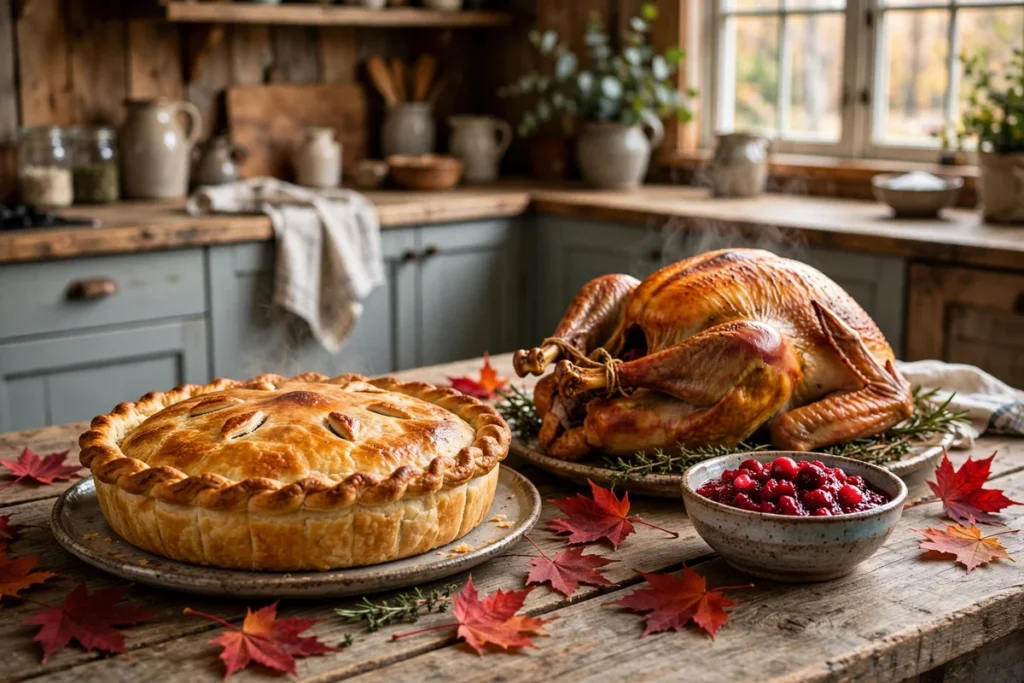
A Canadian Thanksgiving table with roast turkey, maple leaf decorations, and autumn foliage in warm fall colors.
Watch: Canadian Thanksgiving History and Traditions
The truth about Canadian Thanksgiving history — what most people don't know about how Canada's holiday really began.
At a Glance: Canadian Thanksgiving History and Traditions
The milestones of Canada's older — and earlier — Thanksgiving.
| Date | Event | Key detail |
|---|---|---|
| 1578 | Frobisher's feast | Explorer Martin Frobisher holds a thanksgiving celebration in present-day Nunavut — 43 years before Plymouth |
| 1606 | Port Royal | Settlers at Port Royal (Nova Scotia) share harvest feasts with the Mi'kmaq |
| 1879 | First national proclamation | Parliament declares 6 November a national day of Thanksgiving |
| 1957 | Fixed date | Parliament sets Thanksgiving as the second Monday in October — 'a day of general thanksgiving' |
| Today | The traditions | Turkey dinner, pumpkin pie, and fall color — much like the US, but six weeks earlier |
Frequently Asked Questions
Why is Canadian Thanksgiving in October instead of November?
Canada’s harvest ends earlier than America’s. By late November, most of Canada is already experiencing winter weather, so a harvest thanksgiving in November would make little sense. The second Monday of October lands at the genuine close of the Canadian harvest season — and it has been fixed there by Parliament since the 1957 proclamation.
Is Canadian Thanksgiving older than American Thanksgiving?
The earliest documented thanksgiving ceremony on Canadian soil — Martin Frobisher’s 1578 service in what is now Nunavut — predates the 1621 Plymouth feast by 43 years. However, the modern statutory holiday dates to the 1879 proclamation (and its current fixed date to 1957), while the U.S. national holiday dates to Lincoln’s 1863 proclamation. So the ceremonies are older, but the modern holidays are roughly contemporaries.
Do Canadians eat turkey on Thanksgiving?
Yes — roast turkey with stuffing, gravy, and pumpkin pie is the standard Canadian Thanksgiving dinner, essentially the same centerpiece as the American meal. Regional specialties like Quebec’s tourtière or Atlantic Canada’s Jiggs dinner sometimes join the table.
Is Thanksgiving a day off work in Canada?
It depends on where you live. Thanksgiving is a statutory holiday in Alberta, British Columbia, Manitoba, Ontario, Quebec, Saskatchewan, Yukon, Northwest Territories, and Nunavut, and for federally regulated employees everywhere. In the Atlantic provinces — Prince Edward Island, Newfoundland and Labrador, New Brunswick, and Nova Scotia — it is an optional holiday, so many private-sector workers do not get paid time off.
What is the difference between Canadian and American Thanksgiving?
The date (October vs. November), the origin story (Frobisher/Champlain and the 1879 and 1957 proclamations vs. the Pilgrims and 1621 Plymouth), the guaranteed Monday long weekend, and the traditions (CFL football and the Kitchener-Waterloo Oktoberfest parade vs. NFL football and the Macy’s parade). The shared element is the harvest-turkey-pumpkin-pie dinner at the heart of both.
Do French Canadians celebrate Thanksgiving?
Thanksgiving (Action de grâce) is a statutory holiday in Quebec, and many families enjoy turkey dinners and the long weekend. But culturally it is a quieter occasion than in English Canada — Quebec’s big traditional food celebrations revolve around Christmas, New Year, and the spring sugaring-off season instead.
Conclusion
Canadian Thanksgiving history and traditions offer something the louder American holiday cannot: a harvest celebration shaped by Arctic explorers, French colonists, parliamentary proclamations, and the honest rhythm of a northern growing season. From Frobisher’s windswept 1578 service to the 1957 proclamation that fixed the second Monday of October, from cottage-closing weekends to the Kitchener-Waterloo parade, it is a holiday that belongs entirely to its place. Whether you are Canadian planning the perfect long weekend or a visitor curious about the October turkey, understanding this history turns a simple dinner into a story four centuries in the making. For a broader look at how the rest of the planet gives thanks, explore our guide to Thanksgiving around the world — and if you want the deeper American backstory, start with the story of the first Thanksgiving. You can browse the full collection in our Thanksgiving category.