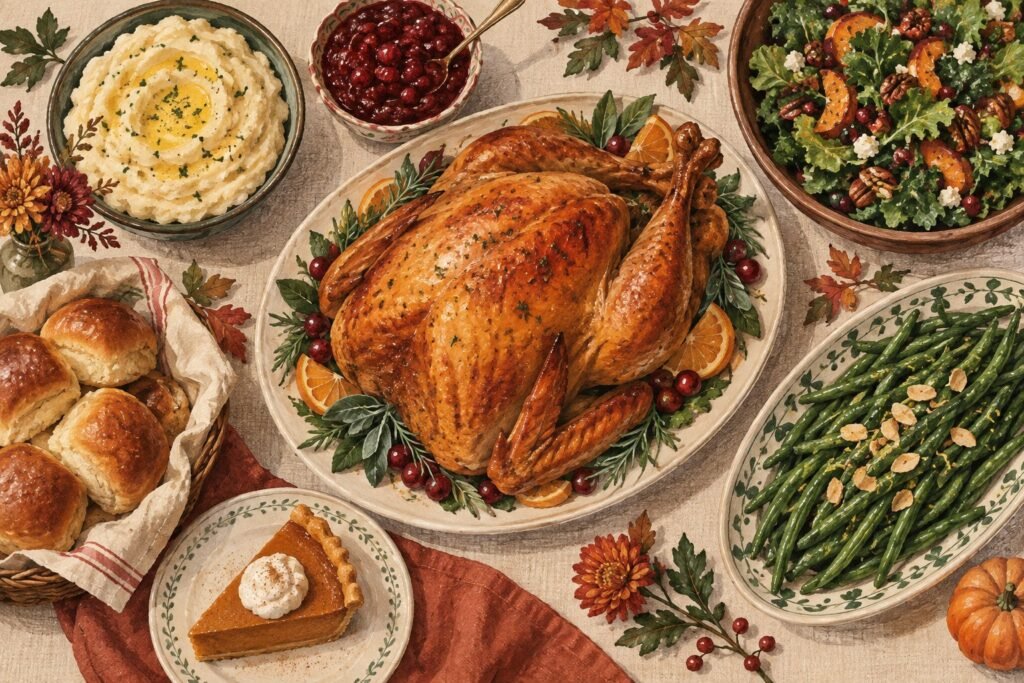
Choosing the best wine with Thanksgiving dinner is famously tricky — and famously overthought. The Thanksgiving table is not one dish but a dozen: sweet roasted turkey, savory gravy, buttery mashed potatoes, tart cranberry sauce, sweet potato casserole with marshmallows, herb stuffing, green beans, and rich pie. No single wine pairs perfectly with all of them, which is liberating once you accept it: the goal is not perfection but versatility. The best Thanksgiving wines are medium-bodied, food-friendly, moderate in alcohol, and high in acidity — wines that refresh the palate between bites rather than competing with the feast. This guide explains exactly why, recommends specific varietals and bottle styles at three price tiers, and gives you serving, quantity, and timing advice for Thanksgiving 2026 on November 26.
You will not find snobbery here. The right Thanksgiving wine is the one your guests enjoy, at a price that lets you buy enough of it. We cover whites, reds, rosés, and sparkling wines; what to serve with turkey, with sides, and with dessert; how much to buy; what temperature to serve; and the common mistakes that turn a good pairing into a bad one. And the standing note: please drink responsibly — Thanksgiving is a marathon, and the wine should enhance the day, not end it early.
Why Thanksgiving Is the Hardest — and Easiest — Pairing of the Year
Wine pairing usually means matching one wine to one dish: fatty fish with crisp white, ribeye with bold red. Thanksgiving breaks that model. A single plate holds sweet, savory, fatty, acidic, herbal, and starchy elements simultaneously, and the “correct” pairing for the turkey (a delicate white) contradicts the “correct” pairing for the sausage stuffing (a robust red). Chasing a perfect match for every bite is a fool’s errand.
The professional solution is to pair with the meal’s overall character, not its components. Thanksgiving dinner is rich, savory-sweet, and marathon-length. That points to wines with three traits: high acidity (cuts through butter, gravy, and richness, and keeps the palate fresh over a long meal), moderate alcohol (12–13.5% — high-alcohol wines overwhelm delicate turkey and fatigue drinkers over hours), and versatile fruit character (apple, pear, citrus, cranberry, cherry — flavors that echo the table rather than clash with it). Tannin is the enemy here: big, tannic reds turn bitter against sweet sides and dry out turkey breast. Oak is a secondary concern — heavily oaked wines can taste flabby next to the meal’s richness.
This is also why Thanksgiving is secretly the easiest pairing of the year: the bar is versatility, not precision, and dozens of wines clear it. Offer one excellent white, one excellent red, and one sparkling wine, and you have covered every guest and every plate. If you want cocktail options for the hours before dinner, our Thanksgiving cocktails guide is built to hand off to wine at the table.
The Golden Rules of Thanksgiving Wine
Before the specific recommendations, five rules that govern every choice below:
1. Acidity is everything. If you remember one word, make it acidity. Crisp wines cleanse the palate between bites of rich food; soft, low-acid wines taste flat and heavy by the second course. When in doubt between two bottles, choose the one described as “crisp,” “lively,” or “bright.”
2. Keep alcohol moderate. A 15% Napa cabernet at 3 PM is a recipe for a 6 PM nap. Thanksgiving drinking stretches for hours, often starting before dinner. Wines at 12–13.5% alcohol let everyone enjoy the whole day. This is hospitality, not a tasting exam.
3. Fruit over oak, finesse over power. Choose wines where fruit leads and oak supports (or is absent). Unoaked or lightly oaked wines taste fresher with the meal. Big, extracted, heavily oaked wines — the “steakhouse reds” — are the most common Thanksgiving wine mistake.
4. A little sweetness is a feature, not a flaw. Off-dry wines (Riesling, Gewürztraminer, Vouvray) are Thanksgiving superstars precisely because a touch of residual sugar tames salt, spice, and tart cranberry. Do not fear the word “off-dry” — these are not dessert wines.
5. When in doubt, go sparkling. Sparkling wine pairs with literally everything on the Thanksgiving table: the bubbles and acidity cut richness, the moderate alcohol keeps the afternoon pleasant, and the festivity is unmatched. If you buy only one wine, make it bubbly.
Best White Wines for Thanksgiving Dinner
White wine is the traditional Thanksgiving champion, and for good reason: it handles turkey breast, loves acidity-driven sides, and suits the afternoon timing. These four varietals are the safest, most rewarding choices.
Riesling — the single best Thanksgiving white
If sommeliers voted, Riesling would win Thanksgiving in a landslide. High acidity, moderate alcohol (often 11–12.5%), and a spectrum from bone-dry to off-dry that lets you match your table’s sweetness. An off-dry Riesling is the answer to cranberry sauce, sweet potatoes, and glazed ham-adjacent sides; a dry Riesling handles the savory end. What to buy: German Riesling labeled Kabinett (light, off-dry, ~$15–25) from the Mosel; Washington State Riesling (dry or off-dry, excellent value at $12–20); or Alsace Riesling (dry, fuller, $18–30). Why it works: acidity cuts richness, touch of sweetness bridges sweet-savory sides, low alcohol suits the long day. Serve at: 45–50°F (well chilled).
Chardonnay (unoaked or lightly oaked)
The crowd-pleaser — most guests know and like Chardonnay. The key is style: choose unoaked or lightly oaked bottles (often labeled “unoaked,” or from cooler regions like Chablis, France, or coastal California). Buttery, rich turkey and gravy love Chardonnay’s weight; unoaked versions keep the freshness. What to buy: Chablis (France — steely, mineral, $20–35); unoaked California or Chilean Chardonnay ($12–20); white Burgundy labeled “Mâcon” for value ($15–25). Avoid big, buttery, heavily oaked styles — they double down on the meal’s richness instead of relieving it. Serve at: 50–55°F (cool, not ice-cold — too cold mutes the flavor).
Sauvignon Blanc
The herbal, citrusy option — a natural fit if your stuffing and turkey lean herby (sage, thyme, rosemary). Its grassy, grapefruit character echoes those flavors beautifully. What to buy: Sancerre or Pouilly-Fumé (Loire Valley, France — the refined benchmark, $22–35); New Zealand Sauvignon Blanc (punchy, tropical, $12–18); or Chilean ($10–15) for value. Caveat: very pungent New Zealand styles can overpower delicate turkey breast — pour them with appetizers and sides rather than as the main turkey wine. Serve at: 45–50°F.
Gewürztraminer and Viognier — the aromatic alternatives
For the adventurous host: Gewürztraminer (Alsace or Washington, $15–25) brings lychee, rose, and spice notes that are magical with sweet potato casserole and spiced sides; Viognier (Rhône or California, $15–28) offers apricot and floral richness that flatters roast turkey. Both are lower-acid, so serve them well chilled and alongside — not instead of — a crisper white. These are the wines guests remember and ask about.
Best Red Wines for Thanksgiving Dinner
Red wine at Thanksgiving is entirely appropriate — it just needs to be the right red. Forget tannic monsters; think bright, juicy, low-tannin reds served slightly cool.
Pinot Noir — the single best Thanksgiving red
Pinot Noir is to red wine what Riesling is to white at Thanksgiving: high acidity, moderate alcohol, low tannin, and red-fruit flavors (cherry, cranberry, raspberry) that echo the table. It handles turkey (both white and dark meat), loves mushroom and herb stuffing, and does not clash with cranberry sauce. What to buy: Willamette Valley, Oregon ($20–35 — the sweet spot of quality and value); California coastal Pinot (Sonoma, Monterey, $15–28); Bourgogne Rouge / basic Burgundy (France, $20–35); or Chilean and New Zealand Pinot ($12–22) for value. Why it works: cranberry-like fruit, refreshing acidity, gentle tannins that will not dry out turkey. Serve at: 55–60°F — slightly cool, about 20 minutes in the fridge. Cool reds taste fresher and more food-friendly.
Beaujolais (Gamay) — the insider’s pick
Beaujolais, made from the Gamay grape, is the wine industry’s open secret for Thanksgiving: light, juicy, low-tannin, served cool, and absurdly food-friendly. Cru Beaujolais (labeled with village names like Morgon, Fleurie, or Juliénas, $16–28) offers surprising depth; Beaujolais-Villages ($12–18) is the value play. Nouveau-style or simple Beaujolais works too. Why it works: bright cherry-berry fruit, virtually no tannin, refreshing chill — it drinks like the red-wine equivalent of cranberry sauce. Serve at: 55°F.
Zinfandel — the bold-but-friendly option
For guests who want a bigger red: Zinfandel (California, $14–25) brings jammy berry fruit and spice that stand up to dark meat, sausage stuffing, and smoky flavors. Choose moderate-alcohol examples (under 14.5% — check the label) and avoid the jammy, high-octane styles that flatten the meal. Old-vine Zinfandels from Lodi or Sonoma often hit the balance best. Serve at: 60–65°F. Pour this for the red-wine loyalists; keep the Pinot for the table at large.
What about Cabernet, Merlot, and Syrah?
Honest answer: they are the most common Thanksgiving wine mistakes. Big Cabernet Sauvignons and Syrahs are tannic, high-alcohol, and oaky — they dry out turkey breast, turn bitter against sweet sides, and tire palates early. If a guest brings one, by all means open it (never refuse a guest’s wine), but do not buy them as your planned Thanksgiving reds. A softer Merlot or Côtes du Rhône (Grenache-Syrah blend, $12–20) can work in a pinch — choose the fruitiest, least oaky bottle you can find.
Rosé and Sparkling: The Secret Weapons
Dry rosé — the diplomat
Dry rosé splits the difference between white and red and pleases both camps. Choose Provençal-style dry rosé (pale, crisp, $12–22) — its strawberry-citrus profile and brisk acidity handle the whole table. Rosé’s only risk is perception; some guests still think it is sweet. Label it “dry rosé from Provence” on your little menu card and watch skeptics convert. Serve at: 45–50°F.
Sparkling wine — buy more than you think
Champagne, Prosecco, Cava, or American sparkling — the bubbles are what matter. Sparkling wine’s acidity and effervescence scrub richness from the palate, its moderate alcohol suits the long day, and nothing says celebration like a pop. What to buy: Prosecco DOC ($12–18 — the value champion; choose “Brut” for dryness); Cava (Spain — $10–16, often the best value in sparkling wine); American sparkling (California, Oregon — $15–30, excellent quality); Champagne (France — $40+; wonderful but unnecessary for the table — save it for the toast). Thanksgiving-specific tip: serve sparkling as the arrival wine (it is the perfect greeting), keep it flowing through appetizers, and bring it back for the toast. One bottle covers about 6 flutes — buy accordingly. Serve at: 40–45°F, well chilled.
Wine by Course: What to Pour When
Arrival and appetizers (2–4 PM)
Sparkling wine and crisp whites. Bubbles greet guests; Sauvignon Blanc or dry Riesling carry through Thanksgiving appetizers and charcuterie boards. Keep pours modest — dinner is coming.
The main event: turkey and sides
Put both the white and the red on the table and let guests choose: off-dry Riesling or unoaked Chardonnay alongside Pinot Noir or Beaujolais. This is the core recommendation of this entire guide — two bottles, both versatile, every guest covered. If your menu runs sweet (marshmallow-topped sweet potatoes, glazed everything), lean the white toward off-dry Riesling; if it runs savory-herbal, lean toward Chardonnay and Pinot.
Dessert
Most Thanksgiving desserts (pumpkin pie, pecan pie, apple pie) actually pair poorly with dry wine — the dessert’s sweetness makes dry wine taste sour and thin. The classic rule: the wine should be at least as sweet as the dessert. Options: a late-harvest Riesling or Gewürztraminer (sweet, $15–25), a glass of Moscato d’Asti (light, fizzy, low-alcohol, $12–18), or ruby port with chocolate desserts. Or skip wine entirely — coffee and our Thanksgiving coffee drinks are the more popular dessert pairing in most American homes, and there is no shame in it. If you serve pie, browse our Thanksgiving desserts for the full spread you are pairing with.
How Much Wine to Buy
The standard planning math: one 750ml bottle yields about five 5-ounce glasses. For a dinner party, plan on roughly half a bottle per adult for the meal itself, plus wine for the pre-dinner hours. A practical formula: (number of drinking adults × 0.75 bottles), rounded up, then add 2–3 extra bottles as buffer. For 12 adults: 12 × 0.75 = 9, plus buffer = 11–12 bottles. Split roughly 40% white, 35% red, 25% sparkling — or adjust to your crowd’s known preferences.
Buy from a shop with a good return policy or a case discount (most wine shops discount 10–15% on 12 bottles, and many accept returns of unopened bottles). Store reds and whites alike in a cool, dark place; refrigerate whites and sparklings the night before. And remember the non-drinkers: our Thanksgiving mocktails guide ensures they have something equally festive — a thoughtful host plans both menus.
Serving Temperatures and Timing Cheat Sheet
Temperature is the most neglected variable in home wine service, and the easiest to fix. The folk wisdom — “whites cold, reds room temperature” — is roughly half wrong. Modern homes run warm (68–72°F), which is too warm for reds: they taste soupy and alcoholic. Use this cheat sheet:
- Sparkling wine: 40–45°F — straight from the fridge, or 20 minutes in an ice bucket.
- Crisp whites (Riesling, Sauvignon Blanc, rosé): 45–50°F — fridge for 2+ hours.
- Fuller whites (oaked Chardonnay, Viognier): 50–55°F — fridge for 1 hour, then 15 minutes out.
- Light reds (Pinot Noir, Beaujolais, Gamay): 55–60°F — 20–30 minutes in the fridge before serving.
- Medium reds (Zinfandel, Merlot, Côtes du Rhône): 60–65°F — 15 minutes in the fridge, or a cool cellar.
Open reds 15–30 minutes before pouring (no need for lengthy decanting with these lighter styles). Open sparkling at the last moment — the pop is part of the theater. If you are juggling oven schedules too, our Thanksgiving day cooking schedule helps you slot wine service into the day’s flow.
Budget Tiers: Great Bottles at Every Price
Under $15 (the smart bulk buy): Washington Riesling, Chilean Sauvignon Blanc, Portuguese Vinho Verde (light, fizzy, delightful with appetizers), Spanish Cava, Chilean Pinot Noir, Côtes du Rhône. At this tier, buy by the case and do not apologize — these are honest, food-friendly wines.
$15–25 (the sweet spot): Mosel Kabinett Riesling, Oregon Pinot Noir (entry level), Cru Beaujolais, Mâcon-Villages Chardonnay, New Zealand Sauvignon Blanc, Prosecco DOC, Alsace Gewürztraminer. This is where quality jumps most per dollar — if your budget allows one upgrade, spend it here.
$25–40 (the showcase bottles): Willamette Valley Pinot Noir (named vineyard), Chablis Premier Cru, Sancerre, good American sparkling (Oregon or California), white Burgundy. Buy one or two showcase bottles for the table’s centerpiece and fill in with the sweet-spot tier — guests remember the best bottle, not the average.
Over $40: unnecessary for Thanksgiving dinner service. If you want to splurge, spend it on Champagne for the toast — a $50 grower Champagne at the toast beats a $50 red lost among twelve side dishes.
Common Wine Mistakes at Thanksgiving
Serving reds too warm. “Room temperature” in a 72°F house with an oven running is 75°F+ — soupy. Twenty minutes in the fridge fixes every red on this list.
Serving whites too cold. Ice-cold wine is mute wine. If your Chardonnay tastes like nothing, let it warm five minutes in the glass.
One bottle for the whole table. A single wine cannot serve every palate and every dish. Two (white + red) is the minimum for a real dinner; three (add sparkling) is ideal.
The trophy red. Opening your prized Napa Cabernet with turkey is like wearing a tuxedo to paint a house — impressive, inappropriate, and a waste. Save trophy bottles for meals built around them.
No plan for the non-drinkers. Already covered, but worth repeating: a great mocktail menu is part of wine planning. See our Thanksgiving mocktails.
Forgetting water. Put a pitcher of water on the table. Hydrated guests enjoy wine more and longer. This is not optional.
Wine and Thanksgiving Dinner for Special Diets
A brief note, since holiday tables are increasingly diverse. Most wines are naturally gluten-free (wine is fermented grape juice; gluten is a grain protein), though guests with celiac disease sometimes ask — standard wines are fine, but avoid wine-based coolers with added flavorings. For vegan guests: many wines use animal-derived fining agents (egg white, gelatin, isinglass). If it matters to your table, look for bottles labeled “vegan” or “unfined/unfiltered” — a growing number, especially from natural-leaning producers. Sulfite sensitivity is real but rare; “contains sulfites” appears on virtually all wine (sulfites occur naturally in fermentation), and true sulfite allergy affects a small fraction of asthmatics. When in doubt, ask the guest rather than guessing — our vegan Thanksgiving menu and gluten-free Thanksgiving menu guides cover the food side.
In Pictures: Best Wine with Thanksgiving Dinner
Thanksgiving is famously tricky to pair — sweet, savory and rich all on one plate. This is the classic red-and-white answer.
Pinot noir and chardonnay bottles with filled glasses beside a roast turkey, candlelight and autumn foliage.
Watch: Best Wine with Thanksgiving Dinner
Eat Drink Fun's sommelier recommends five wines for Thanksgiving dinner — expert pairing advice for a tricky menu.
At a Glance: Best Wine with Thanksgiving Dinner
The wine styles sommeliers reach for at Thanksgiving, and why each one works with the spread.
| Wine | Why it works |
|---|---|
| Pinot Noir | Light-bodied with bright acidity that handles turkey and sides |
| Chardonnay | Unoaked or lightly oaked styles suit buttery mashed potatoes |
| Riesling | Off-dry Riesling cools spicy or sweet dishes |
| Zinfandel | Bold fruit stands up to dark meat and sausage stuffing |
| Sparkling wine | Bubbles and acidity cut through rich gravy and pie |
| Serving tip | Offer one red and one white so guests can choose |
Frequently Asked Questions
What is the absolute best wine to serve with turkey?
For versatility across the whole Thanksgiving plate, off-dry Riesling (white) and Pinot Noir (red) are the two most recommended answers among sommeliers — high acidity, moderate alcohol, fruit that echoes the table, and tannins (in the Pinot’s case) gentle enough for turkey breast. If you must choose one bottle for the turkey course, choose the Riesling: its touch of sweetness handles both white and dark meat plus the sweet-savory sides. But the real answer is to serve both and let guests choose.
Red or white wine with Thanksgiving dinner?
Both. This is the rare meal where the correct answer is genuinely “serve both.” White wine (Riesling, unoaked Chardonnay) suits turkey breast and the meal’s overall richness; red wine (Pinot Noir, Beaujolais) suits dark meat, sausage stuffing, and guests who simply prefer red. Put one of each on the table. Forcing a red-or-white choice at Thanksgiving creates losers; offering both creates a better party.
How many bottles of wine do I need for 15 guests?
Plan on about 11–13 bottles: (15 drinking adults × 0.75) = ~11, plus a 2-bottle buffer. Split roughly 5 white, 4 red, 3 sparkling, adjusted to your crowd. That assumes wine is served from arrival through dinner — if you are also serving cocktails before dinner (see our Thanksgiving cocktails), you can trim 10–15%. Always round up; leftover wine is a gift, but running out is a hosting failure. Check your wine shop’s return policy for unopened bottles.
Should Thanksgiving wine be expensive?
No. Thanksgiving is the worst occasion for expensive wine and the best occasion for smart wine. A dozen side dishes overwhelm subtle, costly bottles — the meal rewards $12–25 food-friendly wines (Riesling, Beaujolais, Cava, Côtes du Rhône) over $60 trophy reds. Spend your splurge budget on one showcase bottle or Champagne for the toast, and fill the table with excellent value wines. Your guests will enjoy the $18 Riesling more than the $80 Cabernet, because it will actually taste good with the food.
Can I serve the same wine I cook with?
The old rule holds: do not cook with wine you would not drink — but that sets a low bar, not a high one. A $10 drinkable dry white is fine for deglazing and gravy; “cooking wine” from the grocery aisle (salted, stabilized) is not wine and should never go in food or glasses. You do not need to cook with your good bottles, but the cooking wine should be a real, drinkable wine. When a recipe calls for white wine, the same unoaked Chardonnay or Sauvignon Blanc you are serving works perfectly.
What wine goes with pumpkin pie?
The rule: the wine must be at least as sweet as the dessert, or it will taste sour and thin. Good matches: late-harvest Riesling, Moscato d’Asti (light, gently sparkling, low alcohol), or a cream sherry. Tawny port works with pecan pie and chocolate desserts. Honestly, though, most Americans pair Thanksgiving pie with coffee — and our Thanksgiving coffee drinks guide leans into that tradition. Wine with pie is lovely but optional; coffee with pie is nearly mandatory.
Conclusion
The best wine with Thanksgiving dinner is not a single bottle — it is a small, thoughtful lineup: a crisp, versatile white (Riesling or unoaked Chardonnay), a bright, gentle red (Pinot Noir or Beaujolais), and a sparkling wine for arrivals and toasts. Keep alcohol moderate, acidity high, and serving temperatures correct, and the wine will do what it is supposed to do: refresh palates, complement the feast, and keep the long afternoon convivial.
Thanksgiving 2026 is November 26. Buy early (the good value Rieslings and Beaujolais sell out the week of Thanksgiving), chill correctly, put water on the table, and plan something beautiful for the non-drinkers too. For the complete holiday, pair this guide with our Thanksgiving dinner menu, our Thanksgiving 2026 date guide, and our party ideas. Please drink responsibly — and enjoy every glass.