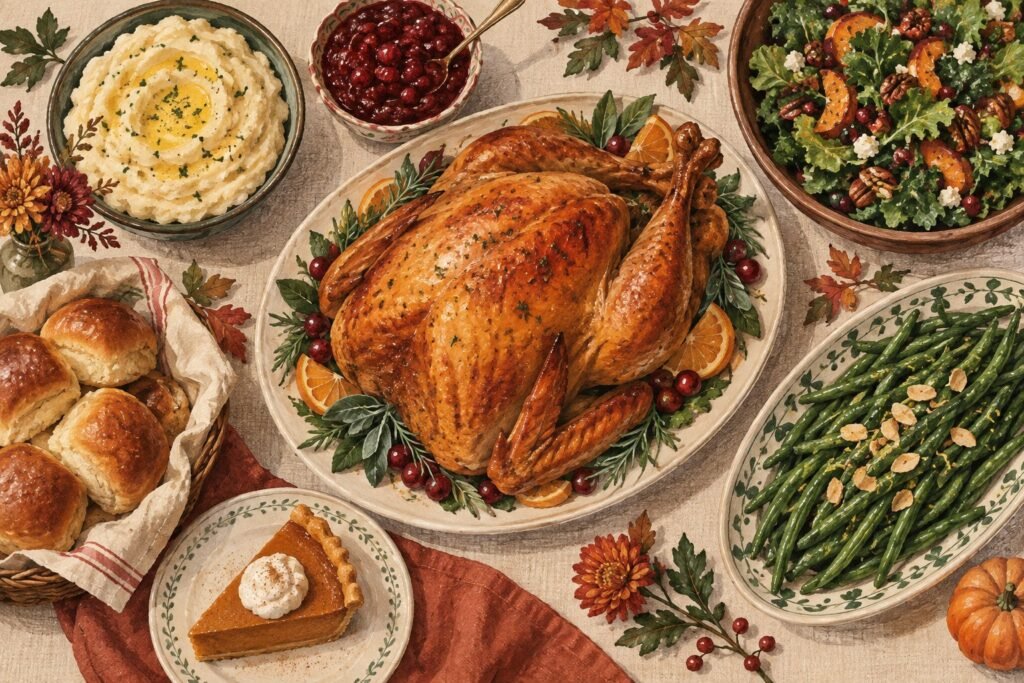
The cruelest timing problem in Thanksgiving cooking is gravy: the best version depends on turkey drippings, which do not exist until the bird is done, which means the most important sauce on the table must be made in the most chaotic thirty minutes of the day. Make ahead turkey gravy without drippings solves this completely. By roasting turkey wings days in advance — extracting their collagen, fond, and roasted flavor into a rich stock — you can produce a gravy so deep and silky that guests will assume it came from the bird, all while your Thanksgiving day stays calm.
This guide is built around the roasted-wing method and a practical timeline. You will learn why wings (not legs, not necks alone) are the ideal gravy foundation, how to roast them for maximum fond, how to build the gravy in about an hour of mostly unattended time, exactly when to make it during Thanksgiving week, and how to finish it on the day with fresh drippings for the best of both worlds. There are variations, troubleshooting, and the storage science that makes this the most freezer-friendly recipe in the collection. If holiday stress had a single antidote, this gravy would be it.
Why Make Gravy Ahead
Thanksgiving day has a fixed amount of oven time, burner space, and cook attention, and the turkey consumes most of all three. Traditional drippings gravy demands a chunk of each at the worst possible moment — while the turkey rests, sides finish, and guests arrive. Making gravy ahead moves that entire project to a quiet weekend afternoon days before, when you can roast wings, simmer stock, and build the gravy without a single competing demand.
The payoff is not just logistical. A make-ahead gravy made from properly roasted wings is genuinely excellent — deep, glossy, and rich — because the wing method gives you something drippings alone do not: time. You can roast the wings dark, simmer the stock long, and reduce it patiently, building layers of flavor that a rushed thirty-minute pan gravy cannot match. Then, on Thanksgiving day, you whisk in the fresh drippings from your Thanksgiving turkey and get both: the depth of the slow method and the freshness of the real thing.
How This Differs from Drippings Gravy
It is worth being precise about the relationship between this recipe and our turkey gravy from drippings, because they are companions, not competitors. Drippings gravy starts with the caramelized juices and fat from your roasted turkey and is made in the thirty minutes after the bird comes out. It is the freshest, most turkey-specific gravy possible — and it cannot be made ahead, because the drippings do not exist yet.
This recipe starts with roasted turkey wings and builds an equivalent flavor foundation from scratch, days in advance. The techniques overlap — both use a roux, both follow the same fat-flour-liquid ratio — but the flavor source differs: roasted wings and long-simmered stock here, fresh pan drippings there. The smartest approach, honestly, is both: make this gravy ahead as your guaranteed base, then enrich it with fresh drippings on the day. You will never run short, never scramble, and never serve a thin backup gravy again.
The Secret: Why Turkey Wings
Turkey wings are the ideal gravy foundation for three reasons. First, they are rich in collagen and connective tissue, which break down during roasting and simmering into gelatin — the substance that gives great gravy its silky, lip-coating body. Second, they have a high skin-to-meat ratio, which means abundant browning and fond, the caramelized bits that carry roasted flavor. Third, they are cheap and widely available, especially in the weeks before Thanksgiving when stores stock them heavily.
Do not substitute chicken wings one-for-one and expect identical results — chicken wings work in a pinch, but they produce a lighter, less turkey-specific flavor. Turkey necks are a fine addition alongside wings (they add even more collagen), but necks alone lack the meaty browning surface that wings provide. Three to four pounds of wings is the right quantity for a full batch of gravy; the roasted wing meat itself can be picked off and added to the gravy, used in soup, or simply eaten by the cook as a well-earned snack.
Building Deep Flavor Without a Roasted Bird
Roast dark
Roast the wings at high heat — 425°F — until deeply browned, turning once. You want real color, not just cooked-through: mahogany skin, browned edges, and a pan full of fond. This browning is the flavor foundation of the entire gravy, and timid roasting is the single biggest reason make-ahead gravies taste flat. Give it the full 45 to 55 minutes.
Brown the aromatics in the wing fat
After roasting, the pan holds rendered turkey fat and fond. Cook chopped onion, carrot, and celery directly in that pan (or transfer the fat to your stockpot) until softened and sweet. Then deglaze with wine or stock, scraping up every browned bit. This step captures flavor that would otherwise be left in the roasting pan.
Simmer, do not boil
Cover the roasted wings and vegetables with stock or water and simmer gently — lazy bubbles, not a rolling boil — for 2 to 3 hours. Boiling emulsifies fat into the liquid and turns the stock cloudy and greasy; simmering keeps it clean while still extracting collagen and flavor. Skim occasionally. The result should be a rich, golden, full-bodied turkey stock that gels lightly when chilled — the gel is proof of extracted collagen.
Ingredients You’ll Need
- 3 to 4 pounds turkey wings, patted dry
- 2 tablespoons neutral oil or melted butter
- Kosher salt and freshly ground black pepper
- 1 large onion, roughly chopped
- 1 large carrot, roughly chopped
- 2 ribs celery, roughly chopped
- 4 cloves garlic, smashed
- 1/2 cup dry white wine or dry vermouth (optional, for deglazing)
- 8 cups low-sodium chicken or turkey stock, plus more as needed
- 3 bay leaves
- 1 tablespoon fresh thyme leaves (or 1 teaspoon dried)
- 8 tablespoons (1 stick) unsalted butter
- 1/2 cup all-purpose flour
- Soy sauce or Worcestershire sauce, to taste (optional)
- Fresh drippings from the Thanksgiving turkey, for day-of finishing (optional but recommended)
Ingredient notes
Turkey wings: Look for whole wings, not pre-cut pieces — whole wings roast more evenly and are easier to handle. If your store only has them frozen, thaw completely and pat very dry; moisture is the enemy of browning.
Stock: You need good stock as the simmering liquid because the wings alone will not produce enough volume. Low-sodium is essential — the stock reduces significantly, concentrating salt. Between the wings’ contribution and reduction, you will end with about 6 cups of rich homemade turkey stock, from which you will build about 5 cups of gravy.
Step-by-Step Instructions
- Roast the wings. Heat the oven to 425°F (220°C). Toss the wings with the oil, salt generously, and pepper. Arrange in a single layer in a large roasting pan and roast 45 to 55 minutes, turning once halfway, until deeply browned with crisp, mahogany skin and a pan full of fond.
- Brown the aromatics. Transfer the wings to a large stockpot. Set the roasting pan over medium heat (or transfer its fat to a skillet), add the onion, carrot, and celery, and cook 8 to 10 minutes until softened and starting to color. Add the garlic and cook 1 minute more. Pour in the wine, if using, and scrape up every browned bit.
- Simmer the stock. Scrape the vegetables and all the pan juices into the stockpot with the wings. Add the 8 cups of stock, bay leaves, and thyme. Bring to a bare simmer — just a few lazy bubbles — and cook 2 to 3 hours, skimming occasionally, until rich and flavorful. Strain through a fine-mesh sieve, pressing on the solids. You should have about 6 cups; if short, add stock to make up the difference. (Pick the meat from the wings now for the cook’s treat or for soup.)
- Make the roux. In a large, heavy saucepan over medium heat, melt the butter. Whisk in the flour and cook 2 to 3 minutes, whisking constantly, until smooth, bubbly, and nutty-smelling — a blond roux.
- Build the gravy. Add the warm wing stock gradually, whisking constantly — about a cup at a time at first, then in a steady stream. Bring to a gentle simmer and cook 8 to 10 minutes, stirring, until the gravy thickly coats a spoon. It should look slightly thinner than your final target; it thickens as it cools.
- Season and strain. Taste and salt carefully — the stock has reduced and concentrated. Add black pepper, a teaspoon of soy sauce or Worcestershire if it needs depth, and a squeeze of lemon if it needs brightness. Strain through a fine-mesh sieve for silkiness. Cool, then refrigerate or freeze (see timeline below).
- Day-of finish (Thanksgiving). Warm the gravy gently in a saucepan. When the turkey rests, whisk in 1/2 to 1 cup of fresh drippings (defatted juices plus a spoonful of the deglazed fond) and simmer 5 minutes to marry the flavors. Adjust thickness with stock and seasoning to taste. Serve hot — this is now a hybrid gravy with the depth of the slow method and the freshness of the day.
The Timeline: When to Make It
The beauty of this recipe is its flexibility. Here is the ideal schedule, working backward from Thanksgiving Thursday:
- Sunday or Monday: Roast the wings and simmer the stock (about 3 1/2 hours, mostly unattended). Strain and refrigerate the stock.
- Monday or Tuesday: Build the gravy from the stock — roux, whisk, simmer, season, strain (about 30 minutes active). Cool and refrigerate, or freeze for longer storage.
- Wednesday: If frozen, move to the refrigerator to thaw. Taste the cold gravy and note any seasoning adjustments for tomorrow.
- Thursday: Warm gently, whisk in fresh drippings while the turkey rests, adjust seasoning, and serve. Total day-of work: about 10 minutes.
Every step can shift a day in either direction without consequence. The gravy itself keeps 4 days refrigerated and 3 months frozen, so even a two-week-ahead batch works if you freeze it.
Variations to Try
Giblet make-ahead gravy
Simmer the turkey’s neck, heart, and gizzard with the wings — they add even more collagen and a traditional depth. Chop the cooked giblet meat finely and stir it into the finished gravy. This is the old-fashioned holiday gravy, fully made ahead.
Mushroom make-ahead gravy
Brown 12 ounces of sliced cremini mushrooms in butter before making the roux, and build the roux over them. The mushrooms’ earthy savoriness layers beautifully with the roasted-wing flavor. Especially good over classic bread stuffing.
Herb and garlic
Roast a whole head of garlic alongside the wings until soft and caramelized; squeeze the cloves into the stock. Finish the gravy with fresh chopped sage, thyme, and parsley. The roasted garlic adds a sweet, mellow depth that regular garlic cannot.
Gluten-free
Replace the flour with sweet rice flour in equal measure — it makes a smooth, stable roux with excellent thickening power. Ensure your stock is certified gluten-free. Rice-flour gravy reheats and freezes particularly well, with less risk of the texture breaking.
Extra-rich (cream finish)
Stir 1/2 cup of heavy cream into the finished gravy off the heat. It is not traditional, but it is luxurious — the cream rounds every edge and gives the gravy a velvety body that is magnificent over creamy mashed potatoes.
Troubleshooting: Fixing Common Problems
The wing stock tastes weak
Under-roasted wings or under-reduced stock. The fixes: roast darker next time (color equals flavor), and reduce the current stock further — simmer it down by a quarter to concentrate. A teaspoon of soy sauce or a spoonful of tomato paste browned with the aromatics also deepens a weak stock. Remember that the stock should taste slightly over-concentrated on its own, because the roux and the volume of gravy will dilute it.
Gravy is bland despite good stock
Under-seasoning, almost always. Salt in layers and taste repeatedly — cold gravy tastes less salty than hot, so season the hot gravy boldly. The depth-boosters (soy sauce, Worcestershire, a splash of wine reduction) exist for exactly this moment. And do not skip the day-of drippings finish if you can help it; fresh fond is the single biggest flavor upgrade available.
Lumps from the roux
Same causes and cures as any roux gravy: liquid added too fast or too cold. Whisk vigorously, strain through a sieve, or blend briefly with an immersion blender. Because you are making this ahead with no time pressure, you can afford to be meticulous — add the stock slowly and whisk like you mean it.
Gravy broke or looks greasy after reheating
Reheated too aggressively. Warm it gently over medium-low heat, whisking constantly, and whisk in a splash of hot stock to bring the emulsion back. Never boil a reheated gravy hard. If it broke badly, a teaspoon of cornstarch slurry whisked into the simmering gravy will re-stabilize it.
Too thick after refrigeration
Completely normal — the starch and gelatin set firmly when cold. It is not ruined; it is just cold. Warm it gently and whisk in stock a few tablespoons at a time until it flows the way you want. Judge the final consistency only when the gravy is fully hot.
Storage, Freezing, and Reheating
Refrigerating
Cool the gravy to room temperature (no more than 2 hours out), then refrigerate in covered containers for up to 4 days. Press plastic wrap directly onto the surface before lidding to prevent a skin from forming — or embrace the skin and whisk it back in during reheating.
Freezing
This gravy freezes superbly for up to 3 months. Freeze in portion-sized containers or freezer bags laid flat (they thaw faster and store neatly). Leave headspace for expansion. Thaw overnight in the refrigerator — never at room temperature — and reheat gently with added stock.
Reheating
Warm over medium-low heat, whisking frequently, adding stock to restore consistency. The microwave works for small portions; whisk halfway through. Only reheat what you will serve — repeated reheating degrades the texture. Once reheated, serve within 2 hours.
Gravy Math: Scaling for Any Crowd
Thanksgiving guest counts shift every year, so here is how to scale this recipe with confidence rather than guesswork. The entire method scales linearly — the only thing that changes is the pot size and the clock.
The per-person formula
Plan on 1/3 cup of finished gravy per person, then add a 20 percent buffer — gravy is the one thing guests consistently use more of than hosts expect, especially when mashed potatoes and stuffing are on the table. For 8 guests, that means about 3 1/2 cups; for 16, about 6 1/2 cups; for 24, close to 10 cups. The base recipe makes about 5 cups, which covers 12 to 15 people comfortably.
Scaling the wings and stock
For a double batch (10 cups of gravy), roast 6 to 8 pounds of wings — use two sheet pans so they brown rather than steam — and simmer in your largest stockpot with 14 to 16 cups of stock. The simmering time stays roughly the same; what changes is the reduction time at the end, since there is more liquid to concentrate. For a half batch, use 1 1/2 to 2 pounds of wings and 4 cups of stock, and everything moves a little faster.
Scaling the roux
Keep the 2-2-1 ratio sacred at any scale: 2 tablespoons each of fat and flour per cup of liquid. For 10 cups of gravy, that is 1 1/4 cups each of butter and flour — a large roux that needs a big, heavy pot and patient whisking. One caution: do not try to build more than a double batch in a single pot. Beyond that, the roux cooks unevenly and the whisking becomes unmanageable. Make two separate batches instead; they combine seamlessly at the end.
In Pictures: Make-Ahead Turkey Gravy
Make-ahead gravy is the host’s secret weapon: all the flavor, none of the day-of panic. The gravy, rich and smooth, ready to reheat.
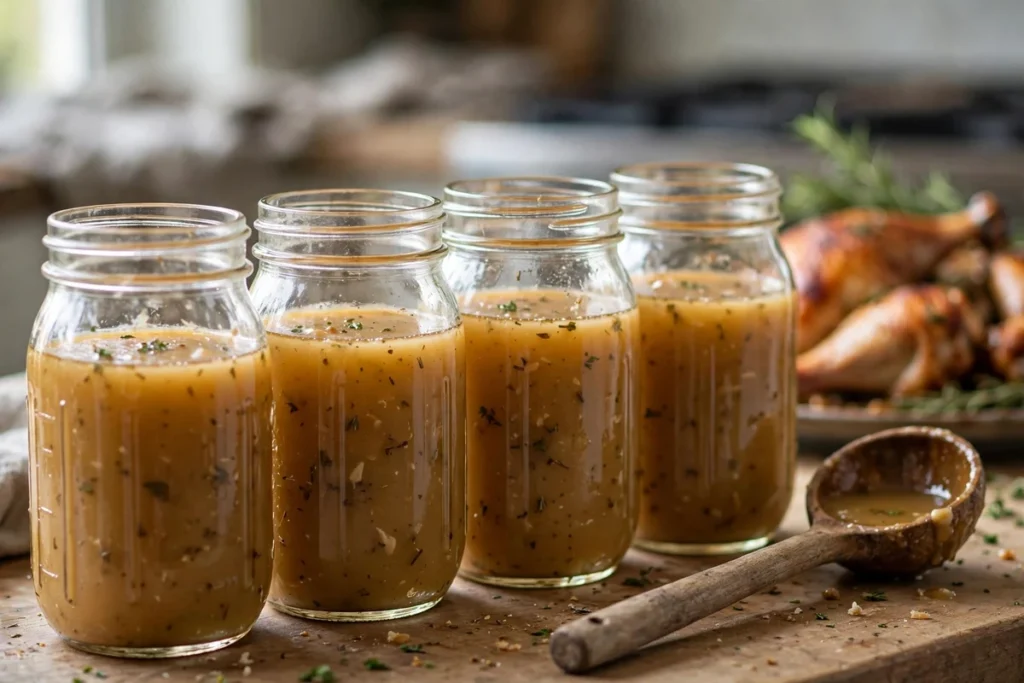
A saucepan of rich make-ahead turkey gravy, smooth and glossy, ready to be reheated for the feast.
Watch: Make-Ahead Turkey Gravy
The Sauce and Gravy Channel builds a full-flavored gravy days ahead — roasting turkey wings for the stock, making a proper roux, and showing exactly how to store and reheat it lump-free.
At a Glance: Make-Ahead Turkey Gravy
Building deep flavor without a roasted bird, from the guide.
| Element | Notes |
|---|---|
| Why make ahead | Frees the stovetop and your attention on Thanksgiving Day itself |
| The secret: turkey wings | Wings (plus the neck and backbone) give you real turkey flavor without roasting a whole bird |
| Roast dark | Roast the wings and aromatics deeply — color equals flavor in the finished gravy |
| Brown in wing fat | Cook the aromatics in the rendered wing fat before building the stock |
| Simmer, don’t boil | A gentle simmer keeps the stock clear and clean-tasting |
| Reheating | Reheat gently with a splash of water or stock, whisking smooth |
Frequently Asked Questions
Can I really not tell the difference from drippings gravy?
Honestly? Side by side, a taster might notice the drippings version has a slightly fresher roasted-meat note. But as served — hot, over turkey and potatoes, amid the chaos of Thanksgiving dinner — the wing-based gravy is superb, and most guests will never suspect it was made days ago. And once you whisk in fresh drippings on the day, the gap closes to nearly nothing.
What if I cannot find turkey wings?
Use turkey necks plus chicken wings, or turkey drumsticks cut into pieces. In a real pinch, brown chicken wings hard and use them — the gravy will be delicious but lighter in turkey character. Ask your butcher: many keep turkey wings in the back even when they are not on display, especially in November.
How much gravy does this make?
About 5 cups from the quantities given — enough for 12 to 15 people at 1/3 cup each, with a little left over. Gravy is the rare dish where leftovers are a feature: it reheats beautifully and transforms next-day turkey sandwiches, so err on the side of plenty.
Can I make this vegetarian?
You can make an excellent vegetarian gravy by the same method — roast mushrooms, onions, and carrots dark, simmer into a rich vegetable stock, and build the roux the same way, with soy sauce and miso for depth. But it will not taste like turkey gravy, because the turkey is the flavor. Call it what it is: a superb mushroom gravy, worthy of its own place on the table.
Do I still need drippings on Thanksgiving day?
No — the gravy is complete and delicious without them. The day-of drippings finish is an enhancement, not a requirement. If your turkey yields little, or you simply do not want the fuss, serve the make-ahead gravy as is with full confidence.
Why did my gravy develop a skin?
Starch-thickened sauces form a skin when exposed to air as they cool — it is harmless dried starch. Prevent it with plastic wrap pressed directly on the surface, or whisk the skin back in during reheating. It has no effect on flavor or safety.
Conclusion
Make ahead turkey gravy without drippings is the rare recipe that reduces stress and improves quality at the same time. Roast the wings dark, simmer the stock low and slow, build the gravy at your leisure, and freeze it with confidence. On Thanksgiving day, warm it, whisk in whatever fresh drippings your turkey offers, and serve a gravy with the depth of a three-hour stock and the freshness of the day. Your future self — the one standing calmly in the kitchen while the turkey rests — will thank you.