20 Traditional Diwali Sweets Recipes: Mithai to Make at Home
No Diwali is complete without mithai. The festival runs on sugar — quite literally — with sweet boxes exchanged between families, ladoos pressed into every guest’s palm, and kitchens perfumed with cardamom, saffron, and ghee for weeks. Store-bought mithai is fine, but homemade Diwali sweets taste better, cost less, and carry the unmistakable flavor of effort. This guide gives you 20 traditional Diwali sweets recipes to make at home, each with a complete ingredient list and step-by-step method, ordered from foolproof to festive-showpiece.
Every recipe here has been chosen for home kitchens — no commercial equipment, no unfindable ingredients. We include difficulty ratings, shelf life, and make-ahead advice so you can plan your Diwali sweet-making like a halwai. Whether you are making your first-ever gulab jamun or attempting soan papdi from scratch, start here. And when the sweets are boxed and ready, pair them with wishes from our Happy Diwali quotes collection.

Your Diwali Mithai Pantry: Essentials to Stock
Before you begin, stock these staples and you can make 18 of the 20 recipes below without another shopping trip: full-cream milk and milk powder, khoya/mawa (or the ingredients to make it), paneer/chenna, besan (gram flour), fine semolina (sooji), all-purpose flour, ghee, sugar, jaggery, cardamom powder, saffron strands, rose water, chopped pistachios, almonds, cashews, desiccated coconut, silver leaf (varak) for garnish, baking soda, and citric acid or lemon juice (for chenna). A heavy-bottomed kadhai, a reliable sugar thermometer (or the cold-water test described below), and parchment paper complete your toolkit.
The sugar-syrup test: many recipes call for “one-string” or “two-string” syrup. Dip a spoon, cool a drop slightly, and press it between thumb and forefinger — one thin string means one-string consistency; two distinct strings means two-string. Practice once and you will never fear syrup again.
The 20 Recipes
1. Gulab Jamun (Easy, makes 25)
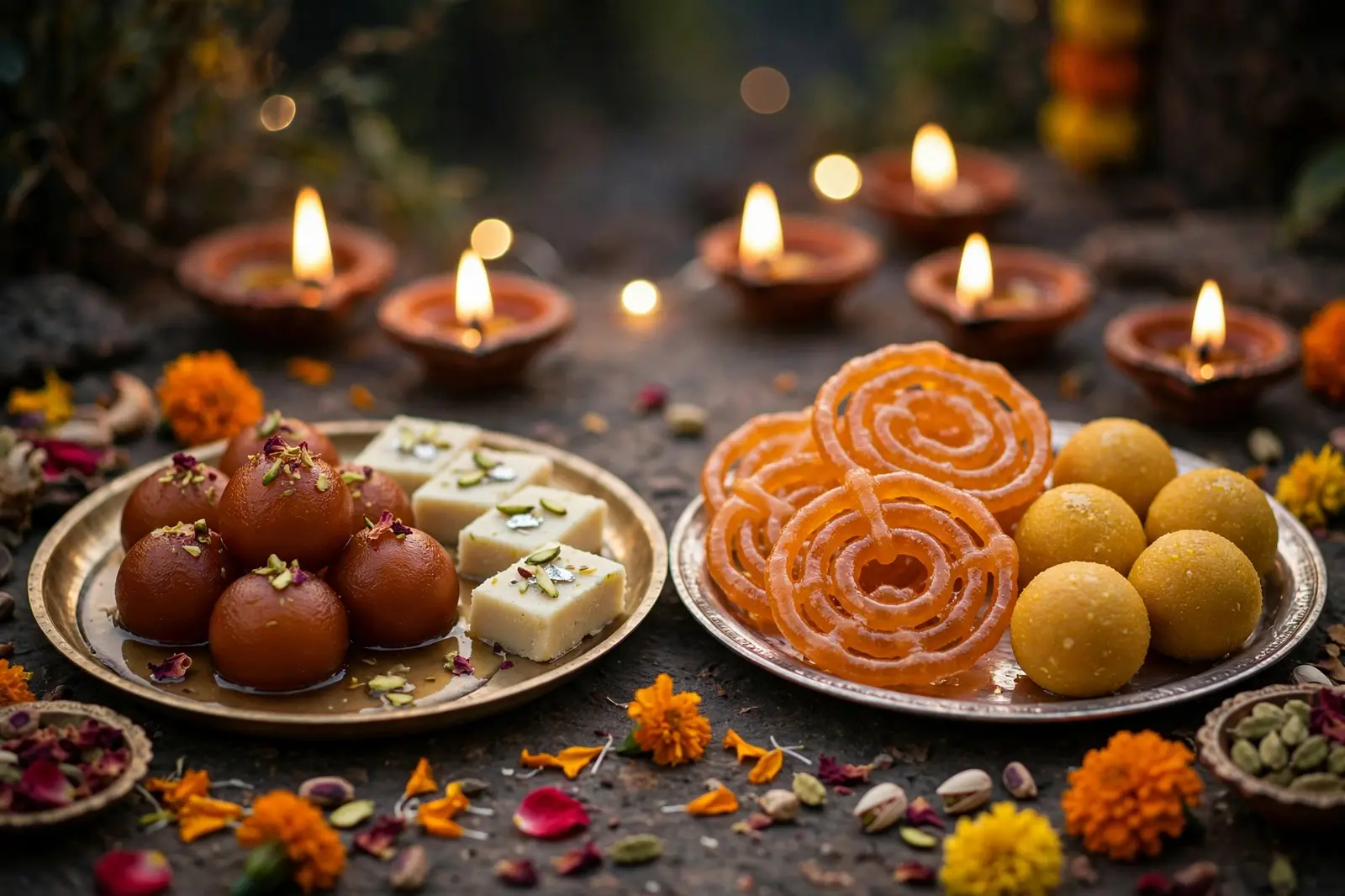
Ingredients: 1 cup milk powder, 1/4 cup all-purpose flour, 1/4 tsp baking soda, 2 tbsp ghee, 1/4 cup warm milk, oil/ghee for frying. Syrup: 2 cups sugar, 2 cups water, 4 cardamom pods, 1 tsp rose water, few saffron strands. Method: Mix dry ingredients, rub in ghee, add warm milk to form a soft dough — rest 15 minutes. Roll smooth, crack-free balls (cracks cause splitting in oil). Heat oil to medium-low (a test ball should rise slowly, not brown instantly). Fry balls until deep golden, stirring gently. Soak in warm (not hot) syrup for at least 2 hours. Tip: if jamuns turn hard, your dough was too dry or the oil too hot — add a spoon of milk next time and lower the flame.
2. Kaju Katli (Medium, makes 30 pieces)
Ingredients: 2 cups cashews (ground to fine powder), 1 cup sugar, 1/2 cup water, 1 tsp ghee, 1/4 tsp cardamom powder, silver leaf to garnish. Method: Make one-string syrup with sugar and water. Add cashew powder and stir on low heat until the mixture leaves the sides and forms a soft dough (8–10 minutes). Cool slightly, knead with ghee until smooth. Roll between parchment sheets to 1/4-inch thickness, apply silver leaf, and cut into diamonds. Tip: overcooking makes katli chewy — pull it off the heat the moment it forms a single mass. Undercook and it will not set; the “soft ball in cold water” test is your friend.
3. Motichoor Ladoo (Medium, makes 30)
Ingredients: 2 cups besan, 1.5 cups sugar, 1.5 cups water, 1/2 tsp cardamom, orange food color (pinch), melon seeds/pistachios, ghee/oil for frying. Method: Make a flowing besan batter (like thin pancake batter). Hold a perforated ladle (boondi jhara) over hot oil and tap batter through to form tiny pearls — fry to light golden, not crisp. Make two-string syrup, add cardamom and color. Mix hot boondi into warm syrup, rest 10 minutes, then shape into ladoos with greased palms while warm. Tip: boondi must go into the syrup hot and the syrup must be warm — cold syrup will not absorb, and you will get loose boondi instead of ladoos.
4. Besan Ladoo (Easy, makes 20)
Ingredients: 2 cups besan, 1 cup ghee, 1.5 cups powdered sugar, 1 tsp cardamom, chopped almonds. Method: Roast besan in ghee on low-medium heat, stirring constantly, for 20–25 minutes until it turns golden and smells nutty — this slow roast is the entire secret. Cool completely (crucial: hot besan melts the sugar into a paste). Mix in powdered sugar, cardamom, and nuts; shape into firm balls. Tip: if the mixture will not hold shape, the besan needs more roasting or a spoon more ghee; if it is oily, add a spoon of roasted besan.
5. Coconut Barfi (Easy, makes 24 pieces)
Ingredients: 3 cups desiccated coconut, 1.5 cups condensed milk, 1/2 tsp cardamom, 2 tbsp milk powder, chopped pistachios. Method: Combine everything in a heavy pan on medium heat. Stir 8–10 minutes until the mixture thickens and leaves the sides. Press into a greased tray, level the top, sprinkle pistachios, and cool 2 hours before cutting into squares. Tip: this is the fastest Diwali sweet in this guide — 20 minutes active time — and it keeps a week refrigerated, making it ideal for gifting in bulk.
6. Rasmalai (Medium, serves 8)
Ingredients: 1 liter full-cream milk (for chenna), 2 tbsp lemon juice, 1 liter milk (for rabri), 1/2 cup sugar, saffron, cardamom, pistachios. Method: Curdle milk with lemon juice, drain chenna in muslin 30 minutes, knead until completely smooth, and shape flat discs. Boil in light sugar syrup 10 minutes until spongy. Meanwhile reduce the second liter of milk to half with sugar, saffron, and cardamom. Soak the discs in the warm rabri 4+ hours (overnight is best). Tip: kneading the chenna until it is silky — no graininess at all — is what separates spongy rasmalai from rubbery discs.
7. Jalebi (Medium-Hard, makes 20)
Ingredients: 1 cup all-purpose flour, 2 tbsp besan, 1/2 tsp yeast or 1/4 tsp baking soda, 3/4 cup warm water, orange color. Syrup: 1.5 cups sugar, 1 cup water, saffron, rose water — one-string. Method: Ferment the batter 6–8 hours (or overnight) for the characteristic tang. Pipe spirals into medium-hot oil using a squeeze bottle or cloth with a hole, fry to crisp golden, and drench immediately in warm syrup for 30 seconds per side. Tip: jalebi waits for no one — serve within an hour for maximum crispness; it softens as it sits, which is why halwais fry to order.
8. Kalakand (Milk Cake) (Easy, makes 20 pieces)
Ingredients: 1 liter full-cream milk, 250 g paneer (crumbled), 3/4 cup sugar, 1/2 tsp cardamom, pistachios. Method: Boil milk, add lemon juice to split it lightly (you want grainy curds, not firm chenna), then add crumbled paneer and sugar. Cook on medium heat, stirring, until the mixture thickens and leaves the sides (20–25 minutes). Press into a greased tray, garnish with pistachios, cool 3 hours, and cut. Tip: the signature grainy texture comes from that light curdling — do not skip the lemon juice or over-stir into smoothness.
9. Soan Papdi (Hard, makes 500 g)
Ingredients: 1.5 cups besan, 1.5 cups all-purpose flour, 250 g ghee, 2.5 cups sugar, 1.5 cups water, 1/2 cup milk, cardamom, chopped nuts. Method: Roast the flours in ghee until golden and sandy. Make a three-string (hard-ball) syrup with sugar, water, and milk. Pour the hot syrup into the roasted flour and beat vigorously — then stretch, fold, and pull the mass repeatedly as it cools; this pulling creates the flaky, cube-like texture. Press into a tray, cool, and cut. Tip: soan papdi is the Everest of home mithai — your first attempt may be crumbly rather than flaky, and it will still taste wonderful. The pulling step is the magic; do not skip it.
10. Mysore Pak (Medium, makes 20 pieces)
Ingredients: 1 cup besan, 1 cup sugar, 1/2 cup water, 1 cup ghee (yes, really). Method: Make one-string syrup. Separately, whisk besan smooth with a little ghee. Add the besan to the syrup, then add the remaining ghee in a thin stream, stirring constantly — the mixture will froth and bubble dramatically. When it turns porous and leaves the sides, pour into a greased tray and cut while warm. Tip: the ghee quantity is not a typo; it creates the melt-in-mouth texture. For a lighter version, halve the ghee and accept a denser result.
11. Rasgulla (Medium, makes 15)
Ingredients: 1 liter full-cream milk, 2 tbsp lemon juice, 1.5 cups sugar, 4 cups water, cardamom. Method: Make chenna, drain 30 minutes, knead until perfectly smooth, and roll crack-free balls. Boil in a wide pan of thin sugar syrup (the balls double in size — give them room) for 12–15 minutes with the lid on. Cool in the syrup. Tip: flat or hard rasgullas mean the chenna was over-kneaded or the syrup too thick; rubbery ones mean under-kneaded chenna. The kneading window is narrow but learnable.
12. Balushahi (Medium, makes 18)
Ingredients: 2 cups all-purpose flour, 1/2 cup ghee, 1/2 cup yogurt, 1/2 tsp baking soda, pinch of salt. Syrup: 2 cups sugar, 1 cup water — two-string, with cardamom. Method: Rub ghee into flour, add yogurt and soda, form a soft dough — rest 30 minutes. Shape into discs with a thumbprint dent in the center (the signature shape). Fry on low heat until golden and cooked through (they darken slowly — patience), then soak 10 minutes in warm syrup. Tip: low flame is everything; high heat browns the outside while the inside stays raw.
13. Kesar Peda (Easy, makes 20)
Ingredients: 2 cups milk powder, 1 cup condensed milk, 2 tbsp ghee, saffron soaked in warm milk, cardamom, pistachio slivers. Method: Cook everything on low heat, stirring, until it forms a soft dough that leaves the sides (10–12 minutes). Cool until handleable, shape into discs, press a thumbprint, and top each with a pistachio sliver. Tip: pedas firm up as they cool — shape them while slightly soft, and they will set perfectly by serving time.
14. Coconut Ladoo (Easy, makes 20)
Ingredients: 2 cups desiccated coconut, 1 cup condensed milk, 1/2 tsp cardamom, extra coconut for rolling. Method: Heat coconut and condensed milk together 5–7 minutes until thick. Cool, shape into balls, roll in dry coconut. Tip: the 15-minute Diwali sweet — make a double batch for unexpected guests, and try a chocolate version by adding 2 tbsp cocoa to the mix.

15. Chocolate Barfi (Easy fusion, makes 20 pieces)
Ingredients: 2 cups milk powder, 1 cup condensed milk, 3 tbsp cocoa powder, 2 tbsp ghee, chopped nuts. Method: Cook milk powder, condensed milk, and ghee until it leaves the sides. Divide in half; mix cocoa into one half. Press the plain layer into a tray, then the chocolate layer on top. Chill 2 hours, cut into squares. Tip: the fusion sweet kids actually fight over — it bridges traditional mithai and modern tastes at mixed-age Diwali parties.
16. Dry Fruit Barfi (Easy, makes 20 pieces)
Ingredients: 1 cup each chopped dates, figs, almonds, cashews, pistachios; 2 tbsp ghee, 1/2 tsp cardamom. Method: Blitz dates and figs into a sticky paste. Toast the nuts in ghee, chop roughly, and knead everything together with cardamom. Press into a tray, chill, and cut. Tip: naturally sweet with no added sugar — the diabetic-friendly and health-conscious option that still feels indulgent. Keeps 3 weeks refrigerated.
17. Malpua (Medium, makes 12)
Ingredients: 1 cup all-purpose flour, 1/2 cup milk, 1/4 cup khoya, 1 tsp fennel seeds, 1/2 tsp cardamom. Syrup: one-string with saffron. Method: Rest the batter 30 minutes, then ladle pancakes into shallow hot ghee, frying until crisp-edged and golden. Soak 2 minutes in warm syrup and serve with rabri. Tip: malpua with rabri is Bengal and Odisha’s festive showpiece — the fennel seeds are non-negotiable for authentic flavor.
18. Kesar Shrikhand (Easy, serves 6)
Ingredients: 500 g hung curd (yogurt drained 6–8 hours), 3/4 cup powdered sugar, saffron in warm milk, cardamom, pistachios. Method: Whisk everything until silky. Chill 4 hours. Serve in small bowls or matkas garnished with pistachios. Tip: the only no-cook sweet in this guide — start it the night before and it is ready when guests arrive. Mango pulp folded in makes the beloved amrakhand variation.
19. Karanji / Gujiya (Medium, makes 20)
Ingredients: 2 cups all-purpose flour, 1/4 cup hot ghee (moyan), water for dough. Filling: 1 cup khoya, 1/2 cup powdered sugar, coconut, cardamom, chopped nuts, raisins. Method: Make a firm dough and rest 30 minutes. Roll small puris, fill with a spoon of the khoya mixture, seal edges with water (crimp decoratively), and deep-fry on medium-low until golden. Tip: seal the edges twice — a leaking gujiya spills its filling into the oil and ruins the batch’s look. Fry in small batches to keep the oil temperature stable.
20. Rice Kheer (Easy, serves 8)
Ingredients: 1 liter full-cream milk, 1/4 cup basmati rice (soaked 30 minutes), 1/2 cup sugar, cardamom, saffron, pistachios, almonds. Method: Simmer rice in milk on low heat, stirring often, for 45–60 minutes until the rice dissolves into creamy thickness. Add sugar, saffron, and cardamom; simmer 10 more minutes. Serve warm or chilled, garnished with nuts. Tip: kheer thickens as it cools — take it off the heat when it is slightly thinner than you want. A pinch of salt sharpens all the flavors.

Sweets at a Glance: Difficulty, Time, and Shelf Life
| # | Sweet | Difficulty | Active Time | Shelf Life |
|---|---|---|---|---|
| 1 | Gulab Jamun | Easy | 45 min | 3 days (refrigerated) |
| 2 | Kaju Katli | Medium | 40 min | 2 weeks |
| 3 | Motichoor Ladoo | Medium | 1 hour | 5 days |
| 4 | Besan Ladoo | Easy | 40 min | 2 weeks |
| 5 | Coconut Barfi | Easy | 20 min | 1 week (refrigerated) |
| 6 | Rasmalai | Medium | 1 hour + soak | 2 days (refrigerated) |
| 7 | Jalebi | Medium-Hard | 1 hour + ferment | Best fresh (1 day) |
| 8 | Kalakand | Easy | 35 min | 4 days (refrigerated) |
| 9 | Soan Papdi | Hard | 1.5 hours | 3 weeks |
| 10 | Mysore Pak | Medium | 30 min | 2 weeks |
| 11 | Rasgulla | Medium | 45 min | 3 days (refrigerated) |
| 12 | Balushahi | Medium | 1 hour | 1 week |
| 13 | Kesar Peda | Easy | 25 min | 5 days (refrigerated) |
| 14 | Coconut Ladoo | Easy | 15 min | 1 week (refrigerated) |
| 15 | Chocolate Barfi | Easy | 25 min | 1 week (refrigerated) |
| 16 | Dry Fruit Barfi | Easy | 25 min | 3 weeks (refrigerated) |
| 17 | Malpua | Medium | 45 min | Best fresh (1 day) |
| 18 | Kesar Shrikhand | Easy | 15 min + chill | 3 days (refrigerated) |
| 19 | Karanji / Gujiya | Medium | 1.5 hours | 1 week |
| 20 | Rice Kheer | Easy | 1 hour | 3 days (refrigerated) |
Tips for Mithai Success
Make a schedule: long-shelf-life sweets (soan papdi, kaju katli, besan ladoo, dry fruit barfi) can be made a week ahead; fresh sweets (jalebi, malpua, rasmalai) belong on Puja day itself. Calibrate your syrup: invest in a sugar thermometer or master the cold-water test — syrup consistency decides half these recipes. Do not double recklessly: syrup-based sweets scale fine, but chenna sweets (rasgulla, rasmalai) are harder in huge batches — make two normal batches instead. Store smart: always cool sweets completely before boxing; trapped steam makes everything soggy. Layer with parchment, refrigerate milk-based sweets, and keep fried sweets at room temperature in airtight tins. Gift beautifully: line boxes with parchment, add a diya or two on top, and tuck in a card — presentation turns homemade into heartfelt. For the festival context behind the gifting tradition, see our Diwali festival of lights guide.
Your Diwali Mithai-Making Timeline
Twenty sweets is a marathon, not a sprint — schedule it across the week. 7 days before: make soan papdi, dry fruit barfi, and besan ladoo (all keep 2–3 weeks). 5 days before: kaju katli, mysore pak, balushahi, karanji (keep 1–2 weeks). 3 days before: coconut barfi, kalakand, kesar peda, coconut ladoo, chocolate barfi (keep about a week refrigerated). 1 day before: motichoor ladoo, rasgulla (keep a few days). Diwali morning: jalebi, malpua (best within hours), and set the shrikhand and rasmalai to chill — they need 4+ hours of soaking. Rule of thumb: if it has chenna or rabri, make it last; if it is a dry sweet, make it first. Label every box with the sweet’s name and date — by day three of the festival, you will not remember which ladoo is which. And pace yourself: two sweets per evening across the week beats a single exhausting 12-hour kitchen marathon. For how mithai fits into India’s broader festive calendar, our Christmas traditions in India piece shows the same gifting spirit at work in December.
Essential Tools for the Home Halwai
You do not need professional equipment, but these tools separate smooth mithai-making from struggle: a heavy-bottomed kadhai or wide pan (even heating prevents the scorching that ruins milk sweets), a sugar thermometer (or master the cold-water string test), a perforated boondi ladle (for motichoor ladoo — no substitute), a fine sieve (for lump-free besan batters and smooth chenna), muslin cloth (for draining chenna and hung curd), parchment paper (for rolling kaju katli without sticking), a flat steel tray (for setting barfis), and airtight steel tins (for storage — plastic traps odors). A kitchen scale is the single best upgrade: mithai is chemistry, and “2 cups” of cashews varies wildly by chop size. Weigh your nuts and flours and your results become repeatable year after year.
Sugar Alternatives and Dietary Tweaks
Festive mithai does not have to sideline guests with dietary needs. Jaggery replaces refined sugar one-to-one in ladoos, barfis, and kheer, adding a deep caramel note — reduce other liquids slightly since jaggery brings moisture. Dates and figs (as in recipe #16) sweeten without any added sugar at all. Coconut sugar works in pedas and barfis with a lower glycemic impact. For diabetic-friendly options, the dry fruit barfi is the star; serve it alongside a small portion of regular mithai so no one feels excluded. Dairy-free: coconut condensed milk subs into ladoo and barfi recipes; use oil instead of ghee in doughs. Nut-free: replace cashew and almond garnishes with roasted melon seeds, sesame, or desiccated coconut — coconut barfi and besan ladoo are naturally nut-free heroes. Label everything clearly on the sweet table; a tiny card saying “sugar-free” or “vegan” is hospitality, not fussiness. The spirit of Diwali mithai is inclusion — every guest should find something sweet waiting for them.
Watch: A Diwali Craft for Your Sweet-Making Day
Sweet-making days are long — take a creative break between batches with this lovely Diwali craft video, a pretty handmade decoration to display beside your mithai boxes:
Frequently Asked Questions About Diwali Sweets
Which Diwali sweets can I make 3–4 days in advance?
Kaju katli, besan ladoo, soan papdi, mysore pak, dry fruit barfi, balushahi, and karanji all keep beautifully for a week or more. Milk-based sweets like rasmalai, kalakand, and shrikhand should be made 1–2 days ahead at most, while jalebi and malpua are best fried fresh on the day.
How do I fix grainy or hard gulab jamun?
Hard jamuns come from dry dough or oil that is too hot. Next time, add an extra spoon of warm milk to the dough, ensure the balls are completely smooth and crack-free, fry on genuinely low heat, and soak in warm — never boiling — syrup. Already-hard jamuns can be gently reheated in warm syrup to soften slightly.
Can I reduce sugar in mithai recipes?
Somewhat. In ladoos, barfis, and pedas you can cut sugar by 20–25 percent without structural problems. But in syrup-based sweets (gulab jamun, jalebi, rasgulla), the syrup concentration is structural — reducing it too far prevents proper soaking and texture. The dry fruit barfi (recipe #16) is naturally the lowest-sugar option here.
What is the best oil for deep-frying Diwali sweets?
Neutral oils with high smoke points — refined sunflower, groundnut, or a ghee-oil mix for flavor. Pure ghee gives the most authentic taste for jalebi and balushahi but costs more. Always fry sweets on low to medium heat; high heat browns the outside before the inside cooks.
How should I package homemade sweets for gifting?
Cool completely, layer with parchment paper in rigid boxes (not bags, which crush delicate pieces), and keep milk-based sweets refrigerated until gifting. Add a small card with the sweet’s name and a “best before” note — it is a thoughtful touch recipients remember. Our Happy Diwali quotes are perfect for those cards.
Are there vegan Diwali sweet options?
Yes — several recipes here adapt easily. Coconut ladoo and coconut barfi work with coconut condensed milk; dry fruit barfi is naturally dairy-free; besan ladoo can use coconut oil instead of ghee. Jalebi batter is already vegan (fry in oil, not ghee). The flavor shifts slightly, but the festive spirit stays intact.
The Bottom Line
Twenty sweets, one festival, endless happy guests. Start with the easy wins — coconut ladoo, besan ladoo, kesar peda — and work your way up to kaju katli and jalebi as your confidence grows. Plan around shelf life, respect the syrup, and remember that even imperfect homemade mithai beats perfect store-bought, because it carries your time. Box them beautifully, share them generously, and let your Diwali 2026 taste like tradition. For more on the festival these sweets celebrate, visit our complete Diwali guide.