Christmas traditions in India are a study in beautiful contrasts: a Hindu-majority nation where Christmas is a national public holiday, where midnight mass fills Goan churches built by the Portuguese 400 years ago, and where paper star lanterns glow from Mumbai apartment balconies. India’s Christian population — around 28 million people — celebrates Christmas with extraordinary devotion, and the wider culture joins in with shopping festivals, decorated malls, and shared joy.
This deep-dive explores how Christmas is celebrated across India’s regions — Goa, Kerala, the Northeast, and the big metros — from the famous star lanterns and midnight masses to the feasts, music, and community spirit that define an Indian Christmas. Whether you’re visiting during the holidays or simply curious, here’s the full picture.
Christmas in a Hindu-Majority Nation: The Big Picture
Christianity arrived in India nearly 2,000 years ago — tradition holds that St. Thomas the Apostle landed on the Kerala coast in 52 AD — making Indian Christianity one of the world’s oldest continuous Christian communities. Portuguese, French, and British colonial eras layered Catholic, Protestant, and Orthodox traditions on top, so Indian Christmas today is a rich mosaic rather than a single tradition.
Christmas (December 25) is a gazetted national holiday across India, and the season is widely celebrated beyond the Christian community: malls in Delhi and Mumbai put up trees and lights, bakeries sell Christmas cakes to everyone, and “Merry Christmas” is exchanged across religions. But the heart of the holiday beats in Christian homes, churches, and neighborhoods, where the celebrations are deeply felt and often spectacular.
Goa: India’s Christmas Capital
No region celebrates Christmas like Goa. This former Portuguese colony on India’s west coast is roughly one-quarter Christian, and December transforms it into India’s Christmas capital. Churches — many of them 16th and 17th-century baroque masterpieces — are strung with lights. Midnight mass at the Basilica of Bom Jesus or Se Cathedral draws enormous crowds, with services in Konkani, English, and Portuguese.
Goan Catholic homes prepare for weeks: kuswar — the traditional Christmas sweets — are made in bulk and shared with neighbors. Dozens of varieties exist: bebinca (layered coconut-milk pudding), dodol (toffee-like coconut sweet), neuris (sweet fried pastries), bolinhos, kulkuls (curled fried dough), and perad (guava cheese). Making kuswar is a communal, multi-generational affair, and no Goan Christmas is complete without plates of sweets exchanged between households.
The Goan Christmas table features sorpotel (spicy pork curry), vindaloo, roast suckling pig, and sannas (steamed rice cakes) — a feast that blends Portuguese and Konkani flavors. Midnight mass is followed by fireworks in many parishes, and Christmas Day itself is a long, joyful day of visiting, eating, and music.
Kerala: Two Thousand Years of Christmas
In Kerala, home to the ancient St. Thomas Christian community, Christmas traditions run astonishingly deep. Churches hold special services through the Advent season, and many families observe a 25-day fast before Christmas, abstaining from meat and sometimes from richer foods — a discipline that makes the Christmas feast taste all the sweeter.
Kerala’s churches are famous for their carol services: groups of carolers visit homes through December, singing in Malayalam and English, collecting donations for charity. On Christmas Eve, churches fill for midnight services, and homes glow with paper star lanterns — the iconic Indian Christmas decoration — hung from windows and balconies.
The Kerala Christmas feast centers on appam and stew (lacy rice pancakes with coconut-milk chicken or vegetable stew), duck curry, fish molee, and the beloved plum cake — India’s Christmas cake, rich with dried fruit soaked in rum, a legacy of British and Portuguese baking traditions. Bakeries across Kerala do a roaring trade in plum cakes through December, selling to Christians and non-Christians alike.
The Star Lanterns: India’s Signature Christmas Decoration
If one image captures Christmas traditions in India, it’s the illuminated paper star hanging in a window. These star-shaped lanterns — called parol in the Philippines, where a similar tradition thrives (see our guide to Christmas traditions in the Philippines) — symbolize the Star of Bethlehem and are hung from homes, churches, shops, and streets across Christian India.
The stars range from simple paper-and-bamboo constructions made by children to elaborate electric-lit displays. In Mumbai’s Bandra neighborhood, in Kochi, and in the hill towns of the Northeast, streets of glowing stars create some of India’s most magical December sights. Making the family star is a cherished pre-Christmas craft in many homes. For more festive styling ideas, see our Christmas decoration ideas.
The Northeast: Where Christmas Is the Biggest Festival
In India’s Northeastern states — Nagaland, Mizoram, Meghalaya, and parts of Manipur and Arunachal Pradesh — Christians form the majority, and Christmas is the biggest festival of the year, full stop. Kohima (Nagaland) and Aizawl (Mizoram) transform in December: streets blaze with lights, churches hold night-long services, and the entire community celebrates together.
Naga and Mizo Christmas traditions blend tribal community spirit with Baptist, Catholic, and Presbyterian worship. Carol singing is massive — choirs process through neighborhoods for weeks. Community feasts see whole villages sharing pork, beef, and rice beer (in communities where it’s customary). The Hornbill Festival in Nagaland (typically early December) flows into the Christmas season, making December the region’s great cultural month. Midnight services on Christmas Eve are deeply emotional affairs, with congregational singing that visitors never forget.
Mumbai, Delhi, and the Metro Christmas
In India’s big cities, Christmas is a cosmopolitan festival. Mumbai’s Bandra neighborhood — home to a large East Indian Catholic community — is the city’s Christmas heart: streets glitter with stars and lights, midnight mass at Mount Mary Basilica draws thousands, and bakeries sell out of plum cake and marzipan sweets. Hill Road and Linking Road become Christmas shopping destinations.
Delhi’s Sacred Heart Cathedral hosts packed Christmas services in English and Hindi, while Connaught Place and the city’s malls glow with decorations. Kolkata — with its Anglo-Indian community and colonial heritage — celebrates with particular style: Park Street is illuminated for the season, historic bakeries like Flurys do a roaring trade, and Christmas parties are a fixture of the city’s social calendar. Chennai and Bangalore blend the season with their own church traditions and legendary bakery scenes.
Across the metros, Secret Santa exchanges sweep through offices, schools hold Christmas plays, and Christmas cake — the rich, rum-soaked plum cake — is gifted across religious lines. It’s common for Hindu and Muslim friends to exchange Christmas greetings and share cake, just as Christians join in Diwali and Eid sweets.
Midnight Mass and the Sound of Indian Christmas
Midnight mass is the spiritual peak of Christmas traditions in India. Churches — from Goa’s baroque basilicas to Kerala’s ancient Syrian-Christian churches to modern city parishes — fill beyond capacity on Christmas Eve. Services blend solemn liturgy with exuberant music: choirs sing carols in Konkani, Malayalam, Tamil, Hindi, English, and dozens of other languages, often with Indian instruments joining the organ.
The crib (natale or nativity scene) is the essential church and home decoration, often elaborate: some Goan and Mangalorean families build large cribs with miniature villages, running water, and local landscapes. After mass, fireworks light up the sky in many parishes, and the feasting begins — Christmas Day breakfast in many Christian homes is itself a celebration, with sweets, appam, and strong coffee or chai.
The Indian Christmas Feast: A Regional Tour
Indian Christmas food deserves its own celebration. Beyond Goa’s kuswar and Kerala’s appam-and-stew, the regional variety is stunning: Mangalorean Catholics serve roce (coconut-milk chicken curry) and idlis; Anglo-Indian families roast turkey with vindaloo-spiced stuffing and serve plum pudding; Tamil Christians enjoy biryani and kalkals (sweet fried curls); East Indians of Mumbai make sorpotel and wedding rice.
And everywhere, the plum cake: dense, dark, studded with rum-soaked dried fruit and nuts, it’s India’s great Christmas equalizer — baked in Christian homes, sold in every bakery, gifted to neighbors of all faiths. Making (or buying) the year’s plum cake is a December ritual across the country. For more festive feast inspiration, explore our Christmas dinner ideas.
Christmas Shopping and the December Economy
Christmas traditions in India come with a massive commercial season. December is one of Indian retail’s biggest months: malls in every metro mount Christmas decorations from November, brands run year-end sales, and Secret Santa exchanges drive office gift-buying. Bakeries — from five-star hotels to neighborhood mithai shops — do a huge share of annual business in plum cakes, which are gifted across religious lines.
The Christmas-New Year week is also peak domestic travel season: Goa’s hotels and beaches fill to capacity (book months ahead), hill stations like Shimla and Manali sell out, and airlines run at full tilt. For Christians, it’s family-reunion season; for everyone else, it’s holiday season. The week between Christmas and New Year is when India parties hardest.
How India’s Christians Prepare: Advent and the 25-Day Fast
Preparation for Christmas in observant Indian Christian homes begins with Advent — and in many communities, with serious fasting. Kerala’s St. Thomas Christians, Goan Catholics, and Northeastern Baptists variously observe meatless days, full fasts, or 25-day fasts through December, with special novena prayers and rosary devotions in the nine days before Christmas.
Homes are whitewashed or repainted before Christmas in many villages — a physical renewal matching the spiritual one. New clothes are bought for the whole family (a tradition shared across Indian festivals). The crib is built, the star is hung, kuswar or cake is baked, and the house is cleaned to a shine. By Christmas Eve, everything gleams — and the fast breaks with the midnight feast.
In Pictures: Christmas in India
India’s Christmas is a regional mosaic — Goan midnight mass, Kerala’s ancient churches, star lanterns everywhere, and the Northeast’s biggest festival.
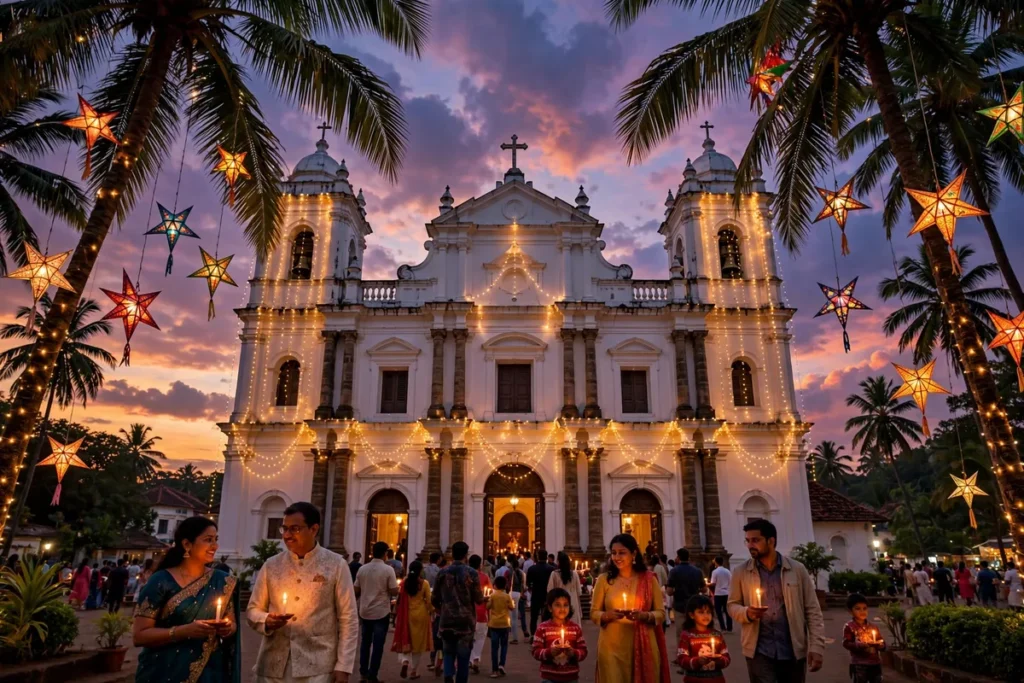
Christmas in Goa at dusk: a white colonial church strung with fairy lights, star lanterns glowing in the palm trees, and families arriving for midnight mass.
Watch: Christmas in India
The Urban Guide celebrates Christmas with a Kerala family in Kochi — decorating, market shopping on Broadway, and a traditional Christmas lunch in Fort Kochi.
At a Glance: Christmas in India
How Christmas unfolds across India’s regions.
| Tradition | Date | Key detail |
|---|---|---|
| Midnight Mass | 24 December | Churches from Goa’s Basilica of Bom Jesus to Kolkata’s St Paul’s Cathedral fill with thousands of devotees for midnight mass |
| Goa’s Portuguese Christmas | December | With a large Christian population, Goa celebrates with Missa de Galo, Konkani carols and fairy-lit heritage homes |
| Star lanterns | December | Glowing star lanterns — India’s signature Christmas decoration — hang outside Christian homes across the country |
| Kerala’s ancient Christmas | 25 December | One of the world’s oldest Christian communities celebrates with plum cake, achappam rose cookies and carol processions |
| The Northeast | 25 December | In Nagaland and Mizoram, Christmas is the biggest festival of the year, with illuminated streets and community feasts |
| Kuswar & plum cake | December | Mangalorean Catholics prepare kuswar — some 20 homemade treats — while fruit-soaked plum cakes are baked for weeks |
| Cochin Carnival | Late December | Fort Kochi’s carnival closes the season with art, food festivals and the burning of the Pappanji effigy on New Year’s Day |
Frequently Asked Questions
How is Christmas celebrated in India?
India’s 28+ million Christians celebrate Christmas with midnight mass, illuminated paper star lanterns hung from homes, elaborate cribs (nativity scenes), carol singing, and grand feasts — plum cake, biryani, sorpotel, appam and stew, and region-specific sweets like Goa’s kuswar. Christmas (December 25) is a national public holiday, and the wider culture joins in with decorations, shopping, and shared greetings. Celebrations peak in Goa, Kerala, the Northeast (Nagaland, Mizoram, Meghalaya), and metro Catholic neighborhoods like Mumbai’s Bandra.
What are the star lanterns hung at Christmas in India?
The illuminated paper stars are India’s signature Christmas decoration — star-shaped lanterns symbolizing the Star of Bethlehem, hung from windows, balconies, churches, and streets. They range from simple handmade paper-and-bamboo stars to elaborate electric displays. Making the family star is a cherished pre-Christmas craft, and streets of glowing stars in Kochi, Bandra, and Northeastern hill towns create magical December sights.
What do Indians eat for Christmas?
Christmas food varies by region: Goa serves sorpotel, vindaloo, roast suckling pig, and kuswar sweets (bebinca, dodol, kulkuls); Kerala serves appam and stew, duck curry, and plum cake; Anglo-Indian families roast turkey with spiced stuffing; Northeastern communities feast on pork and beef with rice; Mumbai’s East Indians make sorpotel and wedding rice. Plum cake — rich, rum-soaked, fruit-laden — is the pan-Indian Christmas cake, gifted across all religions.
Is Christmas a national holiday in India?
Yes — Christmas Day (December 25) is a gazetted national holiday across India, with government offices, banks, and schools closed. The Christmas–New Year week is one of the country’s biggest travel and shopping periods. Christianity arrived in India nearly 2,000 years ago (St. Thomas the Apostle, 52 AD), making it one of the world’s oldest Christian communities.
Where is the best place to experience Christmas in India?
Goa is India’s Christmas capital — Portuguese-era churches, midnight mass at the Basilica of Bom Jesus, kuswar sweets, and beach parties. Kerala offers ancient St. Thomas Christian traditions and carol services; the Northeast (Kohima, Aizawl, Shillong) celebrates Christmas as the year’s biggest festival; Mumbai’s Bandra and Kolkata’s Park Street offer vibrant metro Christmases. Book Goa travel months ahead — December is peak season.
Do non-Christians celebrate Christmas in India?
Widely, yes — in a cultural sense. Malls and streets are decorated nationwide, plum cake is gifted and eaten across religions, offices hold Secret Santa exchanges, and “Merry Christmas” is exchanged freely. Many Hindu and Muslim families enjoy the festive food and shopping season, just as Christians join in Diwali sweets and Eid feasts — India’s festivals are famously shared.
Indian Christmas Sweets: A Confectionery Tour
Christmas traditions in India are inseparable from sweets — and the regional variety is staggering. Goa’s kuswar platters hold dozens of varieties: bebinca (16-layer coconut pudding), dodol, neuris, kulkuls, bolinhos, perad (guava cheese), doce de grão (chickpea fudge), and marzipan fruits. Making kuswar is a multi-day family production in early December, with recipes guarded like heirlooms.
Kerala contributes achappam (rose cookies), kuzhalappam, unniyappam, and wine — homemade grape wine and ginger wine, brewed in earthen pots and shared with neighbors. Mangalorean Catholics make patrode sweets and golden kheer; Anglo-Indian families bake Christmas cake and mince pies; Tamil Christians fry kalkals and thenkuzhal; East Indians of Mumbai prepare thali sweets.
The exchange of sweets is the social ritual: plates of kuswar, cake, and wine move between homes through December, crossing religious lines. To receive a plate of Goan sweets from a neighbor is to be woven into the community — and to return the plate empty is a minor scandal. Always return it full.
Christmas in India for Travelers
Visiting India for Christmas is magical — with planning. Goa is the prime destination: book hotels 3–6 months ahead for Christmas week, when prices peak. Attend midnight mass at the Basilica of Bom Jesus or Se Cathedral (arrive early — they’re packed), stroll lit-up villages, and eat your way through kuswar at local bakeries.
Kerala offers a more serene Christmas: carol services in Kochi’s historic churches, houseboat Christmases on the backwaters, and plum cake from legendary bakeries. The Northeast (Kohima, Aizawl, Shillong) is extraordinary — Christmas as the year’s biggest festival, with community celebrations everywhere — but book transport early and check travel advisories.
Metro Christmases: Mumbai’s Bandra, Kolkata’s Park Street, Delhi’s Sacred Heart Cathedral. Practical notes: December weather is pleasant across most of India (cool north, warm south); domestic flights are expensive at Christmas — book early; and Christmas–New Year week is peak season everywhere. For more destination ideas, see our best places to spend Christmas.
New Year’s Eve in India: From Christmas into 2026
India’s festive season crescendos from Christmas into New Year’s Eve — one of the country’s biggest party nights. Goa’s beach parties (Baga, Anjuna, Palolem) are legendary; Mumbai’s Marine Drive and Bandra-Worli Sea Link glow; Delhi’s hotels host gala dinners; Bangalore’s pubs overflow.
For Christian families, the week between Christmas and New Year is for visiting — relatives tour from house to house, finishing the kuswar and cake. Watchnight services on December 31 fill churches, blending prayer with celebration. And on January 1, the greetings flow across religions: “Happy New Year” in a dozen languages. The Christmas season in India doesn’t really end until the last plum cake is gone — usually sometime in January.
Christmas Eve in India: The Night Before
Christmas Eve is the emotional peak of Christmas traditions in India. The day is spent in final preparations: the crib is completed, the star is lit, new clothes are laid out, and kitchens perfume the neighborhood with plum cake and frying kulkuls. Carolers make their last rounds; churches are decorated with flowers and lights.
As evening falls, families gather for midnight mass — and “midnight” is literal: services typically begin around 11 PM–midnight, running past 1 AM. The churches are packed: arrive an hour early for a seat. The liturgy blends solemnity and joy — choirs in multiple languages, the crib blessing, and at midnight, the celebration erupts: bells, hymns, and in many parishes, fireworks outside.
After mass: Christmas cake and wine shared with fellow parishioners, greetings all around (“Merry Christmas!” in a dozen tongues), and home to a festive breakfast-table already laid. Many families open gifts after returning from mass; others wait for Christmas morning. Either way, sleep is short — Christmas Day dawns with church bells, the smell of festive cooking, and the year’s happiest morning.
Indian Christmas Wishes and Greetings
India’s multilingual Christmas greetings are a joy: “Merry Christmas” works everywhere, but try “Shubh Christmas” (Hindi), “Christmas Ashamsakal” (Malayalam), “Natalache Shubhechha” (Konkani), “Christmas Subhechha” (Bengali), or “Krismas diyan mubarkan” (Punjabi). In Tamil: “Christmas Nalvazhthukkal”; in Telugu: “Christmas Shubhakankshalu”.
Christmas cards in India often feature Indian motifs — the star lantern, the crib with Indian Magi, tropical flowers. WhatsApp greetings flood on Christmas morning across religions. And the cake exchange is itself a greeting: a box of plum cake delivered to a neighbor’s door says Merry Christmas better than words. For message inspiration, see our 100 Christmas wishes and messages.
Why Christmas in India Is Worth Experiencing
Christmas traditions in India offer something no Western Christmas can: ancient Christianity (2,000 years old) meeting vibrant Indian culture — midnight mass in a 400-year-old Goan basilica, paper stars glowing over Mumbai streets, carols in Malayalam, plum cake shared across religions. It’s Christmas as community festival rather than private holiday: the sweets exchanged with neighbors, the whole village at the crib, the church packed beyond its doors.
For travelers, December in India is ideal — pleasant weather, the country’s festive peak, and Christmas celebrations that welcome outsiders warmly. For home celebrants, India’s traditions are wonderfully adoptable: hang a paper star in your window, bake a plum cake, build an elaborate crib, share sweets with neighbors of every faith. The Indian Christmas teaches the season’s deepest lesson: joy multiplies when it’s shared — across religions, regions, and languages. In a country of 1.4 billion people and a thousand festivals, Christmas holds its own — not by outshining the others, but by joining the great Indian celebration of light, sweetness, and togetherness. Merry Christmas — Shubh Christmas!