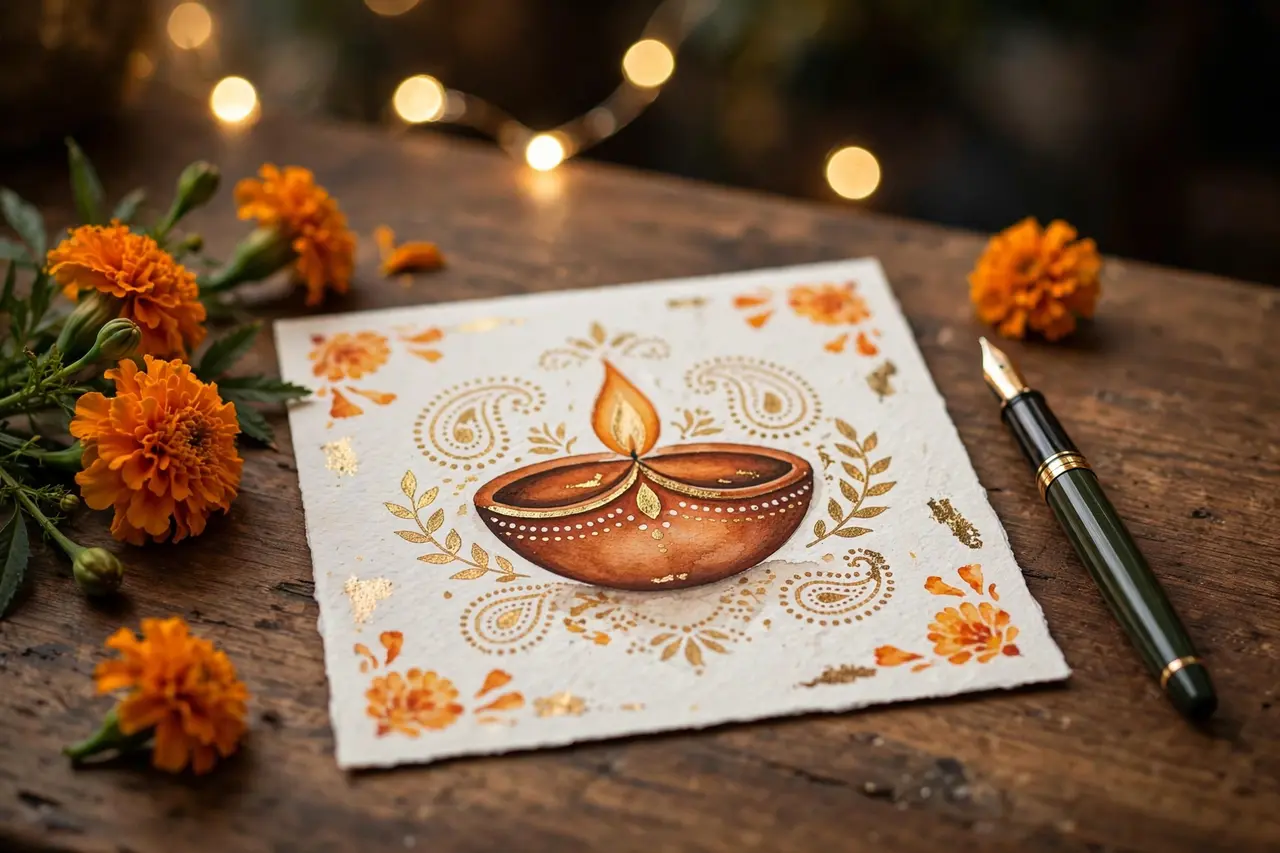
You bought the card — or better, you made it. The diya on the front is painted, the marigolds are glued, the glitter has (mostly) stayed where it belongs. You open it, pen in hand, and your mind goes completely blank. What do you actually write in a Diwali card? “Happy Diwali” feels too thin for your mother. Something poetic feels too much for your boss. And for your best friend, you want funny, but not the kind of funny that lands wrong in a card she keeps.
This is one of the most quietly stressful parts of the festival, and almost nobody talks about it. A Diwali card is a small piece of paper that carries real weight: it is how we tell people they matter to us, in a season that is explicitly about light, gratitude, and new beginnings. The good news is that writing a great Diwali card message is a skill with a formula, not a gift you either have or do not. Once you know the anatomy of the message, the tone ladder from formal to intimate, and a handful of templates you can personalize in two minutes, you will never stare at a blank card again.
This guide covers everything: the four-part structure every Diwali card message follows, ready-to-copy templates for every recipient in your life (parents, in-laws, friends, colleagues, neighbors, teachers), short one-liners for when space is tight, guidance on matching tone to relationship, the mistakes that make cards feel generic, and answers to every question people ask about Diwali card etiquette. By the end, you will have a message for every card in your pile — and you might even enjoy writing them.
The Anatomy of a Perfect Diwali Card Message
Every memorable Diwali card message, from the simplest to the most elaborate, is built from the same four parts. First, the greeting: “Happy Diwali,” “Shubh Deepavali,” or “Wishing you a radiant Diwali” — this anchors the card in the occasion. Second, the wish: one or two sentences of genuine goodwill, and this is where most cards succeed or fail. A specific wish (“may your new home fill with laughter this year”) beats a generic one (“wishing you happiness”) every time, because specificity is what makes the recipient feel seen.
Third, the personal touch: a single sentence that could only have been written by you to them. A shared memory (“still thinking about your legendary Diwali party last year”), an inside reference, or an acknowledgment of something they did (“thank you for always making room for one more at your table”). This one sentence is the difference between a card that gets kept and a card that gets recycled. Fourth, the sign-off: warm and appropriate to the relationship — “With love,” for family; “Warmly,” for colleagues; “Your partner in mithai crime,” for your best friend.
The whole thing can be three sentences or three paragraphs; the structure does not change, only the length. And here is the liberating secret: you do not need to be a poet. Clear, specific, and sincere outperforms flowery every time. A card that says exactly what you mean, plainly, is a card that gets read twice.
8 Ready-to-Use Diwali Card Templates by Recipient
Each template below follows the four-part anatomy and is written to be copied as-is or personalized with the bracketed details. Swap in your own memories and the message becomes unmistakably yours.
1. For Your Parents
Parents get the longest, warmest cards — they have earned it. “Happy Diwali, Mumma and Papa. Every diya I light this year reminds me of the home you built, where the festival always felt like magic no matter how busy life got. Thank you for teaching me that Diwali is not about the perfect decorations but about the people gathered around them. May this year bring you both the health, rest, and joy you so freely give everyone else. With all my love, [your name].” The key ingredients: gratitude, a specific memory, and a wish that centers them rather than you. Parents rarely get wished for themselves; doing it lands deeply.
2. For Your In-Laws
In-law cards walk a line between warmth and respect. “Wishing you a very Happy Diwali. Thank you for welcoming me into your family and your celebrations with such generosity — [specific detail, e.g., ‘the way you insisted I learn your kaju katli recipe’] made me feel at home from the very first year. May the festival bring you prosperity, good health, and many more years of togetherness. Warm regards, [your name].” Keep it gracious, specific, and free of over-familiarity unless the relationship genuinely supports it. A sincere in-law card is one of the highest-ROI messages you will ever write.
3. For Your Best Friend
Best friends get the real you. “Happy Diwali, you legend. Another year of you stealing my ladoos, judging my rangoli, and somehow still being my favorite person. May your year be as bright as the diyas and as drama-free as our friendship definitely is not. Save me some kaju katli or we are fighting. Love you always, [your name].” Humor works here because the relationship can hold it — but keep one sincere line in the mix (“thank you for being the person I call first”) so the card has heart under the jokes.
4. For Your Boss or Manager
Professional cards should be warm but bounded. “Wishing you and your family a happy and prosperous Diwali. Thank you for your guidance and support this year — it has made a real difference to my work. May the festival bring you success and good health. Best regards, [your name].” That is the entire card: three sentences, no more. Do not mention gifts, do not get personal, do not use exclamation marks like confetti. One card, one professional tone, done. For more on striking the right note in workplace greetings, our guide to funny anniversary card messages shows how humor scales with closeness — the same principle applies here in reverse.
5. For Colleagues and Work Friends
Colleagues sit between boss-formal and friend-warm. “Happy Diwali! Hope you and your family have a wonderful celebration — enjoy every ladoo, you have earned them after [project/quarter]. See you on the other side, recharged and ready. Cheers, [your name].” The bracketed detail (a shared work reference) is what elevates this above a generic office card. If you are writing to several colleagues, vary that one line per person; five identical cards discovered side by side on desks is a special kind of embarrassment.
6. For Neighbors
Neighbor cards are short, sweet, and community-minded. “Happy Diwali, neighbors! Wishing your home light, laughter, and the best-smelling kitchen on the street (though ours will give you competition). Thank you for making this building feel like a community. See you at the diya-lighting! Warmly, [your name], [flat/house number].” The flat number matters — neighbors may know your face better than your name. If you are new to the building, a card is a wonderful introduction; if you are old, it is a lovely tradition to keep.
7. For Teachers and Mentors
Mentors deserve acknowledgment of their impact. “Happy Diwali, [title/name]. I have been thinking about how much your [guidance/lessons/encouragement] shaped my year, and I wanted the festival of new beginnings to be the moment I said thank you properly. Wishing you and your family health, happiness, and light. With gratitude, [your name].” Specificity about what they taught you is the whole card — “your lessons” is forgettable, “the way you stayed late to help me understand [topic]” is unforgettable.
8. For Someone Going Through a Hard Year
This is the most important card you will write. “Thinking of you this Diwali. I know this year has asked a lot of you, and I will not pretend a festival fixes that. But I wanted you to know I am thinking of you, I am here, and I am wishing — quietly and sincerely — for lighter days ahead for you and [family]. No need to reply. Just know you are loved. [your name].” Do not force cheer on someone grieving or struggling; acknowledge, offer presence, and keep the wishes gentle. This card will be kept longer than any other you write this year.
Short and Sweet: One-Line Diwali Card Messages
Sometimes the card is small, the handwriting is large, or you are writing twenty of them. These one-liners stand alone — each is a complete message for tight spaces:
“May your Diwali sparkle as brightly as you do.” “Wishing you light in every corner of your life.” “Happy Diwali — eat the good mithai first.” “New year, new light, same wonderful you.” “May your home overflow with diyas and your heart with peace.” “Shubh Deepavali to you and everyone you love.” “Here is to a year as sweet as kaju katli.” “Light a diya, make a wish, eat a ladoo — in that order.” “Wishing you prosperity that multiplies like fairy lights.” “Happy Diwali! Grateful our paths crossed this year.” “May every diya you light return to you as joy.” “Celebrate big, laugh loud, shine brighter.” “To new beginnings and old friends — Happy Diwali.” “May your troubles burst like crackers and vanish like smoke.” “Sending you light, love, and zero burnt diyas.” “Happy Diwali — may your bonus be as big as your heart.” “Wishing you a festival full of family and free of drama.” “Glow on, you beautiful human. Happy Diwali.” “May your rangoli be symmetrical and your year be smooth.” “Diwali hugs and mithai wishes coming your way.” “Light over darkness, always — Happy Diwali.” “May your year be lit in every sense of the word.” “To the brightest star I know — Happy Diwali.” “Wishing you health, wealth, and excellent Wi-Fi this Diwali.” “Shine on — the festival suits you.”
Formal vs. Warm: Matching Tone to the Relationship
Tone mismatch is the number one cause of awkward Diwali cards. The rule is simple: match the card to the relationship you actually have, not the one you wish you had or the one you had five years ago. A good test is the salutation test — if you would never call them by a nickname in person, do not do it in the card. If you hug them hello, “Dear” feels cold; write their name the way you say it.
There is also a generational dimension worth respecting. Elders in many families appreciate a slightly more formal register — full sentences, respectful wishes for health and prosperity, no slang — even when you are close. This is not distance; it is a love language. Younger recipients, meanwhile, tend to value voice and humor over ceremony. When in doubt, write the card you would be happy to have read aloud at the dinner table, because Diwali cards do get read aloud, shown around, and photographed for the family group chat.
| Recipient | Recommended Tone | Ideal Length | Strong Opening Line |
|---|---|---|---|
| Parents | Warm, grateful, personal | 4–6 sentences | “Every diya I light reminds me of home.” |
| In-laws | Respectful, gracious | 3–5 sentences | “Thank you for welcoming me so generously.” |
| Best friend | Playful, sincere underneath | 3–5 sentences | “Another year of you stealing my ladoos.” |
| Boss / manager | Professional, brief | 2–3 sentences | “Thank you for your guidance this year.” |
| Colleagues | Friendly, light | 2–4 sentences | “Enjoy every ladoo — you earned them.” |
| Neighbors | Community-minded, cheerful | 2–3 sentences | “Wishing our street the brightest Diwali.” |
| Teachers / mentors | Respectful, specific | 3–4 sentences | “Your guidance shaped my year.” |
| Someone struggling | Gentle, present | 3–5 sentences | “Thinking of you this Diwali.” |
7 Mistakes That Make Diwali Cards Feel Generic
First, the unsigned card. An unsigned Diwali card is a small tragedy — the recipient loves the message and has no idea who to thank. Always sign, even on office bulk cards. Second, the identical message in every card. If you are writing more than five, vary at least one sentence per recipient; the personal touch is the entire point. Third, wishes that could apply to anyone: “wishing you happiness and prosperity” is the card equivalent of a shrug. Add one specific thing — their new job, their garden, their kid’s exam results — and the card comes alive.
Fourth, humor that punches down or touches sensitive topics: weight, marriage status, job hunting, and family planning are never card material, no matter how close you are. Fifth, the overly long card. Past six sentences, you are writing a letter, and most people stop absorbing after the fourth. Edit ruthlessly. Sixth, religious assumptions: not everyone celebrating with you observes Diwali the same way, and some recipients may celebrate alongside you without sharing the faith. Keep wishes inclusive — “light,” “joy,” “new beginnings” — unless you know the recipient shares your traditions. Seventh, forgetting the practical details: if the card accompanies a gift, mention the gift (“the mithai box is from that shop you love”); if it is mailed, send it a week early — Diwali mail runs slow, and a late card feels like an afterthought.
Handwriting, Presentation, and the Little Things
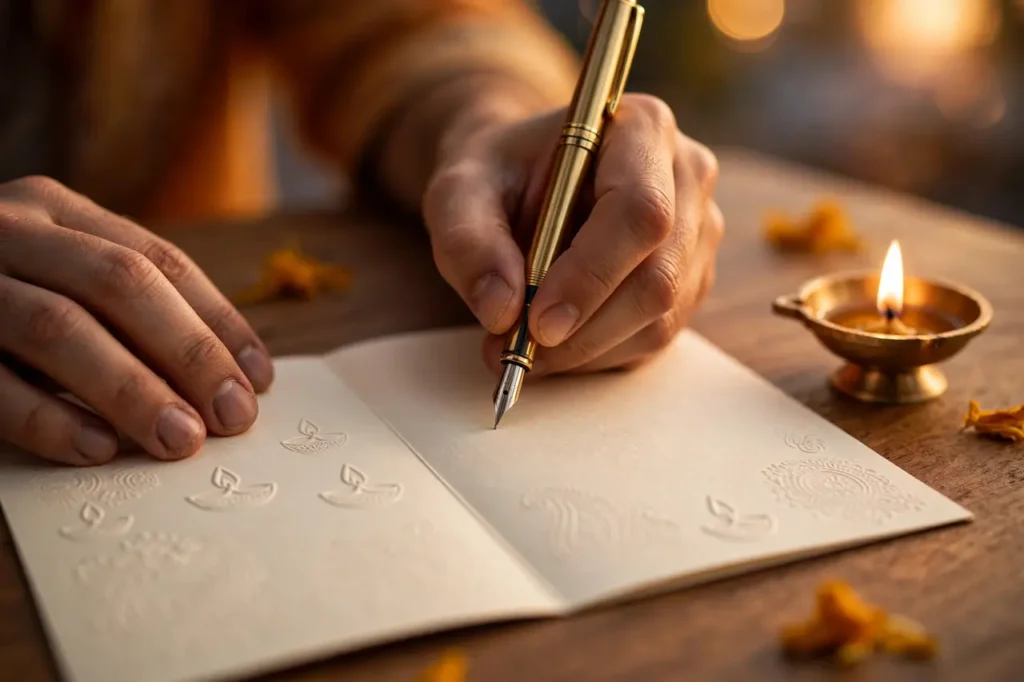
A beautiful message in illegible handwriting is a locked treasure chest. Write slowly, in your best hand, and if your handwriting is truly a hazard, print neatly in block letters — neat printing beats fancy cursive that nobody can read. Use a pen that does not bleed: gel pens on coated card stock are a classic disaster. Test on the envelope flap first. If you make a mistake, do not scribble it out — start the card over or turn the mistake into a joke (“clearly I have had too much chai”). A crossed-out word in an otherwise lovely card is all anyone will see.
Presentation multiplies the message’s impact. Tuck a dried marigold or a small sachet of cardamom into the envelope for scent. Seal with a sticker or a wax seal if you are feeling grand. If you are hand-delivering, pair the card with a single nice sweet rather than a whole box — the card is the gift, the sweet is the garnish. And keep a list of who got what: nothing is more awkward than realizing in December that you sent your aunt the same card two years running. A notes app list takes thirty seconds and saves you forever.
Watch: Make a Card Worth Writing In
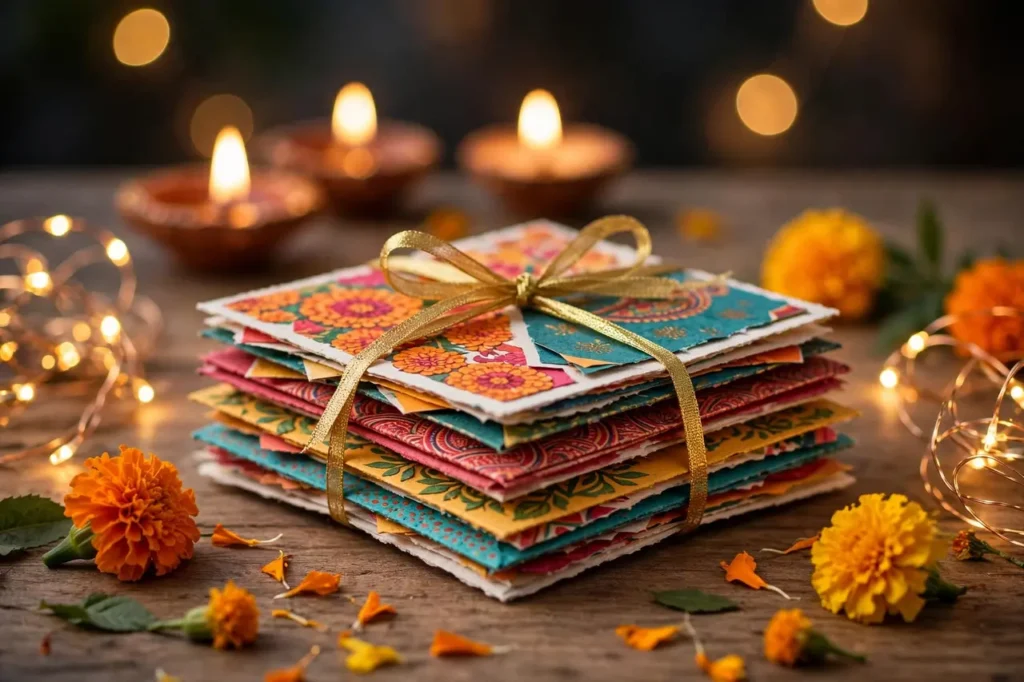
A heartfelt message deserves a beautiful card to live in. This tutorial shows how to make a stunning DIY Diwali pop-up greeting card — handmade, personal, and far more meaningful than anything from a shop. Make a batch, then fill each one with a message from this guide:
What to Write in a Diwali Card: FAQs
What is the simplest good message for a Diwali card?
“Happy Diwali! Wishing you and your family light, laughter, and all good things in the year ahead. Warmly, [your name].” Three sentences, universally appropriate, and genuinely warm. It works for neighbors, colleagues, acquaintances, and anyone you do not know well enough for a personal message. The structure — greeting, wish, sign-off — is the skeleton key that opens every card.
How long should a Diwali card message be?
Two to six sentences for most recipients; up to a short paragraph for parents, partners, and best friends. The card is a gesture, not correspondence — if you have more to say, write a letter or have the conversation. A useful rule: if you cannot read the message aloud in under thirty seconds, it is too long for a card.
Is it okay to write a funny message in a Diwali card?
Absolutely — for the right recipient. Humor is perfect for friends, siblings, cousins, and fun colleagues; it is risky for bosses, elders you are not close to, and anyone going through a hard time. The safest funny cards pair one joke with one sincere line, so the humor lands as affection rather than flippancy. And never joke about the things people are sensitive about: money, marriage, weight, or work stress.
What should I write in a Diwali card for my boss?
Keep it professional and brief: a greeting, one line of thanks for their support or leadership, a wish for their family’s celebration, and a formal sign-off. Two to three sentences total. Do not mention bonuses, promotions, or time off; do not use nicknames or emojis; do sign your full name. The card says “I am thoughtful and professional” — let it say only that.
How do I write a Diwali card to someone who is grieving?
Acknowledge, do not cheerlead. Say you are thinking of them, that you are there, and that you wish them gentleness — not “joy” or “celebration,” which can feel tone-deaf. Keep it short, do not ask for a reply, and consider hand-delivering rather than mailing so it feels personal. The template in section 8 of this guide is written exactly for this situation and can be copied as-is.
Should Diwali card messages be religious?
Match the recipient, not yourself. For family and friends who share your traditions, references to Lakshmi, diyas, and blessings feel natural and warm. For colleagues, neighbors, or friends of other faiths who celebrate alongside you, keep it to universal themes — light, gratitude, new beginnings. When in doubt, the universal version is never wrong; the specific version is only right when you are sure.
Can I just write “Happy Diwali” and sign my name?
You can, and for bulk office or building cards it is completely fine — a signed greeting beats no card at all. But if the person matters to you, add one sentence that only you could write: a memory, a thanks, a specific wish. That single sentence is the difference between a card that is glanced at and a card that is kept. It takes twenty seconds and it is the whole game.
What do I write in a Diwali card for my in-laws?
Gratitude and respect, with one specific detail. Thank them for something concrete — welcoming you, a meal, a tradition they included you in — and wish them health and togetherness. Keep the tone gracious rather than gushing. A well-written in-law card is remembered for years; it is one of the highest-value messages in your stack. See template 2 above for a complete example.
Is it better to buy or make Diwali cards?
Homemade cards carry more emotional weight and are wonderful for close family and friends; beautiful shop-bought cards are perfectly fine for professional and bulk greetings. The message matters more than the medium — a heartfelt note in a simple card outperforms a generic note in a handmade one. If you enjoy crafting, the video tutorial in this guide shows a pop-up design that looks far more impressive than its difficulty suggests.
When should I send Diwali cards?
Mail cards at least a week before Diwali; festival-season post is slow everywhere. Hand-delivered cards can go out during the five days of the festival itself, ideally before the main celebration day. Digital cards and e-cards are fine for distant friends, but send them on the day itself rather than early — an e-card sitting in an inbox for a week loses its moment. And if you miss the window entirely, a “belated Diwali” card with a self-aware joke is far better than silence.
Diwali Greetings in Other Languages
A card that greets someone in their own language feels instantly more personal. “Shubh Deepavali” is the classic Hindi and Marathi greeting; in Tamil you would write “Deepavali Nalvazhthukkal,” in Telugu “Deepavali Shubhakankshalu,” in Kannada “Deepavali Habbada Shubhashayagalu,” and in Bengali “Shubho Deepavali” or “Kali Puja-r shubhechha” where the festival overlaps with Kali Puja. For Gujarati family, Diwali doubles as the new year, so “Saal Mubarak” or “Nutan Varshabhinandan” belongs in the card alongside the Diwali wish — it acknowledges the new-year dimension many outsiders miss. In Punjabi, “Diwali diyan lakh lakh vadhaiyan” carries the warmth of the spoken greeting onto paper. You do not need fluency; one line in the recipient’s language, followed by your message in English, shows a care that transcends grammar. Just double-check spelling with a native speaker before you ink it — a misspelled greeting in a language you do not speak is worse than none at all.
Pick Up the Pen
Here is the truth about Diwali cards: nobody remembers the perfect ones, but everybody remembers receiving one. The card on the mantelpiece, the message read aloud at dinner, the one-liner that made your father laugh — these are small things that compound into the feeling of being loved, which is the entire point of the festival. You do not need perfect words. You need specific ones, sincere ones, signed ones. So pick up the pen, steal a template from this guide, add the one sentence only you could write, and send it. For guidance on the parallel art of anniversary messages, our walkthrough of what to write in an anniversary card for your husband uses the same four-part anatomy — the structure works for every occasion worth a card. And for the office stack, our Thanksgiving card messages collection will get you through the next holiday too. Happy writing — and Happy Diwali.
Frequently Asked Questions
What is the standard greeting to write in a Diwali card?
Happy Diwali or Shubh Deepavali is the universal opener that works for every recipient. Follow it with one warm sentence about what you wish for them — prosperity, health, or joy — and sign with your name. Simple, sincere, and never wrong.
Should I write in English or include Hindi in a Diwali card?
Match the recipient’s comfort: English alone is perfectly fine, but adding one line in Hindi or Hinglish (like ‘Aapke jeevan mein khushiyon ke diye jalein’) makes it feel personal for family and close friends. For professional contacts, keep it in English and slightly formal.
What should I avoid writing in a Diwali card?
Avoid anything that sounds like a sales pitch, backhanded compliments, or jokes about firecrackers and noise — especially for neighbors or colleagues you don’t know well. Keep the tone warm and positive; Diwali cards are about light and goodwill.
How long should a Diwali card message be?
Two to four sentences is the sweet spot for most cards. One heartfelt paragraph works for close family; a single elegant line suits coworkers and acquaintances. The card’s design does half the work — let your words be the personal touch, not an essay.
Can I write the same message in every Diwali card?
You can reuse a structure, but personalize at least one line per recipient — a mention of their family, a shared memory, or a specific wish. People notice when a message feels hand-written for them versus mass-produced, and it takes only a minute.
What do I write in a Diwali card for my boss?
Keep it respectful and brief: ‘Wishing you and your family a prosperous and joyful Diwali. Thank you for your guidance this year.’ Sign with your full name. Avoid overly familiar language or emojis in professional cards.
Is it okay to send a digital Diwali card?
Absolutely — e-cards and designed WhatsApp messages are widely accepted, especially for distant friends and colleagues. Put the same care into the wording as a paper card; a thoughtful message matters more than the medium.
Should children sign Diwali cards too?
Yes — a child’s scribbled signature, handprint, or short sentence (‘I love you, Grandma!’) is often the most treasured part of a family Diwali card. Let them add their own touch rather than writing it for them.