

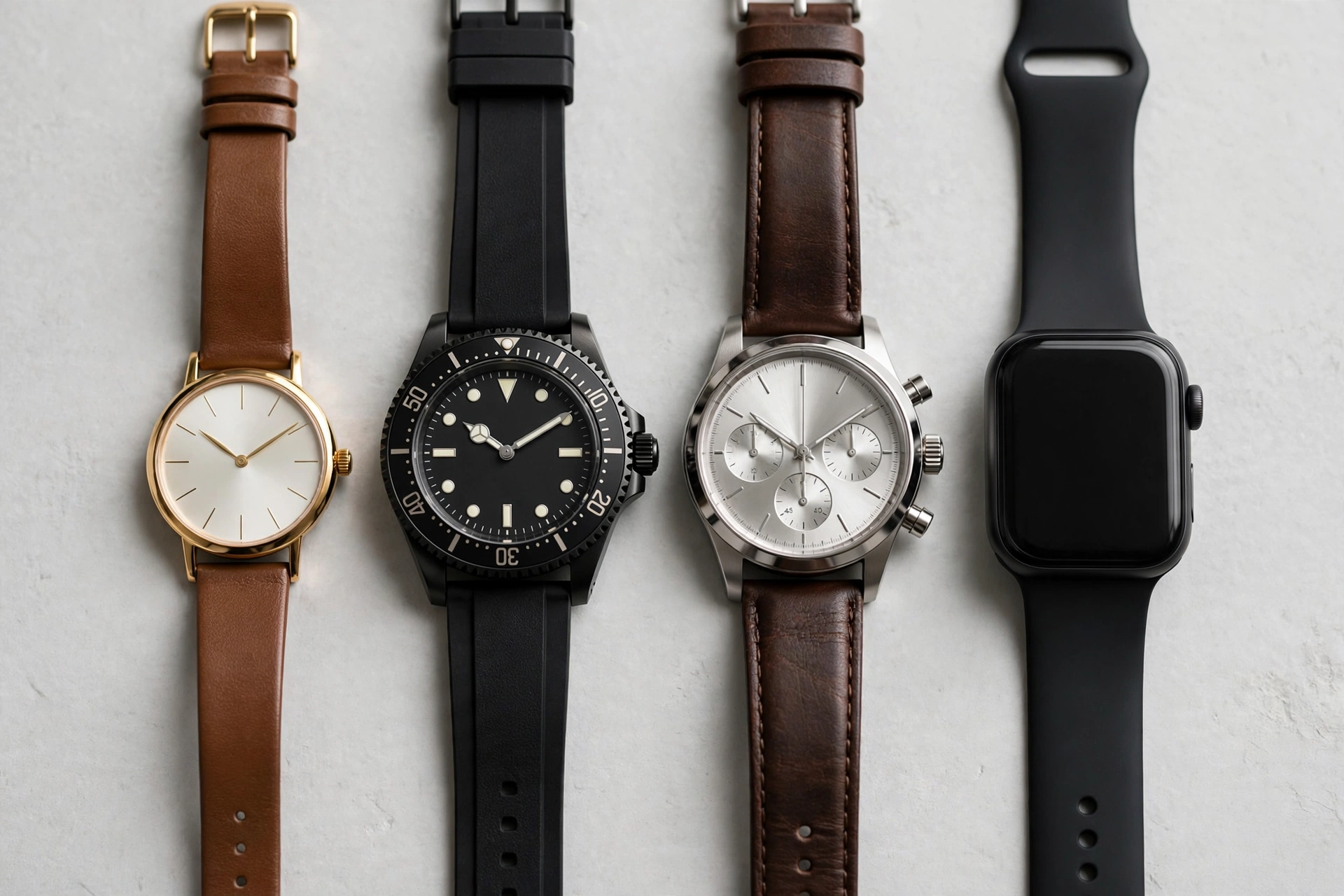
Dive watch, dress watch, chronograph, GMT, field watch, smartwatch — the world of watch types has its own vocabulary, and every type was designed to solve a specific problem. Understanding the major categories is the fastest way to go from overwhelmed to confident, whether you are buying your first real watch, choosing a gift, or just trying to understand what makes one watch cost ten times another. Each type below gets a plain-English explanation of what it is, what it is for, and who it suits best.
This guide covers the eight watch types that account for the vast majority of what you will see in stores: dress, dive, chronograph, field, pilot, GMT, smartwatch, and fashion watches. For each, you will learn the defining features, typical price ranges (broad typical ranges only — verify current retail prices when shopping), and practical buying advice. By the end you will be able to look at any watch and immediately know what family it belongs to and whether it fits your life.
Watch Types at a Glance
| Watch Type | Defining Features | Typical Price Range | Best For |
|---|---|---|---|
| Dress watch | Thin, simple dial, leather strap, minimal complications | Typically $200–$5,000+ | Formal occasions, office wear |
| Dive watch | Rotating bezel, luminous markers, high water resistance | Typically $200–$10,000+ | Everyday wear, sporty style |
| Chronograph | Stopwatch function with subdials and pushers | Typically $300–$15,000+ | Sport timing, technical appeal |
| Field watch | Rugged, highly legible, military heritage | Typically $150–$2,000 | Casual daily wear, outdoors |
| Pilot watch | Large legible dial, often oversized crown | Typically $300–$8,000+ | Bold casual style, aviation fans |
| GMT / dual-time | Second time zone via extra hand or subdial | Typically $500–$12,000+ | Travelers, international work |
| Smartwatch | Digital display, apps, health tracking | Typically $200–$800 | Fitness, notifications, tech lovers |
| Fashion watch | Brand-driven design, quartz movement | Typically $100–$500 | Style on a budget, trend pieces |
Dress Watches: Elegance in Its Purest Form
The dress watch is the tuxedo of watch types: thin enough to slide under a shirt cuff, with a clean uncluttered dial, simple hands, and usually a leather strap. Traditional dress watches are 34–40mm, lack a seconds hand or keep it subtle, and avoid any sporty features. They are powered by slim manual-wind or automatic movements — thinness is the whole point.
Buy a dress watch if you regularly wear suits or business attire, or if you want one elegant watch for weddings and formal events. The classic rule — no watch more casual than the occasion — means a dress watch is the only correct choice with black tie. For daily casual wear, though, a dress watch can feel precious; most owners pair it with a sportier daily piece.
Dive Watches: The Do-Everything Default
Dive watches are the most popular watch type in the world, and most owners never dive. What they offer is a perfect everyday formula: a rotating bezel for timing, highly luminous dials readable in the dark, robust water resistance (typically 200m+), and a sporty-but-versatile look that works with everything from swim trunks to business casual. The archetype — black dial, steel bracelet — goes with literally anything.
If you are buying one watch to wear daily, a dive watch is the safest choice in the entire watch world. They are tough, legible, comfortable, and hold their value better than most categories. Just know that true diving capability requires maintenance: gaskets and seals should be checked every few years if you actually take the watch in the water.
Chronographs: The Stopwatch on Your Wrist
A chronograph is a watch with a built-in stopwatch, operated by pushers on the side of the case, with elapsed time shown on subdials. Originally developed for motorsport, aviation, and science, chronographs are now bought mostly for their technical, instrument-like looks — those busy dials signal mechanical complexity. They are among the most satisfying watches to actually use: timing a parking meter, a steak on the grill, or a workout.
The tradeoff is thickness and cost. Chronograph movements are complex, so these watches run thicker and cost more to service (typically several hundred dollars and up). If you love the look but not the bulk, consider a “bi-compax” or two-subdial layout, which tends to be slimmer and cleaner than three-subdial designs.
Field Watches: Military Heritage, Everyday Toughness
Field watches descend from the military watches issued to soldiers — the design brief was simple: tell the time instantly, survive abuse, and keep ticking. They have high-contrast dials (often black with white numerals), sturdy cases, and traditionally run 36–40mm. Modern field watches keep the rugged legibility while adding comfort and refinement.
Field watches are arguably the best value in mechanical watches: honest, durable, versatile with any strap, and available from respected brands at accessible prices. They are the ideal first mechanical watch — tough enough for real life, simple enough to service cheaply, and stylish enough to wear anywhere casual.
Pilot Watches: Built for the Cockpit
Pilot watches originated with early aviators who needed maximum legibility at a glance — hence the oversized dials, bold Arabic numerals, large crowns operable with gloves, and historically oversized 55mm cases (modern versions are a more wearable 40–44mm). The classic flieger (German for “flyer”) design with its distinctive triangle marker at 12 o’clock remains iconic.
Buy a pilot watch if you like bold, legible, historically rich designs and have the wrist to carry 40mm+. They are statement pieces with genuine heritage, equally at home with a leather jacket or a casual blazer.
GMT and Dual-Time Watches: For Travelers
A GMT watch tracks a second time zone — via an extra 24-hour hand circling the dial, a rotating 24-hour bezel, or a subdial. It was invented for Pan Am pilots crossing time zones in the 1950s, and it remains the most genuinely useful complication for anyone who travels or works across zones. Set the main hands to local time, the GMT hand to home time, and you always know both.
If you travel internationally even a few times a year, a GMT is more useful than a chronograph and barely more complex. “True” GMT movements let you jump the local hour hand independently (ideal for travel); simpler “caller” GMTs are fine for tracking a second zone from home.
Smartwatches: The Computer on Your Wrist
Smartwatches are a different species: digital displays, touchscreens, apps, fitness tracking, heart-rate monitoring, and notifications. They do things no mechanical watch can — and they become obsolete the way phones do, with typical useful lives of 3–5 years versus decades for mechanical watches. Battery life ranges from a day or two to a couple of weeks depending on the model.
The smartwatch decision is practical, not romantic: buy one if you want fitness tracking, notifications, and apps on your wrist. Many watch enthusiasts own both — a smartwatch for workouts and a mechanical watch for everything else. If you are shopping during sale season, tech deals are where smartwatch prices drop hardest; our best Cyber Monday tech deals guide tracks the patterns.
Fashion Watches: Style First
Fashion watches come from clothing and lifestyle brands rather than watchmakers. They prioritize design trends over horology, usually with quartz movements and modest build quality. There is nothing wrong with that — a well-designed fashion watch is a legitimate style accessory — but know what you are buying: you are paying for the brand’s design, not for watchmaking. Do not expect them to hold value or last decades, and do not pay luxury prices for a quartz movement in a designer case.
How to Choose: Matching Watch Type to Your Life
- Start with your wrist and wardrobe. Measure your wrist: under 6.5 inches generally suits 34–40mm; 6.5–7.5 inches suits 38–42mm; above that can carry 42mm+. Match formality: suits want dress watches, casual life wants dive or field watches.
- Be honest about water exposure. Swimmers and beach-goers need real water resistance (100m+ with screw-down crown); desk workers do not.
- Decide mechanical vs. quartz vs. smart. Mechanical for craft and longevity, quartz for accuracy and low maintenance, smart for functionality.
- Set a budget with servicing in mind. Mechanical watches need service every 5–7 years (typically $200–$500+ for simple movements). Factor that into total ownership cost.
- Try before you buy when possible. Lug-to-lug length and thickness affect wear more than diameter numbers suggest.
Watches as Gifts
A watch is one of the most meaningful gifts you can give — it marks time, literally and symbolically. For Father’s Day, a field or dive watch is a classic choice that suits most dads; our best Father’s Day gifts guide and gifts for grandpa guide both include watch recommendations alongside other ideas. When gifting, favor versatile, mid-size pieces in safe styles (dive and field watches please almost everyone), keep the receipt and return policy handy, and consider including an extra strap — it is a thoughtful touch that lets the recipient personalize the gift.
Frequently Asked Questions
What is the best watch type for a first watch?
A dive watch or field watch. Both are versatile, durable, legible, and available at every price point. They suit casual and smart-casual wardrobes, require minimal fuss, and teach you what you like before you spend more.
What is the difference between automatic and quartz?
Automatic watches are mechanical — powered by a spring wound by your wrist’s motion. Quartz watches are electronic — powered by a battery, regulated by a quartz crystal. Quartz is more accurate and cheaper to maintain; automatic offers craftsmanship and never needs a battery. Our detailed automatic vs. quartz comparison (coming soon in this series) covers the full tradeoff.
How big a watch should I wear?
As a starting point, the watch diameter should be proportional to your wrist width — but lug-to-lug distance (how far the lugs extend across your wrist) matters more than the diameter number. A 40mm watch with short lugs can wear smaller than a 38mm watch with long lugs. When in doubt, try it on.
Are smartwatches replacing traditional watches?
For function, largely yes — but traditional watch sales remain strong because watches are jewelry, craft, and personal expression, not just time-telling tools. Most enthusiasts see them as complementary: smartwatch for the gym, mechanical watch for life.
What does “water resistant 30m” actually mean?
Less than it sounds. The rating is tested in static lab conditions; 30m means splash-resistant (hand washing), not swimming. For swimming you want 100m+ with a screw-down crown; for diving, 200m+ and ideally ISO-rated. When in doubt, keep it dry.
Which watch type holds its value best?
Dive watches and GMTs from respected brands historically retain value best, thanks to strong ongoing demand. Dress watches and fashion watches typically depreciate most. But buy to wear, not to invest — value retention is a bonus, not a strategy.
Once you can name the watch types at a glance, the watch world stops being intimidating and starts being fun. Pick the type that matches your actual life — not the life in the advertisement — and you will end up with a watch you reach for every morning. And when you are ready to go deeper, the rabbit holes of movements, vintage pieces, and complications will be waiting.
Case Materials: What Your Watch Is Made Of
Beyond type, case material shapes a watch’s weight, durability, and price:
- Stainless steel: The default — tough, corrosion-resistant, affordable, and easy to refinish. The vast majority of watches use it.
- Titanium: Lighter and stronger than steel, hypoallergenic, with a darker matte tone. Excellent for large watches and sensitive skin; harder to refinish when scratched.
- Gold (solid): Prestigious and heavy, in yellow, rose, or white. Scratches more easily than steel and costs far more — a statement of luxury, not practicality.
- Gold-tone / plated: Base metal with gold plating — the look for a fraction of the price, but plating wears through with time.
- Ceramic: Scratch-proof, lightweight, modern — popular for bezels and some full cases. Nearly impossible to scratch, but can crack on hard impact and cannot be refinished.
- Bronze and brass: Develop a living patina that changes with wear — beloved by enthusiasts who want a watch that ages visibly and uniquely.
Straps and Bracelets: The Other Half of the Watch
The strap or bracelet transforms how a watch looks, feels, and wears — many collectors own more straps than watches:
- Metal bracelets: Durable, dress up or down, add weight. Oyster-style (three-link) reads sporty; jubilee-style (five-link) reads dressier. Size them to fit snugly with a finger’s width of play.
- Leather: The classic dress-watch pairing — calfskin for everyday, alligator or shell cordovan for luxury. Leather wears out (typically 1–3 years of regular use) and hates water.
- Rubber and silicone: The practical choice for sports, swimming, and summer — waterproof, washable, comfortable.
- NATO and fabric straps: Inexpensive, endlessly varied, and secure (if a spring bar fails, the watch stays on your wrist). A $20 NATO can completely change a watch’s personality.
Match strap formality to the watch and occasion: leather for dress, bracelet or rubber for sport. And learn your lug width (stamped between the lugs or in the specs) before ordering — straps are sold by millimeter width.
Complications Beyond the Basics
Once you know the main watch types, you will encounter “complications” — features beyond basic time-telling:
- Date: The most common complication. Date windows at 3 o’clock are standard; pointer dates and big dates are stylistic variants.
- Day-date: Shows day and date — practical, slightly sportier in feel.
- Moonphase: A rotating disc showing the moon’s phase — romantic, beautiful, and genuinely useful to very few people. Buy it for the poetry.
- Power reserve indicator: Shows how much wind remains — genuinely useful on manual-wind watches.
- Perpetual calendar: Tracks day, date, month, and leap years automatically for decades. A pinnacle of traditional watchmaking — and expensive to service.
- Minute repeater: Chimes the time on demand. A rarefied art piece, not a practical tool.
Rule of thumb: each complication adds cost, thickness, and service expense. For a first mechanical watch, date-only or no-date keeps things simple, slim, and affordable to maintain.
Vintage vs. New: Which Path?
Every watch type exists in both vintage and modern form, and the choice echoes the broader debate: vintage offers character, history, smaller classic proportions, and often better value — but with maintenance needs, no warranty, and authenticity risks. New offers warranties, modern materials (sapphire crystals, better lume, improved water resistance), and zero guesswork — but with depreciation and less soul, according to enthusiasts. Many collectors do both: modern for daily reliability, vintage for character. If vintage appeals to you, our vintage watch buying guide (coming soon in this series) covers how to buy safely.
One Watch or Many? Building Your Collection
Start with one versatile piece — a dive or field watch covers 90% of life. From there, expand by occasion gap, not by impulse: add a dress watch when formal events demand it, a beater for rough activities, perhaps a GMT if you travel. Three well-chosen watches (daily, dress, sport) cover virtually everything. Beyond that, you are collecting — which is wonderful, but should be a conscious choice. And remember the maintenance math: every mechanical watch needs servicing every 5–7 years, so each addition is a recurring commitment, not just a purchase price.


