No Diwali is complete without mithai — the sweets are not a side note to the festival, they are the festival in edible form. But “Indian sweets” is a universe, not a category: hundreds of regional specialties, each with its own story, texture, and proper occasion. These are the traditional Diwali sweets to try — the essential canon, from the pan-Indian classics everyone knows to the regional treasures worth seeking out. Inside: the stories behind twelve iconic sweets, a region-by-region guide, a difficulty and shelf-life table for home cooks, how to buy like a connoisseur, serving and pairing suggestions, modern twists that honor tradition, and a full FAQ. Whether you are buying, making, or just tasting your way through the season, this is your field guide to the sweetest part of Diwali.
Why Sweets Are the Soul of Diwali
Every culture has festive food, but few festivals are as inseparable from their sweets as Diwali is from mithai. The sweet is the blessing made edible — offered to gods first, then to guests, then to family, in that order. “Muh meetha karo” (sweeten your mouth) is not just an invitation; it is the festival’s operating principle: sweetness shared is happiness multiplied.
The sweet box is also Diwali’s social currency. It travels between houses, offices, and cities; it says “happy Diwali” when words feel insufficient; it bridges the awkwardness between new neighbors and old friends. A good mithai box opens doors — literally and figuratively. This is why choosing sweets well matters: you are not just buying dessert, you are buying the festival’s handshake.
The freshness imperative: traditional mithai is made with milk, ghee, and sugar — no preservatives, short shelf life, best within days. This is a feature, not a bug: freshness is the quality signal. Buy from shops with visible turnover (if the trays are emptying, the sweets are fresh), ask when the batch was made, and time purchases 1–2 days before gifting. A sweet that is three days old is a different sweet than one made this morning.
The Essential Canon: 12 Traditional Diwali Sweets
If you try nothing else, try these twelve. They are the sweets that define the festival across India — each with centuries of history and a devoted following.
1. Gulab jamun: the undisputed king. Soft, dark-golden dumplings of khoya (milk solids) soaked in rose-cardamom syrup, served warm. The perfect gulab jamun is spongy enough to absorb syrup but firm enough to hold shape — a texture that takes practice and separates great halwais from good ones. Best eaten warm, within hours of soaking. See the video below for a masterclass in getting them right.
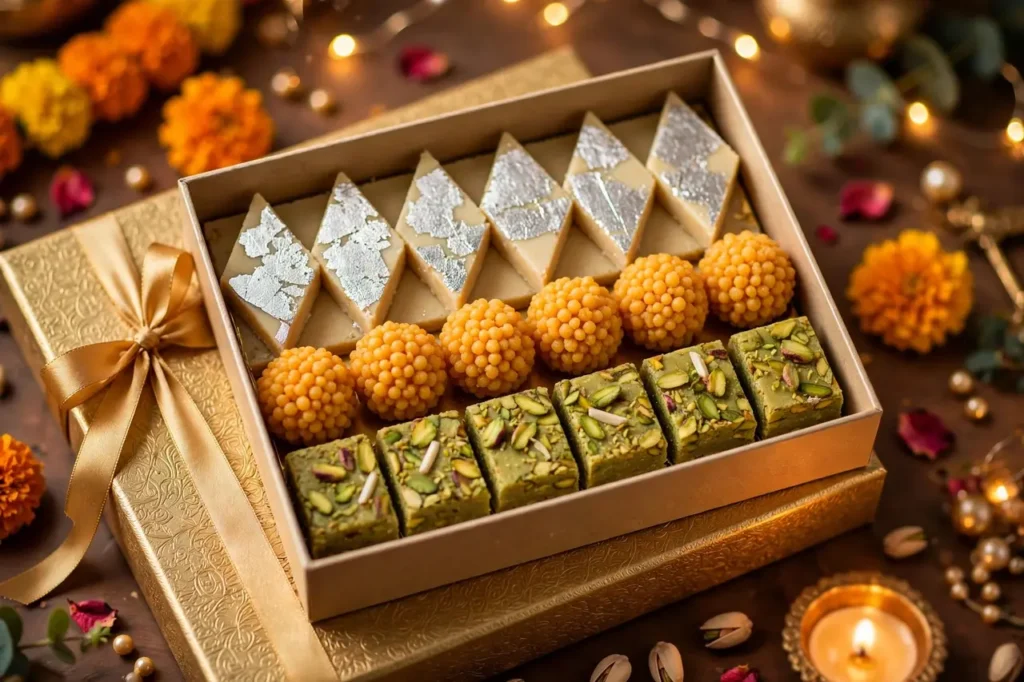
2. Kaju katli: the elegant one. Thin diamond-shaped slices of cashew fudge, often topped with edible silver leaf (varak). Silky, rich, and the most-gifted sweet in India — the kaju katli box is the default premium Diwali gift. Quality test: it should melt on the tongue, not chew like candy; the cashew flavor should be pure and intense.
3. Motichoor ladoo: the festive workhorse. Tiny fried boondi pearls bound with syrup into golden spheres, scented with cardamom. The ladoo of celebrations — weddings, festivals, temple offerings. A good motichoor ladoo is juicy but not soggy, sweet but not cloying, and gone within minutes of the box opening.
4. Besan ladoo: the nostalgic one. Roasted gram flour, ghee, sugar, and cardamom, rolled by hand. The roasting is everything — under-roasted tastes raw, over-roasted tastes burnt, and the perfect amber color with nutty aroma is the halwai’s signature. Tastes like every happy childhood memory at once.
5. Rasmalai: the delicate one. Soft chenna (fresh cheese) discs soaked in saffron-cardamom milk, served chilled. Light, fragrant, and the perfect counterpoint to a heavy Diwali dinner. Must be eaten fresh — rasmalai waits for no one.
6. Jalebi: the theatrical one. Crisp, coiled, saffron-orange spirals soaked in syrup, best eaten hot from the kadhai. The contrast — shattering crisp outside, juicy inside — is one of Indian cuisine’s great textures. Rabri (thickened sweet milk) alongside is the classic pairing; jalebi-rabri at a Diwali morning is pure joy.
7. Mysore pak: the South Indian legend. Gram flour, sugar, and an almost alarming amount of ghee, cooked to a melt-in-mouth fudge that is somehow both rich and delicate. The ghee should glisten; the texture should crumble then melt. Originated in the Mysore palace kitchens — royalty you can eat.
8. Kheer / payasam: the comfort one. Rice slow-cooked in milk until creamy, scented with cardamom and topped with nuts. Every region has its version — Bengali payesh, South Indian pal payasam, Hyderabadi sheer khurma (with vermicelli and dates, the Eid-Diwali crossover star). The slow cooking is non-negotiable; rushed kheer is just sweet rice.
9. Barfi (mixed): the variety platter. Milk fudge in its many forms — plain, chocolate, pistachio, coconut, mango. The mixed barfi box is the democratic sweet: something for every taste, beautiful to look at, easy to share. Quality varies enormously; the milk should taste fresh and the flavors distinct.
10. Soan papdi: the controversial one. Cube-shaped, flaky, melt-in-mouth — people either adore it or find it too sweet. But it is the most-gifted-after-Diwali sweet in India (everyone gives it, everyone re-gifts it — the joke writes itself). Fresh soan papdi from a good maker, eaten within days, is genuinely delicious; stale soan papdi is the meme.
11. Rasgulla: the Bengali pride. Spongy white chenna balls in light syrup — deceptively simple, technically demanding. The best rasgulla is featherlight and juicy; the worst is rubbery. At Diwali, it is the refreshing counterpoint to the richer sweets.
12. Halwa (gajar / moong dal / suji): the warm one. Carrot halwa (winter’s gift — red Delhi carrots, slow-cooked in milk and ghee), moong dal halwa (the labor-intensive luxury, stirred for an hour), suji halwa (the quick comfort). Served warm, preferably with a scoop of vanilla ice cream for the modern table. For more festive dessert inspiration from another tradition, these holiday dessert ideas share the same celebration logic.
Regional Treasures Worth Seeking Out
Beyond the pan-Indian canon, every region has Diwali sweets that rarely travel — and they are worth the hunt.
North: pinni (Punjabi — roasted wheat flour, ghee, jaggery, and nuts, rolled into energy-dense balls; the winter sweet); balushahi (flaky, glazed, like a glazed doughnut’s sophisticated ancestor); dodha barfi (the chewy milk fudge of Punjab).
West: shrikhand (Gujarati/Maharashtrian — strained yogurt whipped with saffron and cardamom; light, tangy, elegant); modak (the Maharashtrian dumpling — rice flour shell, coconut-jaggery filling; technically Ganesh Chaturthi’s star, but beloved at Diwali too); mohanthal (gram flour fudge with a distinctive grainy-melt texture).
South: adirasam (deep-fried jaggery-rice flour discs, like a spiced doughnut); jangri/imarti (jalebi’s thicker, flower-shaped cousin, with a juicier bite); therattipal (milk reduced to fudge with jaggery); kozhukattai (sweet rice dumplings).
East: sandesh (Bengali — fresh chenna sweetened and molded, impossibly delicate); chhena poda (Odia — baked cheese dessert with a caramelized crust); malpua (fried pancakes in syrup, the North’s answer to the pancake, often with rabri).
How to find them: regional sweet shops in your city (every metro has them — ask in community groups), online specialty retailers (many ship fresh with 2-day delivery during festival season), or the most reliable source: a friend’s grandmother. Regional sweets are often still a home-kitchen art; the best version of any of these is made by someone’s nani, not a factory.
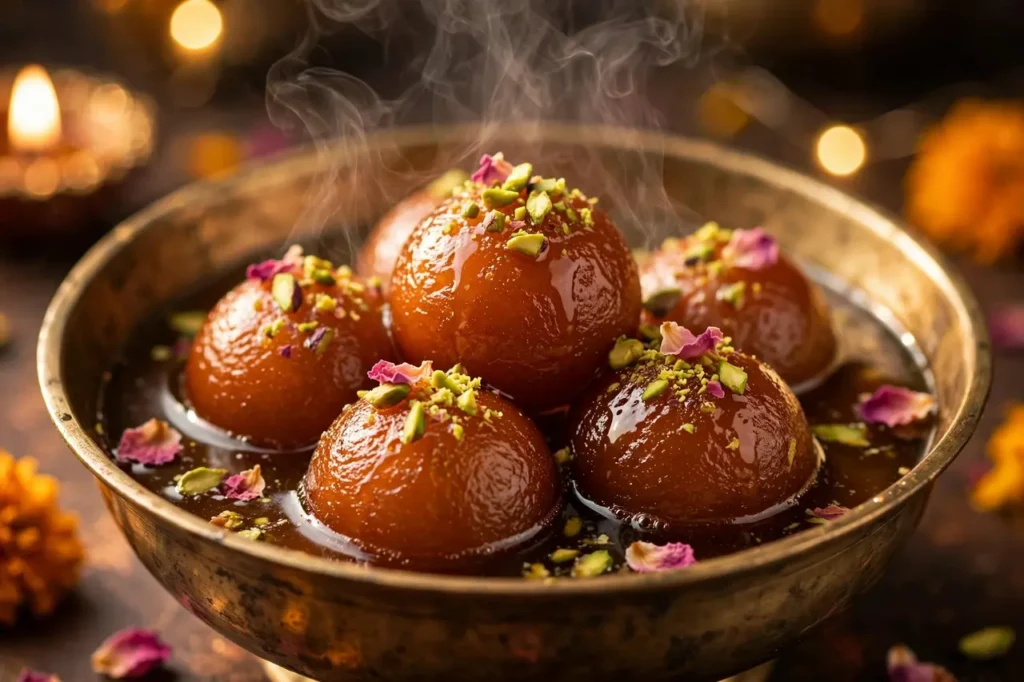
Watch: Perfect Gulab Jamun Masterclass
Learn to make soft, perfect gulab jamun with tips from a professional chef — the ultimate Diwali sweet skill.
The Home Cook’s Table: Difficulty, Time, and Shelf Life
Thinking of making mithai at home? This table tells you what you are signing up for — honestly.
| Sweet | Difficulty | Active time | Shelf life | Beginner tip |
|---|---|---|---|---|
| Coconut ladoo | Easy | 20 min | 4–5 days | The foolproof first mithai — nearly impossible to ruin |
| Besan ladoo | Medium | 40 min | 2 weeks | Roast low and slow; color is the doneness test |
| Gulab jamun (mix) | Easy–Medium | 45 min | 3–4 days refrigerated | Use a good mix first; graduate to khoya later |
| Gulab jamun (khoya) | Hard | 90 min | 3–4 days refrigerated | Fry low and slow — high heat = raw centers |
| Kaju katli | Medium | 30 min | 1–2 weeks | Grind cashews fine; do not overcook the syrup |
| Mysore pak | Medium–Hard | 40 min | 2 weeks | Have everything measured before the ghee goes in |
| Rasmalai | Hard | 90 min | 2 days refrigerated | Chenna texture is everything — knead until smooth |
| Kheer / payasam | Easy | 60 min (mostly unattended) | 3 days refrigerated | Low heat + stirring = no shortcuts, no stress |
| Jalebi | Hard | 60 min + ferment | 1 day (best fresh) | Batter consistency is the whole battle |
| Shrikhand | Easy | 15 min + straining | 3–4 days refrigerated | Strain yogurt overnight; the rest is assembly |
| Chocolate fudge (mithai-style) | Easy | 20 min | 2 weeks | Cardamom + pistachio = instant festive |
| Soan papdi | Expert | 90 min | 2–3 weeks | Buy it. Seriously. Even professionals struggle. |
The beginner’s progression: start with coconut ladoo and kheer (nearly foolproof), graduate to besan ladoo and kaju katli (technique matters but forgiving), attempt gulab jamun from khoya only after a practice batch. Soan papdi and jalebi are aspirational — admire them, buy them, and leave them to the halwais. For more kitchen projects that build these skills, these homemade food gift ideas include beginner-friendly sweets.
How to Buy Mithai Like a Connoisseur
Most people buy sweets the way they buy greeting cards — quickly, and from wherever is closest. The connoisseur’s approach takes barely more effort and produces dramatically better results.
Judge the shop, not the display: high turnover is everything. A shop with a line, emptying trays, and fresh batches coming from the back beats a beautiful display of day-old sweets every time. Ask when the batch was made — good shops will tell you proudly; evasive shops are telling you something too. During Diwali week, the best shops sell out of popular items by evening; morning shopping gets you the freshest selection.
Taste before you commit: reputable sweet shops offer tastes — accept them. The taste test: kaju katli should melt, not chew; gulab jamun should be spongy and warm; ladoo should be juicy; barfi should taste of fresh milk, not of the refrigerator. Trust your palate over the packaging.
Read the sweet: vibrant, unnatural colors often mean heavy food coloring — traditional sweets get their hues from saffron, pistachio, and rose, which are subtle. Excessively bright orange jalebi or neon-green barfi is a quality warning. Silver leaf (varak) should be thin and even; thick, patchy varak suggests corner-cutting.
Packaging for gifting: buy sweets in the shop’s gift boxes (designed for freshness and presentation), not transferred to your own containers — every transfer costs freshness. For shipping, choose dense sweets (kaju katli, mysore pak, dry fruit barfi) over delicate ones (rasmalai, rasgulla do not travel). Order online from reputable makers 5–7 days ahead during festival season.
Price vs. quality: with mithai, price correlates with quality more honestly than in most categories — the ingredients (pure ghee, real khoya, good nuts) cost what they cost. Suspiciously cheap kaju katli is not a bargain; it is a warning. That said, the neighborhood halwai often beats the luxury brand on freshness — price is a signal, not a guarantee.
Serving and Pairing: Getting the Most from Your Sweets
Great sweets deserve great serving. These small rituals elevate the tasting from “eating dessert” to “experiencing Diwali.”
Temperature matters: gulab jamun and jalebi must be warm — 10 seconds in the microwave revives day-old jamun remarkably. Rasmalai and shrikhand must be chilled. Kaju katli and barfi are best at room temperature. Serving everything at the wrong temperature is the most common way good sweets get wasted.
The tasting order: when offering a selection, arrange from delicate to rich — start with rasmalai or sandesh, move through kaju katli and ladoo, finish with the heavy hitters (gulab jamun, halwa). Like a wine tasting, the order shapes perception; the delicate sweets get lost after the rich ones.
Pairings: masala chai is the universal mithai companion — the tannins cut richness and the spices echo the sweets. Filter coffee pairs beautifully with mysore pak and jangri. A glass of cold milk (or badam milk) with jalebi is the traditional indulgence. For the modern table: vanilla ice cream with warm gulab jamun or gajar halwa is the pairing that converts skeptics.
The sweet box as decor: an open box of assorted mithai — the colors, the silver leaf, the jewel tones — is itself a Diwali decoration. Place the open box on the coffee table when guests arrive; it is both offering and ornament. Refill from the kitchen stash; the box should never look depleted.
Modern Twists That Honor Tradition
Tradition is not fragility — it can handle creativity. These contemporary takes keep the soul of the sweets while speaking to modern palates.
Fusion desserts: gulab jamun cheesecake (baked cheesecake topped with jamun and syrup); kaju katli truffles (katli centers dipped in chocolate); thandai panna cotta; masala chai tiramisu; jalebi with rabri ice cream. The rule for fusion: the Indian sweet must be recognizable — if you cannot taste the original, it is not fusion, it is erasure.
Health-conscious adaptations: sugar-free mithai sweetened with dates, stevia, or monk fruit (quality has improved enormously — the best makers now produce genuinely delicious sugar-free kaju katli); baked instead of fried (baked shankarpali, air-fried chakli-adjacent snacks); portion-controlled mini versions (bite-size ladoos, thin katli). These are not compromises — they are how the tradition survives in health-aware households.
Dietary adaptations: vegan mithai using coconut milk, almond milk, and coconut oil instead of dairy (coconut ladoo is naturally close); gluten-free options (most mithai is naturally gluten-free except those with wheat flour — check jalebi and shankarpali); nut-free sweets for allergy households (rasgulla, sandesh, and chenna-based sweets). Label everything when serving mixed groups.
The presentation upgrade: deconstructed desserts (deconstructed rasmalai in a glass — chenna, saffron milk, pistachio dust, layered); mithai charcuterie boards (assorted sweets arranged like a cheese board, with nuts and dried fruits); individual plated desserts for formal dinners. Modern plating does not diminish tradition — it introduces it to people who might otherwise never try it. For more dessert-table inspiration, these festive dessert recipes show how presentation transforms classics.
The Legendary Sweet Shops: A Bucket List
Every region has its legendary halwai — shops whose names are synonymous with a sweet, whose recipes are family secrets, whose Diwali lines stretch around the block. Seeking them out is a pilgrimage worth making.
What makes a shop legendary: consistency over decades (the kaju katli tastes the same as it did twenty years ago), ingredient integrity (pure ghee, real khoya — you can taste the difference), and freshness discipline (small batches, frequent production). Legendary shops rarely have the flashiest packaging; they do not need it. The product is the marketing.
How to find your local legend: ask in community groups (“best kaju katli in [city]?”) — the same two or three names will surface repeatedly. Look for shops that are busy on ordinary weekdays, not just festivals; everyday turnover means everyday freshness. And trust the elders — the grandmother who has bought Diwali sweets from the same shop for thirty years is a more reliable guide than any review site.
Ordering during festival season: legendary shops sell out. Call ahead for large orders (2+ kg), ask about pre-booking for Diwali week, and pick up in the morning. Many now ship nationally — order 7–10 days ahead, choose dense sweets that travel well, and pay for expedited shipping. A legendary sweet eaten three days later still beats an ordinary sweet eaten fresh — but fresh legendary is the peak experience.
Diwali Sweets for Kids: The Next Generation
Kids experience Diwali sweets differently — brighter, simpler, more. Planning the sweet table with children in mind keeps the festival joyful for its youngest celebrants.
Kid favorites: motichoor ladoo (bite-size, sweet, fun to eat), jalebi (the shape alone is entertainment), chocolate barfi (the gateway sweet), coconut ladoo (mild and milky), and anything with sprinkles or color. Kids also love the interactive sweets — decorating their own cookies with icing, or assembling a “sweet pizza” (a cookie base with mithai toppings).
The sugar strategy: kids will eat more sugar at Diwali than at any other time of year — that is the festival, and one week will not hurt. But pace it: serve sweets after meals, not instead of them; keep water (not soda) abundant; and have fruit available alongside the mithai. The goal is joyful indulgence, not a sugar crash that ruins the evening.
Making sweets with kids: coconut ladoo rolling is the perfect kid project (no heat, no sharp tools, instant results); decorating cookies with royal icing; assembling sweet boxes for neighbors (the giving is the lesson). A child who helped make the ladoos will remember this Diwali decades from now — the sticky hands, the cardamom smell, the pride of the finished box.
Frequently Asked Questions
What are the most popular Diwali sweets?
The essential canon: gulab jamun, kaju katli, motichoor ladoo, besan ladoo, rasmalai, jalebi, mysore pak, kheer/payasam, mixed barfi, soan papdi, rasgulla, and halwa (gajar, moong dal, or suji). Kaju katli is the most gifted; gulab jamun is the most universally loved; motichoor ladoo is the festive workhorse. Any Diwali sweet table with five or six of these covers the tradition well.
How long do homemade Diwali sweets last?
Milk-based sweets (rasmalai, kheer) last 2–3 days refrigerated; syrup-soaked sweets (gulab jamun, jalebi) last 3–4 days; ghee-based sweets (besan ladoo, mysore pak, kaju katli) last 1–2 weeks at room temperature in airtight containers. Always store in airtight containers, refrigerate dairy-heavy sweets, and when in doubt, trust your nose — fresh mithai smells of ghee, milk, and spice, never sour.
What is the easiest Diwali sweet to make at home?
Coconut ladoo — desiccated coconut, condensed milk, cardamom; mix, chill, roll. Twenty minutes, nearly impossible to ruin, and genuinely delicious. Next steps up: kheer (simple but needs patience), shrikhand (just strained yogurt plus flavorings), and besan ladoo (needs attention while roasting but very forgiving). Save gulab jamun from scratch and jalebi for after a practice run.
Are there sugar-free Diwali sweets?
Yes — and quality has improved dramatically. Many sweet shops now offer sugar-free kaju katli, sugar-free ladoo, and diabetic-friendly assortments sweetened with dates, stevia, or monk fruit. For homemade, date-sweetened energy balls, stevia-sweetened kheer, and nut-based sweets need the least adaptation. Always verify with the shop what sweetener is used; “sugar-free” varies in meaning.
What sweets are good for gifting vs. serving at home?
For gifting: dense, sturdy, long-lasting sweets — kaju katli, mysore pak, dry fruit barfi, besan ladoo, mixed barfi boxes. They travel well and stay fresh. For serving at home: delicate, fresh, temperature-sensitive sweets — rasmalai, hot jalebi, warm gulab jamun, shrikhand. The rule: gift what survives, serve what shines.
How do I store a Diwali sweet box?
Keep the box closed at room temperature for ghee-based sweets (ladoo, katli, barfi) — refrigeration dries them out. Refrigerate dairy-heavy sweets (rasmalai, shrikhand, kheer). Never mix: the moisture from refrigerated sweets ruins dry sweets. Eat syrup-soaked sweets within 3–4 days, ghee sweets within two weeks, and always check for off smells before serving older sweets.
What is varak (silver leaf) on sweets, and is it safe?
Varak is edible silver (sometimes gold) leaf applied to sweets like kaju katli — pure decoration, no flavor. Food-grade varak is safe; it passes through the body unabsorbed. Buy from reputable makers — cheap varak may contain aluminum. It is traditional, beautiful, and entirely optional; the sweet underneath is what matters.
Can I make Diwali sweets vegan?
Yes, with smart swaps: coconut milk or almond milk for dairy milk in kheer and payasam; coconut oil for ghee in ladoo and halwa (flavor shifts slightly but deliciously); cashew cream for chenna-based sweets is trickier — stick to naturally vegan-friendly sweets like coconut ladoo, jaggery-based sweets, and fruit-based desserts. Label clearly when serving; “vegan mithai” is a selling point, not a compromise.
Why does my homemade gulab jamun turn out hard or raw inside?
The two classic failures: hard jamun means the dough was over-kneaded or overworked (mix gently, just until combined) or fried too hot (high heat browns the outside before the center cooks — fry low and slow at 275–300°F). Raw centers with dark exteriors also mean the oil was too hot. Cracked balls mean the dough was too dry — add milk a teaspoon at a time. And always soak in warm (not hot, not cold) syrup.
How far in advance should I buy Diwali sweets?
Buy 1–2 days before gifting or serving — freshness is the quality signal for mithai. Dense sweets (kaju katli, mysore pak) can be bought 3–4 days ahead; delicate sweets (rasmalai, jalebi) should be bought the same day. During Diwali week, shop in the morning for the best selection — popular items sell out by evening at good shops.
Taste the Festival
The traditional Diwali sweets to try are not a checklist — they are an invitation. Start with the canon, venture into the regional treasures, try your hand at coconut ladoo, buy kaju katli from the shop with the longest line, serve gulab jamun warm, and always — always — offer the box around before taking your own piece. That small gesture, the offering before the eating, is the festival in miniature. The sweets are the medium; the sweetness shared is the message. Happy Diwali — may your mouth, and your year, be sweet.