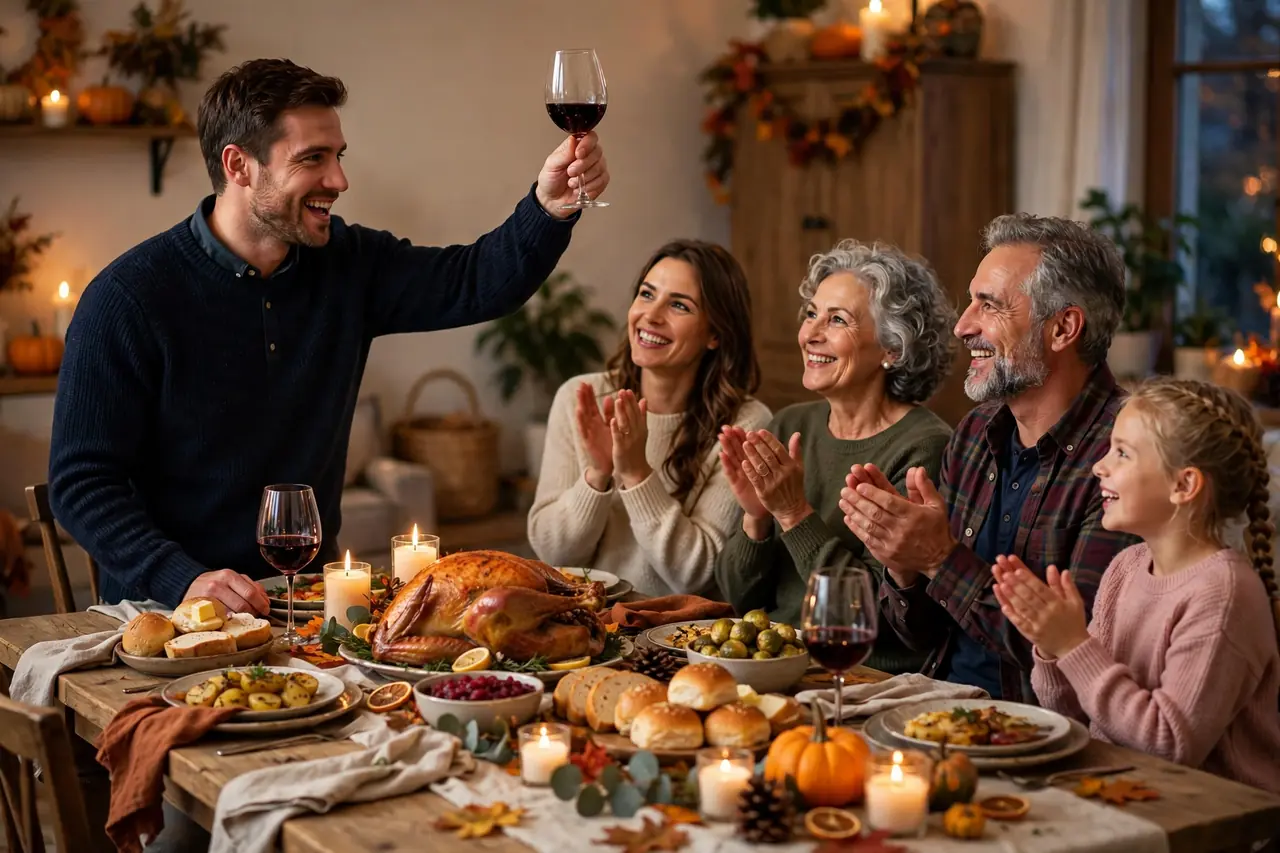
Someone taps a glass. The room quiets. All eyes turn to you — and your mind goes completely blank. The Thanksgiving toast is one of the year’s most meaningful small moments and one of its most dreaded: thirty seconds of public speaking, in front of the people whose opinions matter most, with no script and a glass of wine already in your system. No wonder most people mumble something about “great food” and sit down fast.
It does not have to be that way. This guide gives you 30 ready-to-use Thanksgiving toast examples — short classics, heartfelt tributes, funny ice-breakers, host toasts, guest toasts, toasts for grandparents and kids, Friendsgiving toasts, and faith-based graces — each one a complete script you can read verbatim or adapt. You will also learn the anatomy of a great toast (the three-sentence formula that never fails), delivery tips that kill stage fright, and exactly how long a toast should be. Bookmark this now; you will need it in November.
The Anatomy of a Great Thanksgiving Toast
Every memorable toast follows the same three-beat structure, whether it lasts twenty seconds or two minutes:
- The hook (one sentence): Get attention and set the tone. “I want to say something before we eat” works. So does “Can I have thirty seconds?” The hook is not the content — it is the signal that something meaningful is starting.
- The heart (one to three sentences): The actual substance — gratitude for the hosts, love for the family, a specific memory from the year, or a wish for the future. Specificity is everything: “I’m thankful for Mom’s pie” is forgettable, but “I’m thankful Mom still makes the pie from Grandma’s card, stains and all” makes the table go quiet.
- The lift (one sentence): Raise the glass and give everyone something to drink to. “To family.” “To Mom.” “To being together.” Short, warm, and final — then drink.
The whole thing should run 30 to 90 seconds. Longer than two minutes and you are giving a speech (we have a guide for that too). Shorter than fifteen seconds and it feels like an afterthought. When in doubt, go shorter — a tight thirty-second toast beats a rambling three-minute one every single time.
Toast Length Guide
| Toast type | Ideal length | When to use it |
|---|---|---|
| The quick classic | 15–30 seconds | As a guest; when several people will toast |
| The heartfelt tribute | 60–90 seconds | Honoring a person; the host’s main toast |
| The funny ice-breaker | 30–60 seconds | Breaking tension; Friendsgiving; kids’ table |
| The grace/blessing | 30–60 seconds | Before the meal; faith-based gatherings |
| The story toast | 90–120 seconds | One specific memory, told well, then the lift |
30 Thanksgiving Toast Examples
Each toast below is a complete script. Use them word for word, or steal the structure and fill in your own details. They are organized from simplest to most specific.
Short Classics (say these with confidence)
1. The universal: “Before we eat, I just want to say how good it is to be here, with all of you, around this table. To family — the ones we’re born into and the ones we choose.”
2. The grateful guest: “Thank you for having me at your table. There’s nowhere I’d rather be today. To the cooks, the hosts, and everyone who made this happen.”
3. The simple blessing: “Good food, good company, and a warm house on a cold day. We are lucky. To all of it.”
4. The one-liner: “They say the best things in life aren’t things. Looking around this table, I believe it. Cheers.”
5. The host’s welcome: “Welcome, everyone. This table took all day, but having you all here took all year of looking forward to it. Eat well — to us.”
Heartfelt Tributes
6. To the cook: “I want to toast the person who started cooking at dawn so we could all sit down at four. Mom — this meal is love you can taste. To the hardest-working person at this table.”
7. To a grandparent: “Grandpa, you’ve sat at the head of this table for forty years. Everything good about this family started with you and Grandma. We’re all just trying to live up to the example. To you.”
8. To absent loved ones: “Before we begin, let’s remember those who can’t be here today — and those who are here in our hearts but not in our chairs. We carry them with us. To their memory, and to the love that doesn’t end.”
9. To the new addition: “This time last year, there was one less chair at this table. Welcome to the family, [name] — you picked a great day to join us. To new beginnings.”
10. The year’s reflection: “This year gave us [a wedding, a baby, a graduation, a recovery — pick yours]. It wasn’t all easy. But we’re here, together, and that counts for everything. To making it through, together.”

Funny Ice-Breakers
11. The honest one: “I’d like to thank the turkey for its sacrifice, the potatoes for their service, and the elastic in my waistband for holding strong. To Thanksgiving.”
12. The cook’s confession: “I Googled ‘is it done yet’ eleven times today. The turkey survived, we’re all here, and nobody’s been poisoned. I’d call that a win. Cheers.”
13. The diet’s eulogy: “We gather today to mourn the passing of my diet, which died doing what it loved — standing between me and a second helping. To pie.”
14. The family roast (gentle): “I’m thankful for this family — for Dad’s jokes that get worse every year, for Mom’s refusal to share the gravy recipe, and for all of us pretending we don’t fight over the wishbone. To us, weirdos that we are.”
15. The Friendsgiving classic: “We’re not related, we’re not obligated, and half of us can’t cook — yet here we are, with a better spread than most restaurants. To chosen family.”
Host Toasts
16. The warm welcome: “When I started cooking this morning, the house was quiet. Now it’s full — of noise, of laughter, of the people I love most. That’s the whole point of today. Thank you for filling my house. To all of you.”
17. The first-timer: “This is my first time hosting Thanksgiving, and I was terrified. But you all showed up, you all helped, and somehow it worked. Thank you for making my first time feel like the fiftieth. To many more.”
18. The small gathering: “It’s just us this year — a small table, but I’d argue the best table. No performance, no politics, just the people I actually want to eat pie with. To keeping it simple.”
Guest Toasts
19. The appreciative guest: “You cooked for two days so we could eat for two hours, and I want you to know it didn’t go unnoticed. This is the best meal I’ll have all year. To our hosts.”
20. The far-traveled guest: “I flew two thousand miles for this meal, and I’d do it again tomorrow. Home isn’t a place — it’s this table. Thank you for being my home.”
For Grandparents to Give
21. The legacy toast: “I’ve watched this table grow from four chairs to fourteen. Every face here is the best thing I ever made. Take care of each other — that’s all I’ve ever wanted. To family.”
22. The blessing: “May your plates be full, your hearts be fuller, and may you always have a table like this to come home to. God bless us, every one.”
For Kids to Give
23. The sweet one: “I’m thankful for my family, my dog, and pie. Especially pie. Cheers!”
24. The earnest one: “My teacher said to say what we’re thankful for, so: I’m thankful Grandma taught me to make rolls, and I’m thankful nobody makes me eat the green bean thing. To Thanksgiving!”
Faith-Based Graces
25. The classic grace: “Heavenly Father, we thank You for this food, for the hands that prepared it, and for the family gathered here. Bless us and keep us, and help us carry this gratitude into the world. Amen.”
26. The inclusive blessing: “For the food before us, the friends beside us, and the love between us — we give thanks. May we be worthy of these blessings by sharing them. To gratitude.”
Quotes to Borrow
27. The literary lift: “As Maya Angelou said, ‘Let gratitude be the pillow upon which you kneel to say your nightly prayer.’ Tonight, this table is that pillow. To gratitude.”
28. The simple wisdom: “There’s an old saying: ‘Gratitude turns what we have into enough.’ Looking around, I’d say we have more than enough. Cheers.”
29. The toast to the future: “Here’s to the Thanksgivings behind us — and to all the ones ahead, with more chairs, more laughter, and the same love. To next year.”
30. The closer: “Eat, laugh, linger. These are the good old days, happening right now. To today.”
How to Deliver a Toast Without Stage Fright
The words are only half the toast — delivery is the other half, and it is simpler than people think. Stand up (sitting toasts disappear into the table noise). Hold your glass at chest height, not overhead — you are not hailing a cab. Make eye contact with three different people during the toast; it makes the whole table feel included and gives your nervous eyes somewhere to land.

Speak slowly — nerves make everyone rush, and rushing makes even good words sound panicked. Pause before the final lift line; the half-second of silence tells the table the toast is landing. And here is the secret professionals know: it is completely fine to read from your phone or a notecard. Nobody judges notes; they judge rambling. A thirty-second toast read clearly beats a two-minute toast fumbled from memory.
If your voice shakes, that is fine — it reads as sincerity, not weakness. If you tear up, pause, smile, and keep going; the table will love you for it. And if you completely blank, the universal recovery is: “What I’m trying to say is — I’m really glad you’re all here. To family.” Nobody will ever know it was not the plan.
When to Toast: Timing Matters
The host’s welcome toast comes first, before anyone eats — it is the starting gun. Guest toasts and tributes fit naturally between courses or right after the main plates are cleared, when people are relaxed and the wine is working. The best-man-style big emotional toast lands best after dinner, with coffee — the table is settled, nobody is juggling a carving knife, and the mood is reflective.
Do not toast during the blessing if one is given — grace and toasts are separate moments. Do not tap your glass with silverware; just stand and speak clearly, and the table will quiet. And coordinate loosely: if three people all plan tearjerker tributes to Grandma, space them out or combine forces. One person should quietly MC the toast sequence — usually the host — with a simple “Does anyone else want to say something?” between toasts.
Fill-in-the-Blank Toast Templates
If the 30 examples above are not quite you, build your own from these five proven templates. Fill in the brackets, read it once aloud, and you have a toast that sounds personal because it is.
Template 1 — The Gratitude List: “I’m thankful for three things this year: [specific thing], [specific thing], and all of you. To [the best one].” The rule of three is inherently satisfying, and the specificity requirement forces you past generic thankfulness into something real.
Template 2 — The Memory: “I’ll never forget [specific moment from this year]. It reminded me that [what it taught you]. To more moments like that.” One vivid memory beats ten vague sentiments. Pick the first moment that comes to mind — it is usually the right one.
Template 3 — The Tribute: “[Name], you [specific thing they did]. I don’t say it enough, but [what it meant to you]. To [name].” Direct, personal, and devastatingly effective. Use it for the cook, the host, the grandparent, the friend who showed up.
Template 4 — The Wish: “Here’s what I wish for all of us in the coming year: [hope]. May we [shared aspiration]. To the future.” Forward-looking toasts work beautifully as the evening’s closing toast, when the meal is done and the mood is reflective.
Template 5 — The Humor Sandwich: “[Light joke]. But seriously, [one sincere sentence]. [Callback to the joke as the lift].” Example: “I’m thankful the smoke alarm only went off twice today. But seriously, I’m thankful we’re all here. To only two smoke alarms — a new record.” The joke earns attention; the sincerity earns the emotion; the callback earns the laugh.
Toasts for Tricky Situations
Not every Thanksgiving is uncomplicated. Sometimes the table includes grief, change, or tension — and the toast has to navigate it with grace.
After a loss: Acknowledge it directly and briefly, then pivot to warmth. “We miss [name] today. They loved this table, and I think they’d be happy to see us all here, carrying on. To [name], and to us.” Do not avoid mentioning them — the elephant in the room is worse than the toast about them. One sentence of grief, one of continuity, then lift.
After a divorce or separation: If the family structure changed this year, the toast can quietly bless the new shape. “Families change shape, but this one is still full of love. I’m glad we’re here, exactly as we are. To us.” No commentary on the situation itself — just warmth for whoever is present.
Welcoming a new partner: Make them feel chosen, not examined. “[Name], thank you for joining our beautiful chaos. You’re one of us now — which means you’re stuck with us. To new family.” Humor plus explicit inclusion is the formula.
A genuinely hard year: When the year brought illness, job loss, or struggle, toxic positivity is the enemy. “This year tested us. I’m not going to pretend it didn’t. But we’re here, we’re together, and we’re still standing. That matters. To resilience.” Honesty lands harder than forced cheer, and the table will respect it.
Blended or complicated families: Keep it universal. “Whatever brought each of us to this table, I’m glad the road led here. To the family we’ve built.” The toast’s job is to make everyone present feel they belong — full stop.
The Group Toast: Getting Everyone Involved
The most memorable Thanksgiving toasts are not solo performances — they are group moments. Two formats work beautifully.
Round-robin gratitude: The host starts (“I’m thankful for…”), then each person adds one thing, going around the table. No pressure to be profound — “I’m thankful for pie” is a valid and beloved contribution. The host closes with the lift: “To all of that.” This takes five minutes for twelve people and involves everyone, including kids and quiet relatives who would never volunteer a solo toast.
The popcorn toast: Anyone can jump in at any time with a one-sentence toast, popcorn-style, until the energy naturally winds down. “To Mom’s gravy!” “To not having to do dishes!” “To elastic waistbands!” It is chaotic, funny, and low-pressure — perfect for Friendsgiving or families that groan at formal toasts. The host’s job is to start it and to end it with one sincere line that lands the plane.
Watch: How to Give a Great Toast
See toast delivery done well — this video breaks down what makes a toast land, with real examples of structure, pacing, and the all-important final line.
Toast-Day Checklist
Run through this an hour before dinner and you will be ready for any toast moment:
- Pick your script: Choose one example or template from this guide and personalize the brackets. Write it in your phone’s notes app in large text.
- Time it: Read it aloud once, slowly. If it runs over 90 seconds, cut a sentence. If it runs under 20 seconds, add one specific detail.
- Charge your glass: Make sure you have something to raise — and that it is not empty. An empty-handed toast looks unfinished.
- Know your slot: If you are not the host, quietly check when toasts are happening so you are not caught mid-bite.
- Breathe: Seriously. Three slow breaths before you stand up. Nerves are just energy; the table is on your side.
Thanksgiving Toast Examples: Frequently Asked Questions
How long should a Thanksgiving toast be?
Thirty to ninety seconds — roughly 75 to 200 words. That is long enough to say something real and short enough to hold a hungry table’s attention. If you are the host giving the main welcome toast, aim for the longer end; if you are one of several guests toasting, keep it under a minute. When in doubt, shorter is better.
Is it okay to read my toast from my phone?
Completely. Nobody has ever judged a toast for being read — they judge toasts for rambling, which reading prevents. Keep the text large, hold the phone low (not covering your face), and look up at the table for the final line. A notecard works too and photographs better, if you care about such things.
What should I avoid saying in a Thanksgiving toast?
Avoid inside jokes most of the table will not get, any mention of politics or controversy, embarrassing stories about the hosts, and backhanded compliments (“the turkey is actually edible this year!”). Keep it positive, inclusive, and brief. If a story might make someone uncomfortable, save it for a smaller setting — Thanksgiving toasts are for warmth, not roasts.
Who should give the first toast?
The host — it is their table and their welcome. After that, the order is flexible: the eldest family member, then anyone moved to speak. The host can invite toasts with a simple “Does anyone else want to say a few words?” Do not put people on the spot by name unless you have warned them in advance; ambush toasts produce panic, not poetry.
Can kids give a Thanksgiving toast?
Absolutely — and they are often the highlight. Keep expectations tiny: one or two sentences about what they are thankful for. Do not correct or coach mid-toast; the earnest imperfection is the charm. Examples 23 and 24 above are ready-made for young speakers, and the table will melt.
What is the difference between a toast and a grace?
A grace (or blessing) is a prayer of thanks, usually given before the meal, often faith-based, and directed upward. A toast is a celebratory tribute directed at the people present, sealed by raising glasses. Many families do both: grace before eating, toasts during or after. They serve different purposes — reverence versus celebration — and there is room for both at the table.
What do I do with my glass after the toast?
Take a sip — you do not need to drain it. (Draining a full wine glass on every toast is how Thanksgiving afternoons go sideways.) If you do not drink alcohol, raise whatever is in your glass — cider, water, sparkling juice all count fully. No one is tracking your beverage; the raised glass is the symbol, not the contents.
How do I toast someone who has passed away?
Keep it brief, warm, and forward-looking: acknowledge the absence, share one happy detail if you can (“Dad would have loved this pie”), and lift the glass to their memory. It is okay to get emotional — the table will hold the moment with you. Avoid long eulogies at the dinner table; the toast honors them best when it is loving rather than heavy. Our inspirational Thanksgiving messages collection has more words for difficult moments.
Should I prepare a toast even if I’m just a guest?
Yes — prepare a thirty-second backup, even if you never use it. Being asked unexpectedly with nothing ready is the nightmare scenario this guide exists to prevent. Memorize one short classic (examples 1–5) and you are covered for any table, any year. The prepared guest who speaks briefly always impresses more than the surprised guest who rambles.
What if I get too emotional during my toast?
Let it happen. A cracking voice or a tear reads as sincerity, never weakness — the table will lean in, not judge. Pause, smile, take a breath, and continue; if you need to, skip to your final lift line and raise the glass. Some of the most beloved family toasts in history were delivered through tears. The emotion is the point.
Can I give a toast at Friendsgiving?
Friendsgiving toasts are often the best toasts — funnier, looser, and more honest than family ones. The same structure applies, but the tone can be playful (see example 15). Roast gently, praise sincerely, and keep it short; friend groups have lower tolerance for speeches than families do. End with the group cheer — Friendsgiving runs on collective energy.
The perfect Thanksgiving toast is not a performance — it is a gift. Thirty honest seconds, a raised glass, and the people you love looking back at you: that is all it has ever been, from the humblest Friendsgiving to the grandest family table. The words do not need to be clever; they need to be true. Pick a script from above, or borrow the three-beat structure and write your own, and when the moment comes, stand up and speak from the heart. Your voice may shake — the table will love you for it anyway. For more words for the table, explore our 56 Thanksgiving toast ideas, our 40 Thanksgiving dinner prayers for the grace before the meal, and 81 blessings and prayers for every kind of gathering. To all of it — cheers.