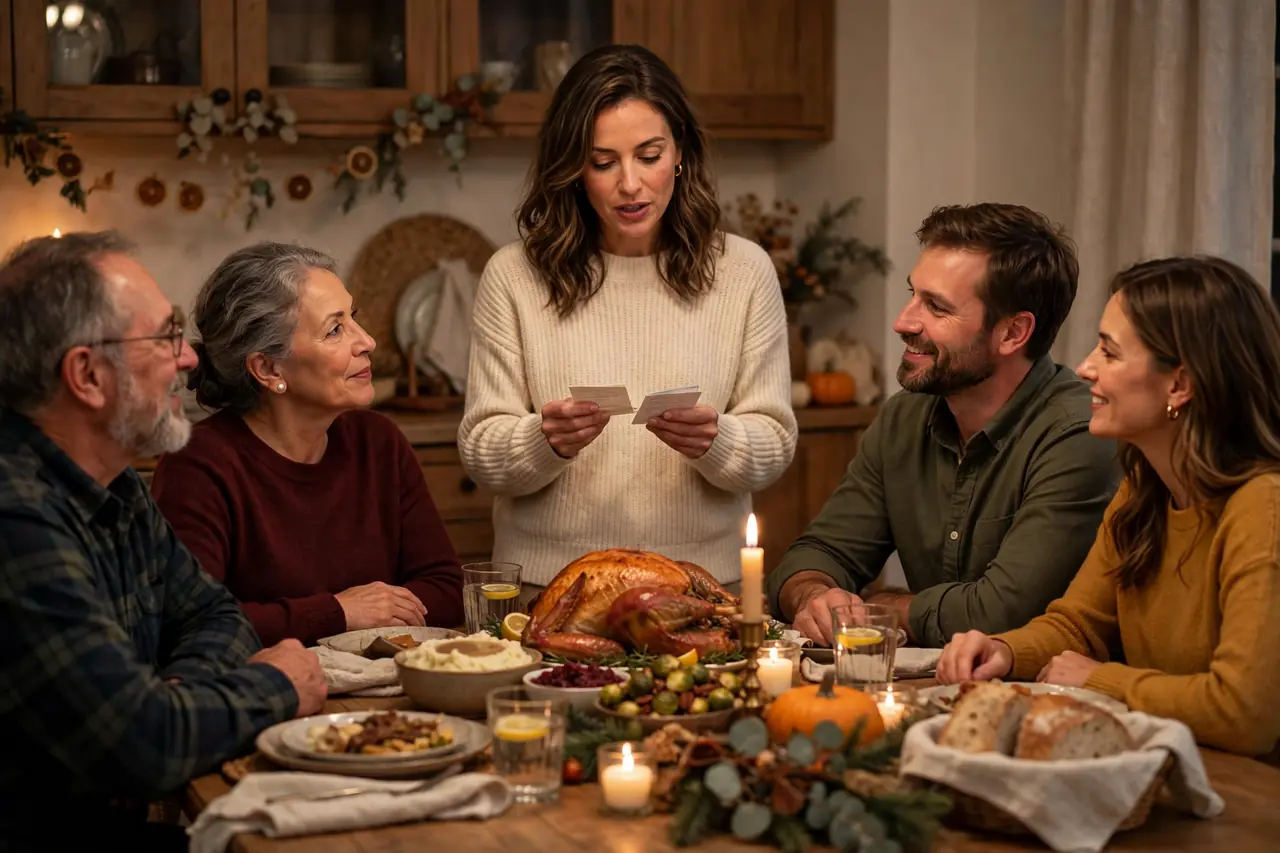
A toast is thirty seconds. A speech is five minutes — and those five minutes can be the emotional centerpiece of the entire Thanksgiving. Maybe you are hosting for the first time and want to welcome everyone properly. Maybe you need to honor a parent, remember someone who is gone, or mark a milestone year. Maybe your family just does speeches, and your turn has come. Whatever the reason, staring at a blank page the night before is miserable — so do not. Start here instead.
This guide gives you 12 complete Thanksgiving speech examples — full scripts running three to six minutes each, covering every situation: the host’s welcome, tributes to parents and grandparents, remembrances, funny speeches, Friendsgiving addresses, gratitude speeches, faith-based reflections, and closers. You will also get the five-minute speech formula, a timing table, delivery techniques that make you look like a natural, and honest advice on writing your own. A great Thanksgiving speech is not about oratory genius. It is about saying one true thing, well.
Toast vs. Speech: Know Which One You Are Giving
People confuse these constantly, and the confusion ruins both. A toast is short (under 90 seconds), ends with raised glasses, and makes one point. A speech is longer (three to six minutes), has a beginning-middle-end structure, and can develop an idea — tell a story, trace a year, build to an emotional peak. If you are looking for quick glass-raising lines, our Thanksgiving toast examples guide has 30 of them. This guide is for the longer form: the welcome address, the tribute, the reflection.
The rule of thumb: if more than two minutes of talking is expected of you, it is a speech — prepare it, structure it, and practice it. If you wing a five-minute speech, it becomes a ten-minute ramble. If you over-prepare a thirty-second toast, it sounds robotic. Match the preparation to the form.
The Five-Minute Speech Formula
Every speech below follows the same architecture. Learn it once and you can write any Thanksgiving speech in twenty minutes:
- Opening (30 seconds): Thank the hosts, name the occasion, and give the audience one reason to listen. A small confession works beautifully: “I wrote this three times and threw it away twice.”
- Story (2 minutes): One specific story — not three, not a summary of the year. The best Thanksgiving stories are small: a Tuesday phone call, a kitchen moment, something ordinary that revealed something true.
- Meaning (1 minute): Say what the story means. This is the “here is why I told you that” beat. Do not skip it — without meaning, a story is just an anecdote.
- Gratitude (1 minute): Name names. Thank specific people for specific things. This is the emotional peak; let it breathe.
- Close (30 seconds): One forward-looking line, then the lift — raise the glass, invite the table to drink. End cleanly; do not trail off.
| Section | Time | Word count | Job |
|---|---|---|---|
| Opening | 0:00–0:30 | 60–75 words | Attention + goodwill |
| Story | 0:30–2:30 | 250–300 words | Emotional engagement |
| Meaning | 2:30–3:30 | 120–150 words | The point |
| Gratitude | 3:30–4:30 | 120–150 words | Emotional peak |
| Close | 4:30–5:00 | 50–75 words | Lift + glasses raised |
12 Complete Thanksgiving Speech Examples
Each speech below is a full script — 600 to 750 words, three to six minutes delivered. Replace the bracketed details with your own. Read your chosen speech aloud twice before the day; familiarity is what makes delivery sound natural.
1. The Host’s Welcome Speech
Thank you all for being here. I mean that more than the usual politeness requires — I started planning this dinner in October, and every decision, from the seating to the pie selection, was made while picturing your faces around this table.
When I was a kid, Thanksgiving happened to me. I showed up, I ate, I disappeared to watch football. It took hosting to understand what I was actually witnessing all those years: someone — usually Mom — performing an act of love so large it looked like logistics. The turkey timing, the seating diplomacy, the gravy that never failed. I see it now. And I am terrified and honored to be the one doing it this year.
Here is what I learned in the process: the meal is not the point. I spent three days on this food, and I would trade all of it — every dish — for one more hour of all of you in this room. The food is just the excuse. You are the reason.
So thank you — to [partner’s name] for peeling what felt like forty pounds of potatoes without complaint, to [name] for the pie rescue when mine collapsed, to everyone who traveled, rearranged, and showed up. You are my favorite people, and this is my favorite day. Please — eat, drink, stay late. To all of you.
2. Tribute to Parents
I want to talk about Mom and Dad for a minute — and I asked their permission first, because the stories involve all of us.
When I was nine, Dad lost his job two weeks before Thanksgiving. I did not know — kids never know — but I remember that Thanksgiving anyway, because nothing about it felt different. Same turkey, same chaos, same Dad carving like a man with zero worries. Years later Mom told me they had almost canceled, almost told everyone to skip it. Dad said no. He said the kids will remember if we skip it, and they will not remember why.
He was right. I do not remember what we ate that year. I remember that we were together, and that it felt normal, and that normal was a gift he gave us on purpose, at cost to himself. That is what parents do — they absorb the worry so the kids get the holiday.
Mom, Dad — thank you for every normal Thanksgiving, and for all the abnormal years you made feel normal. Everything I know about showing up for people, I learned at this table. To Mom and Dad.
3. In Remembrance
Before we eat, I want us to think about [name] for a moment. This is our first Thanksgiving without [him/her/them], and the empty chair is the loudest thing in the room.
[Name] loved this day the way some people love music — completely, without reservation. I keep thinking about last year, when [he/she/they] [specific memory: insisted on the burnt rolls / fell asleep during the game / cried laughing at the toast]. That is the [name] I want us to hold today — not the absence, but the presence. The laugh. The appetite. The way [he/she/they] made everyone feel like the most important person at the table.
Grief and gratitude are not opposites. I am grieving, and I am grateful — grateful that we had [him/her/them], grateful that [his/her/their] love is still feeding us, literally, because this is [his/her/their] stuffing recipe and we all know it. [He/She/They] would want us to eat well and laugh loudly. So let us do both, in [his/her/their] honor. To [name].

4. The Funny Speech
Thank you. I have been asked to say a few words, which is dangerous, because I have many words and very little filter. I will keep it brief — the turkey is getting cold and my credibility is getting colder.
Let us review the year. [Sibling] got married, which means we gained [name] — welcome to the family; the initiation ritual is doing dishes, and it never ends. [Name] had a baby, which means there is now a tiny human at this table who will one day hear about the time Uncle [name] set the rolls on fire. Spoiler: it was this year. The rolls survived. Barely.
Here is what I actually want to say, beneath the jokes: this family is ridiculous, and I would not trade it. We argue about gravy. We have a group chat that should be illegal. We love each other in the loudest, most inconvenient way possible. And every year, we all end up here, because where else would we go? Nowhere. There is nowhere else. To us — the beautiful disaster.
5. The Friendsgiving Address
Look at this table. Really look at it. None of us share DNA — well, [names] do, but the rest of us chose this. We chose each other, and then we chose to spend one of the year’s best days cooking for each other, which is love in its most literal form.
I moved to this city [X] years ago knowing no one. [Name] invited me to Friendsgiving that first November, and I brought a store-bought pie and a lot of anxiety. Nobody cared about the pie. Somebody handed me a drink, somebody else handed me a job — “you’re on gravy” — and by dessert I had a family. That is what this day does. It adopts people.
So here is to the adopters and the adopted, the cooks and the dishwashers, the ones who came early to help and the ones who will stay late because leaving is hard. You are my people. To chosen family.
6. The Gratitude Speech
I have been keeping a list this year — not a formal journal, just notes on my phone, moments I wanted to remember. Let me read you a few: January, [name]’s call when I got the diagnosis. March, the meal train that appeared without anyone asking. July, [name] driving four hours to help me move. October, this table being planned in a group chat full of heart emojis.
Here is what the list taught me: gratitude is not a feeling, it is evidence. It is the record of people showing up. And this year, people showed up for me over and over, in ways large and small, most of which I did not deserve and all of which I needed.
So thank you — not in the abstract, but specifically: [name], for the 2 a.m. phone calls. [Name], for the casserole diplomacy. [Name], for making me laugh when laughing felt impossible. You are the list. You are the evidence. To every person at this table who showed up — thank you.
7. The Faith-Based Reflection
Scripture tells us to give thanks in all circumstances — not for all circumstances, but in them. That distinction has carried me through this year. I did not give thanks for the hard parts. But I found thanks inside them: in the nurse’s kindness, in the friend’s persistence, in the strange peace of a difficult season.
Today, the thanks are easier to see. This food — the result of hands and harvest and providence. This family — gathered, healthy, laughing. This house — warm against the November cold. These are not small things. They are the substance of a blessed life, and I do not want to rush past them.
So let us pray — or reflect, in whatever way is yours — with full hearts. And let us carry this gratitude out of this room and into a world that desperately needs people who know how to be thankful. Amen — and to all of you.
8. The Milestone Year Speech
This Thanksgiving is different, and we all know why: [the milestone — a 50th anniversary, a graduation, a new home, a recovery, a retirement]. So before we eat, I want to mark it properly, because milestones unmarked have a way of slipping past.
[Tell the story of the milestone — the work, the waiting, the moment it happened. Two minutes, specific details, the way it felt.]
What that [event] taught me is [the meaning]. And I look around this table and realize the milestone is not really the point — you are. The achievement would mean nothing without people to share it with. So this toast is really to you: the witnesses, the supporters, the ones who believed it before it happened. To [the milestone] — and to the people who made it matter.
9. The Newlywed / New Partner Welcome
I want to officially welcome [name] to their first [family name] Thanksgiving. [Name], a few things you should know: the stuffing recipe is classified, the wishbone competition is rigged in [name]’s favor, and “just one more slice of pie” is a lie we all tell.
But here is the real thing: [partner’s name] chose you, and [partner’s name] has excellent taste — in food, which you are about to discover, and in people, which is why you are here. Families are built one Thanksgiving at a time, and today you lay your first brick. We are glad it is with us. To [name] — welcome home.
10. The Kids’ Speech (for a teen or confident kid)
Hi. I am [name], and I was volunteered for this, so blame [parent]. I was told to talk about what I am thankful for, and honestly the list is long, but I will keep it to three things so we can eat.
One: I am thankful for [grandparent], who [specific thing — teaches me cards / tells the best stories / sneaks me dessert]. Two: I am thankful for my [siblings/cousins], even though [gentle joke]. Three: I am thankful for this — all of us, here, together. I know when I am older I will look back at days like this and realize they were the best ones. So — to family. Can we eat now?
11. The Recovery / Second Chance Speech
A year ago, I was not sure I would be at this table. [Speak as specifically as you are comfortable — an illness, a struggle, a dark season.] There were days I could not picture this: the noise, the food, the ordinary miracle of everyone talking at once.
But here I am. And I do not take a single second of it for granted — not the burnt rolls, not the loud chewing, not even [name]’s jokes. Especially not those. Okay, maybe those.
Thank you for the prayers, the meals, the rides, the sitting-with-me-in-silence. Thank you for not giving up on me when I had given up on myself. This Thanksgiving, I am not just thankful — I am back. And being back, with all of you, is everything. To second chances.
12. The Closing Speech (end of the evening)
Before we all scatter — before the dishes, before the goodbyes, before the food comas — I want to say one thing while we are all still here.
Days like this do not happen by accident. Someone shopped, someone cooked, someone cleaned a bathroom nobody will mention. Someone drove hours. Someone rearranged a schedule. A hundred small generosities built this evening, and most of them were invisible. I see them. Thank you.
Take a mental photograph right now — this room, these faces, this feeling. This is the good stuff. This is what it is all for. Travel safe, call your mother, and I will see you next year — same table, more chairs. To today.
Delivery: How to Sound Like a Natural
A good script with bad delivery still works — sincerity covers a multitude of stumbles. But a few techniques elevate any speech from “nice” to “unforgettable.”
Practice aloud twice, not twenty times. Two read-throughs build familiarity; twenty build a memorized performance that sounds robotic and shatters if you lose your place. You want to know the speech, not recite it. Mark two or three “anchor lines” — the story’s punchline, the gratitude peak, the closing lift — and let the rest be conversational.

Slow down and pause. Nerves accelerate everyone. Deliberately speak at about 70 percent of your normal pace, and pause for a full beat before and after your most important line. Pauses feel eternal to the speaker and perfect to the audience — they signal that something meaningful just happened or is about to.
Look up. Notes are fine, but the emotional lines must be delivered to faces, not paper. Learn the gratitude section and the closing by heart — even roughly — so your eyes are on the table when it matters most. If you tear up, pause and smile; the table will wait, and the moment will be more powerful for the pause.
End cleanly. The most common speech failure is the trailing ending — “so, yeah… anyway… cheers?” Decide your exact final line in advance, deliver it, raise the glass, and sit down. A crisp ending makes the whole speech feel intentional, even if the middle wandered.
Watch: How to Write a Powerful Speech
For the craft behind the scripts above, this video distills speechwriting wisdom from presidential speechwriters — seven principles that apply as much to a Thanksgiving table as to a graduation stage.
Thanksgiving Speech Examples: Frequently Asked Questions
How long should a Thanksgiving speech be?
Three to six minutes — 400 to 750 words. Under three minutes it is really a toast; over six minutes the table’s attention frays no matter how good you are. Five minutes is the sweet spot: enough for a real story and real emotion, short enough to hold a hungry room. Time yourself reading aloud — most people speak 130–150 words per minute.
Should I memorize my speech or read it?
Neither, exactly — familiarize. Read it aloud twice so you know the flow, mark your anchor lines, and speak from bullet-point notes rather than a full script. Full memorization risks a catastrophic blank; full reading sounds flat. The middle path — knowing it well enough to look up for the important lines — sounds the most natural and survives nerves the best.
What if I cry during my speech?
Let it happen, pause, and continue. Thanksgiving speeches about gratitude, remembrance, or family are supposed to be emotional — a cracking voice proves you mean it. Keep a tissue in your pocket, take a breath, smile at the table, and go on. If you truly cannot continue, skip to your closing line and raise the glass. Nobody will remember the tears as a failure; they will remember them as the moment.
How do I write a speech about someone who died?
Lead with a specific happy memory, not with the grief — the grief is already in the room. One vivid story that captures who they were, one line about what they meant, one line about carrying them forward. Keep it under four minutes; the table’s emotions are already high and brevity is kindness. End with a lift — a toast to their memory — so the moment closes with warmth, not weight. Our inspirational Thanksgiving messages can help with the wording.
Is humor appropriate in a Thanksgiving speech?
Yes, in measured doses — humor opens the audience up and makes the sincere parts land harder. The ideal ratio is about 80 percent heart, 20 percent humor, with the jokes front-loaded and the ending sincere. Never punch down, never embarrass anyone, and never let a joke undercut your emotional peak. Self-deprecating humor is the safest kind; roasting the hosts is the riskiest.
What if someone else’s speech covers the same ground as mine?
Do not panic and do not scrap yours — overlap is natural when everyone loves the same people. If you speak second, acknowledge it lightly (“Well, [name] said it better, but…”) and lean into your unique angle: your specific memory, your specific relationship. Two tributes to the same person from different perspectives are a gift, not a repetition.
Should kids give Thanksgiving speeches?
Short ones, yes — a minute or two from a willing teen or confident kid is often the evening’s highlight. Do not force it; a drafted child delivers resentment, not gratitude. Speech 10 above is written for young speakers. Keep expectations joyful, applaud generously, and let them sit down to cheers.
How do I handle a speech when the year was genuinely terrible?
Do not fake it — the table knows. Acknowledge the difficulty honestly and briefly, then find the real gratitude inside it: the people who helped, the strength discovered, the simple fact of being together. Speech 11 above models this. Toxic positivity (“everything happens for a reason!”) alienates a struggling table; honest resilience (“this year tested us, and we’re still here”) unites it.
Can I combine a speech with the grace or blessing?
Keep them separate. The grace is a prayer before the meal — brief, reverent, directed upward. The speech is a tribute during or after the meal — longer, personal, directed at the table. Combining them muddles both. If you are giving both, do the grace before eating (30–60 seconds) and save the speech for after the plates are cleared. Our Thanksgiving dinner prayers collection covers the grace; this guide covers the speech.
What is the biggest mistake people make in Thanksgiving speeches?
Trying to say everything. The speech that summarizes the whole year, thanks forty people, tells four stories, and runs twelve minutes is the classic failure — the audience checks out at minute seven no matter how much they love you. Pick one story, one meaning, one emotional peak. Constraint is what makes a speech powerful; the things you leave out give weight to the things you keep.
A Thanksgiving speech is a rare and wonderful thing: five minutes when the whole table listens to one voice saying what everyone feels. Do not waste it on generic thanks — tell the one true story, name the names, and end with the glass raised high. Whether you borrow a script above or write your own from the formula, the table will remember it. For shorter glass-raising moments, our toast examples have you covered; for the words of gratitude themselves, 70 gratitude quotes and 26 original Thanksgiving poems offer language worth borrowing. Now go write yours — and practice it twice.