The Thanksgiving parade Chicago 2026 is the Midwest’s answer to the great American holiday parade tradition — and it has been lifting spirits on State Street since the Great Depression. What began in 1934 as a modest “Holiday Caravan” meant to cheer up a struggling city has grown into one of the country’s largest Thanksgiving parades, drawing hundreds of thousands of spectators to downtown Chicago every Thanksgiving morning. Giant helium balloons, marching bands from across the nation, cultural performance groups, and the beloved Teddy the Turkey all march the same storied route.
If you’re planning to see it in 2026, this guide has you covered: the parade’s history, the State Street route, the best viewing spots, transit and parking advice, what to bring, broadcast options, and how to build a full Thanksgiving in Chicago around the morning’s festivities. Confirm 2026 start times, the final lineup, and any route updates on the official parade listings as November approaches — the traditions below are steady, but exact details are finalized each year.
A Parade Born in the Great Depression
Few parades have an origin story as meaningful as Chicago’s. In 1934, in the depths of the Great Depression, the city staged a “Holiday Caravan” to lift the spirits of Chicagoans — a simple procession meant to remind people that joy was still possible. It worked. The caravan became an annual Thanksgiving Day parade, growing year by year into the spectacle it is today.
For decades the parade was famously sponsored by McDonald’s and known nationwide as the McDonald’s Thanksgiving Parade. Today it marches as the Chicago Thanksgiving Parade, but the format that made it famous endures: it’s the only parade in Chicago to feature giant inflatable helium balloons every single year, and its lineup blends classic parade elements — marching bands, floats, clowns — with Chicago’s rich cultural diversity, from Ukrainian dance ensembles to drum lines to equestrian units.
The parade traditionally steps off on Thanksgiving morning and runs for about three hours along State Street. It has become the unofficial opening of Chicago’s holiday season, with the city’s famous holiday markets, ice skating, and light displays all ramping up around it. For the full holiday picture, pair this guide with our Thanksgiving events in Chicago 2026 roundup.
The State Street Route
The parade marches exclusively on State Street in downtown Chicago. The procession traditionally begins near the southern end of the route — around State and Ida B. Wells Drive (historically Congress Parkway) — and travels north to Randolph Street, passing through the heart of the Loop. That’s roughly a mile of prime downtown real estate, lined on both sides with spectators.
State Street is one of Chicago’s most iconic thoroughfares, and the parade route passes landmarks, theaters, and the city’s famous elevated train tracks. The canyon of downtown buildings makes the giant balloons look even more enormous as they float between the skyscrapers — it’s a distinctly Chicago visual you won’t get anywhere else.
Because the route is relatively compact, crowds concentrate. The blocks near the start of the route tend to be slightly less packed than those near the finish at Randolph, where spectators gather for the finale. Either way, this is a parade where arriving early genuinely matters — the Loop’s sidewalks fill up fast on Thanksgiving morning.
At a Glance: The Route on the Map
Get oriented before parade morning with this map of downtown Chicago’s State Street corridor. The parade traditionally marches north on State Street from the Ida B. Wells Drive area up to Randolph Street. Note the nearby CTA stations — the Loop is one of the best-served transit hubs in the country, which makes getting to the route easy if you plan ahead.
The pin marks the State and Randolph area near the traditional northern end of the route. Plan your arrival station in advance — the Red and Blue Line subway stations and the elevated Loop stations all put you within easy walking distance.
Best Viewing Spots Along State Street
Southern End: State & Ida B. Wells
The start of the route is often the roomiest. The parade is fresh, the performers are energetic, and you can sometimes snag a curb spot with a shorter wait than the northern blocks. It’s also the easiest area to exit from when you’re ready to head to Thanksgiving dinner.
Mid-Route: The Theater District Blocks
The middle stretch of State Street offers a great balance — full parade energy, beautiful downtown backdrops, and manageable crowds if you arrive early. The elevated train tracks overhead add to the uniquely Chicago atmosphere.
Northern End: Near Randolph Street
The finish-line area has the biggest crowds and the most electric atmosphere, as the parade builds to its finale. Arrive earliest for these blocks, and be prepared for dense crowds. The payoff is seeing every unit at full performance energy as they complete the route.
Getting There: CTA, Parking, and Timing
The CTA is your best friend on parade morning. The Red Line (subway) runs directly under State Street with stations all along the route — Jackson, Monroe, and Washington are all parade-adjacent. The Blue Line and the elevated Loop lines (Brown, Green, Orange, Pink, Purple) also serve downtown. Trains run on a holiday schedule, so check times the night before and build in buffer.
Driving downtown on Thanksgiving morning is doable but requires planning: many streets near the route close, and garage parking fills up. If you drive, aim for a garage several blocks from State Street and walk in. Better yet, stay downtown the night before — waking up within walking distance of the parade is the ultimate luxury, and Thanksgiving-morning hotel rates in the Loop can be surprisingly reasonable.
Whatever your transport, arrive early. Two hours before the scheduled step-off is the veteran’s rule for a good curb spot. Bring coffee, dress warmly — late-November Chicago mornings are famously brisk — and use the restroom before you claim your position.
Parade Morning with Kids: A Survival Guide
Bringing kids to the Chicago parade can be magical — or miserable. The difference is preparation. First, manage the morning: feed them a real breakfast before you leave, because no one is happy waiting on an empty stomach. Dress them in one more layer than you think they need, and make that layer bright — a neon hat or colorful scarf makes your child findable in a sea of dark winter coats.
Second, manage the wait. The parade is worth it, but the pre-parade standing-around is the hard part for small legs. Bring a “wait kit”: coloring supplies, a small toy, snacks in a backpack they can carry. Turn the wait into a game — a scavenger hunt for things you’ll see (“find a tuba, a giant balloon, someone in a turkey hat”) keeps eyes busy and spirits high. A portable stool or bucket to sit on saves little legs.
Third, manage the exit. Decide your departure trigger in advance — “we leave after Santa passes” or “we stay one hour” — and stick to it. Leaving on a high note beats dragging overtired kids through the finale crowds. Head straight to a warm lunch spot; downtown diners and cafes near the Loop are parade-day lifesavers. The kids will remember the balloons, not how long you stayed.
Budget Tips: Doing Parade Day Without Overspending
The parade itself is free, which makes it one of the best-value holiday outings in Chicago — but the day around it can add up. Transit is the biggest saver: a CTA day pass costs a fraction of downtown parking, and you skip the garage hunt entirely. Pack your own thermos and snacks instead of buying from vendors at parade-inflated prices.
If you’re coming from out of town, Thanksgiving is actually a reasonable time for downtown hotels — business travel pauses for the holiday, so Loop hotels that are pricey on weekdays can be surprisingly affordable. Book early and compare; some properties offer holiday packages. For dinner, the classic move is cooking at your rental or a relative’s home, but if you’re dining out, lunch menus and early-bird seatings on Thanksgiving Day are often cheaper than prime dinner slots.
Souvenirs? Set a budget before you go and stick to it. The official merchandise stands are tempting, but a photo of your family with the balloons behind you is free and will outlast any trinket. If the kids need a take-home, the holiday markets that open around Thanksgiving offer unique local crafts at fair prices.
Chicago’s Holiday Season Starts Here
One of the best things about the Thanksgiving parade is its timing: it’s the starting gun for Chicago’s holiday season. In the days after Thanksgiving, the city transforms — the great tree goes up, the holiday markets open, the ice skating ribbon welcomes its first skaters, and the downtown light displays switch on. If you can stretch your trip through the weekend, you’ll catch the city at its most festive.
The weekend after Thanksgiving is also prime time for holiday shopping on State Street and Michigan Avenue, where the parade route you stood on Thursday becomes a glittering retail corridor by Saturday. Many visitors make it a tradition: parade Thursday morning, holiday markets Friday, ice skating Saturday, and a long brunch Sunday before heading home. It’s a full, joyful weekend built around one free morning on State Street.
Watch: The 2025 Parade in 4K
See exactly what awaits on State Street with this full-coverage 4K recording of the 2025 Chicago Thanksgiving Day Parade — the balloons between the skyscrapers, the marching bands, and the crowd energy that makes this parade special:
Watch for the balloon handlers navigating the downtown wind corridors — State Street’s building canyons create gusts that make their job genuinely athletic. It’s one of the most impressive behind-the-scenes details of the live experience.
What You’ll See: Balloons, Bands, and Chicago Flavor
The Chicago parade’s lineup is a joyful mix of the classic and the local. The giant helium balloons are the headliners — beloved characters floating high above State Street, handled by teams of trained volunteers. New balloons debut most years, so there’s always something fresh alongside the returning favorites like Teddy the Turkey, the parade’s longtime mascot.
Marching bands are the parade’s backbone, traveling from high schools and universities across the country to perform on State Street. The cultural performance groups are where Chicago’s diversity shines: dance ensembles, drum lines, and traditional performers representing the city’s many communities. Add decorative floats, equestrian units, novelty acts, and a Santa finale, and you have three hours of continuous spectacle.
And then there’s the finale. Every great parade builds to a closing moment, and Chicago’s is Santa’s arrival — the official signal that the holiday season has begun. The crowd’s energy shifts when the final units approach: kids who’ve been patient for two hours suddenly light up, the bands play a little louder, and the whole street seems to lean in. It’s a genuinely moving few minutes, and it’s worth timing your day so you don’t miss it. If you have to choose between arriving for the very first balloon and staying for Santa, choose Santa.
One distinctive note: the parade has a warm, civic feel that sets it apart from its coastal cousins. This is Chicago celebrating itself — neighborhood groups, local schools, and city institutions marching alongside national acts. The crowd reflects it too: multi-generational families who’ve held the same curb spots for decades, cheering like it’s a home game.
In Pictures
Here’s the scene on State Street: giant balloons threading between downtown skyscrapers, marching bands in formation, and crowds packed along one of America’s great streets. This is Thanksgiving morning, Chicago style:
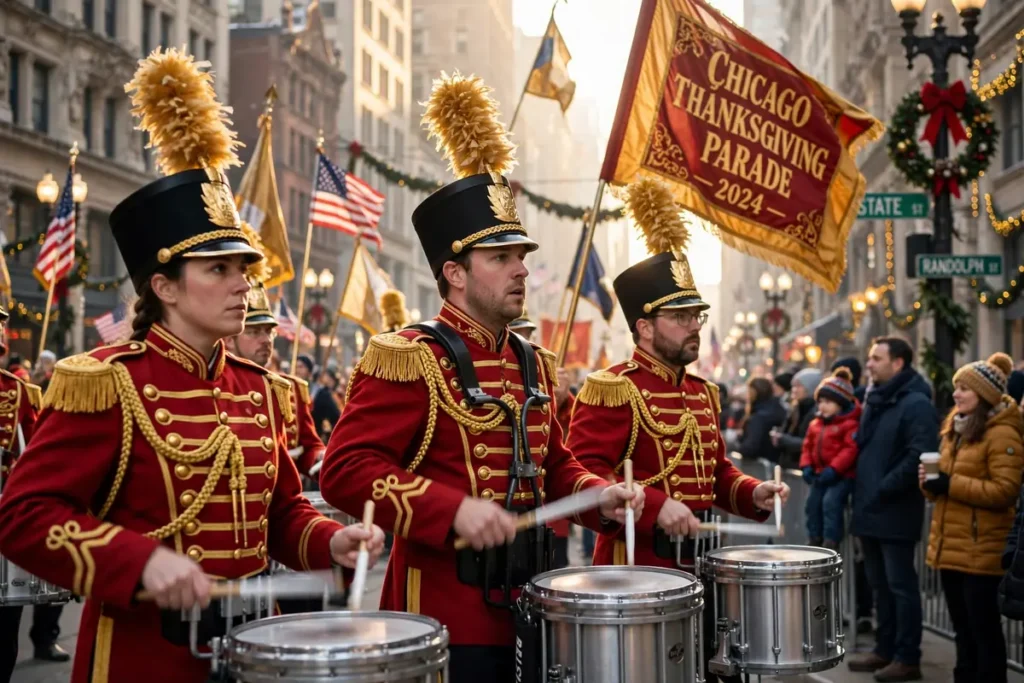
The downtown canyon effect is what makes Chicago’s parade visually unique — nowhere else do the balloons float through a corridor of skyscrapers quite like this. If you’re road-tripping for Midwest parades, Milwaukee’s holiday events pair well; see our Thanksgiving events in Milwaukee 2026 guide.
What to Bring for a November Morning in Chicago
Let’s be direct: Chicago in late November is cold. Dress like you mean it — thermal base layers, a warm coat, hat, gloves, scarf, and insulated, waterproof boots. You’ll be standing on concrete for hours, and the wind off the lake finds every gap in your armor. Hand and foot warmers are cheap insurance.
Bring a thermos of coffee or hot chocolate, snacks (especially for kids), a fully charged phone, and a small blanket or stadium seat for curb-sitting. A compact backpack beats a big bag — you’ll be navigating dense crowds. Skip the umbrella (it blocks views and catches wind); a hooded rain shell is the better call if precipitation is in the forecast.
For kids: bright, warm layers so you can spot them in a crowd, plus entertainment for the pre-parade wait — coloring books, a tablet, or a scavenger hunt (“spot five marching bands, three dogs in costume, one tuba”). Set a meeting point and write your phone number on their arm or a tag. Most families with young kids watch the first hour or so and head out happy.
After the Parade: Thanksgiving Day in Chicago
The parade ends late morning, leaving the whole afternoon for Thanksgiving proper. Many downtown and neighborhood restaurants serve special holiday dinners — book well in advance, as the best spots fill up by early November. The Loop, River North, and the West Loop all offer excellent options, from classic turkey prix-fixe menus to creative alternatives.
If you’re spending the weekend, Chicago’s holiday season is in full swing by Thanksgiving: the city’s famous holiday markets, the ice skating ribbon, and the dazzling downtown light displays all make perfect post-parade activities. A post-dinner stroll to see the lights has become a beloved Chicago Thanksgiving tradition in its own right — walk off the pie while the city glows.
Watching from Home
Can’t make it downtown? The parade is traditionally televised locally and streamed online — check the official parade announcements in November 2026 for the confirmed broadcast and streaming details. The TV coverage captures angles no curb can offer, including close-ups of the performers and commentary on the bands and floats.
Make it an event: invite friends over for a parade watch party with a breakfast spread, and let the State Street spectacle be your Thanksgiving morning entertainment. It’s a low-effort, high-charm tradition — especially for anyone who’d rather watch balloons from a warm couch than a cold curb.
Frequently Asked Questions
What time does the Chicago Thanksgiving Parade start in 2026?
The parade traditionally steps off on Thanksgiving morning and runs for about three hours — historically in the morning hours. The exact 2026 start time is announced by organizers closer to November, so confirm on the official parade listings before planning your morning. Plan to arrive at your viewing spot about two hours before the scheduled step-off.
Is the Chicago Thanksgiving Parade free?
Yes — watching from public sidewalks along State Street is completely free, no tickets needed. As with all major parades, beware of anyone selling “tickets” for curb spots; sidewalk viewing costs nothing.
Where is the best place to watch the Chicago parade?
The southern end of the route (near State and Ida B. Wells) tends to be roomiest, while the northern end near Randolph has the biggest crowds and the most electric finale atmosphere. Mid-route blocks offer a good balance. Wherever you choose, arrive early — the Loop’s sidewalks fill quickly.
How do I get to the parade without driving?
Take the CTA. The Red Line subway runs directly under State Street with stations along the entire route, and the elevated Loop lines serve downtown from all directions. Trains run on a holiday schedule on Thanksgiving morning, so check times in advance and allow extra buffer.
What happens if the weather is bad?
The parade marches rain or shine. High winds are the main concern — in strong gusts, giant balloons may be flown lower or grounded for safety. Dress for the forecast, and check the morning-of weather before heading downtown. Chicago’s late-November mornings are often near freezing, so dress warmer than you think necessary.
Can I bring my dog to the parade?
Dogs are a common sight along the route, and many sport adorable holiday costumes. That said, the crowds, noise, and cold are a lot for some pets — know your dog. Keep them leashed, bring water and waste bags, and have an exit plan if they get overwhelmed. Very crowded blocks near the finale are best avoided with anxious animals.
How long is the parade route?
The route runs along State Street from the Ida B. Wells Drive area north to Randolph Street — roughly a mile through downtown Chicago. The procession itself takes about three hours from the first unit to the finale, though you’ll see the bulk of it pass your spot in a shorter window depending on where you stand.
Conclusion
The Thanksgiving parade Chicago 2026 continues a tradition that started as a simple act of hope in 1934 — and nearly a century later, it’s still doing exactly what it was designed to do: lift the spirits of everyone who watches. Whether you’re a lifelong Chicagoan defending your family’s curb spot or a first-timer braving a November morning for the balloons, State Street on Thanksgiving is something special.
Dress warm, arrive early, and stay for the finale. Then go enjoy your Thanksgiving dinner — you’ve earned it.
There’s a reason this parade has endured since 1934 while so many other civic traditions faded: it asks nothing of you except showing up, and it gives back a morning of pure, uncomplicated joy. In a holiday season that can feel increasingly commercial and frantic, three free hours on State Street — balloons overhead, a band playing, strangers smiling at each other — is a reminder of what the day is actually about. See you on the curb.
For more holiday planning, explore our Thanksgiving guides collection, with city-by-city event roundups and dinner ideas across the country.