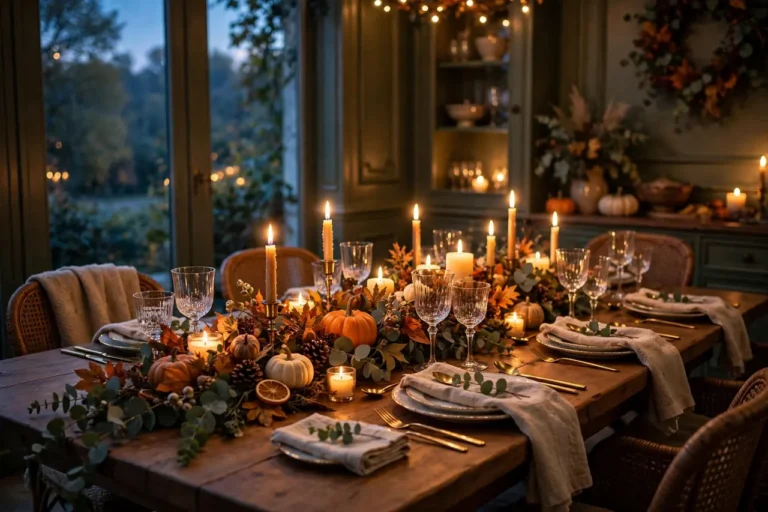
Here is the secret every experienced Thanksgiving host knows: Thanksgiving kids table decor is not really about decoration — it is about occupation. A beautifully styled kids’ table that bores children within ten minutes has failed; a slightly chaotic table that keeps them happily busy for two hours is a triumph. The best kids’ tables do three jobs at once: they make children feel honored (their own special table, not an afterthought), they keep small hands busy through the long adult stretches of the day (the cooking wait, the toasts, the post-dinner sprawl), and they contain the mess so the rest of your home survives. This guide is a complete playbook for the kids’ Thanksgiving table — the philosophy of designing for children, the table setup itself, 20+ activity and decor ideas organized by age, the menu considerations that prevent meltdowns, safety rules, and a timeline for pulling it all together. Whether you are hosting two grandkids or twelve cousins, you will find a plan here that lets the adults actually enjoy their dinner.
The Philosophy: Design for Occupation, Not Admiration
Adult Thanksgiving decor is designed to be admired. Kids’ table decor must be designed to be used. This single shift in thinking changes every decision. A pristine white tablecloth is wrong for the kids’ table; a kraft-paper covering they can draw on is right. Fragile ceramic pumpkins are wrong; no-carve decorated pumpkins they can handle, paint, and sticker are right. Tall, tippy centerpieces are wrong; low, touchable, even edible decorations are right.
The second principle is staged revelation. Do not put every activity on the table at once — children will burn through everything in twenty minutes and then ask what is next. Instead, plan three waves: Wave 1 (arrival through appetizers): coloring placemats and crayons, already on the table. Wave 2 (during the main adult dinner service): a craft project you introduce with mild ceremony — “now it’s time for the turkey craft!” Wave 3 (dessert and after): a quiet activity like sticker scenes, gratitude cards, or a simple game. Three waves turn one table into three hours of engagement.
The third principle is containment. Everything on the kids’ table should assume spills, because spills will happen. Washable markers (not permanent), a table covering you do not love, cups with lids for the under-six crowd, and a clear rule — stated cheerfully at the start — that paint and glitter stay at the table. A kids’ table that is designed for mess produces less stress than a “nice” table that everyone anxiously guards.
Setting Up the Kids’ Table: The Foundation
The table itself: a card table, a folding table, or even a low coffee table works — kids do not need a dining table, and a lower table feels like it belongs to them. Cover it with kraft paper (the classic: doubles as a coloring surface), a plastic wipeable tablecloth in a fall color, or a paper table runner. Avoid fabric tablecloths you care about. If you want it to look styled, layer: a plastic cloth underneath for protection, kraft paper on top for activities.
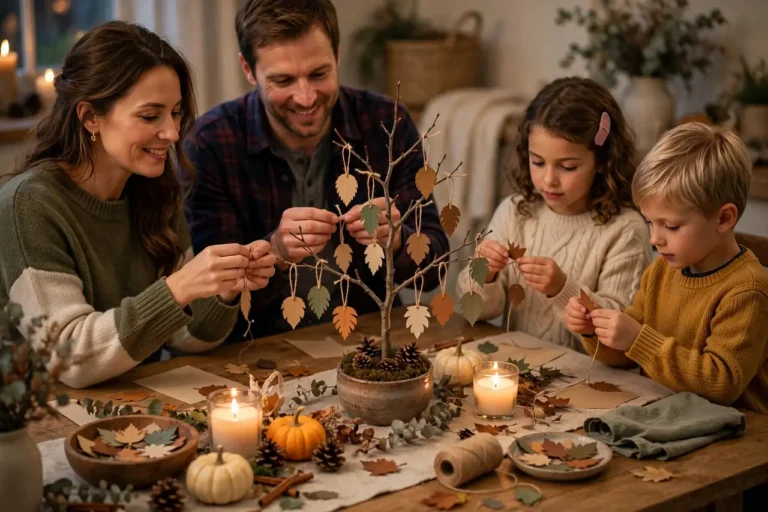
Seating: match chair height to the table — kids’ knees should fit comfortably underneath. Mix-and-match chairs are fine and even charming; tie a balloon or a paper turkey to each chair so children can find “their” seat. For toddlers, booster seats strapped to adult chairs at the kids’ table keep them included safely.
Tableware: sturdy, not precious. Paper plates in fall patterns, plastic cups with lids for young kids, paper napkins (cloth napkins will be used as capes — plan accordingly). Real flatware is fine for kids over six; for younger ones, sturdy plastic. Put a small trash bowl in the center of the table — children will actually use it, and it dramatically reduces floor mess.
The centerpiece: low, touchable, and interesting. A basket of painted mini pumpkins, a bowl of pinecones and smooth stones for handling, a small potted mum, or a “thankful tree” — bare branches in a vase with paper leaves children can write on and hang. Avoid candles entirely (even LED tea lights become projectiles); avoid anything glass, tall, or tippy. The centerpiece should survive being grabbed — because it will be grabbed.
20+ Kids’ Table Activity and Decor Ideas by Age
Ages 2–4: Sensory and Simple
1. Giant coloring placemats. Print or draw large Thanksgiving-themed placemats (turkey outline, pumpkin patch, cornucopia) on big paper and let toddlers scribble with chunky washable crayons. Tape the placemats to the table so they do not slide. 2. Sticker scenes. Peel-and-stick Thanksgiving sticker sheets on cardstock backgrounds — no glue, no mess, infinite rearrangement. 3. Playdough pumpkins. Orange playdough, a few real mini pumpkins as models, and plastic pumpkin-face cutters. Contained, tactile, and quietly absorbing. 4. Sensory bin centerpiece. A shallow bin of dried corn kernels, mini gourds, and scoops — doubles as decor and entertainment for the youngest guests. Supervise for mouthing with under-threes.
Ages 5–8: Crafts and Creativity
5. Handprint turkeys. The eternal classic: trace hands on paper, turn each finger into a feather with crayons or paint, add a body and beak. Display the finished turkeys along the table as a garland. 6. No-carve pumpkin decorating. Set out mini pumpkins with washable paint pens, stickers, googly eyes, and adhesive foam shapes. Zero knives, zero mess beyond what paint pens produce, and every child takes home their creation. Our no carve pumpkin decorating ideas guide has 25 techniques to choose from. 7. Gratitude leaf garland. Cut leaf shapes from colored paper; each child writes (or dictates) something they are thankful for on several leaves, then strings them on twine. Hang the finished garland across the kids’ table or in a doorway. 8. Turkey headbands. Paper strips, paper feathers, glue sticks — ten minutes of craft, then an afternoon of children wearing their creations. Photograph them; you will treasure these. 9. Placemat puzzles. Print Thanksgiving word searches, mazes, and connect-the-dots sized as placemats. Quiet, absorbing, and educational enough to please grandparents. 10. Pinecone turkeys. Pinecones, adhesive foam feathers, googly eyes, and brown pipe-cleaner legs. Rustic, adorable, and nearly indestructible once dry.
Ages 9–12: Projects With Pride
11. Pumpkin painting studio. Older kids can handle real acrylics and detail brushes — set up a proper mini studio with water cups, palettes, and paper towels, and let them paint pumpkins as serious art. Display the results on the front porch for maximum pride. 12. Thanksgiving bingo. Custom bingo cards with holiday squares (someone says “I’m stuffed,” a dog begs, the parade is on TV) — played through the afternoon with small prizes. Keeps tweens engaged without feeling babyish. 13. Gratitude video interviews. Hand a tween your phone and appoint them the family documentarian: interview each guest with “what are you thankful for this year?” Edit later into a family keepsake. Tweens love a job with a device. 14. Table-decorating contest. Give each older child a section of the kids’ table and a box of supplies (mini pumpkins, leaves, candles — LED only, ribbon, kraft paper) and let them style their zone. Judge after dinner with silly award categories. 15. Pie-tasting scorecards. If dessert includes multiple pies, print scorecards and let the kids rate each on appearance, taste, and “would eat again” — it makes them feel like honored critics and slows down the sugar rush.
All Ages: Whole-Table Ideas
16. The kraft-paper tablecloth. Cover the entire table in kraft paper and scatter crayons, markers, and colored pencils down the center. The table is the activity — children draw, doodle, and write messages to each other all afternoon. Write conversation starters on the paper in advance (“draw your dream Thanksgiving dinner,” “what are you thankful for?”). 17. Balloon chairs. Tie one fall-colored balloon to each chair. Instant festivity, instant joy, and children can take them home. (Keep balloons away from under-threes — choking hazard — and dispose of popped balloon pieces immediately.) 18. The photo booth corner. A kraft-paper backdrop taped to the wall near the kids’ table with props on sticks — pilgrim hats, turkey beaks, “thankful” speech bubbles. Children will entertain themselves (and the adults) for an astonishingly long time. 19. Thanksgiving mad libs. Print holiday-themed mad libs; kids fill them in collaboratively and read the results aloud after dinner. The readings are reliably hilarious and become family lore. 20. The leftover craft box. As the afternoon winds down, bring out a box of pipe cleaners, googly eyes, felt scraps, and glue — unstructured making time for whoever still has creative energy. No instructions, no expected outcome, just materials and freedom.
The Kids’ Menu: Food That Prevents Meltdowns
Decor keeps kids busy; food keeps them civilized. A few hard-won rules: serve kids first, or at least simultaneously — hungry children waiting through adult grace, toasts, and serving-line politics is how meltdowns happen. Offer familiar foods alongside the Thanksgiving spread: plain turkey slices (no gravy architecture), rolls, buttered corn, fruit. Adventurous eaters will try the Brussels sprouts; picky ones need safe options. Cut everything small for under-sixes — it is faster than dealing with choking anxiety mid-meal. Limit sugar timing: dessert is inevitable, but serving it immediately after the meal rather than an hour later prevents the crash-and-burn cycle from hitting during cleanup. Hydrate: put water cups (with lids) on the kids’ table from the start — thirsty kids are cranky kids, and juice-only policies backfire by mid-afternoon. And embrace the classics: mac and cheese as a Thanksgiving side is not a compromise, it is diplomacy.
Safety Rules for the Kids’ Table
Say these out loud, cheerfully, at the start — stated rules prevent 90 percent of incidents. No real candles at or near the kids’ table, ever — use LED only, and even those should be out of toddler reach. Age-appropriate tools only: no carving tools, no sharp scissors for under-fives (safety scissors only), no hot glue guns (low-temp with supervision for older kids, or adults handle the gluing). Choking hazards: no small beads, buttons, or balloon pieces for under-threes; cut grapes and hot dogs lengthwise for toddlers. Allergies: ask about craft-material allergies (latex balloons, wheat-based playdough for celiac kids) as well as food allergies, and label the kids’ food clearly. Supervision: the kids’ table needs a designated adult nearby — not hovering, just present. Rotate the duty so no one misses the whole adult dinner. Cleanup plan: have trash bags, wet wipes, and a stain-treatment pen staged nearby before you need them, because you will need them.
The Kids’ Table Through the Day: An Hour-by-Hour Playbook
Thanksgiving is a marathon, not a sprint — for children, the day can stretch six or more hours from arrival to departure. Here is how the kids’ table carries its weight through each phase, so you are never caught wondering “what now?”
Arrival hour (the cousins converge): energy is high and attention is scattered. Do not attempt structured activities yet. Wave 1 goes live the moment the first child sits down: coloring placemats, crayons, sticker sheets. Let kids arrive into an already-active table rather than a bare one — it signals immediately that this table is theirs and it is fun. Greet each child by name at their seat; assigned seats (even loosely assigned) prevent the musical-chairs chaos that eats the first thirty minutes.
The cooking wait (the longest hour): adults are in the kitchen, smells are building, and children are getting hungry and restless. This is the moment for a substantial craft — Wave 2’s main project. The no-carve pumpkin decorating or handprint turkeys land here, introduced with a little ceremony by your designated kid-table adult. Put out a pre-dinner snack at the kids’ table now — cheese cubes, crackers, apple slices — because a fed child is a patient child, and the adults’ appetizer spread is not engineered for small grazers.
Dinner service: serve the kids first, quickly, and simply. Keep one adult at the kids’ table through the first fifteen minutes of the meal to handle spills, cut food, and settle disputes; then that adult can rotate out. Conversation starters on the kraft paper (“what’s the funniest thing that happened this year?”) keep the table lively without adult facilitation. Expect the kids to finish in twenty minutes while the adults take ninety — this is normal and fine, because Wave 3 is waiting.
The adult lingering hour: the grown-ups are on second helpings and long stories; the kids are done. Launch Wave 3 now: bingo, mad libs, the photo booth, the gratitude video interviews. This is also the ideal window for the movie backup if energy is flagging — a film in a nearby room with popcorn buys the adults a genuinely relaxed hour and the kids a genuinely happy one.
Dessert and departure: bring the kids back for pie (the scorecards make this an event), then transition to goodbyes while energy is still positive. Hand each child their bag of crafts at the door — the take-home bag turns departure from a meltdown trigger into a proud moment. The kids’ table has now done its job across five phases, and you never once had to improvise.
The Timeline: Pulling It Together
Week before: buy or print activity supplies — coloring placemats, sticker sheets, craft kits, bingo cards, mad libs. Test any craft yourself once (ten minutes now saves tears later). Confirm the kids’ headcount and ages with parents; adjust activities accordingly. Day before: set up the table and chairs, lay the covering, arrange the centerpiece, and stage Wave 1 activities (crayons, placemats) on the table. Pack Waves 2 and 3 in labeled bags or boxes, hidden away. Prep any food that can be made ahead. Morning of: set out Wave 1, do a safety sweep (outlets covered, sharp objects removed, choking hazards cleared), and brief your co-pilot adult on the wave plan. During the event: launch Wave 2 as adult dinner service begins, Wave 3 at dessert. Take photos of every craft — children forget, photos remember. After: send each child home with their creations in a paper bag labeled with their name. The bag of crafts is the party favor, and parents will thank you for containing it.
In Pictures: Thanksgiving Kids' Table Decor
The kids' table shouldn't be an afterthought — it's where the holiday's youngest memories are made. A little color, a few activities, and spill-proof choices turn it into the fun table.

A cheerful kids' Thanksgiving table with a kraft-paper runner, crayons, printable placemats, and small pumpkins to decorate.
Watch: Thanksgiving Kids' Table Decor
A sweet, simple craft and activity idea for the Thanksgiving kids' table — the kind of thing that keeps little hands busy while dinner finishes.
At a Glance: Thanksgiving Kids' Table Decor
What makes a kids' table festive, functional, and (mostly) mess-proof.
| Element | Purpose | Tip |
|---|---|---|
| Kraft-paper runner | Coloring surface + tablecloth in one | Roll it down the center and set out crayons — instant entertainment |
| Printable placemats | Activity + place setting | Thanksgiving coloring pages or 'what I'm thankful for' prompts work beautifully |
| Small pumpkins | Decor they can touch | Mini pumpkins as place cards double as take-home favors |
| Unbreakable tableware | Spill insurance | Melamine or sturdy paper plates in fall patterns keep it festive and safe |
| Low centerpiece | Decor that survives elbows | Keep it flat and soft — a felt leaf garland or plush turkey beats glass |
| Thankful tree | Meaningful activity | Branches in a jar plus paper leaves for kids to write gratitudes on |
Frequently Asked Questions
What age should kids sit at the kids’ table? There is no rule, but the sweet spot is roughly ages 3 to 12. Under-threes usually do better with a parent (high chair at the main table or a booster at the kids’ table with mom or dad nearby). Over-twelves often prefer the main table — let them choose; forcing a tween to the kids’ table breeds resentment, while inviting them to “help run” the kids’ table gives them status.
How do I decorate a kids’ table on a budget? Kraft paper, crayons, printed placemats, balloons, and one bag of mini pumpkins will carry the whole table for very little money. Dollar-store craft supplies — sticker sheets, foam shapes, pipe cleaners — are perfectly good for one-afternoon projects. The most expensive item should be nothing; the most valuable items are your time and attention in planning the waves.
What if I only have one or two kids coming? Scale down, not out. A small table (or a card table) with two waves of activities is plenty. One child can join the adults for dinner and use the kids’ zone for crafts — the “kids’ table” can be an activity station rather than a dining table. Two cousins will entertain each other with half the structure a dozen need.
How do I handle different ages at one table? Zone the table: sensory activities at one end for toddlers, crafts in the middle for grade-schoolers, project materials at the far end for tweens. Alternatively, run the same activity at different difficulty levels — everyone decorates a pumpkin, but toddlers get stickers while tweens get paint. The wave system also helps: launch the toddler-friendly wave first, then the older-kid project while toddlers nap or free-play.
Should the kids’ table match the adult table’s decor style? It should echo it, not match it. Use the same color family and one or two shared elements (the same eucalyptus sprigs, the same kraft paper) so the two tables feel related, but let the kids’ table be visibly more playful. A miniature version of the adult centerpiece — a tiny pumpkin cluster mirroring the big one — is a lovely touch that makes children feel included in the “real” celebration.
What do I do with twelve kids and no helper? Recruit the oldest kids as junior counselors — tweens given responsibility rise to it magnificently. Simplify to two waves instead of three, choose the lowest-mess activities (stickers, coloring, bingo over paint and glue), and set up a movie as the emergency backup wave. There is no shame in a well-timed film; even the most Pinterest-perfect kids’ table benefits from a 90-minute animated intermission.
How do I keep craft supplies from migrating all over the house? The “table boundary” rule, stated cheerfully at the start: everything with glue, paint, or glitter stays at the kids’ table, period. Enforce it by making the table genuinely the most fun place to be — a child who is absorbed will not wander. Keep a small “travel kit” (a ziplock with crayons and a coloring page) for the car ride home and for any child who needs a change of scenery, so wandering has a sanctioned, mess-free outlet. And do a supply sweep every hour: gather strays back to the table before they colonize the living room.
Conclusion
The kids’ Thanksgiving table is the highest-leverage decorating you will do all holiday: a few hours of thoughtful planning buys you a relaxed adult dinner, happy children, and the kind of afternoon that becomes family legend. Remember the three principles — design for occupation, stage the waves, contain the mess — and the rest is details. Set the table with love, launch Wave 1 as the first cousins arrive, and then enjoy your own dinner knowing the kids are not just supervised but genuinely delighted. For the grown-up side of the celebration, from rustic tablescapes to candlelit centerpieces, explore our Thanksgiving collection. Happy Thanksgiving — to every generation at the table.