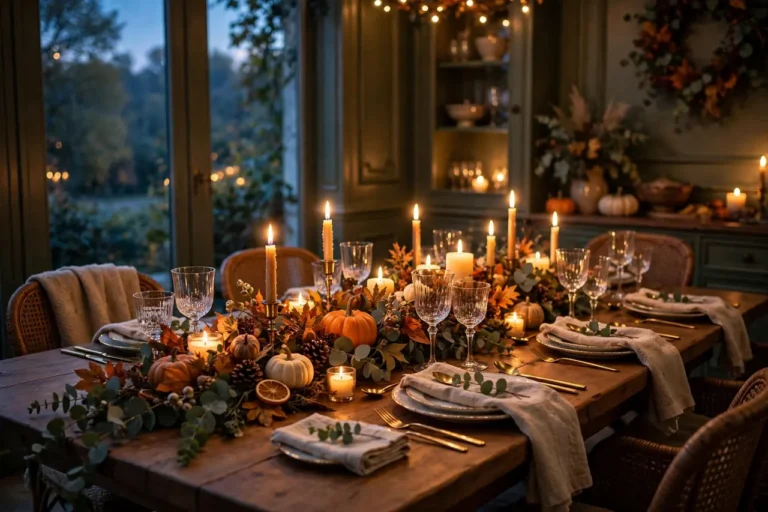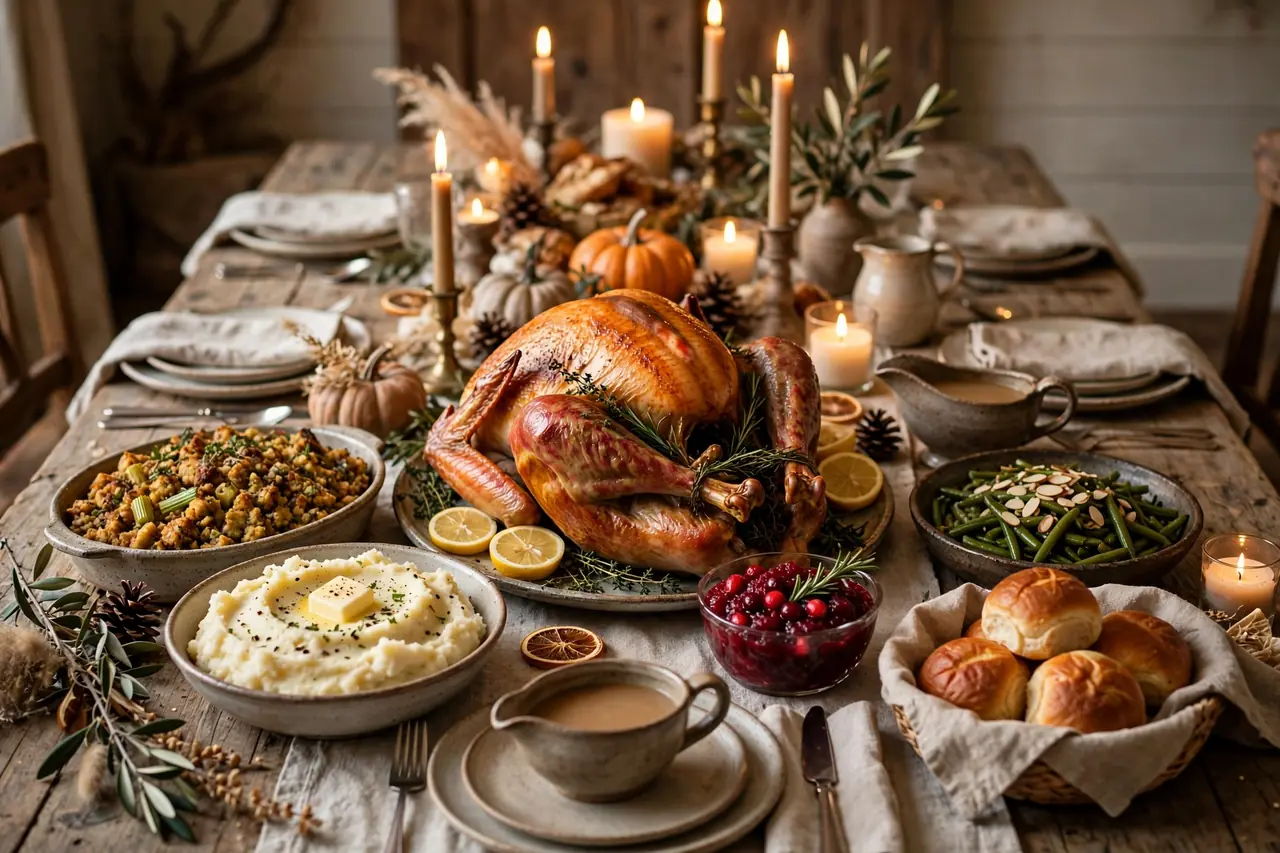
The Thanksgiving dinner menu is the most consequential meal plan of the American year. It is the one dinner where tradition, expectation, logistics, and love all collide on a single table — where someone’s grandmother’s stuffing recipe is treated with the reverence of a religious text, and where running out of gravy is remembered longer than the toast. Planning it well is not about culinary ambition. It is about choosing a menu you can actually execute, in your kitchen, on your timeline, for your people.
This guide gives you four complete Thanksgiving dinner menu ideas — the Traditional Classic, the Modern Twist, the Intimate Gathering for four to six, and the Vegetarian Celebration — each with every course mapped out. You will also get the great turkey debate settled (whole bird versus breast versus alternatives), every side dish ranked by make-ahead friendliness, a dessert strategy, wine pairings, and a three-day timeline that gets dinner on the table without a 5 a.m. alarm. Let’s build your menu.
The Anatomy of a Perfect Thanksgiving Dinner
A Thanksgiving dinner has seven movements, and every successful menu — traditional or rebellious — covers all of them. Miss one and guests feel the gap, even if they cannot name it.
- The welcome bite: Something small when guests arrive — a cheese board, warm nuts, crudités. It buys the cook ninety minutes of goodwill.
- The centerpiece: Turkey for most, but the role matters more than the protein — it is the visual and emotional anchor of the table.
- The starches: Mashed potatoes plus one more (stuffing/dressing, rolls, sweet potatoes). Starches are the comfort engine of the meal.
- The vegetables: Two vegetable sides minimum — one green (green beans, Brussels sprouts), one roasted (carrots, squash). Color on the plate matters.
- The bright notes: Cranberry sauce and gravy. These acidic, savory accents cut the richness and keep the meal from becoming monotonous.
- The salad or soup: Optional but wise — a bitter greens salad or butternut squash soup lightens the meal’s opening.
- The dessert: Pie is traditional, but the real requirement is something sweet with coffee to close the evening.
Four Complete Thanksgiving Dinner Menus
Pick the menu that fits your crowd. Each serves 8–10 unless noted, and every dish includes a make-ahead note so you can plan backward from dinner time.
Menu 1: The Traditional Classic
For the family where changing the stuffing recipe would cause an actual incident. Do not innovate; execute perfectly.
- Welcome: Aged cheddar and apple cheese board with crackers, honey, and walnuts
- Soup: Butternut squash soup with brown butter and sage (make ahead — reheats perfectly)
- Centerpiece: Herb-butter roasted whole turkey with pan gravy
- Starches: Classic bread stuffing with sausage and herbs; creamy mashed potatoes; Parker House rolls
- Vegetables: Green bean casserole; honey-glazed roasted carrots
- Bright notes: Fresh cranberry-orange relish; turkey gravy (make extra — always)
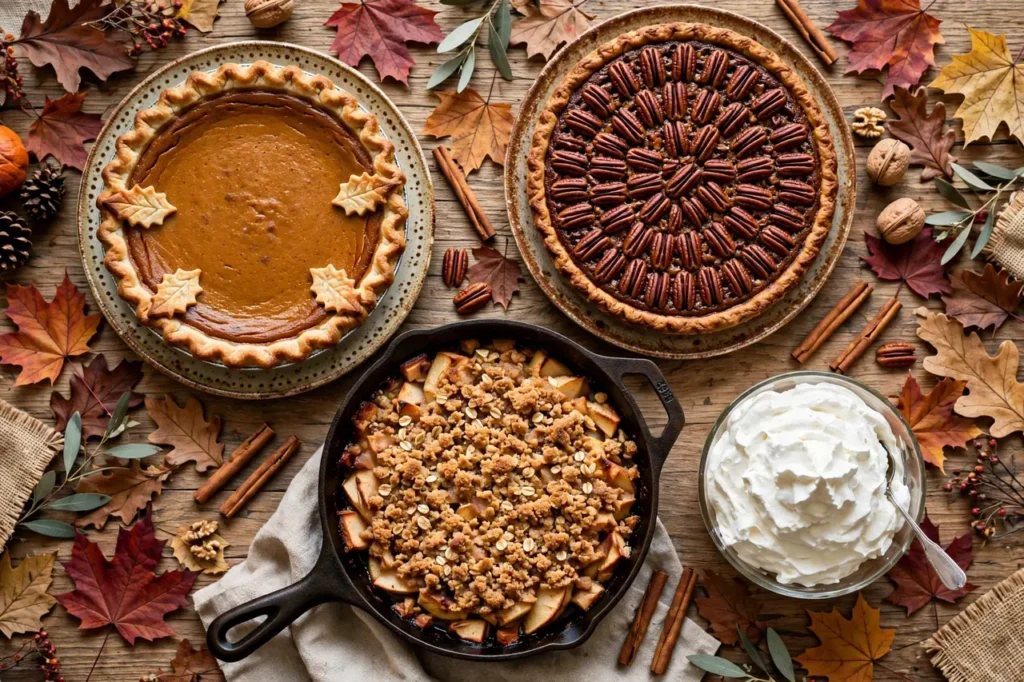
- Dessert: Pumpkin pie with whipped cream; pecan pie; coffee
Menu 2: The Modern Twist
All the Thanksgiving flavors, none of the heaviness — for the crowd that wants to feel good after dinner.
- Welcome: Whipped ricotta crostini with hot honey and thyme
- Salad: Shaved Brussels sprout and kale salad with pecorino, apple, and cider vinaigrette
- Centerpiece: Dry-brined turkey breast with herb compound butter (faster, juicier, easier to carve)
- Starches: Wild mushroom and leek bread pudding; cauliflower mash with roasted garlic; seeded whole-grain rolls
- Vegetables: Charred Brussels sprouts with balsamic glaze; roasted delicata squash with tahini
- Bright notes: Cranberry-ginger chutney; miso-enhanced gravy
- Dessert: Olive oil pumpkin cake with mascarpone; poached pears with vanilla
Menu 3: The Intimate Gathering (serves 4–6)
Small Thanksgiving is not sad Thanksgiving — it is the best Thanksgiving, with better food and zero chaos. Our Thanksgiving dinner for two guide scales this philosophy even smaller.
- Welcome: Warm marinated olives and good bread with salted butter
- Centerpiece: Roast turkey breast or a whole roasted chicken with lemon and herbs
- Starches: Small-batch sausage stuffing; garlic mashed potatoes
- Vegetables: Sautéed green beans with almonds; one roasted vegetable (whatever looks best at the market)
- Bright notes: One jar of excellent cranberry sauce (homemade or the best store-bought — no judgment); simple pan gravy
- Dessert: One perfect pie — your favorite — with real whipped cream
Menu 4: The Vegetarian Celebration
A Thanksgiving where the vegetables are the point, not the apology. This menu satisfies committed carnivores too.
- Welcome: Roasted butternut hummus with pomegranate and pita
- Soup: Wild mushroom soup with truffle oil and chives
- Centerpiece: Whole roasted cauliflower with romesco sauce, or a mushroom Wellington
- Starches: Cornbread and leek stuffing; parsnip-potato mash; flaky buttermilk biscuits
- Vegetables: Balsamic-roasted Brussels sprouts; maple-glazed rainbow carrots
- Bright notes: Cranberry-port relish; rich vegetable gravy (roasted mushrooms are the secret)
- Dessert: Apple galette with oat crumble; chocolate-pecan tart

The Appetizer Hour: Welcome Bites That Buy You Time
Guests arrive hungry; the turkey needs another hour. The appetizer spread is not a nicety — it is a strategic buffer that protects your timeline and your sanity. The rules: everything must be room-temperature stable for two hours, require zero last-minute work, and be genuinely good (sad veggie trays set a sad tone).
Build a three-part welcome spread. First, the cheese and charcuterie board: two cheeses (one hard like aged cheddar, one soft like brie), one cured meat, crackers, honey, and nuts — arranged on your largest board, it looks abundant with minimal effort. Second, something warm from the oven’s margins: baked brie with cranberry sauce and pecans (15 minutes at 375°F, and it can go in alongside anything), or roasted mixed nuts with rosemary and brown sugar tossed warm. Third, something fresh: crudités are fine if the dip is excellent — a white bean and roasted garlic dip or a proper onion dip made with caramelized onions, not the packet.
Set the appetizers away from the kitchen — in the living room or on the porch — so guests naturally migrate out of your workspace. Put drinks nearby and you have created a self-sustaining ecosystem: guests are happy, fed, and nowhere near the oven. Refresh the board once, halfway through the hour. And keep one rule sacred: the cook does not replenish appetizers. Assign that job to an early-arriving guest who wants to help; it makes them feel useful and keeps you on the turkey.
Carving Like You Mean It: The 10-Minute Skill
Carving at the table is theater; carving in the kitchen is strategy. For groups over eight, carve in the kitchen — it is faster, less messy, and nobody watches you saw at a leg joint. Bring the meat out on a warmed platter, arranged and garnished, looking like a magazine. The whole bird can make a brief appearance for photos first, then retreat for surgery.
The technique: let the bird rest 30–45 minutes (tent with foil). Remove the legs first — cut through the skin between leg and breast, then pop the joint by bending the leg back until it separates; cut through the joint, not the bone. Slice the thigh meat off the bone. For the breast, make a deep horizontal cut along the base of the breast, then slice downward in even medallions — slicing across the grain gives tender, beautiful pieces instead of long shreds. Arrange white and dark meat in alternating rows on the platter, drizzle with a little warm broth or pan juices, and tuck in fresh herbs and roasted fruit for color.
Two tools matter: a sharp carving knife (sharpen it the night before — a dull knife is the real reason carving goes badly) and a large cutting board with a juice groove. A carving fork steadies the bird; tongs work in a pinch. Save every drop of juice from the board — it goes into the gravy or gets drizzled over the platter. And carve only what you will serve in the first pass; the bird holds heat and moisture far better whole than sliced, so do a second carving round if the platter empties.
The Kids’ Table Menu: Keeping Small Guests Happy
Children experience Thanksgiving differently: the meal is long, the food is unfamiliar, and the wait is endless. A kids’ table strategy prevents the 5 p.m. meltdown that derails dinner.
Serve kids first, before the adults sit down — a small plate of turkey, mashed potatoes, rolls, and fruit, eaten while the grown-ups are still milling with appetizers. Hungry kids cannot wait for ceremony. Keep the kids’ menu simple and recognizable: plain turkey slices (no gravy debates), buttered rolls, mashed potatoes, corn, apple slices, and one fun item like pigs in a blanket. Put the adventurous stuff (oyster stuffing, Brussels sprouts) on the adult table only; Thanksgiving is not the day for food battles.
Entertainment is part of the menu. Cover the kids’ table with kraft paper and provide crayons — a coloring tablecloth buys forty-five minutes of peace. A “thankful tree” craft (paper leaves to write on and hang) doubles as decor and activity. And seat one fun adult at the kids’ table — the cool aunt or uncle who will actually engage — rather than exiling the children to a joyless corner. Kids who feel included behave like guests; kids who feel parked behave like prisoners.
The Turkey Decision: Whole Bird, Breast, or Something Else?
The turkey question paralyzes more hosts than any other decision. Here is the honest breakdown.
| Option | Serves | Cook time | Difficulty | Best for |
|---|---|---|---|---|
| Whole turkey (12–14 lb) | 10–12 | 3–3.5 hours | Medium | The traditional table; big crowds; carving theater |
| Turkey breast (bone-in, 6–8 lb) | 6–8 | 1.5–2 hours | Easy | Small groups; white-meat lovers; weeknight-simple |
| Spatchcocked turkey | 10–12 | 1.5–2 hours | Medium-hard | Crispy-skin obsessives; faster cooking |
| Smoked turkey | 10–12 | 4–6 hours (mostly hands-off) | Easy (with smoker) | Flavor adventurers; frees the oven entirely |
| Roast chicken (two birds) | 8–10 | 1–1.25 hours | Easy | Turkey skeptics; small ovens |
| Ham or rib roast | 8–12 | 2–3 hours | Easy | Families that never liked turkey anyway |
The dry brine is the single highest-impact technique regardless of which bird you choose: salt the turkey 24–48 hours ahead (1 tablespoon kosher salt per 5 pounds), refrigerate uncovered, and skip the wet brine bucket entirely. Dry-brined birds have crispier skin, juicier meat, and seasoned flavor all the way through — and they take up no extra fridge space. If you do nothing else from this guide, dry brine.
Every Side Dish, Ranked by Make-Ahead Friendliness
Sides win or lose Thanksgiving on logistics. A side you can make entirely on Wednesday is worth two sides that demand the oven at 4 p.m. Thursday.
| Side dish | Make-ahead level | Strategy |
|---|---|---|
| Cranberry sauce/relish | ★★★★★ (3–5 days) | Make Sunday–Tuesday; flavor improves with rest |
| Pie dough / pies | ★★★★★ (dough freezes weeks) | Bake pies Wednesday; dough can be frozen a month out |
| Stuffing/dressing | ★★★★☆ (assemble Wed) | Assemble Wednesday, bake Thursday; add 10 min to bake time |
| Casseroles (sweet potato, green bean) | ★★★★☆ (assemble Wed) | Assemble without topping; add topping before baking |
| Mashed potatoes | ★★★★☆ (reheat method) | Make Thursday morning; hold in slow cooker on warm with extra butter |
| Gravy | ★★★★☆ (base ahead) | Make base Wednesday from roasted wings; finish with turkey drippings Thursday |
| Roasted vegetables | ★★★☆☆ (par-cook) | Par-roast Wednesday; finish at high heat Thursday |
| Rolls/bread | ★★★☆☆ (dough Wed) | Shape Wednesday, refrigerate; bake Thursday for fresh-bread glory |
| Salads | ★★☆☆☆ (components) | Prep components; dress at the last minute only |
Dessert Strategy: The Pie Math
Plan one pie per six guests, minimum two varieties — pumpkin plus one other (pecan, apple, or chocolate). Pies are the most make-ahead-friendly course: bake them all on Wednesday, when the oven is free and the kitchen is calm. Serve at room temperature; only the whipped cream needs to be fresh (whip it while coffee brews after dinner — it takes three minutes and tastes nothing like the canned stuff).
Beyond pie, consider the strategic second dessert: something chocolate for the pumpkin skeptics (a flourless chocolate torte or chocolate-pecan tart), and something light for the overstuffed (poached pears, or simply excellent vanilla ice cream with warm cranberry compote). And always — always — make more whipped cream than you think you need. Running out of whipped cream at a Thanksgiving table is a minor tragedy.
Wine and Drinks Pairing
Thanksgiving is notoriously hard to pair — sweet, savory, rich, and acidic all on one plate. The solution is versatile, food-friendly wines rather than one “perfect” bottle. Our full Thanksgiving wine pairing guide goes deep, but the short version: offer one white (dry Riesling or unoaked Chardonnay), one red (Pinot Noir or Beaujolais), one sparkling (Prosecco or Cava for the toast), plus beer, cider, and a zero-proof option. Let guests choose their own adventure — with this spread on one plate, there is no single right answer, and that is fine.
For the welcome hour, a batch cocktail keeps things simple: apple cider bourbon punch, cranberry vodka spritzers, or a big pitcher of autumn sangria (red wine, brandy, apple cider, sliced apples and oranges, cinnamon sticks). One signature drink, self-serve, done. Save the elaborate cocktails for a smaller party.
The Three-Day Timeline
| Day | Morning | Afternoon | Evening |
|---|---|---|---|
| Tuesday | Shop with list; buy turkey if fresh | Make cranberry sauce; bake pie dough shells | Dry brine the turkey (salt + refrigerate uncovered) |
| Wednesday | Bake pies; make soup or salad components | Assemble stuffing and casseroles; make gravy base; bake rolls dough (refrigerate shaped) | Set the table completely; chill wines; prep welcome bites |
| Thursday | Turkey in oven (calculate backward from dinner); mash potatoes into slow cooker | Sides into oven in waves; finish gravy with drippings; bake rolls | Carve, serve, enjoy — you are done cooking |
The backward calculation is the whole game: decide dinner time, subtract the turkey’s rest (30 minutes, non-negotiable — it finishes cooking and redistributes juices), subtract cook time, and that is when the bird goes in. Everything else schedules around the bird. Write the timeline on paper and tape it to the fridge; in the Thursday chaos, you will not remember what you planned.
Common Menu Mistakes (and Easy Fixes)
Most Thanksgiving menu failures are predictable — and preventable. Here are the classics:
| Mistake | What goes wrong | The fix |
|---|---|---|
| Too many oven dishes at once | Half the sides go in late; dinner delayed an hour | Max 3 oven sides; rest are stovetop, slow-cooker, or room-temp |
| No written timeline | 4 p.m. chaos; forgotten dishes discovered at 7 p.m. | Tape the backward-calculated timeline to the fridge |
| New recipes for the whole menu | Untested dishes fail under pressure | One new dish max; the rest are proven winners |
| Skipping the appetizer buffer | Hangry guests hovering in the kitchen | Room-temp welcome spread, set away from the kitchen |
| Underestimating gravy | The great Gravy Shortage of this year | Make double; gravy base on Wednesday + drippings Thursday |
| Carving at the table for 14 | 20-minute surgery while food cools | Carve in kitchen; present on warmed platter |
The meta-lesson: Thanksgiving rewards conservatism. This is not the meal for proving your culinary range — it is the meal for delivering comfort flawlessly. Save the experiments for a random Saturday in February, when the stakes are low and the audience is forgiving.
Watch: Thanksgiving Menu Ideas for Showoffs
Need visual inspiration for your menu? This video walks through an elevated Thanksgiving menu — turkey roulade, duchess potatoes, pumpkin crème brûlée — with a full game plan for timing it all.
Thanksgiving Dinner Menu Ideas: Frequently Asked Questions
How many side dishes should I serve?
Five to seven sides for a crowd of 8–12: two starches, two vegetables, cranberry sauce, gravy, and rolls. Fewer than five feels sparse; more than seven creates oven gridlock and half the dishes go lukewarm. Quality over quantity — three perfect sides beat seven mediocre ones, and guests remember the best dish, not the count.
What time should Thanksgiving dinner be served?
Between 3:00 and 5:00 p.m. is traditional and practical — it gives the turkey all morning, allows a relaxed afternoon of appetizers, and leaves the evening for dessert and lingering. Earlier than 2:00 p.m. rushes the cook; later than 6:00 p.m. means hungry, cranky guests. Announce the time clearly and serve appetizers on schedule regardless.
How big a turkey do I need?
Plan 1 to 1½ pounds per person (bone-in weight), which accounts for bones, shrinkage, and leftovers — the leftovers are half the point. For 10 guests, a 14–15 pound bird. When in doubt, go bigger: leftover turkey is a feature, and a slightly-too-large bird is far better than a slightly-too-small one. No host has ever been criticized for too many leftovers.
Can I cook the turkey the day before?
You can, and for stressed hosts it is a legitimate strategy: roast Wednesday, carve, refrigerate in its juices, and reheat gently Thursday in a covered pan with broth at 325°F. The skin will not be as crisp, but the meat stays moist and Thursday becomes dramatically calmer. That said, a same-day bird with a proper rest is juicier — choose based on your stress budget, not your pride.
What do I do if the turkey is done early?
Celebrate — this is good news. Tent it loosely with foil and let it rest; a turkey can rest up to 90 minutes and only improves, staying hot inside while juices redistribute. Use the freed oven for sides. Never carve early “to keep it warm” — carved meat cools and dries far faster than a whole rested bird.
Should I serve soup or salad as a first course?
One or the other, not both — and soup wins for most crowds. A small cup of butternut squash or mushroom soup served while the turkey rests is elegant, fills the awkward carving gap, and can be made entirely ahead. Salad works better for the modern lighter menu, where freshness is the theme. Either way, keep the first course small: it is an opening act, not a second dinner. Guests should finish it wanting more, not wondering how they will survive the main event.
How do I keep the menu affordable without it feeling cheap?
Thanksgiving is naturally budget-friendly — turkey is one of the cheapest proteins per pound, and the classic sides are humble ingredients (potatoes, bread, squash) transformed by technique. Save money by making everything from scratch (a $4 bag of cranberries beats a $6 can, and tastes ten times better), buying the turkey on sale the week before, and accepting potluck contributions for appetizers and desserts. Spend your budget where guests taste it: good butter, real vanilla, decent wine, and excellent coffee. Nobody remembers the brand of the flour; everybody remembers the gravy.
What if the turkey is still frozen on Thanksgiving morning?
Cold-water thaw: submerge the wrapped turkey in cold water, changing the water every 30 minutes. It thaws about 30 minutes per pound — a 14-pound bird needs 7 hours. As a last resort, you can roast from partially frozen (it takes about 50% longer, and the USDA says it is safe), but the texture suffers. Set a phone reminder to move the turkey to the fridge four days ahead — future you says thanks.
How do I keep everything warm when the oven is full?
Stagger strategically: the turkey rests 30+ minutes, freeing the oven for sides in waves. Use the microwave as a warming box (just do not turn it on), wrap dishes in towels inside a cooler, and hold mashed potatoes in a slow cooker. Serve in waves if needed — soup first while sides finish is elegant, not disorganized.
What should guests bring to Thanksgiving dinner?
Assign, do not improvise. Give each guest a specific dish (“bring the green bean casserole” beats “bring something”), and keep a shared list so you do not get four desserts. Good guest assignments: appetizers, a side dish, dessert, wine, or ice. Never assign the turkey, the gravy, or anything load-bearing — the host controls the critical path. Our Thanksgiving potluck guide has the full playbook for coordinated contributions.
How do I handle vegetarian or vegan guests at a traditional dinner?
Make sure at least three substantial dishes are vegetarian without modification: the vegetable sides, the starches (use vegetable stock in stuffing and mash with olive oil or vegan butter), and a dedicated centerpiece like a whole roasted cauliflower or mushroom Wellington. Do not make the vegetarian eat “sides only” — a centerpiece dish signals they were planned for, not accommodated. Ask about needs a week ahead via our grocery list planning.
What is the best way to handle leftovers?
Send guests home with packed boxes — it is traditional, generous, and reduces your fridge chaos. Have containers ready before dinner. Refrigerate everything within two hours of serving; turkey keeps 3–4 days, sides 3–4 days, pie 4–5 days. Freeze turkey in meal-size portions for up to 3 months. The day-after turkey sandwich, with stuffing and cranberry sauce on a roll, is arguably better than the dinner itself.
Your Thanksgiving dinner menu does not need to be ambitious — it needs to be achievable, delicious, and on the table while everyone is still happy. Choose the menu that fits your crowd, dry brine the bird, make everything you can on Wednesday, and write the timeline on the fridge. Then on Thursday, cook with confidence and eat with the people you love. For the full shopping plan, grab our complete Thanksgiving grocery list — and when the last pie is served, our Thanksgiving desserts collection will already have you planning next year’s sweet finale.