Snake Plant Care Guide: The Ultimate Low-Maintenance Plant
Snake plant is the houseplant for people who kill houseplants: it tolerates low light, survives months of neglect, shrugs off dry air, and still looks sculptural and modern. NASA even flagged it for air-purifying qualities. It is the rare plant that thrives on being ignored — which makes its one killer (overwatering) almost ironic.
A succulent from West Africa, snake plant stores water in its thick upright leaves and spreads via underground rhizomes. Everything about its care flows from that: water rarely, drain sharply, and give it light — though it tolerates dim corners better than almost any plant, it grows visibly faster and stronger in bright light.
This guide covers the real care details: light range and how it affects growth, the watering discipline (the whole game), soil that drains, feeding (minimal), repotting and division, the varieties worth knowing, and the short list of problems — nearly all of which trace to too much water.
Snake Plant at a Glance
| Care Factor | What Snake Plant Wants |
|---|---|
| Light | Low to bright indirect; tolerates direct sun |
| Water | When soil fully dry; every 2–6 weeks |
| Soil | Cactus/succulent mix; must drain sharply |
| Temperature | 60–85°F (15–29°C) |
| Humidity | Tolerates dry air perfectly |
| Feeding | 2–3 times yearly; very light feeder |
| Varieties | Laurentii, Moonshine, Black Gold, Cylindrica, Hahnii |
Light Requirements
Famously low-light tolerant — snake plant survives in dim corners where other plants die. But ‘survives’ vs ‘thrives’: in bright indirect light it grows faster, stands stiffer, and shows stronger variegation; in deep shade it merely persists. Give it the brightest spot you can for best results, though any spot works.
It also tolerates direct sun (acclimate gradually to prevent scorch) and looks superb in a sunny window. The only light to avoid is abrupt change — a plant moved from dark corner to full sun burns; transition over 1–2 weeks.
Watering
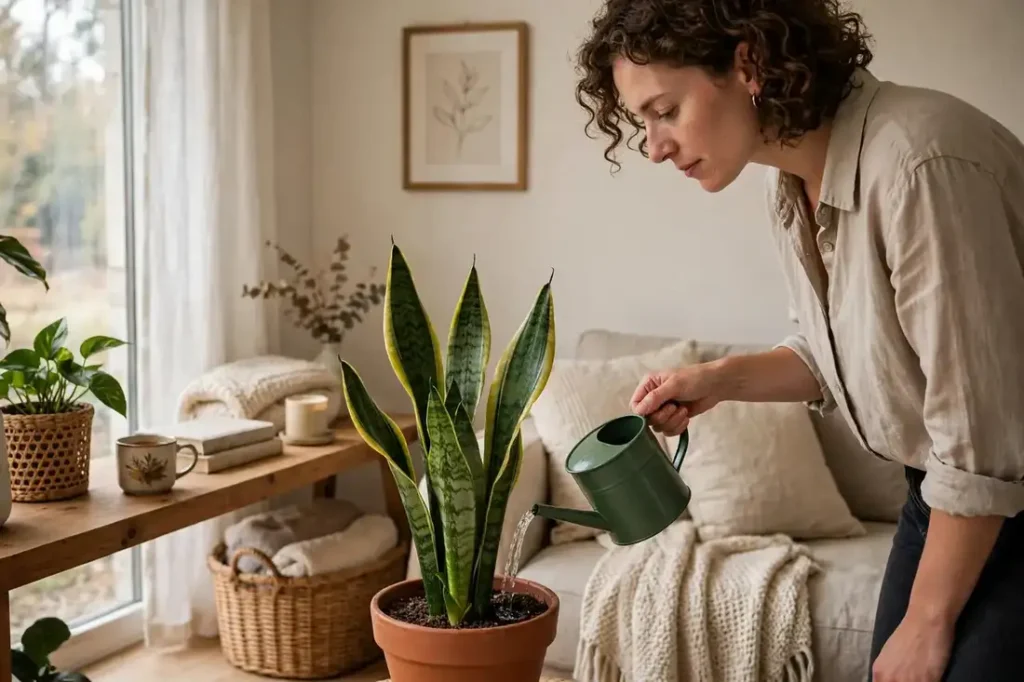
Water deeply but infrequently: drench until it drains, then wait until the soil is completely dry through the pot — typically every 2–4 weeks in summer, every 4–8 weeks in winter. When in doubt, wait: snake plant’s water-storing leaves forgive drought for months.
Overwatering is the only common killer: soggy soil rots the rhizome, and the first sign is mushy yellow leaves at the base. Always use a pot with drainage holes, never let it sit in a saucer of water, and cut watering drastically in winter when growth stops.
Soil and Potting
Fast-draining cactus or succulent mix is ideal; standard potting soil holds too much moisture unless heavily amended with perlite or coarse sand. The mix should dry fully within a week or two of watering.
Repot every 2–3 years in spring, or when the pot is visibly bursting — snake plants bloom and pup best when slightly root-bound, so do not rush to upsize. Clay pots are excellent: they wick moisture and reduce rot risk.
Temperature and Humidity
Standard room temperatures 60–85°F; brief dips to 50°F are tolerated but growth stops. Keep away from frosty windows — cold plus wet soil is the deadly combination.
Humidity is irrelevant to snake plant — it evolved for dry air and handles heated winter homes perfectly. No misting, no pebble trays, no humidifier needed. This is the plant for dry apartments.
Feeding
A very light feeder: 2–3 applications of half-strength balanced fertilizer per year (spring and summer) is plenty. Overfertilizing causes weak floppy growth and salt damage — the plant evolved in poor soils and prefers lean conditions.
Pale, slow growth in good light occasionally indicates hunger, but 90% of the time slow growth just means winter or low light. Feed only actively growing plants in the warm months.
Pruning and Maintenance
Minimal pruning needed: remove damaged or mushy leaves at the base with clean shears, cutting at soil level. You cannot trim a leaf shorter — cut leaves do not regrow tips and look blunt forever, so remove whole leaves only.
Division is the propagation and maintenance method: unpot crowded plants in spring and cut rhizomes apart, ensuring each section has leaves and roots. Note that leaf cuttings revert variegated cultivars to green — divide to preserve ‘Laurentii’ and other named types.

Understanding Light: A Practical Guide
Light is food for plants — they literally eat photons — so placement is the single most consequential decision you make. South-facing windows give the strongest light (direct sun for hours), east and west give moderate light (gentle morning or warm afternoon sun), and north gives soft indirect light all day. Your plant’s light needs determine its window, not the other way around.
Judge by the plant’s response, not by your impression of brightness: stretching toward the window (etiolation), shrinking new leaves, and dropping lower leaves mean more light is needed; bleached patches, crispy brown edges, and curling leaves mean too much direct sun. Move snake plant gradually — a foot every few days — since sudden light changes shock plants as surely as anything else.
Supplement when needed: a simple full-spectrum LED grow light 12–24 inches above the plant, running 12–14 hours daily on a timer, transforms dark rooms and winter windowsills. Rotate the pot a quarter turn weekly for even growth. Light is the one input you cannot fake with more of something else.
The Art of Watering
More plants die from overwatering than from every other cause combined, because drowning is invisible until it is advanced. The rule that replaces all watering schedules: check the soil, not the calendar. Push a finger 1–2 inches in (deeper for large pots and garden beds) — water thoroughly when dry at that depth, wait when moist.
When you water, water completely: soak until water runs from drainage holes (containers) or penetrates 6–8 inches (garden beds). Shallow sips train roots to stay near the surface, where they are vulnerable to heat and drought; deep watering builds deep, resilient root systems. Then let the soil dry appropriately before watering again — roots need oxygen between drinks.
Water quality matters at the margins: snake plant is sensitive to fluoride and chlorine in tap water (brown leaf tips are the signature). Letting water sit overnight dissipates chlorine; rainwater or filtered water is the gold standard. Room-temperature water avoids shocking roots — cold water on a warm plant is a small stress you can simply avoid.
Fertilizer Decoded: NPK and Feeding Strategy
Fertilizer labels show N-P-K: nitrogen (leaf growth), phosphorus (roots and flowers), potassium (overall vigor and disease resistance). A balanced 10-10-10 or 20-20-20 suits most plants; high-nitrogen formulas push foliage, high-phosphorus ‘bloom boosters’ support flowering. The numbers are percentages — 20-20-20 is simply twice as concentrated as 10-10-10.
The golden rule: fertilize only actively growing plants. A plant in winter dormancy or stress cannot use fertilizer — the salts accumulate and burn roots. Dilute liquid fertilizer to half the label strength and apply every 2–4 weeks in the growing season; slow-release granules (one application lasting months) are the low-maintenance alternative.
Organic vs synthetic is mostly about speed and soil life: synthetics feed the plant directly and work fast; organics (compost, worm castings, fish emulsion) feed soil microbes that feed the plant, improving soil structure over time. Either works — what matters is consistent, moderate feeding rather than occasional heavy doses. Yellow older leaves often mean nitrogen hunger; dark green with no growth often means the plant needs light, not food.
Repotting Masterclass
Repot snake plant when roots circle the pot’s interior or poke from drainage holes, growth stalls despite good care, or water runs straight through (root-bound soil cannot absorb). Spring is ideal — the plant’s active growth recovers fastest — but a severely struggling plant should be repotted whenever needed.
Go only one size up (1–2 inches larger in diameter). A huge pot holds excess wet soil around small roots — the classic overpotting rot. Use fresh potting mix (old mix is depleted and compacted), set the plant at the same depth it grew before, water thoroughly, and expect a week or two of sulking while roots establish.
Root-bound plants often benefit from gentle root loosening: tease apart circling roots with your fingers or make a few vertical cuts in a dense root ball to encourage outward growth. It looks brutal; the plant recovers faster than if the roots keep circling.
Pet Safety and Placement
Before placing snake plant where pets roam, check its toxicity: the ASPCA’s plant database is the authoritative reference. Many beloved plants are toxic to cats and dogs — lilies can be fatal to cats, sago palm to dogs — while others are merely irritating. Know your plant’s status before an emergency, not during one.
For toxic-but-beloved plants, placement is the compromise: high shelves, hanging planters, and closed rooms keep plants and pets separated. Bitter apple spray deters chewing; providing pet grass or catnip gives cats an approved alternative. When in doubt, choose from the reliably non-toxic list (spider plants, Boston ferns, parlor palms, most herbs) for rooms pets frequent.
Snake Plant Seasonal Care Calendar
| Season | Tasks | Why |
|---|---|---|
| Spring | Resume feeding; repot if needed; move outdoors after frost (houseplants); prune | Active growth season — the plant’s productive months |
| Summer | Peak watering; watch for pests; provide afternoon shade in heat | Heat stress and pests peak now |
| Fall | Reduce feeding; bring tender plants in before frost; plant spring bulbs | Plants slow down; prepare for dormancy |
| Winter | Minimal water; no fertilizer; maximize light; watch humidity indoors | Dormancy — the plant rests; let it |
Cleaning and Grooming Your Plants
Dust is a slow suffocation: a dusty leaf photosynthesizes measurably less than a clean one, and dust harbors spider mites and other pests. Wipe snake plant leaves every few weeks with a damp soft cloth, supporting each leaf from beneath to avoid tearing. For plants with many small leaves, a lukewarm shower (or a spell in gentle rain for outdoor plants) does the job — let them dry before returning to strong sun to avoid leaf burn from water droplets.
Grooming goes beyond cleaning: remove spent flowers promptly (deadheading redirects energy from seed-making into more blooms or stronger growth), trim damaged or yellowing leaves at the base with clean scissors, and wipe up fallen debris from the soil surface (decaying matter breeds fungus gnats). These small rituals, done during your regular watering check, prevent most cosmetic problems before they start.
Shiny-leaf products are unnecessary and often harmful — they clog the stomata (leaf pores) the plant breathes through. Water and a cloth achieve the same shine without the risk. For fuzzy-leaved plants, skip the cloth and use a soft brush; water on fuzzy leaves invites rot.
Root Rot Emergency Protocol
Root rot is the plant emergency most worth knowing how to handle, because hours matter. Symptoms: wilting despite wet soil, yellowing lower leaves, a sour or rotten smell from the soil, and — the definitive test — brown, mushy roots instead of firm white ones. If you suspect it in your snake plant, act the same day.
The protocol: remove the plant from its pot, shake and rinse away all old soil, and inspect the roots. Trim away every brown, mushy, or foul-smelling root with sterilized scissors — be ruthless; rotten tissue left behind restarts the infection. Healthy roots are firm and white or tan. Soak the remaining root ball briefly in a dilute hydrogen peroxide solution (1 part 3% peroxide to 3 parts water) to kill surface pathogens.
Repot into fresh, dry, well-draining mix in a clean pot (scrubbed with 1:10 bleach solution and rinsed) — never reuse the old soil. Water lightly, place in bright indirect light, and do not fertilize until new growth appears. Recovery takes weeks; some plants do not make it. The lesson to carry forward: drainage and careful watering prevent nearly all root rot, and no rescue beats prevention.
Vacation and Holiday Care
Plants do not pause when you travel, but snake plant can easily survive a week or two with preparation. The week before: water thoroughly, move plants slightly away from intense sun (reducing light reduces water demand), group plants together (creating a humid microclimate), and mulch container surfaces to slow evaporation. Most healthy plants handle 7–10 days this way without stress.
For longer absences, set up self-watering: a wick system (cotton rope from a water reservoir into the soil) handles 2–3 weeks for moderate drinkers; a trusted plant-sitter with written instructions handles anything longer. Write the instructions concretely — ‘water the monstera when the top 2 inches are dry, about once a week’ beats ‘water occasionally’. Leave a marked watering can and demonstrate once.
Resist the urge to overwater ‘just in case’ before leaving — soggy soil for two weeks causes the root rot you were trying to prevent. And upon return, do not flood a dry plant all at once; rehydrate gradually over a day or two. Plants are resilient; they mostly need you to avoid the extremes.
Knowing When to Let Go
Not every plant can be saved, and knowing when to stop is part of good plant care. The honest assessment: if a plant has lost all its leaves and the stems are mushy or brittle-dry throughout, if rot has consumed the crown or the entire root system, or if a pest infestation has resisted three rounds of proper treatment and threatens your other plants — it is time.
Before composting, take cuttings from any healthy tissue — a dying plant often yields viable propagations, which is a genuine form of rescue. Quarantine pest-infested discards in a sealed bag (do not compost pest-ridden material). And conduct the debrief: what went wrong, and what will you change? Every dead plant is tuition; make sure you collect the education.
There is no shame in it. Professional growers lose plants constantly — they just start with hundreds. The goal was never a perfect record; it is a thriving collection and growing skill. Replace the loss with something suited to what you learned, and keep going.
Building a Collection That Thrives Together
A collection built around snake plant succeeds when its members want similar conditions — grouping plants by needs (all the bright-light lovers together, all the humidity lovers together) lets you create microclimates instead of fighting your home’s conditions. A pebble tray or small humidifier serves a cluster of tropicals far better than it serves one lonely plant.
Add new plants deliberately: one at a time, quarantined for 2–3 weeks away from the collection (pests hitchhike from stores with depressing regularity), and researched before purchase rather than after. The ‘rescue shelf’ at the garden center is tempting, but a struggling plant you do not understand becomes a vector for problems across your collection.
Rotate your attention seasonally: spring is for repotting and acquiring, summer for enjoying and maintaining, fall for bringing in and treating, winter for resting and planning. Collections thrive on rhythm — and so do the gardeners who keep them.
Fungus Gnats: The Complete Battle Plan
If tiny black flies rise from your snake plant’s soil every time you water, you have fungus gnats — the most common indoor plant pest and the most complained about. The adults are harmless (annoying, not damaging); the larvae, translucent worms in the top inch of soil, feed on roots and organic matter, damaging seedlings and stressed plants. Understanding this life cycle is the key to defeating them, because the adults you see are only 10% of the problem.
The battle plan, in order: first, let the soil dry deeper between waterings — gnat larvae need consistently moist surface soil, and breaking that cycle kills the next generation. Top-dress with a half inch of sand or fine gravel (larvae cannot breed through the dry barrier). Deploy yellow sticky traps to catch adults and monitor populations — when trap counts drop for two weeks straight, you are winning.
For persistent infestations, add biological control: Bacillus thuringiensis israelensis (Bti, sold as mosquito bits) soaked in watering water kills larvae without harming plants, pets, or people — it is the same biological used in drinking water for mosquito control. Apply for three consecutive waterings to break the life cycle. Beneficial nematodes (Steinernema feltiae) are the heavy artillery for severe cases.
Prevention beats treatment permanently: bottom-water when possible (keeps the surface dry), avoid overpotting (excess wet soil breeds gnats), quarantine new plants (they arrive with gnats more often than not), and never reuse old potting mix without sterilizing. A gnat-free collection is a well-watered collection — the pests are a symptom of too-wet soil, and the cure improves the plant’s health beyond just pest control.
Measuring Light: Meters, Apps, and Your Eyes
Guessing light levels is the root of most placement mistakes — human eyes are terrible light meters (your pupils adjust, making a dark corner feel ‘bright enough’). A dedicated light meter ($30–$50) gives readings in foot-candles or lux: under 200 foot-candles is low light, 200–500 is medium, 500+ is bright indirect, and direct sun runs into the thousands. One measurement session, room by room, permanently improves every placement decision.
Smartphone light meter apps (free to a few dollars) are surprisingly accurate for relative comparisons — not lab-grade, but perfectly adequate for ‘is this spot brighter than that spot’ decisions. Measure at plant height, at the times of day that matter, and on both sunny and overcast days; light varies more than intuition suggests.
Learn the plant’s own reporting system too: a plant getting enough light grows compactly with appropriately sized leaves and (for flowering types) blooms; too little light produces leggy, pale growth with shrinking leaves; too much bleaches or scorches. The meter tells you the number; the plant tells you what the number means for it. Together they replace all guesswork.
Seasonal adjustment is the advanced move: a south window that is perfect in December may scorch in June, and a bright summer spot may be dim by November. Re-measure twice a year and shift snake plant accordingly — or simpler, note the dates when you move plants and repeat annually. The gardeners with the best indoor plants are not lucky with windows; they are systematic about light.
The Two-Minute Daily Check
The highest-ROI habit in snake plant care is not a technique — it is a ritual. Every day (or every few days), spend two minutes per plant on a deliberate check: finger-test the soil moisture, glance at the leaves (top and underside — pests hide beneath), note new growth or the lack of it, rotate the pot a quarter turn, and remove any dead leaf or spent flower. Two minutes. That is the whole system.
What this ritual buys you: problems caught at the ‘wipe it off’ stage instead of the ‘treat for six weeks’ stage, watering timed to the plant’s actual needs instead of a schedule’s guesses, and a relationship with the plant that makes its normal state familiar — so abnormal stands out immediately. Experienced gardeners do not have better plants because of better products; they have better plants because they look at them.
Pair the check with an existing habit — morning coffee, the evening wind-down — and it becomes automatic within two weeks. Keep a small watering can and a cloth where you will see them; friction is the enemy of ritual. The plants will not thank you in words, but they will thank you in growth.
Snake Plant Pests and Problems
Even easy plants have their nemeses. Here is what to watch for and how to respond:
Mealybugs
The most common pest — white cottony clusters where leaves meet at the base. Dab with alcohol; severe cases need unpotting, washing, and repotting in fresh mix.
Spider mites
Uncommon; stippling in very dry dusty conditions. Wipe leaves and raise humidity slightly.
Fungus gnats
A sign the soil stays too wet. Let it dry thoroughly; top-dress with sand to deter egg-laying.
Root/rhizome rot
Mushy base leaves from overwatering. Cut away rot to firm tissue, let callus, repot in dry gritty mix, and do not water for 1–2 weeks.
5 Snake Plant Mistakes to Avoid
- Watering on a schedule: the classic killer. Water by complete dryness, not by calendar.
- No drainage hole: a decorative pot without drainage is a slow death sentence. Always use drainage.
- Dense moisture-holding soil: repot from nursery peat into gritty mix if it stays wet for weeks.
- Expecting fast growth in dark corners: it survives there but barely grows. Bright light = growth.
- Misting: pointless for this plant and wets the crown, inviting rot. Never mist snake plants.
Watch: Snake Plant Care Tips in Action
See the key care techniques demonstrated for snake plant:
Frequently Asked Questions About Snake Plant Care
How often should I water a snake plant?
When the soil is completely dry — roughly every 2–4 weeks in summer, monthly or less in winter. Underwatering is safe; overwatering kills. Learn the weight of the dry pot and water by feel.
Why are the leaves turning yellow and mushy?
Overwatering and rot, almost certainly. Unpot, cut away all mushy tissue to firm healthy parts, let cuts callus, and repot in dry cactus mix. Do not water for 1–2 weeks after.
Can snake plants grow in low light?
Yes — they are among the most low-light-tolerant houseplants. Growth slows dramatically, but the plant stays healthy. For actual growth, brighter light is much better.
Why is my snake plant not growing?
Usually winter dormancy, very low light, or a recently repotted plant establishing roots. In the growing season with good light, slow growth may mean it needs feeding (rare) — be patient; they are slow plants.
Do snake plants clean the air?
The famous NASA study showed plants can remove some VOCs in sealed chambers; in a real room the effect is minimal. Buy it for its looks and toughness, not as an air purifier.
Are snake plants toxic to pets?
Yes — saponins are toxic to cats and dogs if ingested. The stiff upright leaves are less tempting than trailing plants, but keep out of reach of dedicated chewers.
Keep Reading on DayZora
The Bottom Line
Snake Plant (Sansevieria trifasciata (Dracaena)) is a genuinely rewarding plant once you understand what it is asking for — and most of what it asks is simple: the right light, thoughtful watering, and a little seasonal attention. Follow this guide’s routine and you will have a specimen that thrives for years, not months. The best time to start was when you brought it home; the second-best time is today.