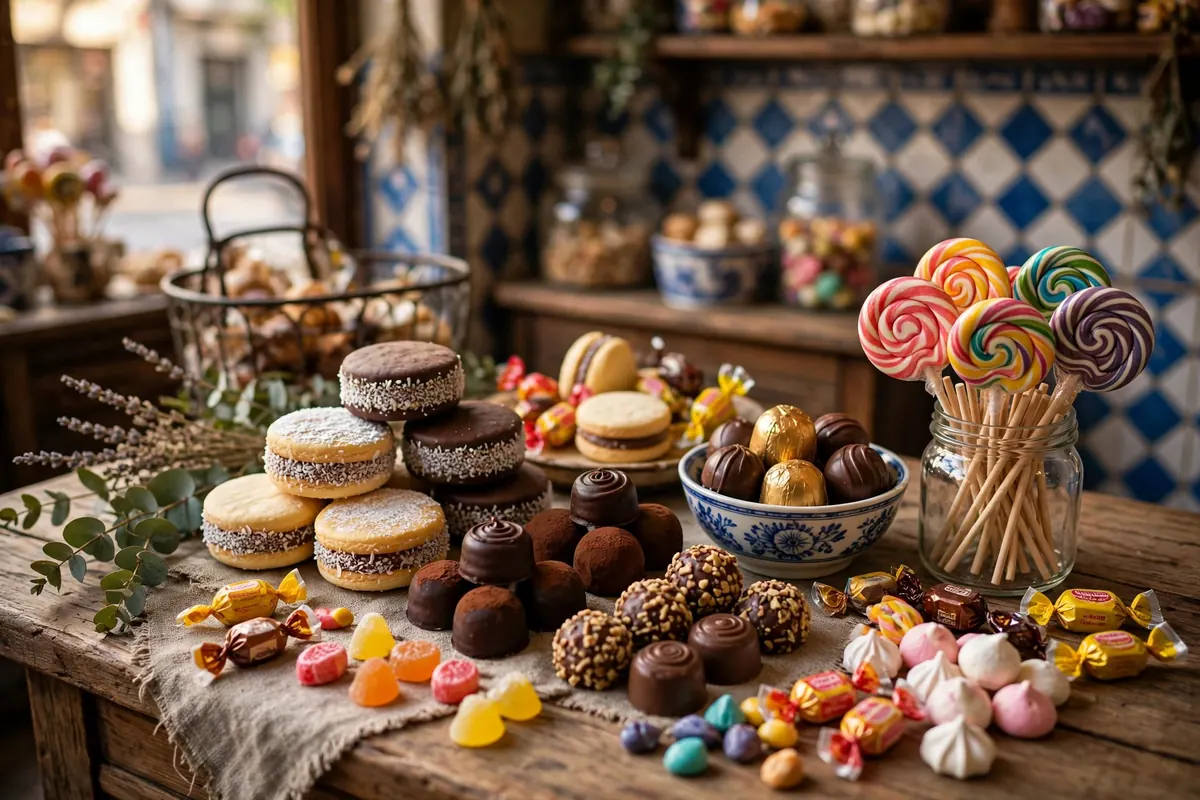
What if Valentine’s Day lasted a whole week, happened in July, and was for everyone — not just couples? Argentina has exactly that: Semana de la Dulzura, the Week of Sweetness, seven days every July when the entire country trades candy for kisses. Friends, coworkers, family members, lovers, even strangers — everyone gives sweets, and everyone gets a kiss (on the cheek) in return.
It’s one of the world’s most successful marketing campaigns ever — a 1989 corporate promotion so effective it became a national tradition, survived a pandemic by going virtual, and eventually expanded to fill the whole month. This is the story of how Argentina turned a sales slump into a culture of sweetness.
What Is Semana de la Dulzura?
Every year from July 1 to July 7, Argentina celebrates the Semana de la Dulzura — literally “Sweetness Week.” The premise is disarmingly simple: give someone a sweet — a candy, a chocolate, an alfajor — and receive a kiss in exchange. The original slogan said it all: “Una golosina por un beso” — a sweet for a kiss.
But the crucial difference from Valentine’s Day is scope. La Semana de la Dulzura is emphatically not just for couples. Children trade candy at school; coworkers leave chocolates on desks; friends show up with bags of sweets; families sweeten the week together. As Argentines themselves put it: el Día de los Enamorados (February 14, which Argentina also celebrates) is for those in love — la Semana de la Dulzura is for everyone. It’s Valentine’s Day democratized, decoupled from romance, and extended to a full week.
The mechanics are loose by design. There’s no official ritual, no required gift, no ceremony — just a national, week-long encouragement to be sweet to people, literally. Kiosks (kioscos) — the beloved Argentine corner shops — stock special displays; supermarkets run promotions; offices see a week of sugar-fueled goodwill. The kiss itself is the Argentine cheek-kiss, the standard social greeting — so the “price” of a candy is something Argentines were going to do anyway. The genius of the campaign was making affection transactional in the gentlest possible way.
The Origin Story: A 1989 Marketing Campaign That Became Culture
Unlike most traditions, which fade into anonymous antiquity, the Semana de la Dulzura has a precise birth certificate — and it’s a corporate one.
In 1989, Argentina was in the grip of a severe economic crisis and hyperinflation. Food companies were suffering, and candy manufacturers were hit especially hard: sweets are discretionary spending, and discretionary spending was collapsing. The Córdoba-based confectionery giant Arcor — one of Argentina’s most iconic companies — joined forces with the Asociación de Distribuidores de Golosinas, Galletitas y Afines (ADGyA), the candy distributors’ association, to engineer a solution: invent a reason to buy candy.
The campaign they created was elegantly simple. A dedicated week — July 1 to 7 — during which Argentines would be encouraged to give sweets in exchange for kisses: “una golosina por un beso.” The results were immediate and dramatic. In its first edition, the campaign drove roughly a 20% increase in candy sales at kiosks versus the annual trend — an astonishing lift for a single invented week. The companies repeated it the next year. And the next. And somewhere along the way, the marketing campaign crossed the invisible line into culture: Argentines kept celebrating it because they’d made it theirs.
Why July? The choice was strategic, not sentimental. July is deep winter in Argentina — the Southern Hemisphere’s coldest stretch — and winter is when Argentines naturally crave calories and chocolate. The campaign surfed a real seasonal appetite. It also sat neatly in the calendar: far from the February Día de los Enamorados, and just ahead of the Día del Amigo (Friend’s Day) on July 20 — Argentina’s beloved celebration of friendship — which amplified the month’s affectionate mood. In recent years the celebration has stretched beyond its week into the Mes de la Dulzura — the Month of Sweetness — with the whole of July now carrying the tradition.
Even the pandemic couldn’t kill it. During the COVID years, when cheek-kisses were impossible, the campaign adapted its slogan to “un beso virtual por una golosina real” — a virtual kiss for a real sweet — and the tradition survived lockdown intact. A marketing invention that survives a pandemic has officially become folklore.
Semana de la Dulzura at a Glance
| Detail | What to Know |
|---|---|
| Dates | July 1–7 every year (now often extended through July: the Mes de la Dulzura) |
| Meaning | “Sweetness Week” — give a sweet, receive a kiss |
| Original slogan | “Una golosina por un beso” — a sweet for a kiss |
| Created | 1989, by Arcor and the candy distributors’ association (ADGyA) |
| Why it worked | First edition drove ~20% sales lift during hyperinflation-era consumption crisis |
| Why July | Winter — peak chocolate/calorie-craving season; ahead of Friend’s Day (July 20) |
| Who it’s for | Everyone — friends, family, coworkers, couples, strangers |
| Pandemic version | “Un beso virtual por una golosina real” — a virtual kiss for a real sweet |
Watch: How a Marketing Campaign Became a Tradition
The full story of the Semana de la Dulzura — Arcor, ADGyA, the 1989 launch, the “una golosina por un beso” slogan, and how a corporate strategy rooted itself in Argentine popular culture.

What Argentines Actually Exchange
The Semana de la Dulzura has a canon — a set of iconic Argentine sweets that define the week. Knowing them is knowing the tradition:
Alfajores are the undisputed kings. The cookie-sandwich filled with dulce de leche (and often coated in chocolate) is Argentina’s national sweet, and during Dulzura week, alfajores move in staggering volumes. Brands like Havanna, Jorgito, Guaymallén, and Capitán del Espacio are the household names — giving someone a Havanna alfajor is the Dulzura equivalent of a dozen roses: the premium play.
Chocolates and bombones come next: Bon o Bon (the hazelnut-cream-filled wafer bonbon that some accounts associate with the tradition’s early campaigns), Cofler, Block, Águila, Milka. The bombón — the filled chocolate — is the week’s workhorse gift: elegant enough for a crush, casual enough for a coworker.
Chupetines and retro candy — lollipops like the Pico Dulce, plus nostalgic sweets (Fizz, Flynn Paff, Mielcitas, Palitos de la Selva) — handle the playful end of the market: schoolyards, children’s exchanges, the joke gifts between friends. The retro candies carry their own Proustian charge for Argentine adults; giving someone the candy of their childhood is a specific, potent affection.
The exchange venues are as traditional as the sweets: the kiosco (corner kiosk) is the week’s temple — Argentines buy their Dulzura supplies where they’ve always bought candy, and kiosks prepare special displays and assortments. Supermarkets run themed promotions. Offices develop their own rituals: the communal candy bowl, the desk-to-desk rounds, the boss who buys for the whole floor. Schools see a week of sugar-fueled social negotiation among children who understand the kiss economy perfectly.
Dulzura vs. Día de los Enamorados: Argentina’s Two Loves
Argentina is one of the few countries with two fully realized love holidays — and they serve opposite purposes. Understanding the pair is understanding Argentine affection.
El Día de los Enamorados (February 14) is the romantic one: couples, dinners, roses, the imported Valentine’s script performed with Argentine passion. It’s intimate, couple-focused, and — by Argentine standards — relatively conventional.
La Semana de la Dulzura (July 1–7) is the expansive one: everyone, all week, sweets for kisses. It’s social rather than romantic, abundant rather than intimate, and entirely Argentine in origin. If February 14 is about the one, July is about everyone.
The two don’t compete; they complement. February handles romance; July handles affection. An Argentine who neglects their partner in February is in trouble; an Argentine who neglects their friends in July is a amargo — a bitter one, the week’s worst insult. Together, the pair gives Argentina the most complete love calendar in the Americas — and a useful model for the rest of us: one day for passion, one week for kindness.
Colombia, interestingly, solved the same problem differently — moving its whole Valentine’s to September and expanding it to friendship. Our guide to Día del Amor y la Amistad: Colombia’s Valentine’s Day in September shows the fascinating parallel: two Latin American countries, two different answers to the question of who Valentine’s Day is for.
A Day-by-Day Guide to Sweetness Week
Seven days, seven ways to be sweet. Here’s how a perfect Semana de la Dulzura unfolds:
July 1 — Launch Day: Stock Up
The week opens with a kiosco run. Buy in bulk and buy in variety: alfajores for the important people, bombones for colleagues, retro candy for friends who’ll get the joke. The Argentine pro move is the mixed bag — a little of everything, ready for whoever crosses your path.
July 2 — Family Day
Start with family: sweets for parents, grandparents, siblings, the kids. The family exchange sets the week’s tone — affection as default, not occasion. A Havanna alfajor for your mother on July 2 is worth more than flowers on any other date.
July 3 — Office Day
Bring the communal supply to work. The desk-to-desk candy round is the week’s great social leveler — bosses and interns united by chocolate. In many Argentine offices, July 3 is the Semana de la Dulzura: the day the whole floor gets sweet.
July 4 — Old Friends Day
Track down the friends you haven’t seen in months. The week is the perfect pretext — “te traje algo por la semana de la dulzura” (I brought you something for sweetness week) — and the retro candy does the emotional work: remember when we were kids?
July 5 — Sweetheart Day
Reserve the week’s midpoint for romance. This is the day for the premium alfajores, the good bombones, the gesture with intent. Couples who also do February 14 treat July 5 as the relaxed, playful counterpoint — less pressure, more sweetness.
July 6 — Strangers Day
The week’s most Argentine day: give sweets to people you don’t know well — the doorman, the barista, the bus driver. The cheek-kiss economy at its most democratic. Small candy, big humanity.
July 7 — Closing Day: The Sweetest Person
End with the person who most deserves it — and tell them why. The week’s final exchange should be deliberate: the best sweet you have, for the person who’s been sweetest to you. Close the circle.
How to Celebrate Sweetness Week Anywhere
You don’t need to be in Buenos Aires — or in July — to borrow the world’s sweetest tradition.
1. Adopt the rule: a sweet for a kind act
The “una golosina por un beso” formula translates to any culture: give a small sweet, receive warmth in return. Keep a bowl of good candy at your desk for a week and watch what happens to the office mood.
2. Make it everyone, not just the one
The radical move is the scope. Don’t limit your sweetness week to your partner — include friends, family, coworkers, neighbors. The Argentine insight is that affection is not a finite resource; spreading it doesn’t dilute it. For keeping the gesture affordable across a big circle, our guide to a thoughtful Valentine’s on a budget has the right philosophy.
3. Go local with the sweets
Argentina has alfajores; you have your own local canon. The tradition works with any region’s iconic candy — the point is shared cultural reference, not a specific product. Give the sweet that tastes like home.
4. Keep the kiss (or its equivalent)
The cheek-kiss is the Argentine social default; adapt the “payment” to your culture’s greeting — a hug, a warm hello, a moment of genuine attention. The transaction matters less than the reciprocity: sweetness given, warmth returned.
5. Stretch it to a week
One day of sweetness is a gesture; a week is a practice. The seven-day format is what makes Dulzura transformative rather than merely nice — it builds a habit. Try it: seven days, seven categories of people, one sweet each. For individual gift ideas within the week, our Valentine’s Day gifts for her guide can help with the romantic day.
Myth vs. Fact: Semana de la Dulzura
Myth: It’s an ancient Argentine folk tradition.
Fact: It’s a 1989 marketing campaign — created by Arcor and the ADGyA candy distributors’ association during a hyperinflation crisis. Its age is precisely documented, which makes its transformation into genuine culture all the more remarkable.
Myth: It was invented by Bon o Bon.
Fact: Some accounts credit the Bon o Bon brand, but the well-documented origin is the Arcor–ADGyA campaign of July 1989. Bon o Bon’s bombones were among the iconic products of the early campaigns, which likely seeded the confusion.
Myth: It’s just Valentine’s Day moved to July.
Fact: Argentina also celebrates Día de los Enamorados on February 14. Dulzura week is a separate, additional tradition — and crucially, it’s for everyone, not just couples. The two holidays coexist.
Myth: The “kiss” is romantic.
Fact: It’s the Argentine cheek-kiss — the standard social greeting, exchanged between friends, family, and colleagues of all genders. The week’s kisses are affectionate, not romantic (except on Sweetheart Day).
Myth: It’s only the first week of July.
Fact: Officially July 1–7, but the celebration increasingly stretches through the whole month — the Mes de la Dulzura — especially as it merges with the run-up to Friend’s Day on July 20.
The Kiosco: Temple of the Sweetness Week
No institution embodies the Semana de la Dulzura like the kiosco — the Argentine corner kiosk, part newsstand, part candy shop, part neighborhood confessional. If Sweetness Week has a cathedral, it’s the kiosco’s crammed, glowing shelves.
The kiosco is where Argentina actually buys its candy — not the supermarket, not the boutique chocolatier, but the tiny shop on the corner run by someone who knows your name and your brand. During Dulzura week, kioscos transform: windows fill with themed displays, counters stack with special assortments, and the kiosquero becomes an unofficial consultant — ¿para quién es? ¿novia, amigo, jefe? (who’s it for — girlfriend, friend, boss?) — dispensing romantic advice with the change.
The economics are real. The original 1989 campaign’s 20% sales lift was measured at kiosks, and the week remains one of the kiosco trade’s biggest annual events — a winter counterpart to the summer ice-cream rush. Industry groups still coordinate the campaign; manufacturers still release Dulzura-week packaging; and the whole supply chain, from Arcor’s factories to the corner shop, still gears up every June.
But the kiosco‘s deeper role is social. It’s where the schoolchild buys the chupetín for a crush, where the office worker grabs the emergency alfajor for a forgotten colleague, where the last-minute romantic finds salvation at 11 PM on July 6. The kiosco never closes on anyone’s affection — and during Sweetness Week, it’s open for everyone’s. In a tradition invented by corporations, the corner shop is where it became human.
Frequently Asked Questions
What is Semana de la Dulzura?
The Semana de la Dulzura (“Sweetness Week”) is Argentina’s week-long celebration, July 1–7, in which people exchange sweets and candy for kisses. Created as a 1989 marketing campaign, it’s now a beloved national tradition — and unlike Valentine’s Day, it’s for everyone: friends, family, coworkers, and couples.
Why is Semana de la Dulzura celebrated in July?
July is winter in Argentina — peak season for chocolate and calorie cravings — and the date sits neatly between February’s Día de los Enamorados and Friend’s Day (Día del Amigo) on July 20. The 1989 Arcor–ADGyA campaign chose the first week of July strategically; the tradition stuck.
What does “una golosina por un beso” mean?
“A sweet for a kiss” — the original 1989 campaign slogan. Give someone a candy (golosina), receive an Argentine cheek-kiss (beso) in return. During the pandemic it became “un beso virtual por una golosina real” — a virtual kiss for a real sweet.
What sweets are traditional for Semana de la Dulzura?
Alfajores (especially Havanna) are the premium choice; bombones (filled chocolates like Bon o Bon) are the workhorse gift; chupetines (lollipops) and retro candies (Pico Dulce, Flynn Paff) cover the playful end. The kiosco (corner kiosk) is the traditional place to buy them.
Is Semana de la Dulzura only for couples?
No — that’s the whole point. It’s for friends, family, coworkers, and strangers too. Argentina celebrates Día de los Enamorados on February 14 for couples; Sweetness Week in July is for everyone.
What is the Mes de la Dulzura?
The “Month of Sweetness” — the modern extension of the tradition beyond July 1–7 to fill the whole month of July, blending into the run-up to Friend’s Day on July 20. July is now, effectively, Argentina’s month of affection. Retailers, kioscos, and offices increasingly treat the entire month as fair game for the sweetness exchange, and the Mes de la Dulzura framing gives latecomers a second chance: missed the first week? The month is still sweet.
The Sweetest Invention in Marketing History
Consider what happened here. A candy company, facing hyperinflation and collapsing sales, invented a week. Thirty-five years later, that week is a national tradition that survived a pandemic, expanded to a month, and taught a country to be systematically sweet to each other every winter. There are advertising campaigns that won awards; this one won culture.
The Semana de la Dulzura is the loveliest proof that traditions don’t have to be ancient to be real — they just have to be true. And “give something sweet, get a kiss” is true in every language, every July, everywhere. It began as a line on a marketing plan in a year of hyperinflation; it endures because Argentines recognized something genuine inside the sales pitch — that affection, given freely and often, is the cheapest luxury there is. ¡Feliz Semana de la Dulzura!