

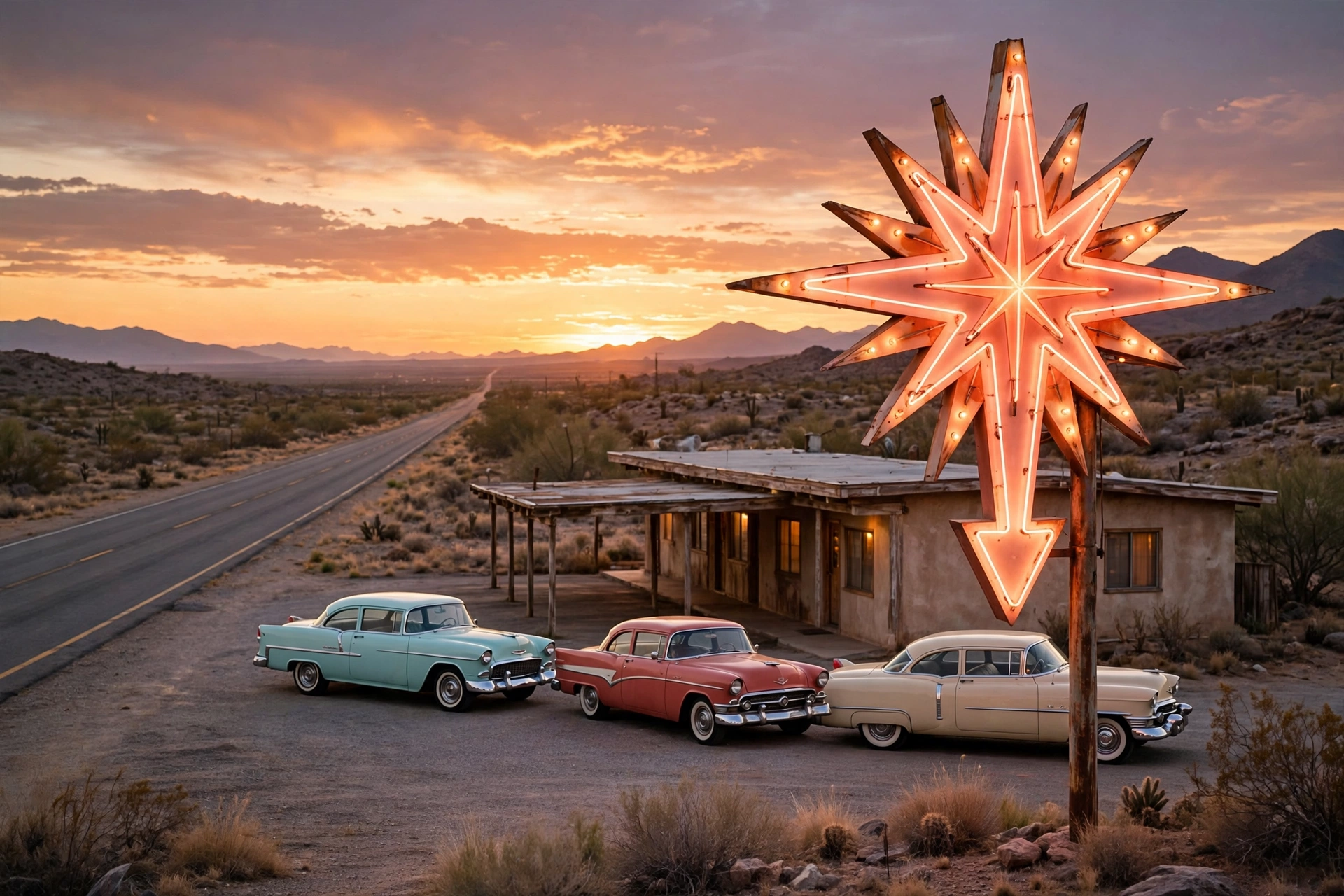
This Route 66 Attractions Guide covers the 2,400-mile Mother Road at the perfect moment: 2026 marks the 100th anniversary of Route 66, and towns all along the highway — from Chicago to Santa Monica — are celebrating with centennial events, restored neon, and special exhibits. Decommissioned in 1985 but never forgotten, Route 66 remains America’s most iconic road trip: a ribbon of vintage diners, roadside giants, neon-lit motor courts, and desert landscapes that no interstate can replicate. This guide maps the must-see attractions state by state, answers the practical questions (how many days, best direction, best season), and shares the planning strategies that turn a bucket-list drive into the trip of a lifetime.
Route 66 at a Glance
| Fact | Detail |
|---|---|
| Total length | ~2,400 miles from Chicago, Illinois to Santa Monica, California |
| States crossed | 8: Illinois, Missouri, Kansas, Oklahoma, Texas, New Mexico, Arizona, California |
| Established | November 11, 1926 — the 2026 centennial is the biggest celebration in the road’s history |
| Driving time (nonstop) | ~35–40 hours; most travelers take 10–14 days with stops |
| Best seasons | Spring (April–May) and fall (September–October); summer is hot in the desert, winter brings ice in the high country |
| Best direction | East to west (Chicago → Santa Monica) follows the historic migration narrative and puts the desert sunsets ahead of you |
| Road condition | Not one continuous highway — historic alignments mix with frontage roads and interstate hops; a good guide or app is essential |
The Centennial Factor: Why 2026 Is the Year to Go
The Route 66 Attractions Guide for any other year would be evergreen — but 2026 is special. The Route 66 centennial (the highway was officially designated on November 11, 1926) has triggered the largest coordinated restoration effort in the road’s history: towns have relit historic neon signs, museums have mounted centennial exhibits, and festivals are scheduled across all eight states. The National Park Service’s Route 66 Corridor Preservation Program and state centennial commissions have funded facade restorations, new interpretive signage, and events from Illinois to California. Practical upshot: the road has never looked better, but popular stretches — especially around the summer centennial events — book up early. Reserve iconic motels (Blue Swallow, Wigwam) months ahead if you’re traveling in 2026.
Route 66 Centennial Events in 2026
The Route 66 Attractions Guide for 2026 comes with a calendar other years can’t match. Centennial celebrations are planned across all eight states, anchored by festivals in Springfield, Missouri (the highway’s official birthplace), Albuquerque, Flagstaff, and Santa Monica. Expect classic-car cruises drawing thousands of vintage vehicles, neon-sign relighting ceremonies in towns like Tucumcari and Seligman, special centennial exhibits at the Oklahoma Route 66 Museum in Clinton and the California Route 66 Museum in Victorville, and a Route 66 centennial passport program encouraging travelers to collect stamps at stops along the way. The National Park Service and state tourism offices are publishing centennial itineraries, and several towns are unveiling newly restored murals, motor courts, and interpretive plazas timed for the anniversary. The practical advice: if you want to attend a specific festival, book lodging now — small towns along the route have limited hotel capacity, and the marquee summer 2026 weekends are already filling. If you prefer a quieter trip, travel in April–May or September–October to enjoy the restored road without the festival crowds.
Must-See Route 66 Attractions State by State
Illinois: The Beginning
Your journey starts at the “Begin Route 66” sign on Adams Street in downtown Chicago — the official eastern terminus photo op. Heading southwest, the road quickly turns nostalgic: the Gemini Giant in Wilmington (a 30-foot fiberglass spaceman holding a rocket, one of the classic “Muffler Men”), the Polk-A-Dot Drive In in Braidwood, and the Route 66 Hall of Fame & Museum in Pontiac (housed in a former fire station, free admission). In Atlanta, Illinois, don’t miss the Bunyon Giant hot-dog-holding statue and the restored Palms Grill Café. Springfield brings the Cozy Dog Drive In — birthplace of the corn dog on a stick — and the Abraham Lincoln Presidential Library (a worthy detour). The Chain of Rocks Bridge near St. Louis, with its famous 22-degree bend over the Mississippi, is the definitive Illinois-Missouri crossing — now a bike and pedestrian trail with skyline views. Starting your trip with a Chicago stay? Our weekend getaways from Chicago guide covers the city side of the send-off.
Missouri: Caverns, Custard, and Neon
Missouri packs some of the road’s best-loved stops into a few hundred miles. St. Louis offers the Gateway Arch (technically just off the route but unmissable) and Ted Drewes Frozen Custard, a Route 66 institution since 1929. West of the city, Meramec Caverns — the legendary Jesse James hideout — has drawn road-trippers since the 1930s with its “witness rock” formations and relentless billboard campaign. Cuba proudly calls itself “Route 66 Mural City,” with a dozen large outdoor murals telling the road’s story. The Route 66 Rocker (once the world’s largest rocking chair) in Fanning, the Devil’s Elbow Bridge, and the neon-soaked Munger Moss Motel in Lebanon (family-owned since 1946) keep the kitsch coming. Springfield — where the highway got its “66” name in 1926 — celebrates with the Birthplace of Route 66 Roadside Park and a full roster of centennial events. End the state in Joplin, where the Route 66 Mural Park and vintage Schifferdecker Park mark the Kansas line.
Kansas: The Short but Sweet Stretch
Kansas claims only 13 miles of Route 66 — the shortest of any state — but makes every mile count. Galena’s Cars on the Route (the restored Kan-O-Tex service station that inspired Pixar’s Cars) is a pilgrimage site for families, with the original “Tow Tater” truck out front. Baxter Springs offers the Rainbow Bridge — the last of its kind, a 1923 concrete arch you can still drive (carefully) — and a cluster of vintage storefronts. It’s a 30-minute detour off the interstate and absolutely worth it.
Oklahoma: The Heartland Miles
Oklahoma holds the longest drivable stretch of Route 66 (over 400 miles) and some of its most beloved icons. The Blue Whale of Catoosa — an 80-foot bright-blue whale in a pond, built as a family swimming spot in the 1970s — is the road’s most photographed oddity. Tulsa’s Meadow Gold District (restored neon), the Continental Theatre sign, and the Route 66 Village celebrate the oil-boom era. In Arcadia, Pops 66 — a 66-foot-tall LED soda bottle next to a store selling 700+ soda varieties — and the 1898 Round Barn are essential stops. Oklahoma City’s National Cowboy & Western Heritage Museum (just off the route) and the Milk Bottle Grocery building add range. In Clinton, the Oklahoma Route 66 Museum is the single best history museum on the entire road — allow two hours. Western Oklahoma delivers the National Route 66 Museum in Elk City and the haunting Sandhills Curiosity Shop in Erick (call ahead — hours are eccentric).
Texas: Big Skies and Bigger Icons
The Texas Panhandle stretch is short but legendary. In Amarillo, Cadillac Ranch — ten classic Cadillacs buried nose-first in a wheat field, layered in decades of spray paint — is the road’s most interactive art installation: bring a spray can and add your tag. The Big Texan Steak Ranch (home of the 72-ounce steak challenge) is pure roadside theater. In Adrian, the Midpoint Café marks the exact halfway point between Chicago and Los Angeles — the “ugly crust” pies are the real draw. Tucumcari’s Blue Swallow Motel (1939, National Register, gloriously neon) is arguably the most beautiful motor court on the entire route — book months ahead, especially in 2026. The Tee Pee Curios shop and its concrete teepees round out the town’s neon row.
New Mexico: Neon, Pueblos, and Desert Color
New Mexico is many travelers’ favorite state on the route — and the longest stretch of neon. Albuquerque’s Central Avenue strings miles of restored signs through Nob Hill and Old Town; the Route 66 Diner and the El Vado Motel anchor the experience. West of town, the Rio Puerco Bridge and Laguna Pueblo lands give way to Gallup’s trading-post row. Don’t miss the Blue Hole in Santa Rosa (an 81-foot-deep artesian swimming hole of impossibly blue water) and the Route 66 Auto Museum in Santa Rosa. Detour north to Santa Fe (the pre-1937 alignment) for adobe architecture, the Plaza, and green-chile everything — it’s worth a full day. The stretch from Gallup to the Arizona line crosses some of the emptiest, most beautiful high desert on the road.
Arizona: The Golden Stretch
Arizona holds the longest unbroken drivable sections of original 66 and the road’s most cinematic landscapes. Holbrook’s Wigwam Motel — concrete teepee cabins, vintage cars out front, National Register listed — is the single most iconic overnight stay on the route. Nearby, the Petrified Forest National Park (the only national park directly on Route 66) and the Painted Desert deliver otherworldly color. Winslow’s “Standin’ on the Corner” Park (yes, the Eagles lyric — there’s a flatbed Ford) is a mandatory photo. Flagstaff’s Hotel Monte Vista and downtown neon make a great base — and the Grand Canyon is just 80 miles north, the essential Route 66 detour. Our national parks guide for first-time visitors covers planning the canyon add-on. West of Flagstaff, Seligman — the town that sparked the Route 66 revival movement — offers the Snow Cap Drive-In (deliberately silly service, genuinely good burgers) and the Route 66 Gift Shop & Museum. Kingman adds the Route 66 Museum (in the historic Powerhouse) and the Mr. D’z Route 66 Diner, before the road climbs the Sitgreaves Pass switchbacks to Oatman — a semi-ghost town where wild burros roam the main street.
California: Desert to the Pacific
The final state runs from ghost-town desert to the beach. Roy’s Motel and Café in Amboy — an isolated Googie-sign icon against empty desert — is the photographer’s Route 66. Elmer’s Bottle Tree Ranch in Oro Grande turns scrap metal and bottles into folk-art forest. Barstow’s Route 66 Mother Road Museum and San Bernardino’s Original McDonald’s Museum (the 1940 Speedee Service birthplace) cover the history. The Wigwam Motel in Rialto (the second of three Wigwams) and Pasadena’s Colorado Boulevard cruise into Los Angeles, where the Santa Monica Pier — with its “End of the Trail” sign, Ferris wheel, and Pacific sunset — is the emotional finish line. Dip your toes in the ocean. You’ve earned it.
The Essential Route 66 Attractions: Top 20 Quick List
- Begin Route 66 Sign — Chicago, Illinois (the start-line photo)
- Gemini Giant — Wilmington, Illinois
- Chain of Rocks Bridge — St. Louis, Missouri
- Meramec Caverns — Stanton, Missouri
- Munger Moss Motel — Lebanon, Missouri
- Rainbow Bridge — Baxter Springs, Kansas
- Blue Whale of Catoosa — Catoosa, Oklahoma
- Pops 66 — Arcadia, Oklahoma
- Oklahoma Route 66 Museum — Clinton, Oklahoma
- Cadillac Ranch — Amarillo, Texas
- Midpoint Café — Adrian, Texas
- Blue Swallow Motel — Tucumcari, New Mexico
- Blue Hole — Santa Rosa, New Mexico
- Wigwam Motel — Holbrook, Arizona
- Petrified Forest National Park — Arizona
- Standin’ on the Corner Park — Winslow, Arizona
- Grand Canyon detour — via Flagstaff, Arizona
- Seligman — Arizona (the revival’s birthplace)
- Roy’s Motel and Café — Amboy, California
- Santa Monica Pier — Santa Monica, California (the finish line)
Planning Your Route 66 Road Trip
- How many days? Ten days is the practical minimum for Chicago-to-Santa Monica with real stops; two full weeks (12–14 days) is the sweet spot. Anything less becomes a driving marathon. Our family road trip ideas guide has more multi-day planning strategies.
- Which direction? East to west is traditional — you follow the Dust Bowl migration story, and the desert sunsets are in front of you. West to east works fine too; Chicago’s deep-dish is a better farewell than hello.
- What to drive? Any reliable car works; convertibles and classic-car rentals add romance but cost more. Camper vans are popular but check height clearances on old alignments. There’s no need for 4WD — the entire route is paved.
- Navigation: the road is not continuous. Download an offline Route 66 navigation app (several excellent ones exist) or carry the classic EZ66 Guide. Cell service drops in the desert stretches of New Mexico and Arizona.
- Where to stay: the vintage motor courts (Blue Swallow, Wigwam, Munger Moss, El Vado) are experiences, not just beds — book 2–3 months ahead for 2026. Between icons, chain motels in Amarillo, Flagstaff, and Kingman are cheap and plentiful.
- Budget: a two-week trip for two typically runs $3,000–$5,000 including a rental car, mid-range motels, diner meals, and attraction fees. Most roadside attractions are free or under $15; museums run $5–$15.
- Best photo strategy: golden hour transforms neon signs and desert landscapes. Plan to be at Roy’s, the Blue Swallow, or Cadillac Ranch within an hour of sunset.
Route 66 Detours Worth the Extra Miles
The Mother Road rewards wandering. The Grand Canyon (80 miles north of Flagstaff) is the single essential detour — even a half-day at the South Rim justifies it. Santa Fe adds a full day of adobe culture on the pre-1937 alignment. The Painted Desert and Petrified Forest sit directly on the route but deserve 3–4 hours, not a drive-by. Palo Duro Canyon (south of Amarillo) is the “Grand Canyon of Texas.” And Las Vegas is a 2.5-hour detour from Kingman via Oatman — if neon overload appeals, it’s there. For pairing the trip with other iconic sights, our famous landmarks in the USA guide maps the heavy hitters.
FAQ: Route 66 Attractions Guide
How long does it take to drive Route 66?
The drive itself is 35–40 hours of wheel time over roughly 2,400 miles. Most travelers take 10–14 days to do it properly, with stops at the major attractions in each state. Rushing it in under a week means skipping the experiences that make the road special.
Is Route 66 still drivable in 2026?
Yes — about 85% of the original route is still drivable, though it’s not one continuous highway. You’ll follow historic alignments, frontage roads, and short interstate hops. A dedicated Route 66 navigation app or the EZ66 Guide is essential; don’t rely on standard GPS alone.
What is the best time of year to drive Route 66?
April–May and September–October offer the best weather across all eight states: mild desert temperatures, open attractions, and smaller crowds. Summer brings extreme heat to the Mojave and Texas Panhandle (100°F+); winter can ice the high-elevation stretches near Flagstaff.
What are the must-see attractions on Route 66?
The consensus top five: Cadillac Ranch (Texas), the Blue Whale of Catoosa (Oklahoma), the Wigwam Motel (Arizona), the Blue Swallow Motel (New Mexico), and the Santa Monica Pier (California). Add Meramec Caverns, Pops 66, the Petrified Forest, and Seligman for the full experience.
How much does a Route 66 road trip cost?
Budget $3,000–$5,000 for two people over two weeks, including a rental car, motels, meals, and attraction fees. The road itself is the attraction — most roadside stops are free or under $15, which keeps the daily cost lower than a typical national-park or city trip.
Can you drive Route 66 in an RV or camper van?
Yes, with caveats: most of the route handles RVs fine, but some historic alignments (Sitgreaves Pass to Oatman, parts of the Ozarks) are narrow and winding — check clearances and consider unhooking a towed vehicle. Many travelers prefer a car plus vintage motel stays, which is the classic Route 66 experience anyway.
What is the best direction to drive Route 66 — east to west or west to east?
Tradition says Chicago to Los Angeles: you follow the historic migration narrative, the sun stays at your back in the morning, and you finish at the Santa Monica Pier sign. West-to-east works fine too and can mean lighter traffic at popular photo stops. Either way, allow at least two weeks to do the full 2,400 miles without rushing — the joy is in the unplanned diner stops and roadside oddities, not the mileage.
Do you need a special map or app for Route 66?
Yes — do not rely on standard GPS alone, because modern highways bypass the historic alignments and signage is inconsistent across the eight states. The EZ66 Guide for Travelers is the bible (turn-by-turn in both directions), and apps like Route 66 Navigation overlay the historic road on live maps. Download offline maps before the desert stretches in New Mexico, Texas, and Arizona, where cell service drops out for long miles.
What should you pack for a Route 66 road trip?
Beyond the obvious: a cooler for drinks and snacks (long gaps between towns in the Southwest), some cash for cash-only diners and roadside stands, a real camera or charged phone for the neon-sign night shots, and a playlist that mixes road-trip rock with Route 66 history podcasts. Bring layers — desert mornings are cold even in summer — and a basic emergency kit, since services can be 50+ miles apart on the loneliest stretches.


