Pumpkin pie with gingersnap crust is what happens when the classic Thanksgiving pie gets a bold, spicy upgrade. Instead of traditional pastry, the silky pumpkin custard sits in a press-in crust of crushed gingersnap cookies bound with butter — a shell that is snappy, caramelized, and humming with ginger, molasses, and warm spice. It is easier than rolling pie dough, more forgiving than pastry, and the flavor pairing is one of those combinations that tastes inevitable: the deep, earthy sweetness of pumpkin against the fiery snap of ginger. If you love our classic pumpkin pie from scratch but want a variation with more personality — or if pie dough has ever defeated you — this is your pie.
This post is deliberately crust-focused. The pumpkin custard here is a slightly adapted version of the classic — less heavily spiced, since the crust brings its own fire — but the star is the shell: how to choose the right cookies, the crumb-to-butter ratio that holds a clean slice, the pre-bake that keeps it crisp under wet filling, and the variations (chocolate, maple, gluten-free) that make this technique a year-round tool. By the end, you will understand press-in crusts the way the classic post teaches pastry — and you will have a Thanksgiving pie that stands apart on a crowded dessert table.
Why Gingersnap Crust Works So Well
The pairing of pumpkin and ginger is rooted in flavor chemistry. Pumpkin’s flavor compounds are mild and earthy; they need warm, assertive spices to read as “pumpkin pie” at all. Gingersnaps deliver those spices — ginger, cinnamon, cloves, molasses — in concentrated form, plus something pastry cannot: the deep, almost burnt-sugar notes of a twice-baked cookie. When you crush gingersnaps and re-bake them as a crust, those flavors intensify further, creating a shell that tastes like the spiciest, most caramelized edge of the pie in every bite.
There is also a textural argument. Traditional pastry is flaky and delicate; a gingersnap crust is snappy and sturdy. That sturdiness is an asset under a wet custard filling — press-in cookie crusts resist sogginess far better than raw pastry, because the crumbs are already baked and the butter binding them is hydrophobic. The result is a pie that slices cleanly even on day three, with a crust that stays crisp to the last serving.
Choosing the Right Gingersnaps
Not all gingersnaps are equal, and the cookie you choose shapes the crust. The ideal gingersnap for crust-making is hard, snappy, and assertively spiced — the kind that shatters when you bite it. Soft, chewy ginger cookies contain more moisture and less structure; they make a gummy, dense crust. Supermarket staples vary enormously in spice level, so taste before you commit: the crust will taste like a concentrated version of the cookie.
What to Look For
Read the ingredient list. Molasses should appear high on it — that is where the deep, dark flavor comes from. A cookie with real ginger (listed as ginger or ginger powder) beats one flavored primarily with “spices.” Avoid cookies with chocolate coatings or soft centers. If you have a favorite bakery gingersnap, it will make a superb crust; just make sure it is fully crisp, drying softer cookies in a low oven for 10 minutes before crushing if needed.
How Many Cookies?
You need about 8 ounces (225g) of gingersnaps — roughly 32 to 40 small cookies, or 2 cups of fine crumbs. Buying by weight is more reliable than counting cookies, since sizes vary. When in doubt, buy extra; leftover crumbs mixed with melted butter make an excellent topping for ice cream or a base for cheesecake bars.
The Crumb-to-Butter Ratio: The Only Formula You Need
A press-in crust is a simple system: dry crumbs plus melted fat plus a little sugar and salt, pressed into a pan and baked. The ratio determines everything. Too little butter and the crust crumbles apart when sliced; too much and it bakes up greasy and hard. The reliable formula is 2 cups fine crumbs to 6 tablespoons melted butter, plus 2 tablespoons sugar and a pinch of salt — though with sweet, rich gingersnaps, you can reduce the sugar to 1 tablespoon.
Grind Fine, Then Finer
Texture of the crumbs matters as much as ratio. Process the cookies in a food processor until they resemble fine sand with no visible chunks — coarse crumbs make a crumbly, uneven crust that sheds at the slice. If you do not have a food processor, seal the cookies in a zip-top bag and crush with a rolling pin, then sift out any larger pieces and re-crush them. Drizzle in the melted butter and pulse (or stir) until the mixture resembles wet sand and holds together when squeezed.
Pressing Technique
Dump the mixture into a 9-inch pie pan and press it firmly and evenly across the bottom and up the sides, using the flat bottom of a measuring cup or glass. Pay special attention to the corner where the bottom meets the sides — thin spots there lead to breakage. The sides should be an even 1/4 inch thick; thicker sides bake up hard and are difficult to cut. Chill the pressed crust for 20 minutes before baking to firm up the butter, which helps it hold its shape.
Pre-Baking: The Crispness Insurance
Unlike a pastry shell, a gingersnap crust does not strictly require blind baking with weights — it is already a baked product being re-baked. But a short pre-bake is still essential: 10 to 12 minutes at 350°F (175°C) sets the butter-crumb matrix, deepens the caramelized flavor, and creates a moisture-resistant layer that keeps the crust crisp under the custard. Let it cool for 10 minutes before adding the filling; pouring wet custard into a piping-hot crust can make the bottom layer gummy.
Watch the edges during the pre-bake — the high sugar content of gingersnaps means they brown (and then burn) faster than graham cracker crusts. If your oven runs hot, check at 8 minutes. The crust should smell toasty and look a shade darker; it will firm up considerably as it cools, so do not judge doneness by hardness when hot.
Adapting the Filling for a Spicy Crust
The classic pumpkin custard was designed for a neutral pastry shell; against a fiery gingersnap crust, its full spice load becomes muddy and overwhelming. The adjustment is simple: reduce the spices by about half and let the crust carry the spice while the filling emphasizes pumpkin, cream, and sweetness. The filling below uses a lighter hand with cinnamon and ginger, drops the cloves entirely (the crust supplies them), and adds a touch more brown sugar to balance the crust’s peppery bite.
One more adaptation: because the crust is sweet, reduce the filling’s sugar slightly compared with the classic recipe. The goal is balance — each bite should deliver creamy pumpkin first, then the warm ginger snap of the crust, finishing clean rather than cloying.
Ingredients
For the Gingersnap Crust
- 8 ounces (about 2 cups) gingersnap cookie crumbs, finely ground
- 6 tablespoons unsalted butter, melted
- 1 to 2 tablespoons granulated sugar (use 1 if your cookies are very sweet)
- 1/4 teaspoon kosher salt
For the Pumpkin Filling (adapted for the spicy crust)
- 2 cups roasted sugar-pumpkin purée, drained (or one 15-ounce can plain pumpkin purée)
- 3 large eggs, at room temperature
- 3/4 cup packed dark brown sugar
- 2 tablespoons granulated sugar
- 1 teaspoon ground cinnamon
- 1/4 teaspoon ground ginger
- 1/4 teaspoon freshly grated nutmeg
- 1/2 teaspoon kosher salt
- 1 cup heavy cream
- 1/2 cup evaporated milk or whole milk
- 1 teaspoon vanilla extract
Step-by-Step Method
- Make the crumbs. Process the gingersnaps in a food processor to fine, even crumbs — finer than you think necessary. You should have 2 cups. Add the sugar and salt and pulse to combine.
- Bind with butter. Drizzle the melted butter over the crumbs and pulse (or stir with a fork) until the mixture resembles wet sand and clumps when squeezed. If it seems dry, add melted butter 1 teaspoon at a time; different cookies absorb differently.
- Press into the pan. Transfer to a 9-inch pie pan. Press firmly and evenly over the bottom and up the sides with a flat-bottomed glass, keeping the thickness uniform at about 1/4 inch. Chill 20 minutes.
- Pre-bake. Bake at 350°F (175°C) for 10 to 12 minutes, until fragrant and a shade darker. Cool on a rack for 10 minutes. Keep the oven at 350°F.
- Mix the filling. Whisk the pumpkin, both sugars, spices, and salt until smooth. Whisk in the eggs one at a time, then the cream, milk, and vanilla. Strain through a fine-mesh sieve for silkiness.
- Fill and bake. Pour the filling into the cooled crust. Bake on a preheated baking sheet at 350°F (175°C) for 50 to 60 minutes, until the edges are set and the center wobbles like gelatin when nudged (170 to 175°F / 77 to 79°C at the center). Shield the crust edge with foil if it darkens too quickly — gingersnap edges burn faster than pastry.
- Cool completely. Cool on a wire rack for at least 2 hours, then refrigerate. The pie slices cleanest when fully chilled, though it serves beautifully at cool room temperature. Top with softly whipped cream.
Variations on the Gingersnap Crust
Chocolate Gingersnap Crust
Add 2 tablespoons of Dutch-process cocoa powder to the crumbs and increase the butter to 7 tablespoons. The chocolate deepens the crust’s color to near-black and adds a mocha-like complexity that is stunning with pumpkin. Finish the pie with a drizzle of chocolate ganache instead of whipped cream.
Maple Gingersnap Crust
Replace the granulated sugar with 2 tablespoons of pure maple syrup and reduce the butter to 5 tablespoons (the syrup adds moisture). The maple amplifies the crust’s caramel notes and ties it to the Thanksgiving table, where maple appears in everything from sweet potatoes to pie toppings.
Gluten-Free Gingersnap Crust
Use gluten-free gingersnaps — several national brands make excellent ones — and the entire pie becomes gluten-free with no other changes. Press-in crusts are the easiest path to gluten-free pie, since there is no gluten development to replicate. Your gluten-free guests will be genuinely touched to have a real pie option.
Gingersnap Crust for Other Fillings
Once you own this technique, use it beyond pumpkin: it is superb under chocolate cream pie, eggnog custard, butterscotch pudding pie, and even a no-bake cheesecake filling. The method is identical; only the filling changes.
Troubleshooting
Crust falls apart when sliced. Too little butter, crumbs too coarse, or the crust was under-pressed. Next time, grind finer, press harder (especially at the corners), and make sure the mixture holds together when squeezed before it goes into the pan. Serving the pie well-chilled also helps clean slices.
Crust is hard as a rock. Too much butter, overbaked, or the sides were pressed too thick. Stick to the ratio, keep sides at 1/4 inch, and pull the pre-bake at 10 minutes. A rock-hard crust is almost always an overbaked crust.
Edges burned during the custard bake. Gingersnap crusts brown faster than pastry because of their high sugar content. Shield the edge with a pie shield or foil ring from the start of the custard bake, not after you notice darkening.
Filling tastes flat against the crust. The filling was under-salted or under-sweetened for the pairing. Remember: the filling must be seasoned to stand up to an assertive crust. Do not be shy with the salt, and taste the filling (before adding eggs, if you prefer) for balance.
Make-Ahead & Storage
The pressed, unbaked crust can be wrapped and frozen for up to a month — bake it straight from frozen, adding 2 minutes to the pre-bake. Crumbs can be ground days ahead and stored airtight. The finished pie keeps 3 days refrigerated and, thanks to the sturdy crust, actually slices better on day two. Freeze the baked pie up to 1 month; thaw overnight in the refrigerator. The crust stays remarkably crisp through all of this, which is one of its great advantages over pastry.
Serving Suggestions
Whipped cream is the classic topping, but consider variations that play against the ginger: a maple-sweetened whipped cream, a quenelle of mascarpone, or vanilla ice cream for warm-cold contrast (serve the pie at room temperature with cold ice cream). A light dusting of ground ginger mixed with powdered sugar over the whipped cream signals the crust’s flavor before the first bite. For a Thanksgiving dessert table with multiple pies, slice this one slightly thinner than the classic — its bold flavor means a little goes a long way, and guests will want room to try everything.
The Science of Press-In Crusts
Understanding why a press-in crust works helps you improvise with confidence. A cookie crumb is essentially flour, sugar, and fat that has already been baked — its starches are gelatinized, its sugars caramelized, its proteins set. When you grind it and add melted butter, you are creating a new matrix: the butter coats the crumbs and, as it chills and then re-bakes, binds them into a solid shell. The pre-bake drives off residual moisture and lets the butter fully penetrate the crumbs, which is why a pre-baked press-in crust resists the wet custard poured over it.
Sugar content is the variable most bakers overlook. Cookies high in sugar (like gingersnaps) need less added sugar in the crust formula and brown faster in the oven; drier, less sweet cookies (like digestive biscuits) need the full 2 tablespoons of sugar and tolerate longer baking. Salt is non-negotiable in every version — 1/4 teaspoon sharpens the cookie’s flavor and balances the sweetness, and its absence is noticeable. Once you internalize the base formula (2 cups fine crumbs, 5 to 7 tablespoons melted butter adjusted for the cookie’s richness, 1 to 2 tablespoons sugar adjusted for sweetness, 1/4 teaspoon salt), you can build a crust from virtually any crisp cookie in the pantry.
Planning It Into the Thanksgiving Menu
This pie earns its place strategically. Because the crust requires no rolling and no pastry skill, it is the ideal pie to delegate to a guest who wants to contribute but does not bake — the filling is a whisk-and-pour affair, and the crust is crush, press, and bake. It is also the best pie choice when oven time is scarce: the crust pre-bakes in 10 minutes and can be done days ahead, and the filled pie bakes at the same 350°F (175°C) as dinner rolls and casseroles, sliding into the oven alongside them.
For a dessert table with multiple pies, this one plays a specific role: the bold, spicy counterpoint to milder offerings. Pair it with the delicate custard of a classic pumpkin pie, the buttery fruit of an old fashioned apple pie, and something chocolate, and you have a dessert spread with genuine range. Label it clearly — “Pumpkin Pie, Gingersnap Crust” — because guests who loved it last year will go looking for it, and guests avoiding gluten will want to know it can be made gluten-free on request.
In Pictures: Pumpkin Pie with Gingersnap Crust
A gingersnap crust trades plain pastry for spiced, buttery crunch — pumpkin pie’s most charismatic partner. The pie, dark-crusted and glossy.
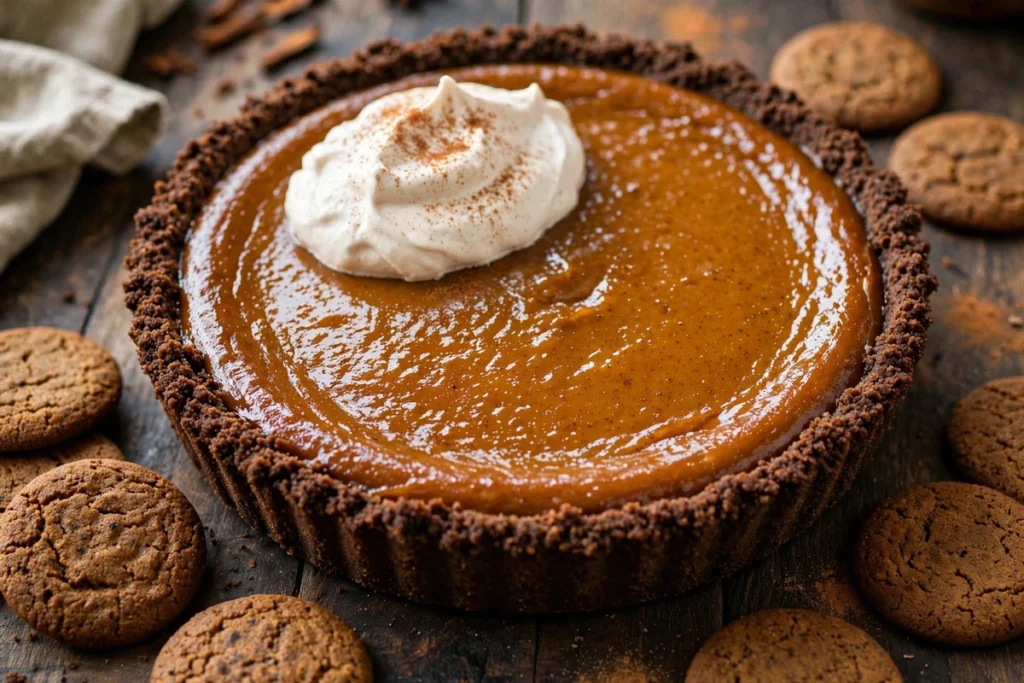
A pumpkin pie with a dark gingersnap crumb crust and a dollop of cinnamon whipped cream.
Watch: Pumpkin Pie with Gingersnap Crust
Food52’s pumpkin pie with gingersnap crust shows why the swap works — snappy cookie crumbs pressed into the pan, a classic spiced filling, and cinnamon whipped cream on top.
At a Glance: Pumpkin Pie with Gingersnap Crust
The crumb-crust formula, from the guide.
| Topic | Notes |
|---|---|
| Why it works | Gingersnaps echo the pie’s own spices — ginger, cinnamon, and clove in every bite |
| Choosing cookies | Look for snappy, deeply spiced gingersnaps; soft cookies make a soggy crust |
| How many | About 8 ounces (roughly 32 cookies) for a standard 9-inch pie |
| Crumb-to-butter ratio | Fine crumbs plus about ¼ cup melted butter, pressed firmly — the only formula you need |
| Grind fine | Process to even, sandy crumbs so the crust holds together |
| Pre-baking | A short pre-bake is crispness insurance against the wet filling |
Frequently Asked Questions
Can I use store-bought gingersnap crumbs?
Yes, if you can find them — cookie crumb products are sold in some baking aisles. But grinding whole cookies takes two minutes and gives you control over the cookie choice, which is the soul of this crust. Pre-ground crumbs also tend to be coarser and staler than fresh-ground.
How is this different from the classic pumpkin pie?
The filling is a close cousin — slightly less spiced and sweet to balance the crust — but the experience is entirely different. The classic, with its flaky pastry, is delicate and traditional; this version is bold, spicy, and snappy, with a crust that tastes like the best part of a spice cookie. Our classic pumpkin pie from scratch guide covers the pastry technique in full if you want to compare.
Can I make this pie without a food processor?
Absolutely. Seal the cookies in a sturdy zip-top bag, press out the air, and crush with a rolling pin or heavy pan. Sift the crumbs through a coarse strainer and re-crush any large pieces. It takes a few minutes longer but works perfectly.
Why did my crust shrink down the sides during pre-baking?
The butter was too warm when pressed, or the crust was not chilled before baking. Always chill the pressed crust for 20 minutes — the cold butter firms up and holds the shape during the pre-bake. Pressing the sides slightly thicker at the top edge also helps them stay put.
Can I prepare the crust and filling on different days?
Yes — this is an ideal split. Press and pre-bake the crust up to 2 days ahead (store airtight at room temperature once cool), mix the filling the morning of baking, and assemble. The whole pie can also be baked 2 days ahead and refrigerated.
What should I do with leftover gingersnap crumbs?
Do not discard them. Toss leftover crumbs with a little melted butter and toast in a 350°F (175°C) oven for 8 minutes for a spiced streusel topping — excellent over vanilla ice cream, baked apples, or yogurt parfaits. They also make a wonderful base layer for a pumpkin trifle if you are building a larger Thanksgiving dessert spread.
Conclusion
Pumpkin pie with gingersnap crust is proof that a single bold substitution can reinvent a classic. The press-in crust eliminates the most intimidating part of pie-making — rolling pastry — while delivering more flavor than pastry ever could: ginger, molasses, caramel, snap. Adapt the filling to let the crust shine, pre-bake for crispness, shield those sugary edges, and you will have a Thanksgiving pie with genuine personality. Serve it alongside the classic version and let guests debate their favorite — or explore our full Thanksgiving desserts collection for the rest of the holiday spread.