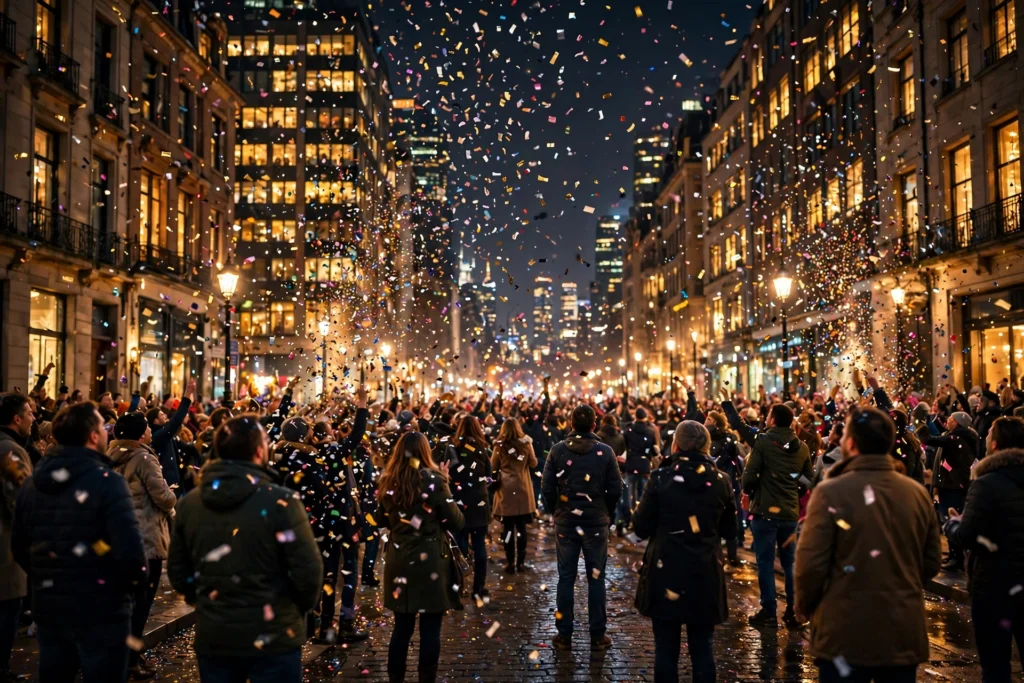
South Africa celebrates the new year in summer. While the northern hemisphere shivers through its countdowns, South Africans mark December 31 in shorts and sandals — with beach days that flow into braais (barbecues) that flow into rooftop parties under warm night skies. From the fireworks over Cape Town’s V&A Waterfront to the rooftop countdowns of Johannesburg, from Durban’s beachfront to the extraordinary street carnival of the Kaapse Klopse on January 2, South Africa’s New Year is a uniquely southern-hemisphere celebration: outdoors, musical, diverse, and full of light.
This is a regional tour of how South Africa welcomes the new year — city by city, tradition by tradition — plus the customs, food, and practical tips for celebrating the South African way.
Summer New Year: The Season Shapes Everything
The single most important fact about New Year in South Africa is the weather. December is midsummer: long, hot days, warm evenings, and holiday season in full swing. Schools are on summer break from early December to mid-January, and much of the country takes its annual leave over the festive season. The result is that New Year’s Eve feels less like a single night and more like the climax of a weeks-long summer holiday.
This shapes every tradition. Countdowns happen outdoors — on beaches, rooftops, and in backyards. The “big night out” competes with the “big day at the beach.” And January 1 is not a grey day of recovery indoors but a beach day, a braai day, a continuation of summer. If you are visiting from the northern hemisphere, the disorientation is delightful: Christmas and New Year in 30-degree heat, with the ocean a few minutes away.
Cape Town: Fireworks Over the Waterfront
Cape Town hosts South Africa’s most famous New Year’s Eve. The center of gravity is the V&A Waterfront — the harbor shopping and entertainment district beneath Table Mountain — which traditionally hosts the city’s headline countdown: live music through the evening, food stalls, family entertainment, and fireworks over the harbor at midnight, with the mountain as a backdrop.
The Waterfront Countdown
The Waterfront’s New Year’s Eve is a genuinely public celebration — free, open, and drawing tens of thousands. Families arrive in the afternoon, claim spots along the quays, and settle in for the evening’s program. The midnight fireworks, launched from the harbor, reflect off the water with Table Mountain looming behind — one of the great urban fireworks settings in the world. Arrive early for a good position; the precinct fills up well before midnight.
Check the Waterfront’s official channels for the current year’s program — formats and timings are confirmed annually, and special events or road closures are announced in December. The city’s MyCiTi buses and ride-shares run special holiday operations; driving into the Waterfront on the night is not recommended.
Beyond the Waterfront
Cape Town’s celebration radiates outward. Camps Bay’s beachfront restaurants host gala dinners with sunset views; the city’s winelands — Stellenbosch, Franschhoek, Constantia — run New Year’s Eve programs among the vines; and Long Street’s clubs and bars keep the backpacker-and-local party going until morning. For the adventurous, watching midnight from the slopes of Signal Hill or a boat in the bay is unforgettable — book boats well ahead.
New Year’s Day: The Beach
January 1 in Cape Town belongs to the beaches — and to one more quiet tradition: the deliberate first swim of the year, taken with intention and often accompanied by a shouted resolution as you dive in. Clifton, Camps Bay, Muizenberg, and Boulders (with its penguins) fill with South Africans recovering in the best possible way: swimming, sunbathing, and eating. The tradition is simple — start the year in the ocean — and it is observed with near-religious devotion. Join it.
Johannesburg: Rooftops, Braais, and House Parties
Johannesburg — Joburg, Jozi — celebrates differently. Africa’s economic powerhouse is not a beach city; its New Year is a city of rooftops, clubs, and legendary house parties. The Joburg New Year’s Eve has a high-energy, dressed-up character: the city’s style-conscious crowds treat the night as the social event of the summer.
Rooftop Countdowns
Joburg’s skyline rooftops — in Sandton, Rosebank, Braamfontein, and the Maboneng Precinct — host the night’s premium parties: DJs, skyline views, and midnight toasts above the city lights. The rooftop party is the Joburg answer to the beach countdown: elevation instead of ocean, with the warm summer night making open-air celebration natural.
The House Party Capital
Ask Joburgers about New Year’s Eve and many will tell you the real action is the house party. Johannesburg’s sprawling suburbs, with their big gardens and swimming pools, are made for it: the pool party that starts in the afternoon, becomes a braai at sunset, and turns into a dance floor by midnight. These private celebrations are the backbone of the Joburg New Year — intimate, abundant, and very South African.
Clubs and Concerts
The city’s clubs and live venues run headline New Year’s Eve events, with South African house music — the country’s globally influential electronic genre — often center stage. Major concerts and festivals are sometimes scheduled around the holiday; check listings in December for the current year’s lineup.
Durban and the Coast: Beachfront Countdowns
Durban, on the warm Indian Ocean, offers the most tropical of South Africa’s New Years. The beachfront — the Golden Mile — is the natural gathering place: warm water (mid-20s Celsius), humid summer nights, and a promenade built for evening crowds. Beachfront hotels host gala dinners; the promenade fills with families and revelers; and midnight is marked with fireworks over the ocean.
Durban’s large Indian community adds a distinctive flavor — the city’s New Year blends Zulu, Indian, and colonial-British influences in its food, music, and customs. Bunny chow (curry served in a hollowed-out loaf of bread) at 1 a.m. on New Year’s morning is a Durban rite of passage.
Further afield, the Garden Route towns (Knysna, Plettenberg Bay) and the Eastern Cape beaches host smaller, relaxed celebrations — ideal for those who want the summer New Year without the city crowds. Plettenberg Bay in particular draws a glamorous holiday crowd over the festive season.
The Kaapse Klopse: Tweede Nuwe Jaar (Second New Year)
South Africa’s most extraordinary New Year tradition does not happen on January 1 at all — it happens on January 2, known as Tweede Nuwe Jaar (Second New Year). The Kaapse Klopse — the Cape Town Minstrel Carnival — is a street parade of elaborately costumed minstrel troupes through the city center, and it is one of the great cultural spectacles of the South African year.
History and Meaning
The tradition’s roots lie in the days of slavery at the Cape: January 2 was historically the one day of the year when enslaved people were given leave, and they celebrated with music and parading. After emancipation, the celebration continued and grew, becoming a proud expression of Cape Malay and working-class Capetonian culture. The troupes — with their painted faces, sequined uniforms, banjos, and brass bands — parade through the city singing traditional Kaapse Klopse songs.
Today the carnival is both a celebration and a contested cultural symbol: beloved by its participants as heritage, debated by critics over the minstrel imagery’s origins. What is undeniable is its centrality to Cape Town’s identity — Tweede Nuwe Jaar is a public holiday in the Western Cape precisely because of it, and the parade draws enormous crowds.
Experiencing It
The troupes parade through central Cape Town (traditionally starting from District Six and moving through the city), with competitions between troupes for the best performance. The atmosphere is joyful and family-friendly: street food, music, dancing, and a sea of color. If your South African trip spans the new year, plan to stay for January 2 — it is the deeper cultural experience, the locals’ New Year rather than the tourists’.
Braai Culture: The Backyard New Year
No account of the South African New Year is complete without the braai. The backyard barbecue is South Africa’s national social institution, and New Year’s Eve is one of its high holy days. The format is sacred and simple: wood or charcoal (gas is tolerated but judged), boerewors (farmers’ sausage), lamb chops, steak, chicken, sosaties (kebabs), mielies (corn), and salads — with the braai master presiding over the fire like a priest at an altar.
The New Year braai typically starts in the afternoon and runs past midnight. Guests bring meat, drinks, and salads; the host provides the fire and the venue. Swimming pools, cricket in the garden, and children running wild are standard features. At midnight, the braai pauses for champagne and wishes, then resumes — because in South Africa, the fire does not go out for something as minor as the turning of the year.
The braai’s democratic nature is its beauty: it works for a family of five or a party of fifty, in a mansion garden or a township yard. It is the great leveler of the South African New Year — everyone, everywhere, standing around a fire with people they love.
Customs and Beliefs: First-Footing and New Year Luck
South Africa’s settler and immigrant histories have layered several Northern-hemisphere customs onto the summer celebration. First-footing — the Scottish tradition that the first visitor of the new year should be a dark-haired man bearing gifts (coal, whisky, shortbread) — is still observed in some families of British and Scottish descent, adapted to local conditions (the coal is symbolic in 30-degree heat).
Among Afrikaans families, New Year’s Day visits to elders (nuwejaarsgroet) carry the year’s blessings; among many Black South African families, the emphasis is on church services on New Year’s Eve or New Year’s morning — “crossover” style services are common — followed by family feasts. The country’s eleven official languages mean eleven sets of New Year greetings; “Gelukkige Nuwe Jaar” (Afrikaans) and “uNyaka oNtsha oMuhle” (Zulu, roughly “beautiful new year”) are two you will hear most.
Church on New Year’s Eve: The Other Celebration
Parallel to the parties, millions of South Africans mark the new year in church. Watchnight and crossover services on December 31 are a major tradition across denominations — from township mega-churches to rural chapels. The services blend prayer, gospel music, testimonies, and the midnight moment of prayer as the year turns. For many families, the pattern is: church until just after midnight, then home for the feast — or the feast first, then church. Either way, faith and festivity share the night.
This dual celebration — the sacred and the social — mirrors patterns across Africa. Ghana’s watchnight services and Nigeria’s crossover nights are the continent’s great church-based New Years; see New Year traditions in Ghana and New Year traditions in Nigeria for the parallels.
Practical Tips: Celebrating New Year in South Africa
- Book summer accommodation early: The mid-December to mid-January period is South Africa’s peak holiday season. Coastal accommodation, especially in Cape Town and the Garden Route, sells out months ahead.
- Sun protection is non-negotiable: The southern-hemisphere summer sun is fierce. Sunscreen, hats, and shade are essential for daytime celebrations — sunburn on December 31 ruins January 1.
- Plan transport: Drink-driving enforcement is strict over the festive season. Arrange designated drivers, ride-shares, or accommodation within walking distance of your celebration.
- Stay for January 2: In Cape Town, Tweede Nuwe Jaar and the Kaapse Klopse are worth extending your trip for.
- Respect the fire: Summer is wildfire season in the Western Cape. Braais are fine in controlled settings; never light fires in the open veld, and heed fire bans.
- Load-shedding awareness: South Africa’s electricity grid has historically experienced scheduled outages (load-shedding), particularly in past years. Check the current situation before the holidays and keep phones and power banks charged — many venues have backup power, but private parties may not.
The Cape Malay Influence: Spiced Roots of the Celebration
Cape Town’s New Year carries the unmistakable imprint of the Cape Malay community — descendants of enslaved and exiled people brought from Southeast Asia by the Dutch in the 17th and 18th centuries. Their influence runs through the city’s food, music, and the Kaapse Klopse tradition itself, whose songs include Malay-derived melodies and whose community base is historically Cape Malay and working-class Capetonian.
The culinary influence is the most delicious: Cape Malay curries, bredies (stews), koesisters (spiced doughnuts), and denningvleis appear on New Year tables across the Cape, and the community’s tradition of sharing food with neighbors during festive periods shapes the broader culture of the holiday. The Bo-Kaap neighborhood — with its brightly painted houses above the city center — is the historic heart of this community, and walking its streets in the festive season, with cooking smells drifting from doorways, is one of Cape Town’s great December pleasures.
The musical influence is equally deep: the Kaapse Klopse’s banjo-and-brass sound, the Dutch-derived folk songs, the Malay choir traditions — all of it flows into the January 2 parade. To understand the Cape New Year fully is to understand this history: a celebration forged by people who turned the one free day of the year into a carnival, and whose descendants still lead the parade.
New Year’s Day: The Recovery Rituals
January 1 in South Africa has its own choreography of recovery — and it is gloriously outdoors. The day begins late and slowly: a swim (the ocean cures everything), a massive breakfast or brunch, and then the settling into the day’s real business, which is doing as little as possible, as pleasantly as possible.
The traditional January 1 lunch is a second braai — because the fire from the night before is barely cold — or a long, lazy restaurant meal. Families visit; friends compare notes on the night; children, who stayed up far too late, sleep through most of it. In Cape Town, the beaches do their biggest business of the year; in Johannesburg, the malls and parks fill; in Durban, the promenade hums.
There is also a lovely custom in many families: the New Year’s Day swim as a deliberate ritual — the first swim of the year, taken with intention, sometimes with a shouted resolution as you dive in. It is the summer-hemisphere answer to the polar bear plunge: instead of proving your hardiness against the cold, you celebrate your luck in the warmth. Either way, the water marks the threshold — and the year begins clean.
The First Sunrise: Greeting the Year
A growing South African custom — informal, unorganized, and lovely — is the first-sunrise gathering: friends or families meeting at a viewpoint, beach, or hilltop to watch the year’s first dawn. Cape Town’s Signal Hill and Lion’s Head, Johannesburg’s Northcliff Hill, Durban’s beachfront at dawn — on January 1, these spots fill with quiet crowds holding coffee, watching the sun come up on the new year.
There is no program, no speeches, no official anything — just people, choosing to be awake and together for the year’s first light. It is the contemplative bookend to the night’s revelry: the braai and the fireworks give way to silence and sunrise. If the South African New Year has a spiritual core, it might be here — not in any church or ceremony, but in a crowd of strangers on a hilltop, watching the same sun rise on the same new year, together.
Frequently Asked Questions
What is Tweede Nuwe Jaar?
Tweede Nuwe Jaar (Second New Year) is January 2, a public holiday in the Western Cape marked by the Kaapse Klopse (Cape Town Minstrel Carnival) — a historic street parade of costumed minstrel troupes with music and dancing through central Cape Town. Its roots lie in the one annual day of leave granted to enslaved people at the Cape.
Where is the best place for New Year’s Eve in South Africa?
Cape Town’s V&A Waterfront offers the most famous public countdown with harbor fireworks beneath Table Mountain. Johannesburg excels at rooftop and house parties; Durban offers a tropical beachfront celebration. For culture over spectacle, stay for the Kaapse Klopse on January 2.
What is a braai and why does it matter on New Year?
A braai is South Africa’s traditional wood-or-charcoal barbecue — boerewors, chops, steak, and sosaties cooked over an open fire. The New Year braai, running from afternoon past midnight, is the country’s defining home celebration: democratic, outdoors, and built around the fire.
Is it safe to celebrate New Year’s Eve in South Africa?
The main tourist celebration areas are well-policed on the night, but standard big-city precautions apply: avoid displaying valuables, use reputable transport, stay in groups late at night, and keep to well-lit, populated areas. Check current travel advisories before your trip.
What is the weather like on New Year’s Eve in South Africa?
Midsummer: hot days (often 28–35°C inland, mid-20s on the coasts) and warm evenings. Cape Town evenings can be cooled by the famous Cape Doctor wind — bring a light layer. Thunderstorms are possible on the Highveld (Johannesburg) on summer afternoons.
How do South Africans say Happy New Year?
In Afrikaans: “Gelukkige Nuwe Jaar.” In Zulu: “uNyaka oNtsha oMuhle.” In English: “Happy New Year,” universally understood. For message inspiration, browse our New Year wishes and captions for 2027 — and if you are planning your resolutions, our New Year reset guide can help.
A Final Word
South Africa’s New Year is a reminder that the holiday is not really about winter at all — it is about marking time together, and that works just as well in sunshine. The braai smoke, the harbor fireworks, the Klopse troupes in their sequins, the ocean on January 1st: these are the textures of a new year celebrated outdoors, in summer, with the whole country on holiday. Whether you are watching midnight from a Cape Town rooftop, tending a fire in a Joburg backyard, or dancing behind the minstrels on January 2, you are part of something the northern hemisphere never gets — a new year that begins not with a shiver, but with warmth. For a structured way to welcome it at home, see our practical New Year’s Eve at home plan.