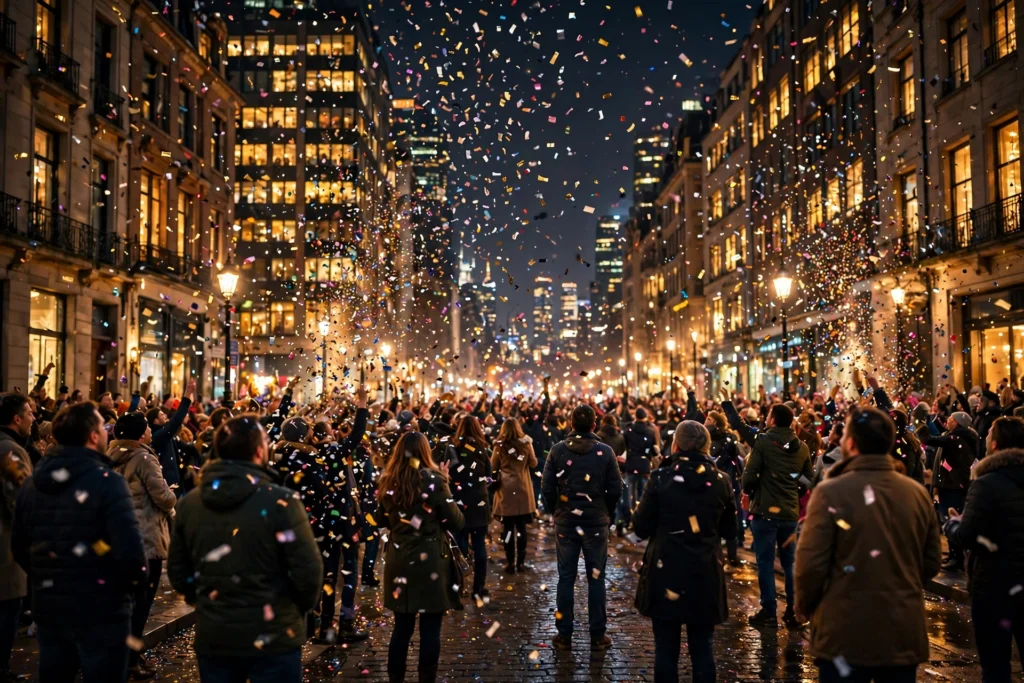
In Ghana, December 31 is known simply as “31st Night” — and it belongs to the church. Across the country, from Accra’s mega-auditoriums to village chapels in the Ashanti Region, millions of Ghanaians gather for watchnight services: all-night worship that carries them from the old year into the new with prayer, gospel music, prophecy, and thanksgiving. When the services end in the early hours, the celebration continues — family feasts, the Osu nightlife strip, beach parties, and the great national debate over jollof rice. Ghana’s New Year is faith first, festivity always, and community throughout.
This guide covers Ghana’s watchnight tradition, the customs around it, Accra’s celebrations, the food, and how the diaspora keeps 31st Night alive abroad.
Watchnight Services: Ghana’s Defining Tradition
The watchnight service (also called 31st Night service) is the undisputed center of the Ghanaian New Year. The concept: believers “watch” through the night in prayer, like the biblical watchmen, guarding the passage from one year to the next. Services typically begin around 9 p.m. on December 31 and run until 1 or 2 a.m. on January 1, structured around the midnight crossing.
The Shape of the Night
A Ghanaian watchnight service moves through familiar movements: opening praise and worship with full gospel bands, choir ministrations, congregational dancing, prayers of thanksgiving for the year ending, the sermon — often including the declaration of the coming year’s theme — and then the intense final hour. As midnight approaches, the atmosphere heightens: collective prayer, sometimes loud and simultaneous, builds to the moment of crossing.
At midnight: jubilation. Shouts, hugs, dancing, trumpets and vuvuzelas in some congregations, and the pronouncement of blessings. Prophetic declarations — words of direction and blessing for the new year, for the nation, for individuals — are a hallmark, and in Ghana’s charismatic tradition they are received with deep seriousness. The service closes with thanksgiving for the new year and a benediction, and worshippers stream out into the January dark, joyful and exhausted.
White Clothes and Solemn Joy
Many Ghanaians wear white to watchnight services — symbolizing purity, newness, and victory. The sight of thousands in white, singing under auditorium lights as midnight strikes, is one of the iconic images of the African New Year. Others dress in their festive best: the watchnight is a gala, and Ghanaian fashion — kente, lace, bold prints — is on full display.
Why Watchnight Runs So Deep
Ghana is a profoundly religious country, and the watchnight tradition draws on deep roots: the Methodist and mission-church watchnight services of the colonial era, fused with the exuberant worship of the charismatic movement that has shaped Ghanaian Christianity for decades. For many families, 31st Night in church is non-negotiable — the way the year is properly closed and opened. Children grow up falling asleep on church benches as midnight approaches; adults describe the crossing as the year’s most important spiritual moment.
The Great Churches and Their 31st Night
Ghana’s church landscape is rich, and its 31st Night services reflect that diversity — a few prominent examples among thousands.
Action Chapel International
Archbishop Nicholas Duncan-Williams’ Action Chapel — one of Ghana’s pioneering charismatic ministries — holds a renowned 31st Night service at its Prayer Cathedral in Accra. The Archbishop’s prophetic declarations for the coming year are national news, discussed across media and social platforms for days. The service draws worshippers from across the country and the diaspora.
ICGC (International Central Gospel Church)
Dr. Mensa Otabil’s ICGC holds its crossover/watchnight service at Christ Temple in Accra, known for its teaching depth and the declaration of the year’s theme. ICGC’s emphasis on practical faith and national development gives its New Year observance a distinctive reflective character alongside the celebration.
The Church of Pentecost
One of Ghana’s largest denominations, the Church of Pentecost holds watchnight services in thousands of local assemblies nationwide — the grassroots backbone of the tradition. In villages and towns across the country, the local Pentecost assembly’s 31st Night is the community’s New Year.
Catholic, Methodist, Anglican, and Presbyterian Watchnights
The historic mission churches hold their own watchnight services — often more liturgical, with hymns, litanies, and Holy Communion as the year turns. These services connect the Ghanaian New Year to a global Christian tradition of New Year’s Eve worship, observed with Ghanaian warmth.
Prophecy Night: A Ghanaian Specialty
A distinctive feature of Ghana’s 31st Night is the prominence of prophecy. In the charismatic tradition, the crossing into the new year is a moment of heightened spiritual sensitivity, and pastors deliver prophetic words — for the nation, for the church, for individuals. These prophecies are taken seriously: national prophecies about the coming year’s politics and economy are reported in the press, debated on radio, and remembered (and checked) as the year unfolds.
Ghana’s police have in past years cautioned churches about prophecies that could cause public alarm — particularly death prophecies about public figures — and some churches have adjusted how such words are delivered. The dynamic is a fascinating window into the intersection of faith and public life: in Ghana, the New Year is not just celebrated; it is spiritually mapped, and the map matters.
After the Amen: Accra Celebrates
When the services end, Ghana’s New Year shifts from the sacred to the social — and Accra, the capital, leads the way.
Osu: The Nightlife Strip
Osu — specifically Oxford Street — is Accra’s famous nightlife district, and on 31st Night it comes alive after the churches empty. Bars, clubs, and street food vendors do their biggest business of the year; the street fills with celebrants; music spills from every doorway. The Osu New Year has a democratic, street-party energy: everyone is welcome, the drinks are affordable, and the dancing goes until morning.
Beach Parties and Rooftops
Accra’s beaches — Labadi, Coco Beach — host New Year’s Eve parties with the Atlantic as a backdrop, while the city’s growing rooftop scene offers skyline countdowns. Ghana’s December weather (warm, dry — the harmattan dust sometimes hazes the skies) makes outdoor celebration natural.
Fireworks Over the City
Fireworks mark midnight across Accra — municipal displays in some years, private and hotel displays in others, and neighborhood knockouts everywhere. The city’s skyline on 31st Night, glittering over the Gulf of Guinea, is a sight worth traveling for.
Family Customs: The Feast and the Visits
The Ghanaian family New Year centers on food and visiting. After (or before) the watchnight service, families feast — and Ghanaian holiday cooking is serious business.
The New Year Table
The spread: jollof rice (Ghana’s pride — see below), waakye, fufu with light soup or groundnut soup, banku with tilapia, fried plantain, kelewele (spicy fried plantain), and grilled meats. The cooking is communal — women of the extended family gather to prepare, and the quantities are designed for crowds. Fufu pounding on New Year’s Eve is a sound of the season.
The Jollof Wars: Ghana’s Claim
The great West African debate: Ghana vs. Nigeria, whose jollof reigns? Ghanaian jollof — cooked with fragrant jasmine rice, a rich tomato-pepper base, and often served with shito (black pepper sauce) — has its fierce defenders, and Ghanaians argue their version’s superiority with patriotic fervor. International jollof competitions have only intensified the rivalry. Our diplomatic position, as ever: both are magnificent, and the debate is the real tradition. (Nigeria’s case is made in New Year traditions in Nigeria.)
Visits, Blessings, and New Clothes
New Year’s Day is for visiting elders and family — children in new clothes paying respects, blessings given, small gifts exchanged. The extended family compound is the setting: cousins everywhere, aunties directing operations, the elders holding court. It is loud, warm, and essentially Ghanaian.
Regional Ghana: Beyond Accra
Kumasi and the Ashanti Region
Kumasi, the Ashanti capital, celebrates with royal dignity and massive church gatherings. The Manhyia Palace area and the city’s cultural center host events; the Ashanti New Year blends Akan traditional customs with the Christian watchnight. The kente cloth on display on 31st Night in Kumasi is unmatched anywhere.
Cape Coast and Elmina
The historic coastal towns offer a reflective New Year — the Atlantic, the castles, and a quieter celebration. Some visitors combine the New Year with heritage tourism at Cape Coast Castle, making the turning of the year a moment of historical reckoning as well as celebration.
The North
In Tamale and the northern regions, where Islam predominates, December 31 is a more low-key, social occasion — family dinners, community gatherings — while the Christian minority holds its watchnight services. The coexistence is easy and long-standing.
Detty December, Ghanaian Style
Like Nigeria, Ghana has its own December homecoming season — the diaspora (“been-tos”) returning from London, New York, and Toronto, Afrochella (now Afrofuture) and the festival calendar drawing international visitors, and Accra’s social scene at its annual peak. The Ghanaian December is a major cultural tourism draw, and 31st Night is its climax: watchnight in church, then the city until dawn.
The Diaspora 31st Night
Ghanaian churches abroad — in London, New York, Toronto, Amsterdam — hold full watchnight services on December 31, replicating the homeland night: white clothes, gospel bands, midnight prophecy, the theme declaration. For the diaspora, 31st Night is the umbilical cord to home — the night Ghana feels closest, wherever you are.
Second-generation Ghanaians abroad often experience the watchnight as their most Ghanaian night of the year — the Twi and Ga phrases, the specific songs, the aunties’ cooking afterward. The tradition transmits identity more effectively than any lecture: you learn you are Ghanaian by crossing midnight in a room full of Ghanaians.
31st Night Fashion: Dressing for the Crossing
Like Nigeria, Ghana treats 31st Night as a fashion occasion — and Ghanaian style on December 31 is a spectacle in its own right. The white-outfit tradition gives the watchnight a striking visual unity, but within the white there is infinite variation: white lace, white kente accents, white agbada with embroidery, white gowns with bold accessories. Those not in white wear their festive best — and Ghanaian festive best is not subtle.
The kente cloth deserves special attention. Woven by the Asante and Ewe peoples, kente’s bright geometric patterns are among the world’s most recognizable textiles, and 31st Night is a prime occasion for wearing it — stoles, wrappers, and full ensembles that turn the congregation into a living tapestry. The fashion markets of Accra (Makola) and Kumasi do roaring business in December as families buy fabrics and commission tailors.
As in Nigeria, the fashion carries meaning: you cross into the new year presenting your best self, honoring the occasion and the community. The photographs — shared across social media within hours — become the visual record of the year turned. “What did you wear for 31st Night?” is a question with real social weight.
New Year’s Day: Rest, Food, and Football
January 1 in Ghana unfolds at a humane pace. The watchnight ended in the early hours; the morning is for sleep. By afternoon, the family gathers again — for the leftovers feast, which in Ghana is an institution: the jollof somehow improved overnight, the fufu pounded fresh, the gathering smaller and sleepier than the night before but no less warm.
The afternoon’s entertainment is often football — the European leagues play through the holiday, and Ghana’s football-mad public follows the Premier League with passion. The television goes on, the debates begin (Arsenal vs. everyone, as ever), and the New Year settles into its comfortable second day.
Visits continue through the day: the rounds of elders, the neighbors’ greetings, the children’s collections. And in the evening, the more energetic head back out — the January 1 parties and beach gatherings are a tradition for the young, the night’s second act for those with stamina remaining. Ghana’s New Year is a marathon, and January 1 is the cool-down lap: joyful, unhurried, and full of food.
The Music of 31st Night: Gospel, Highlife, and Hiplife
The soundtrack of Ghana’s New Year deserves its own appreciation. The watchnight services run on gospel — Ghanaian gospel music is a powerhouse tradition, with mass choirs, virtuoso soloists, and bands that could headline festivals. The praise-and-worship sessions before midnight are full concerts: call-and-response singing, traditional drums alongside modern kits, dancing in the aisles. Even the theologically skeptical find themselves moved — the music is simply that good.
After church, the soundtrack shifts: highlife — Ghana’s signature popular music, born in the early 20th century from the fusion of Akan rhythms, Western instruments, and jazz — provides the after-party’s swing, alongside hiplife (Ghanaian hip-hop), Afrobeats, and gospel’s party-friendly cousins. The Osu street party runs on this mix; the beach parties add international dance music; and the family compounds play whatever the bluetooth speaker holds.
Music is not decoration in the Ghanaian New Year — it is infrastructure. The songs carry the theology, the dancing carries the joy, and the shared repertoire (everyone knows the watchnight hymns, everyone knows the highlife classics) makes the whole country feel like one congregation. A Ghanaian New Year without music is unimaginable; with it, even the waiting — for midnight, for the prophecy, for the food — feels like celebration. And when the watchnight ends and the highlife takes over, the transition is seamless: the same joy, the same community, just a different rhythm — praise giving way to party without missing a beat.
Highlife Classics and the After-Party
The after-church celebration runs on highlife’s golden repertoire — the guitar-band classics that every Ghanaian knows by heart — mixed with contemporary hiplife and Afrobeats. DJs at the Osu street parties and beach events read the crowd expertly: the older classics for the aunties and uncles, the new hits for the youth, and the gospel crossovers that keep the night’s spiritual thread alive. By 3 a.m., the distinctions blur: everyone is dancing to everything, and the New Year has achieved its final form — a whole city, moving together.
The Harmattan Season: Weather and Atmosphere
Ghana’s New Year unfolds during the harmattan — the dry, dusty trade wind that blows from the Sahara across West Africa from roughly November to March. The harmattan hazes the skies, cools the nights, and coats everything in fine dust. It gives December in Ghana its distinctive atmosphere: bright but softened sunlight, cool dry evenings perfect for outdoor celebration, and a fine red dust on shoes by night’s end.
The harmattan shapes the holiday practically: the dry air is kind to the all-night outdoor portions of the celebration, the cooler nights make the white watchnight outfits comfortable, and the hazy skies give Accra’s fireworks a diffused, glowing quality. Visitors should pack accordingly — lip balm and moisturizer against the dry air, a light layer for the evening, and no white shoes you care about. The dust gets everywhere; Ghanaians accept it with the ease of long familiarity. It is, in its way, part of the season’s sensory signature: the smell of dust, the sound of gospel, the taste of jollof — the Ghanaian New Year, complete.
Frequently Asked Questions
What is 31st Night in Ghana?
“31st Night” is the Ghanaian name for New Year’s Eve, centered on the watchnight church service — all-night worship (roughly 9 p.m. to 1–2 a.m.) carrying believers across midnight into the new year with prayer, gospel music, prophecy, and thanksgiving. It is the defining ritual of the Ghanaian New Year.
Why do Ghanaians wear white to watchnight services?
White symbolizes purity, newness, and victory — fitting for crossing into a new year. The sight of congregations in white at midnight is an iconic image of the Ghanaian New Year, though festive dress of all kinds is also common.
What is the prophecy tradition on 31st Night?
In Ghana’s charismatic churches, pastors deliver prophetic declarations for the coming year — for the nation, the church, and individuals — at the midnight crossing. These are taken seriously and widely discussed; authorities have occasionally cautioned against alarming public prophecies.
Where should visitors celebrate New Year’s Eve in Ghana?
Attend a watchnight service for the authentic core of the celebration (visitors are welcome; dress festively and arrive early), then experience Osu’s nightlife, a beach party, or a rooftop countdown. Accra is the center of the action; Kumasi offers Ashanti cultural depth.
What do Ghanaians eat on New Year?
Jollof rice, waakye, fufu with soup, banku with tilapia, kelewele, and grilled meats — communal, abundant cooking by the extended family. The Ghana-Nigeria jollof rivalry is a beloved holiday debate.
How does Ghana’s New Year compare to Nigeria’s?
Both center on December 31 church services, but Ghana’s watchnight has its own character — the white clothes, the prophecy emphasis, the Osu after-party. See New Year traditions in Nigeria for the crossover-night parallel, and New Year traditions in South Africa for another African celebration. For your own planning: New Year reset guide and New Year wishes for 2027.
What should visitors wear to a 31st Night service?
Dress festively — this is a gala occasion. Many Ghanaians wear white (symbolizing purity and newness), so a white or light-colored outfit fits beautifully; otherwise, wear your celebratory best. Ghanaian fashion on 31st Night is bold and elegant, and visitors who dress up are showing respect. Arrive early, as popular services fill hours before the 9 p.m. start.
A Final Word
Ghana’s New Year is a masterclass in how to meet the future: awake, together, dressed in white, singing. The watchnight tradition says that the turning of the year deserves witnesses — that you should be present, prayerful, and surrounded by your people when the clock strikes twelve. Then you feast, you dance on Oxford Street, you argue about jollof, and you visit your grandmother on New Year’s Day. Faith and joy, reverence and revelry: Ghana holds them together without contradiction, and the new year is better for it. However you celebrate — in church, at home with our practical New Year’s Eve plan, or on a rooftop somewhere — take Ghana’s lesson with you: be awake for midnight, and be grateful when it comes — and if you are lucky enough to spend it in Ghana, wear white, sing loud, and save room for the jollof — Ghanaian, obviously.