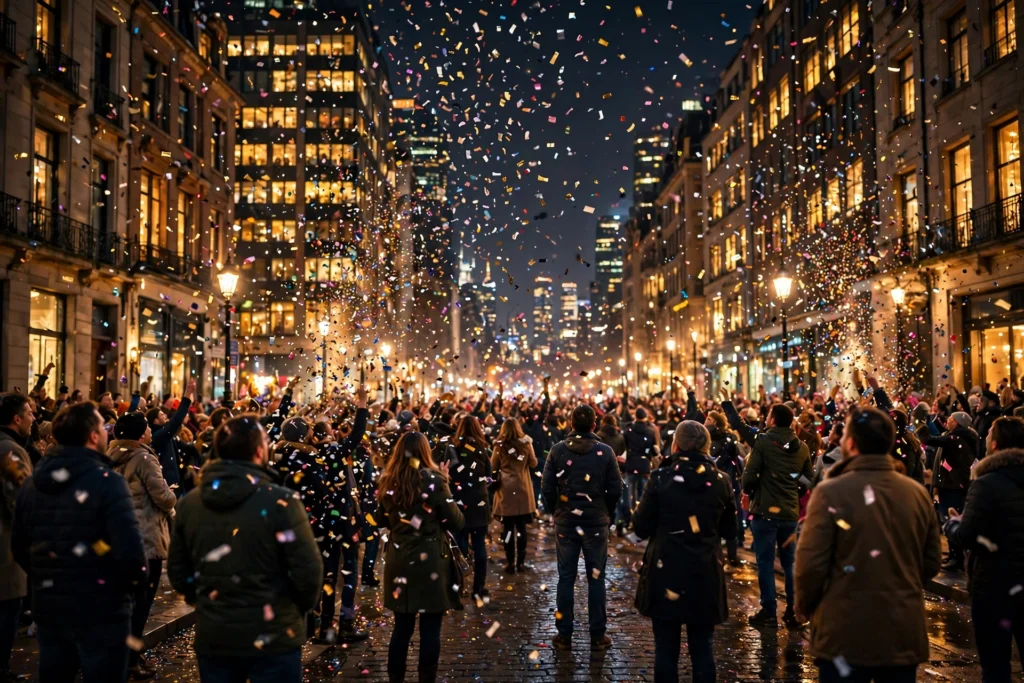
In Nigeria, the new year does not begin with fireworks — it begins with prayer. On December 31, tens of millions of Nigerians head to church for “crossover night”: all-night worship services that carry the faithful from the old year into the new with praise, dancing, prophecy, and communion. The crossover service is the defining ritual of the Nigerian New Year — a phenomenon so central that the country’s biggest churches build auditoriums for hundreds of thousands, broadcast to millions more, and set the spiritual agenda for the nation. Then, as the services end in the early hours, Lagos erupts: Detty December parties, street celebrations, and fireworks carry the joy until dawn.
This guide explains Nigeria’s crossover night tradition — what happens in the services, which churches lead them, how families celebrate after, and how Lagos turns December into the party month of the African calendar.
Crossover Night: The Church Service That Defines the Nigerian New Year
“Crossover” is the operative word. The theology is vivid: at midnight, believers spiritually cross from the old year into the new — leaving behind its troubles, carrying forward its lessons, and entering the new year under divine covering. The service is structured around this crossing: the hours before midnight are for thanksgiving for the year ending; midnight itself is the moment of prayer, prophecy, and declaration; the hours after are for celebration and the first communion of the year.
The scale is staggering. Nigeria is home to some of the world’s largest church congregations, and their crossover services are among the largest religious gatherings on earth. Services typically run from around 9 or 10 p.m. on December 31 until 2 or 3 a.m. on January 1 — though many worshippers arrive hours early to secure seats, and the atmosphere in the final hour before midnight is electric: singing, dancing, and anticipation building toward the crossing.
The Anatomy of a Crossover Service
While each church has its own order of service, the crossover night follows a recognizable arc:
- Praise and worship: The evening opens with extended singing — Nigerian gospel music is joyful, percussive, and participatory. Congregations sing, dance, and wave; the band plays; the energy builds. This is not background music; it is the main event for the first hours.
- Thanksgiving: Testimonies and prayers of gratitude for the year ending — for survival, for provision, for answered prayers. The thanksgiving offering is a significant moment: generous giving as the year closes.
- The Word: A sermon, often focused on the theme for the coming year. Major churches announce an annual theme — a word or phrase (e.g., a “year of” something) that frames preaching and prayer for the next twelve months. The theme declaration is a headline event, reported in Nigerian media.
- The crossover moment: As midnight approaches, the service shifts into intense prayer — often loud, simultaneous, whole-congregation prayer. At the stroke of twelve, the declaration: shouts of joy, hugs, dancing, and the pronouncement of blessings for the new year. Prophetic declarations for the nation and for individuals are a hallmark of this moment.
- Communion and first blessing: Many services include Holy Communion as the first act of the new year — a solemn, unifying moment after the exuberance of midnight. The service then winds down with final songs and the benediction, typically ending in the early hours of January 1.
Why It Matters So Much
To understand crossover night’s centrality, understand Nigeria. This is a deeply religious country — Christianity dominant in the south, Islam in the north — where faith is not a private compartment but the organizing frame of life. The new year is not just a calendar event; it is a spiritual threshold. Crossing it in prayer, surrounded by tens of thousands of fellow believers, is for many Nigerians the most important night of the year — more significant than any party.
The services also function as national moments. The prophecies and theme declarations of prominent pastors are discussed across the country for weeks; the attendance figures make headlines; and the broadcasts reach the vast Nigerian diaspora, for whom watching the crossover service from London or Houston is a way of being home for the new year.
The Great Churches and Their Crossover Nights
A few institutions define the landscape — described here as prominent examples, with the note that Nigeria has thousands of churches holding crossover services, from cathedrals to village chapels.
The Redeemed Christian Church of God (RCCG)
RCCG’s crossover service at the Redemption Camp along the Lagos-Ibadan Expressway is among the world’s largest annual religious gatherings — a purpose-built arena holding hundreds of thousands, with the service led by the church’s General Overseer. The Holy Ghost Congress in December builds toward it; the crossover night is its climax. Attendance requires planning: traffic on the expressway on December 31 is legendary, and worshippers arrive many hours early.
Winners’ Chapel (Living Faith Church)
Bishop Oyedepo’s Winners’ Chapel holds its crossover service at Faith Tabernacle in Ota, Ogun State — one of the world’s largest church auditoriums — with the annual theme declaration a signature moment. The church’s emphasis on faith, prosperity, and “breaking limits” gives its crossover a distinctive declarative energy.
Mountain of Fire and Miracles (MFM)
MFM’s crossover services are famous for their intensity — the church’s prayer tradition is vigorous and warfare-oriented, and its New Year’s Eve services draw enormous crowds to its Prayer City, also along the Lagos-Ibadan corridor. For those seeking the most fervent version of crossover night, MFM is its exemplar.
Christ Embassy (LoveWorld)
Pastor Chris Oyakhilome’s Christ Embassy holds its crossover service with a global broadcast reach — the church’s media infrastructure carries the night to viewers worldwide, making it the crossover of choice for much of the diaspora. The New Year’s Eve service includes the declaration of the coming year’s theme, watched internationally.
…And Thousands More
Beyond the giants: every neighborhood church, from the Anglican and Catholic parishes to the newest Pentecostal plants, holds its own crossover. In many ways these smaller services are the heart of the tradition — the community gathered, the pastor who knows every family, the children asleep on the pews as midnight approaches. The mega-churches make the headlines; the neighborhood churches make the memories.
Detty December: Lagos After the Amen
When the services end — typically between 1 and 3 a.m. — Lagos does not sleep. December in Lagos is “Detty December”: the month when the diaspora returns (the “IJGBs” — I Just Got Backs), the city fills with parties, concerts, and weddings, and the social calendar goes into overdrive. New Year’s Eve is the peak of the peak.
The Return of the Diaspora
Detty December is driven by returnees: Nigerians living in London, New York, Toronto, and beyond who come home for the holidays with savings to spend and reunions to enjoy. Their return transforms the city — traffic thickens, clubs fill, and a whole economy of parties, concerts, and events springs up to serve them. The energy is infectious: Lagos in December feels like a city throwing a month-long party for its returning children.
Concerts and Parties
Nigeria’s Afrobeats superstars — the world’s biggest Afropop acts — typically headline December concerts in Lagos, and New Year’s Eve events range from beach parties at Landmark and Elegushi to rooftop countdowns on Victoria Island and warehouse raves on the mainland. Tickets for the headline events sell out; the informal street parties need no tickets at all.
Fireworks and “Knockouts”
Fireworks light up the Lagos skyline at midnight — from private displays at upscale events to the beloved street-level “knockouts” (powerful bangers) that echo through neighborhoods. Note that some states and authorities periodically restrict or discourage fireworks for safety and security reasons; check current local guidance. The noise, in any case, is guaranteed: Lagos does not do quiet midnights.
Family Celebrations: The Feast After the Faith
For most Nigerian families, the pattern is: church first, feast after. Worshippers return home in the early hours of January 1 to tables prepared before they left — or they feast on New Year’s Day itself, when the extended family gathers.
The New Year Table
The Nigerian New Year feast is a showcase of the country’s cuisine: jollof rice (the subject of the famous West African rivalry — more below), fried rice, ofada or white rice with ayamase, pounded yam with egusi or efo riro, peppered chicken, turkey, asun (spicy goat meat), and nkwobi or isi ewu for those who love the rich, traditional flavors. Drinks flow: Chapman (the beloved Nigerian mocktail), zobo, palm wine in some regions, kunnu, and champagne for the midnight toast at parties. The quantities are designed for crowds — and the crowds always come.
The Jollof Question
No discussion of a Nigerian feast is complete without acknowledging the jollof wars — the friendly-but-fierce rivalry with Ghana over whose jollof rice reigns supreme. Nigerian jollof, smoky from the party-style cooking over firewood, has its passionate defenders; Ghanaian jollof has its own. The debate is a staple of West African social life and flares reliably every holiday season. Our position: both are excellent, and the argument is half the fun. (See New Year traditions in Ghana for the other side.)
Visits and Blessings
New Year’s Day is for visiting: children pay respects to parents and elders, families exchange greetings, and the traditional rulers and community leaders receive homage in some regions. New clothes are worn — “Christmas clothes” extend through the New Year — and photographs in matching family outfits are a holiday staple. Blessings flow downward from elders to the young, often accompanied by gifts of money for children.
Crossover Night for Visitors: What to Know
Attending a crossover service as a visitor is a profound cultural experience — and churches generally welcome respectful guests. A few notes:
- Dress well: Nigerians dress up for crossover night — this is a gala occasion. Smart, festive attire is the norm.
- Arrive early: Popular services fill hours before the start. Plan transport carefully; traffic around major venues on December 31 is extreme.
- Expect length: Services run 4–6 hours. Pace yourself; there are usually breaks and the energy carries you.
- Participate respectfully: Stand, sing, and join in as you are comfortable. You will not be singled out — the congregation is focused on worship, not on you.
- Security: Major venues have organized security and traffic management. Follow ushers’ instructions and keep valuables minimal.
- After the service: If invited to a family’s New Year feast afterward, accept — it is the fullest version of the celebration.
The Diaspora Crossover: Nigeria’s New Year Abroad
Nigerian churches abroad — in London, Houston, Toronto, Johannesburg — hold their own crossover services, often timed to Nigerian midnight or local midnight (sometimes both). For the diaspora, these services are the anchor of homesickness and identity: the same songs, the same prayers, the same crossing, thousands of miles from Lagos.
The broadcasts of the mega-church services serve the same function digitally: families in the diaspora stream the crossover from the Redemption Camp or Faith Tabernacle, crossing into the new year simultaneously with the homeland. It is a remarkable use of technology in service of tradition — the village square, expanded to the size of the planet.
Crossover Fashion: Dressing for the Night
Crossover night is a fashion event. Nigerians dress for December 31 the way others dress for weddings — and the “crossover outfit” is planned, discussed, and photographed with real seriousness. The unwritten dress code: festive, elegant, and new if possible. Flowing gowns, sharp suits, elaborate traditional wear — agbada, aso-ebi (coordinated family fabrics), lace, and gele headwraps — fill the auditoriums in a display of style that is itself a form of celebration.
The aso-ebi tradition deserves special mention: families or groups choose a matching fabric and have outfits made in coordinated styles, so the whole clan arrives as a visual unit — a stunning statement of togetherness in a crowd of hundreds of thousands. Tailors do their busiest business of the year in December, and the markets for lace, ankara, and aso-oke fabrics overflow in the final weeks of the year.
The fashion has meaning beyond vanity. Dressing magnificently for crossover night is a theological statement: you appear before God in the new year at your best, and you honor the occasion with your presentation. It is also, practically, how you will be remembered in a year of photographs. The crossover outfit, worn once and treasured, becomes part of the family’s visual history — the “what we wore when we crossed into” the year.
New Year’s Day: Thanksgiving Services and Family Time
January 1 in Nigeria begins, for many, back in church — the New Year thanksgiving service, a shorter, joyful gathering to dedicate the year just begun. Then the day opens into its true purpose: family. The extended family converges on the family house — grandparents’ home, or the eldest’s — for the New Year feast, the visits, and the long, happy chaos of a Nigerian family gathering.
The day’s rituals: new clothes (the Christmas outfits get a second outing), photographs (the matching-family-outfit photoshoot is a serious production), visits to elders and neighbors, and the children’s favorite — the collection of New Year gifts and money from uncles and aunties. Plates of food move between houses; music plays; the television shows the previous night’s crossover highlights.
For the diaspora returnees, New Year’s Day is often the emotional peak of the trip — the full family, together, unhurried. For those who could not travel, the video calls continue: the family holds the phone up so the absent ones can see the table, hear the noise, and feel, for a moment, less far away. The Nigerian New Year, sacred and social at once, ends as it began: with everyone together, grateful, and looking forward.
The Theme of the Year: How Churches Set the Agenda
One of crossover night’s most consequential rituals is the declaration of the coming year’s theme. Major Nigerian churches announce an annual theme — a phrase that will frame sermons, prayer points, conferences, and personal devotion for the next twelve months. The themes are bold and declarative: years “of” open heavens, overflow, dominion, or divine speed — each a theological lens and a motivational slogan at once.
The theme declaration is genuine news in Nigeria. It trends on social media within minutes, dominates Christian media for days, and becomes the vocabulary of the faithful — believers speak of “my year of” this or that, pray the theme’s scriptures, and measure the year against its promise. Critics sometimes dismiss the themes as marketing; adherents experience them as direction — a word to hold onto when the year gets difficult.
The practice has spread beyond the mega-churches: thousands of smaller congregations now declare their own annual themes, and the themes cross denominational lines — you will hear them in Anglican parishes and Pentecostal plants alike. Whether or not one shares the theology, the psychological wisdom is clear: beginning the year with a declared intention — a word to carry, prayed over and spoken aloud at midnight — is a powerful way to face twelve unknown months. It is Nigeria’s distinctive contribution to the global art of the New Year’s resolution: not a private wish, but a proclaimed theme.
Frequently Asked Questions
What is crossover night in Nigeria?
Crossover night is the all-night church service on December 31 (typically ~9 p.m. to 2–3 a.m.) during which worshippers pray, sing, and celebrate across the midnight boundary into the new year. It is the defining ritual of the Nigerian New Year, observed by tens of millions across thousands of churches.
Which churches hold the biggest crossover services?
The largest include RCCG’s service at the Redemption Camp, Winners’ Chapel at Faith Tabernacle in Ota, MFM’s Prayer City, and Christ Embassy’s globally broadcast service — all in the Lagos/Ogun corridor. Thousands of smaller churches hold their own crossover nights nationwide.
What happens at midnight during a crossover service?
Intense congregational prayer, shouts of joy, dancing, hugs, prophetic declarations and blessings for the new year, and often Holy Communion as the first act of January 1. The annual theme for the coming year is typically declared around this time.
What is Detty December?
“Detty December” is the nickname for Lagos’s festive season, when the Nigerian diaspora returns home and the city fills with parties, concerts, weddings, and events throughout December, peaking on New Year’s Eve. It is one of Africa’s great social seasons.
Can visitors attend a crossover service?
Yes — churches generally welcome respectful visitors. Dress festively, arrive early (venues fill hours ahead), expect a 4–6 hour service, and plan transport carefully given the extreme holiday traffic around major venues.
How does Nigeria’s New Year compare to Ghana’s?
Both center on December 31 church services (crossover/watchnight), but Nigeria’s are larger in scale and more nationally prominent, while Ghana’s have their own distinct traditions. Compare with New Year traditions in Ghana — and settle the jollof debate there too. For your own new-year planning, see our New Year reset guide and New Year wishes for 2027.
What is the significance of the crossover theme?
Each major church declares an annual theme on crossover night — a phrase framing the coming year’s preaching, prayer, and devotion (e.g., a “year of” open heavens or overflow). The themes trend nationally on social media, become the vocabulary of believers’ prayers, and function as a collective New Year’s resolution: a declared intention carried into the unknown months. Thousands of smaller churches now declare their own themes as well.
A Final Word
Nigeria’s New Year is a testament to the power of beginning deliberately. Tens of millions of people choose to meet the new year not with distraction but with intention — on their knees or on their feet dancing, but gathered, awake, and purposeful at the exact moment the calendar turns. The crossover is more than a service; it is a national act of hope, repeated every year: that the coming twelve months can be faced, and shaped, and blessed. Then Lagos parties until dawn — because hope, in Nigeria, is also a celebration — loud, danced, and shared with everyone within earshot. However you mark your own crossing, do it with intention: gather your people, name your hopes for the year, and step across midnight together, awake and grateful. Our practical New Year’s Eve at home plan can help you design the evening.