On December 31, while much of the world counts down, Israel throws one of its biggest parties of the year — under a name that puzzles outsiders. Israelis call New Year’s Eve “Sylvester” (סילבסטר), after Pope Sylvester I, whose feast day falls on December 31. For a country whose religious new year (Rosh Hashanah) arrives in early autumn with apples, honey, and solemn prayer, the December celebration is something else entirely: a secular, cosmopolitan, unapologetically fun night out. Tel Aviv’s rooftops fill, champagne flows, and a million Russian-speaking Israelis celebrate Novy God with a decorated yolka tree as if they never left Moscow.
This guide explains how Sylvester night is celebrated in Israel: the name, the parties, the cultural tensions, and the traditions of the communities that keep the night alive.
Why Is It Called “Sylvester”?
The name is the first thing to understand. December 31 is the feast day of Saint Sylvester — Pope Sylvester I, who died on December 31, 335 AD. In many European countries (Germany, Austria, Switzerland, France, Poland), New Year’s Eve is still called Silvester or Sylvestre. The name came to Israel with European Jewish immigrants and stuck — so firmly that most Israelis have no idea who Sylvester was. Ask a twenty-something in Tel Aviv what “Sylvester” means and you will likely get a shrug: it is just what the night is called.
The name carries a quiet irony. A Catholic pope’s feast day became the label for a secular Israeli party night — a neat illustration of how the holiday functions in Israel: culturally imported, religiously neutralized, and repurposed for fun. Some Israelis, particularly those sensitive to the holiday’s Christian associations, prefer to call it simply “New Year’s Eve” or “the civil new year” (ראש השנה האזרחית, Rosh Hashanah Ezrahit). But “Sylvester” remains the everyday word — on invitations, in advertising, in conversation.
Rosh Hashanah vs. Sylvester: Two New Years
Israel genuinely has two new years, and they could not be more different. Rosh Hashanah, the Jewish new year, falls in September or October (on the Hebrew calendar). It is a major religious holiday: two days of synagogue services, festive family meals, apples dipped in honey for a sweet year, the sounding of the shofar (ram’s horn), and ten days of reflection leading to Yom Kippur. It is solemn, sacred, and central to Jewish identity.
Sylvester, by contrast, is a party. There is no religious content, no synagogue, no ritual — just the global, secular celebration of the Gregorian calendar turning. The two coexist easily because they serve different needs: Rosh Hashanah is the spiritual new year; Sylvester is the social one. Most secular Israelis observe both without any sense of contradiction, the way many Westerners treat Christmas as both religious and cultural.
This duality is worth keeping in mind when comparing Israel to other countries with multiple new years. India’s traditional new years, for example, carry deep religious weight while December 31 is the party — a similar split, differently arranged. See New Year traditions in India for the parallel.
How Secular Israelis Celebrate Sylvester Night
For secular Israelis — the majority in Tel Aviv and a large share of the country — Sylvester is a straightforward night of celebration: dinner with friends, a party or club, champagne at midnight, and the standard global countdown rituals. There are no Israel-specific religious customs attached; the traditions are the international ones, performed with Israeli enthusiasm.
The House Party
The most common Sylvester format is the house party. Friends gather for dinner — often a potluck, often elaborate — drink, talk, and count down together. Israeli house parties on Sylvester tend to be loud, late, and food-heavy; the dinner is not a prelude to the party but a central event. Midnight is marked with champagne (or sparkling wine), hugs, and phone calls to family.
Restaurants and Bars
Tel Aviv’s restaurants run special Sylvester menus — multi-course dinners with champagne pairings — and book out well in advance. Bars and clubs host ticketed parties with DJs, and the city’s famous nightlife does what it does best: stays open until morning. Jerusalem has a quieter but growing scene; Haifa, with its mixed Jewish-Arab population and hillside views over the bay, offers a distinctive setting.
What People Wear and Bring
Dress codes are festive but not formal — Tel Aviv style is polished-casual even on Sylvester. Common contributions to a house party: a bottle of wine or champagne, a dessert, and the expectation that you will stay very late. Fireworks are restricted in many areas (and politically sensitive — more on that below), so the midnight moment is usually marked with champagne, music, and noise rather than pyrotechnics.
Tel Aviv: The Heart of the Party
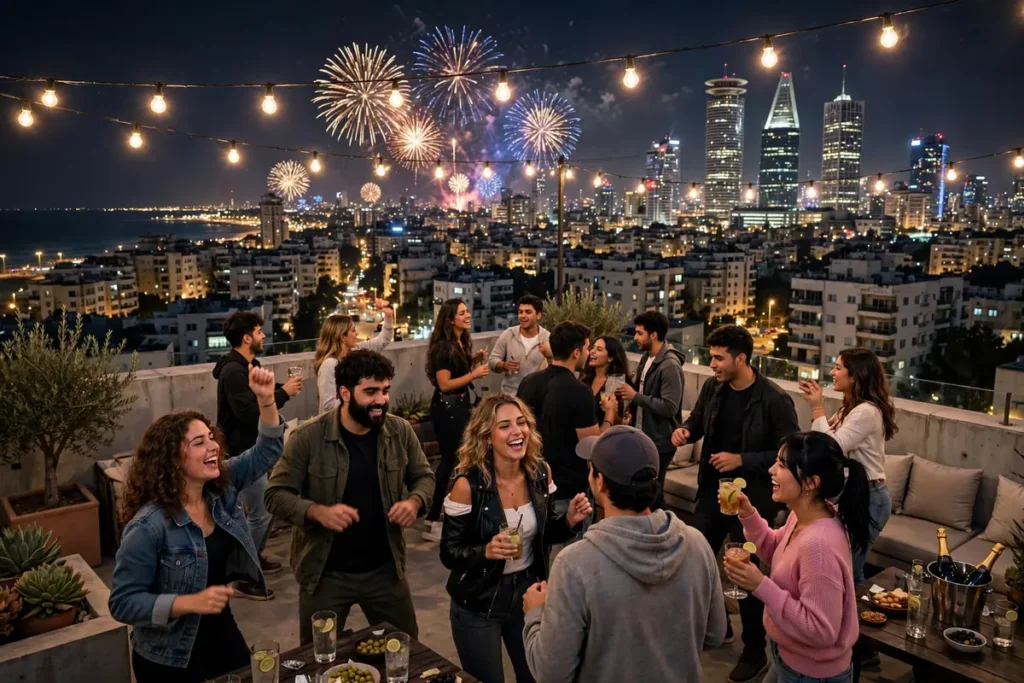
Tel Aviv is where Sylvester lives most vividly. The White City’s rooftop bars, beachfront clubs, and restaurant rows in areas like Rothschild Boulevard, Dizengoff, and the Jaffa port fill with celebrants. The Mediterranean setting gives the night a distinctive flavor: even in late December, Tel Aviv evenings are mild (typically 10–15°C), so rooftop and terrace parties are comfortable — a striking contrast to the freezing countdowns of northern Europe and North America.
The city’s international character shapes the celebration. Tel Aviv’s large community of expats, tech workers, and tourists means Sylvester parties often blend Israeli, European, and American customs. English is widely spoken at the bigger events, and visitors will find the city welcoming and easy to navigate on the night — though booking restaurants and clubs ahead is essential, as the best spots fill up.
A practical note: public transport in Israel largely shuts down from Friday afternoon to Saturday evening for Shabbat — and December 31 sometimes falls on a Friday or Saturday. When it does, plan transport carefully: taxis and ride-shares operate, but demand surges. Check the calendar for the year you are visiting.
The Russian-Speaking Community: Novy God in Israel
One of the richest Sylvester traditions in Israel belongs to the country’s roughly one million Russian-speaking immigrants, who arrived mainly in the 1990s. In the Soviet Union, New Year (Novy God) was the great winter holiday — Christmas was suppressed, so December 31 became the occasion for the decorated tree (yolka), the gift-giving, the family feast, and Ded Moroz (Father Frost). Immigrants brought the whole celebration with them.
For many Russian-speaking Israeli families, Novy God is the most important family holiday of the year — bigger, in emotional terms, than Rosh Hashanah. The traditions are observed with care: the yolka decorated with ornaments, the Olivier salad (a Russian potato salad that is non-negotiable), herring under a fur coat (layered herring salad), mandarin oranges, champagne at midnight to the chimes of the Kremlin clock (watched on Russian TV or streamed), and wishes written on paper, burned, and drunk in champagne for luck.
This community’s celebration has gradually influenced the broader Israeli Sylvester: the yolka appears in more and more non-Russian homes, and Russian New Year foods have entered the general holiday repertoire. It is a living example of how immigration reshapes a country’s traditions — and a reminder that “how Israel celebrates” has many answers.
Religious Perspectives: Not Everyone Celebrates
An honest guide must note that Sylvester is controversial in some quarters. Many religiously observant Jews do not celebrate December 31, viewing it as a non-Jewish holiday with Christian associations (hence the sensitivity around the name “Sylvester”). Some rabbis have discouraged participation; in ultra-Orthodox (Haredi) communities, the night passes like any other.
Among the broader religious-Zionist and traditional populations, attitudes vary: some ignore it, some treat it as a harmless secular date, and some celebrate quietly. The tension occasionally surfaces in public debate — over municipal funding for Sylvester events, or over the appropriateness of the name — but for most Israelis, it is background noise. The country has settled into a live-and-let-live equilibrium: Tel Aviv parties, Jerusalem is quieter, and everyone does as they wish.
Visitors should be aware of this diversity and respectful of it. Do not assume your Israeli hosts celebrate; if invited to a Sylvester gathering, it is a genuine welcome. And understand that fireworks, in a country with real security sensitivities, are not the casual neighborhood affair they are elsewhere — leave pyrotechnics to professional displays.
Food, Champagne, and Countdown Customs
There is no traditional “Sylvester menu” in Israel beyond the global standards — but the night’s eating and drinking have local character. Restaurant Sylvester menus lean Mediterranean: fresh fish, grilled meats, mezze spreads, and Israeli wine (the country’s wine industry is excellent and worth exploring). At house parties, the spread reflects Israel’s food culture: salads (many salads), dips, cheeses, and desserts.
Champagne — or, more commonly, cava, prosecco, or Israeli sparkling wine — is the midnight drink. The countdown itself follows the international format: ten seconds, shouting, hugs, kisses, phone calls. “Shana Tova” (Happy New Year) is the Rosh Hashanah greeting; on Sylvester, Israelis typically say “Happy New Year” in English or “Shana Tova Ezrahit” (civil Happy New Year). A kiss on the cheek — one, two, or three depending on background — seals it.
One charming custom that has taken hold: the midnight wish. Many Israelis write down wishes or resolutions as the clock strikes twelve — a quiet, personal moment amid the noise. If you are setting your own intentions, our New Year reset guide offers a thoughtful framework.
Celebrating Sylvester as a Visitor: Practical Tips
- Book ahead: Tel Aviv’s top restaurants and clubs sell out for Sylvester. Reserve dinners and buy party tickets in advance.
- Check Shabbat: If December 31 falls on Friday or Saturday, public transport is limited. Arrange taxis or stay within walking distance of your plans.
- Dress smart-casual: Festive but not black-tie, unless your venue specifies otherwise. December evenings are mild but bring a layer.
- Respect the diversity: Not everyone celebrates. Be gracious, do not proselytize the party, and keep fireworks expectations in check.
- Try Novy God food: If you are invited to a Russian-Israeli celebration, say yes — the Olivier salad and the midnight champagne ritual are worth experiencing.
- Stay safe: Tel Aviv is a safe party city, but standard big-night precautions apply: watch your drinks, plan your ride home, and keep your phone charged.
Sylvester and the Diaspora: Celebrating Israeli-Style Abroad
Israeli expats carry Sylvester with them. In New York, London, Berlin, and Los Angeles, Israeli communities host Sylvester parties that recreate the Tel Aviv vibe — the music, the food, the late-night energy. The Russian-Israeli Novy God tradition travels particularly well: a yolka, Olivier salad, and champagne at midnight work in any timezone.
For Israelis abroad, Sylvester often carries an extra charge of nostalgia — it is the night that feels most like home, precisely because it is the least religious and most social of the year’s holidays. The party becomes a portable piece of Tel Aviv.
The December Season: How Israel Looks in Late December
Visit Israel in late December and you will notice the season’s visual signatures — with local twists. In Tel Aviv, Haifa, and Jerusalem’s western neighborhoods, shops and malls put up lights and decorations; the “holiday sales” are a major retail event; and in areas with Christian or mixed populations — Jaffa, Haifa’s German Colony, Nazareth, Jerusalem’s Christian Quarter — you will see genuine Christmas decorations, markets, and trees.
Nazareth deserves special mention: the city of Jesus’ childhood goes all-out for the season, with a famous Christmas market, a giant tree, and illuminations that draw visitors from across the country. For many Israelis, a December trip to Nazareth or Haifa’s German Colony — with its lit-up Bahai Gardens backdrop — is the seasonal outing, the local equivalent of visiting a Christmas market in Europe.
In predominantly Jewish areas, the decorations lean generic-winter rather than Christmas-specific: lights, stars, “Happy New Year” banners in English. The retail calendar has its own rhythm — the big sales cluster around the end of the Gregorian year, and “Sylvester parties” are advertised everywhere from nightclubs to community centers. It is a festive, commercial, thoroughly modern December — recognizably part of the global season, inflected everywhere by Israel’s particular cultural mix.
New Year’s Day: What’s Open and What Isn’t
January 1 is not an official public holiday in Israel — a fact that surprises visitors. Government offices, banks, and many businesses operate normally (unless the date falls on Shabbat, when they close for the weekend). Schools are typically in session. This gives the Israeli Sylvester a particular poignancy: the party ends, and life resumes immediately.
In practice, the country runs at half-speed on January 1. Many workplaces unofficially tolerate late arrivals; Tel Aviv’s cafes fill with the bleary-eyed; and the beaches — yes, even in January, the Mediterranean is walkable — see a contemplative crowd. The Russian-speaking community, for whom Novy God is the bigger deal, often treats January 1 as a de facto holiday regardless.
For visitors: confirm opening hours for specific attractions, as some sites and museums adjust schedules around the date — the Tower of David Museum, for instance, may run special programming, while others keep standard hours. Restaurants and the Tel Aviv beachfront operate normally. And if you are out late on Sylvester itself, remember that the city wakes up on time the next morning — plan a slow January 1, Israeli style: strong coffee, a long walk along the tayelet (promenade), and no regrets. Laila tov — and happy new year, however you choose to mark it.
Beyond Tel Aviv: Jerusalem, Haifa, and Eilat
Tel Aviv dominates the Sylvester narrative, but the rest of Israel celebrates in its own keys. Jerusalem — holy, contested, and far more traditional than Tel Aviv — has a quieter, more ambivalent relationship with the night. The western (Jewish) side of the city hosts restaurant dinners and small parties; the German Colony and the city center see the most activity. But Jerusalem never fully lets go of its gravitas: even on Sylvester, the Old City walls glow gold, the night feels ancient, and the party has a self-conscious edge — fun, but fun in Jerusalem.
Haifa offers perhaps the most symbolically rich Sylvester in the country. The city’s Bahai Gardens — the terraced shrine glowing on Mount Carmel — provide a backdrop no other city can match, and Haifa’s genuine Jewish-Arab coexistence gives its New Year a shared, easy character. The German Colony’s restaurants and the port area host the night’s main events; the midnight view over the bay, with the gardens illuminated above, is quietly spectacular.
Eilat, at the country’s southern tip on the Red Sea, does the resort-town New Year: hotel galas, beach parties (the December weather is genuinely warm — often the warmest in the country), and a tourist-heavy crowd mixing Israelis with European winter-sun seekers. It is the choice for Israelis who want the holiday without the city — sun, sea, desert mountains across the water, and a countdown on the beach promenade with the mildest weather of any Israeli Sylvester.
In Pictures: New Year Traditions in Israel
In Israel, December 31 wears two names — “Sylvester” for secular partygoers and “Novy God” for the Russian-speaking community’s beloved holiday.
A decorated Novy God tree in an Israeli home, blending Soviet tradition with Middle Eastern warmth.
Watch: New Year Traditions in Israel
A short explainer on why Israelis call New Year’s Eve “Sylvester” — and how Novy God became a family holiday.
At a Glance: New Year Traditions in Israel
Israel’s layered New Year — Rosh Hashanah, Sylvester, and Novy God.
| Observance | When | What to know |
|---|---|---|
| Rosh Hashanah | Autumn (Sept–Oct) | The Jewish New Year — the religious and national new year, marked with prayer, apples and honey, and the shofar |
| Novy God | 31 December | Celebrated by many first- and second-generation immigrants from the former Soviet Union (a community of roughly a million arrivals since 1989); a secular family holiday with a decorated tree, Ded Moroz (Grandfather Frost), gifts, and a lavish midnight feast |
| “Sylvester” | 31 December | The common Israeli name for secular New Year’s Eve, after St. Sylvester whose feast day falls on December 31 — the name itself has been controversial |
| Novy God foods | 31 December night | Classic dishes include Olivier salad, herring under a fur coat, and champagne at midnight |
| Growing acceptance | 2010s onward | Retailers now stock Novy God goods and public figures acknowledge the holiday; workers can take January 1 off |
Frequently Asked Questions
Why do Israelis call New Year’s Eve “Sylvester”?
December 31 is the feast day of Pope Sylvester I (died 335 AD), and many European countries call the night Silvester/Sylvestre. The name came to Israel with European immigrants and became the everyday Hebrew term for New Year’s Eve, though many Israelis do not know its origin.
Do religious Jews celebrate New Year’s Eve?
Generally, no — many observant Jews view December 31 as a non-Jewish holiday and do not celebrate it. Israel’s Jewish new year is Rosh Hashanah in September/October. Sylvester is primarily a secular celebration, biggest in Tel Aviv and among Russian-speaking immigrants.
What is Novy God?
Novy God (Russian for “New Year”) is the December 31 celebration observed by Israel’s roughly one million Russian-speaking immigrants, with Soviet-era traditions: a decorated yolka tree, Olivier salad, herring under a fur coat, mandarin oranges, champagne at midnight to the Kremlin chimes, and wishes written on paper, burned, and drunk in champagne for luck. For many families, it is the year’s most important family holiday — bigger in emotional terms than Rosh Hashanah — and its foods and customs have gradually entered the broader Israeli celebration.
Is Tel Aviv good for New Year’s Eve?
Yes — Tel Aviv’s rooftop bars, clubs, and restaurants make it one of the Mediterranean’s best Sylvester destinations, with mild December weather as a bonus. Book ahead, check whether the date falls on Shabbat (affecting transport), and plan your evening in one walkable area.
Are there fireworks in Israel on New Year’s Eve?
Large public fireworks are uncommon — partly for security sensitivities, partly for noise and safety regulations. The midnight moment is typically marked with champagne, music, and celebration rather than pyrotechnics. Do not set off private fireworks.
How do you say Happy New Year in Israel on December 31?
“Happy New Year” in English is common; in Hebrew, “Shana Tova Ezrahit” (civil Happy New Year) distinguishes it from the Rosh Hashanah greeting “Shana Tova.” For message ideas, see our New Year wishes and captions for 2027. For comparison with another multi-new-year culture, read New Year traditions in Turkey.
Do Israeli schools and businesses close on January 1?
Generally no — January 1 is a regular working day in Israel (unless it falls on Shabbat). Schools are in session and offices operate normally, though many workplaces unofficially tolerate late arrivals after Sylvester night. Tourists should not expect closures, but should confirm hours for specific attractions. The Russian-speaking community often treats the day as a de facto holiday regardless of official status.
A Final Word
Sylvester in Israel is a study in reinvention: a pope’s feast day turned into a secular party, a Soviet winter holiday transplanted to the Mediterranean, a religious new year in autumn and a social one in winter, each complete on its own terms. It works because Israelis are comfortable holding multiple identities at once — ancient and modern, Middle Eastern and European, religious and secular. On December 31, the country does what it does best: argues about the name, then parties anyway. Whether you are on a Tel Aviv rooftop, at a Russian family’s yolka, or hosting your own countdown at home with our practical New Year’s Eve plan, the lesson of the Israeli Sylvester is simple: the new year belongs to whoever claims it, and it is always better shared.