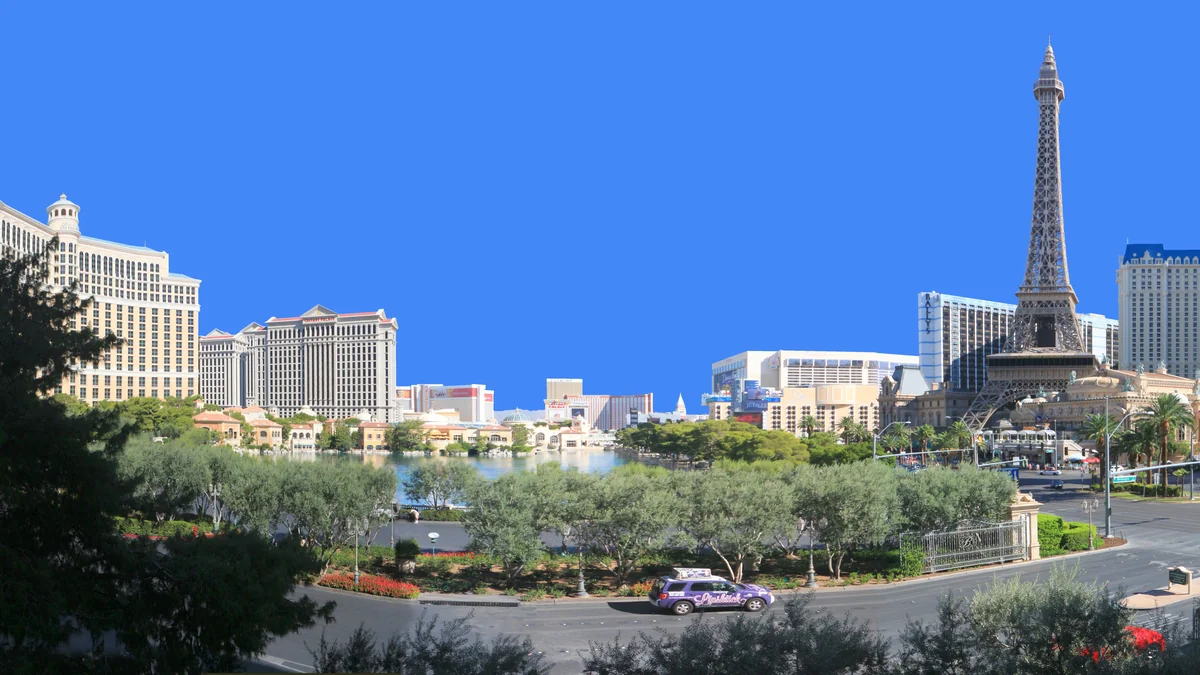
City information last reviewed: September 26, 2026.
Las Vegas is easiest to enjoy when you stop treating every resort as the next door along a short street. The Strip's scale, the distance to Downtown and the desert climate shape a trip as much as its shows and restaurants. A well-placed hotel and a few deliberate reservations can leave more time for entertainment, food and the parts of the city beyond the casino floor.
This Las Vegas travel guide is for first-time visitors planning a city break, with or without gambling. It compares the Strip, Fremont Street and other useful areas; explains transport and hotel costs; and separates manageable desert excursions from journeys better given an overnight stop. Use the neighborhood table to choose a base, pick one or two ticketed experiences, then build the remaining time around nearby attractions. The three-day itinerary keeps Downtown together and leaves outdoor plans adjustable for conditions. If Las Vegas is the start of a longer Southwest trip, the linked week-long itinerary handles that broader route without making it a daily commute from one hotel.
Las Vegas at a Glance
On mobile, swipe the table sideways to see every column.
| Planning question | DayZora recommendation |
|---|---|
| Best for | Live shows, destination dining, large resorts, design and nearby desert landscapes |
| Ideal stay | 3–4 nights for the city; longer for separate outdoor excursions |
| Best time to visit | Spring and fall for outdoor time, checking event-driven room demand |
| Main airport | Harry Reid International Airport (LAS) |
| Getting around | Short walking clusters, RTC buses, taxis/rideshare and limited Monorail journeys |
| Car needed | Usually not for a Strip-centered stay; useful for a planned desert day |
| Budget level | Flexible, but mandatory fees and entertainment can raise the total quickly |
| First-time bases | Central Strip for convenience; Downtown for a different evening focus |
City Map and Geographic Planning
Swipe within the map or open the full-size map. Numbers identify locations, not a visit sequence.
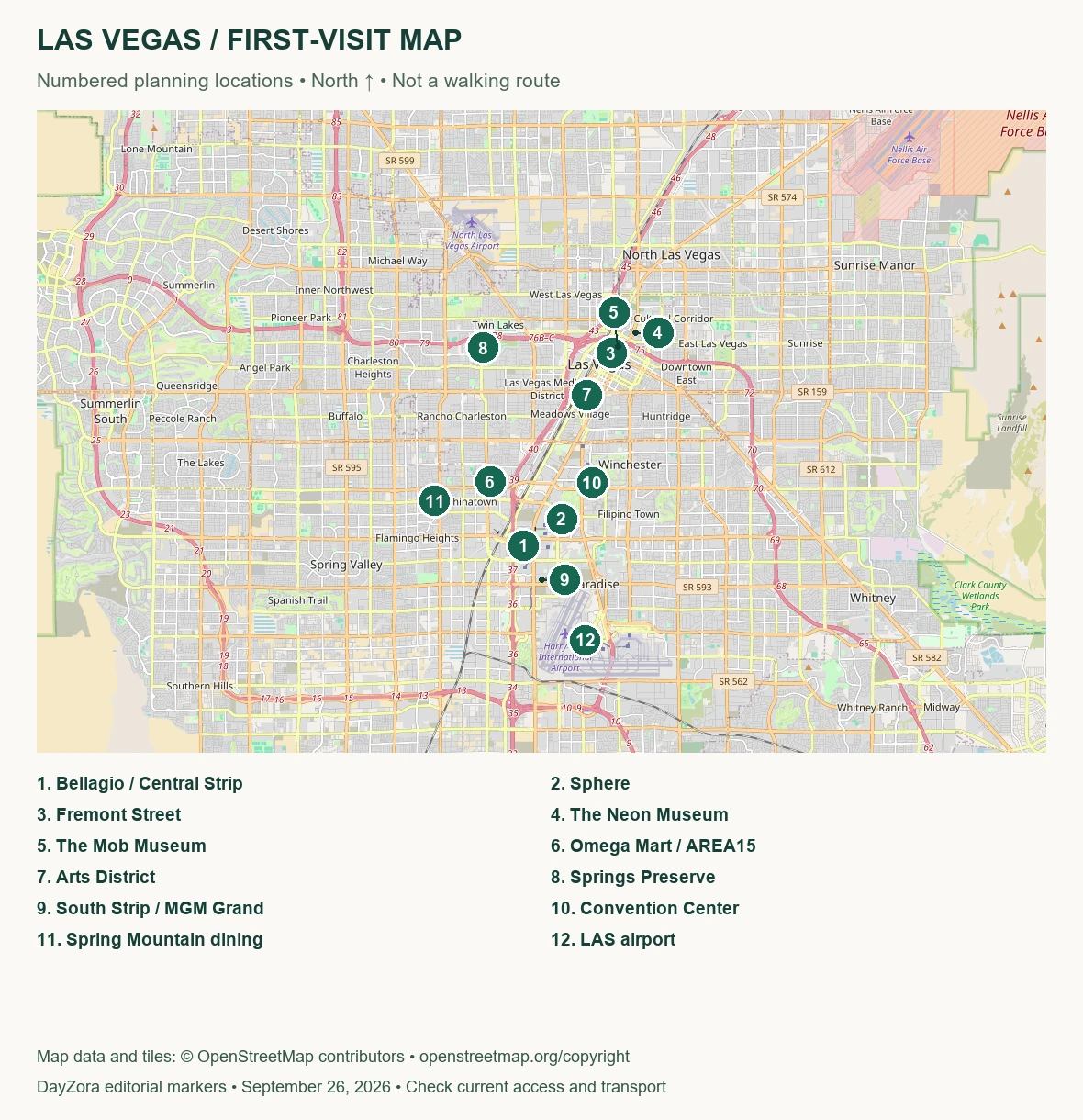
The Strip and Downtown are distinct visitor areas, and neither represents the whole metropolitan area. Many famous Strip properties are outside the City of Las Vegas municipal boundary. For planning, the useful question is how your hotel connects to your chosen activities. A building that looks close across the boulevard can involve bridges, escalators, long corridors and a specific rideshare zone.
Best Things to Do in Las Vegas
1. Watch the Fountains of Bellagio
The fountains are a free outdoor performance that works as a short evening anchor rather than a day-long attraction. View from a permitted public area, leave space for pedestrians and allow for the interval until the next display. A nearby dinner can make the visit feel unhurried. Buying a fountain-view room or restaurant table is a separate choice, not a requirement to watch.
Best for: First visits, couples and a low-cost evening stop. Time: 20–40 minutes with a possible wait. Area: Central Strip. Tickets: Public viewing is free. Displays can be canceled for weather and schedules vary; check Bellagio's official fountain page.
2. See the Bellagio Conservatory & Botanical Gardens
This indoor seasonal display offers a compact contrast to the Strip outside. The interest is in the elaborate planting and design, so it suits visitors who enjoy details as much as photographs. Pair it with the fountains rather than making two separate journeys. It is also useful during a hot part of the day, although popular display periods can be crowded.
Best for: Design, floral displays and mixed-age groups. Time: 20–45 minutes. Area: Bellagio, Central Strip. Tickets: General viewing is free. Installation-change periods may affect access; use the official conservatory calendar before relying on a particular display.
3. Choose a live production that fits your audience
Las Vegas entertainment ranges from acrobatics and theatrical productions to concerts, comedy and adult-oriented shows. Make the choice by content, venue and timing. A famous brand name does not tell you whether the material suits children or whether your seats have the view you expect. Keep the preceding meal nearby; resort-to-resort travel can take longer than the map suggests.
Best for: A trip-defining evening and travelers who do not want a casino-centered visit. Time: Most of an evening including entry and dinner. Area: Venue-dependent, often the Strip. Tickets: Advance paid booking is sensible for a must-see performance. Cirque du Soleil's official Las Vegas listings provide current productions, calendars and age guidance. Compare the final ticket price including fees.
4. Book a Sphere experience deliberately
Sphere combines a large immersive venue with a distinctive exterior presence. Going inside is a specific ticketed experience, not simply an extension of seeing the building from outside. Decide whether the scheduled film, immersive production or concert actually interests you before paying for the venue alone. Read the seat description and sensory guidance, especially when traveling with children or anyone sensitive to intense visuals.
Best for: Music, audiovisual experiences and architecture enthusiasts. Time: Depends on the booked event; leave additional time for arrival and exit. Area: East of the central/northern Strip. Tickets: Event-specific paid admission. Verify the current program, age guidance and access arrangements through Sphere.
5. Spend an evening around Fremont Street
Fremont Street Experience concentrates lights, music and pedestrian activity in Downtown. It has a different scale and atmosphere from the Strip, making it useful for travelers who want a second perspective on Las Vegas. Expect noise and crowds around performances; an earlier visit can be easier for families. The surrounding streets contain additional dining and nightlife, so choose a destination rather than wandering indefinitely between reservations.
Best for: Evening atmosphere, live public entertainment and Downtown exploration. Time: 1–3 hours with a meal. Area: Downtown. Tickets: Ordinary pedestrian access and many public performances are free; special events, zipline rides and venues can charge. Check Fremont Street Experience for access conditions and event rules.
6. Visit The Neon Museum
The museum preserves signs that help explain how Las Vegas presented itself across different eras. It is more rewarding when you treat it as a design and local-history experience rather than only a backdrop for photos. Choose the visit format and time that match your interests, and consider the heat if much of your chosen program is outdoors.
Best for: Photography, graphic design and local history. Time: 1–1½ hours, depending on the selected experience. Area: North of the main Fremont visitor area. Tickets: Paid reservations; formats and schedules vary. Check the museum's current location and booking options before travel, and do not assume every sign is illuminated during every visit.
7. Explore The Mob Museum
This Downtown museum examines organized crime and law enforcement, offering a substantial indoor visit beyond resort entertainment. The subject matter suits interested adults and older teens more readily than small children. Give it enough time to follow the historical material rather than racing through it before a fixed lunch. Pairing it with a Downtown afternoon minimizes an extra Strip return.
Best for: History, indoor sightseeing and a noncasino day. Time: 2–3 hours. Area: Downtown, near Fremont Street. Tickets: Paid entry; some interactive experiences and programs have additional charges or restrictions. Review official tickets and visitor information to distinguish basic admission from add-ons.
8. Enter Omega Mart at AREA15
Meow Wolf's Omega Mart uses an imagined supermarket as the entrance to an immersive art environment. It is a different kind of attraction from a conventional museum: visitors can explore visual spaces and follow story elements at their own pace. Choose it when the group enjoys unusual interactive experiences. An overstimulated child or a traveler wanting quiet art galleries may prefer something else.
Best for: Immersive art, teens and curious adults. Time: 2–3 hours. Area: AREA15, west of the Strip. Tickets: Paid, usually best booked for a specific time. General AREA15 access does not automatically include Omega Mart. Check Meow Wolf's official visitor and accessibility information.
9. Give the Arts District a daylight-to-dinner visit
The Arts District provides a useful counterpoint to large resort interiors, with galleries, shops, murals and places to eat. Choose a few blocks around your actual dining or gallery interests, and look at opening days before arriving. A district walk can be free; the things you buy and organized events are separate. It is a neighborhood to spend time in rather than a single admission attraction.
Best for: Independent dining, browsing and visitors returning to Las Vegas for something different. Time: 2–3 hours with a meal. Area: 18b Arts District, south of Fremont. Tickets: Public streets require no ticket; individual venues set their own rules. Use official Downtown visitor information for orientation.
10. Learn about the desert at Springs Preserve
Springs Preserve adds natural and regional history to a trip often dominated by entertainment. Its combination of indoor interpretation and outdoor areas works best with the weather, not against it. Check the day's operating areas and seasonal offerings rather than assuming every exhibit or activity is available. Families can use a morning here as a deliberate change of pace from the Strip.
Best for: Families, desert ecology and local history. Time: 2–4 hours. Area: Northwest of Downtown's main visitor core. Tickets: General admission is paid; some offerings are seasonal or separately scheduled. Verify the official visit planner and tickets.
Best Neighborhoods and Areas to Explore
On mobile, swipe the table sideways to see every column.
| Area | Best for | Transport and tradeoff |
|---|---|---|
| Central Strip | First-time resort and show access | Walk in small clusters; expect long internal distances |
| South Strip | Selected entertainment and airport-side lodging | Convenient only if your chosen venues are nearby |
| North Strip / Convention Center area | Particular resorts, events and Monorail connections | Gaps between destinations make walking less appealing |
| Downtown / Fremont | Lights, museums and nightlife | A separate trip from the Strip; evening noise varies by block |
| Arts District | Galleries, shops and dinner | Plan transport after a late meal; do not assume it is all Fremont |
| Chinatown / Spring Mountain corridor | A food-focused outing | Spread-out destinations favor a specific restaurant plan and road transport |
Central Strip is the simplest starting point for many first visits because several major resort experiences can be grouped. It is also where a visitor can overestimate walking convenience. The time from room to street may be substantial, and crossing the boulevard is not always direct. For families, build hotel breaks around that real distance.
South Strip suits travelers whose entertainment and dining bookings cluster there. Choose it for the itinerary rather than an airport-proximity claim alone; airport pickups and road traffic have their own logistics. Resort pools can be a reason to stay, but verify seasonal opening, family access and any separate day-club rules.
North Strip and the Convention Center area work well for a particular venue or event. They are less useful when every planned evening is far south. A Monorail station can help, but the station-to-room walk still matters. Convention dates can influence accommodation prices even when you are visiting purely for leisure.
Downtown/Fremont gives nightlife-focused travelers a compact core and proximity to the Mob Museum and other city-history experiences. Ask about room orientation and music noise. A Downtown hotel is not a walkable base for repeated Strip visits, so include those trips in the cost comparison.
The Arts District fits a slower browsing afternoon and an independent dinner. It can be combined with Downtown while remaining a separate stop. Gallery hours and evening venues vary; families may prefer daytime exploring, while adults can build an evening around a specific booking.
The Spring Mountain dining corridor makes food the purpose of the journey. It is not a single pedestrian food court. Pick a restaurant or small cluster, verify hours, and arrange the return trip. Its range of Asian dining is a reason to leave the resort, not a promise that every meal will cost less.
Where to Stay in Las Vegas
For first-time convenience, start with the Central Strip and compare walking access to your actual show and dinner venues. For nightlife, choose either the Strip or Downtown deliberately; neither is automatically better for every traveler. For families, prioritize a usable room layout, age-appropriate pool and a manageable route through the property over a large list of advertised amenities.
For luxury, compare service, room category, dining access and the exact view rather than assuming all rooms in a famous resort offer the same experience. For budget-conscious travelers, inspect total prices Downtown, on the Strip and off-Strip. A cheaper room that requires several paid rides every day may not save money. Off-Strip lodging can work especially well when the trip already includes a car and activities away from the boulevard.
Relative price labels run from $ budget-oriented to $$$$ luxury; they are not verified nightly averages. Before payment, compare the final accommodation total including mandatory resort charges and taxes. Also price parking, breakfast and deposits or incidental holds. Parking policies differ by property and guest status. A pool, refrigerator or late checkout should be treated as included only when the selected room/rate confirms it.
What to Eat in Las Vegas
Las Vegas is best understood as a dining crossroads rather than a city with one compulsory local dish. A trip might combine a carefully chosen resort restaurant, an Arts District lunch and a Spring Mountain dinner. Celebrity branding can be part of the appeal, but it does not remove the need to inspect the current menu and total price.
Buffets can suit groups who want variety, yet value depends on appetite, timing and what is actually included. Do not assume a buffet is operating because an old guide names it. Food halls and casual counters are useful between activities, but a resort location can still carry premium prices. A simple breakfast plan can prevent a long queue from consuming the morning.
Reserve the restaurant that matters most, then keep the rest flexible. Show-night meals should be in the same property or a genuinely nearby one. For a dietary restriction, contact the restaurant rather than assuming a large buffet or menu guarantees suitable preparation. Compare an off-Strip meal's food savings with transport cost, especially for a small party.
Getting Around and Airport Arrivals
Use Harry Reid International Airport's official transport information to identify pickup areas for your terminal. Taxi and rideshare boarding points are designated, and the appropriate place may be on a different level from baggage claim. Avoid promising a fixed airport-to-hotel journey time: traffic, terminal, queues and the resort entrance all matter.
RTC buses can reduce costs, including Strip/Downtown travel on the Deuce. However, the network changed in August 2026. Use the current RTC planner and service-change information for airport journeys instead of relying on an old CX or Route 109 instruction. Check the visitor fares and passes before purchase; this guide does not quote an unverified airport fare.
The Las Vegas Monorail serves a specific corridor along the east side of the Strip. It is useful when both ends of your trip are close to stations, not a complete city network or a direct airport train. Walking through a large resort to its station can offset part of the benefit. Resort trams likewise cover limited connections and should not be confused with the Monorail.
For a Strip-centered stay, start without a car. Rent one for a planned desert day if the total makes sense, then compare pickup logistics, parking and return times. Rideshare works for city outings but is a poor plan for remote trailheads without a reliable return arrangement. Walking and cycling must account for heat, road layout and the length of crossings; map distance alone is not enough.
Best Time to Visit
On mobile, swipe the table sideways to see every column.
| Season | Weather pattern | Crowds and room-price considerations | Best use |
|---|---|---|---|
| Spring | Often more comfortable outdoors; variable wind and temperatures | Popular weekends and events can be costly | City and desert combination |
| Summer | Extreme heat can limit outdoor plans | A room deal does not make midday hiking sensible | Indoor attractions, shows and carefully timed pool use |
| Fall | Often improving outdoor conditions | Major events can sharply change availability | A balanced city break with a desert day |
| Winter | Cool days and cold evenings possible | Holidays/conventions differ from quieter dates | Dining, museums and entertainment |
Check convention, sports and performance calendars alongside flight prices. Event preparations can affect roads before the event itself. For an October visit, our Las Vegas Halloween guide offers seasonal starting points; confirm dates and admission directly with organizers.
3-Day Las Vegas Itinerary
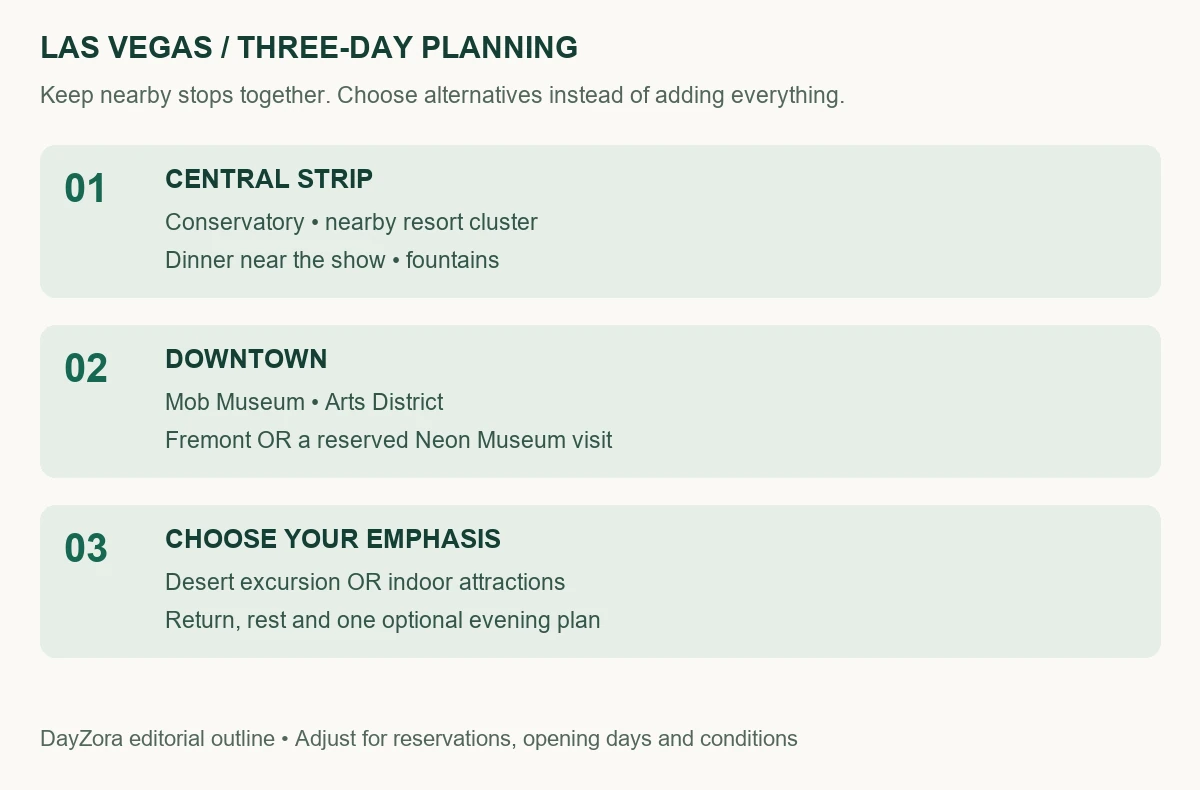
Day 1 — Central Strip and one show
Morning: Arrive or explore a small resort cluster. Afternoon: Bellagio Conservatory and a rest break. Evening: Dinner near the chosen theater, then the show or fountains according to timing. Do not schedule a distant dinner after a late arrival.
Day 2 — Downtown and city history
Morning: The Mob Museum. Afternoon: Arts District browsing and a meal, with transport between areas. Evening: Fremont Street, or a reserved Neon Museum experience if it fits the calendar. Choose the museum experience before deciding how late to stay outside.
Day 3 — Choose a desert or indoor day
Morning: Red Rock Canyon with appropriate reservations and conditions, or Springs Preserve. Afternoon: Return and rest; avoid adding multiple remote stops. Evening: A second entertainment booking only if wanted. Omega Mart or Sphere can replace part of this day, rather than being stacked on top.
For a longer journey, follow our Las Vegas and Grand Canyon itinerary and U.S. road-trip guide. A convention-centered trip may also benefit from visiting a Las Vegas trade show without renting a car.
Trip Budget: Compare the Full Stay
On mobile, swipe the table sideways to see every column.
| Expense | Budget-oriented | Mid-range | Higher-end |
|---|---|---|---|
| Hotel | Compare complete totals, flexible dates | Convenient base with suitable room | Premium category or suite |
| Food | Simple breakfasts and casual meals | One booked dinner plus casual choices | Destination dining, tasting menus and drinks |
| Transport | Walking clusters and bus | Some taxis/rideshare | Frequent private transfers or car with parking |
| Entertainment | Free displays plus one priority | Selected shows and museum visits | Premium seats and experiences |
No dollar averages are implied. Add confirmed resort fees/taxes, parking, meals, transport and the final ticket checkout amounts. Keep any gambling allowance separate from the sightseeing budget and treat it as money you may lose, not a way to finance the trip. Compare a package with buying its components separately before assuming it is a bargain.
Best Free Things to Do
- Watch the Fountains of Bellagio from public viewing areas.
- Explore the Bellagio Conservatory outside installation-change closures.
- Walk Fremont Street during ordinary public access; special events can differ.
- Browse Arts District streets and public murals; purchases and individual venues are separate.
- Explore public resort lobbies and themed shopping promenades where access is permitted, without assuming shows or rides inside are free.
The first four are supported by the official attraction/district links above. Visit Las Vegas's free-activity guide is useful for further options, but inspect the precise inclusion: free entry to a venue does not necessarily mean its games or attractions are free.
Visiting Las Vegas With Kids
Plan an explicitly family-focused version of the city: suitable shows, Springs Preserve, selected indoor attractions and a verified family pool. Do not assume the presence of children in advertising means every performance or pool is appropriate. Check age limits, height rules and sensory guidance. Short daytime walking blocks work better than a full Strip march, especially in heat. Fremont's late-evening atmosphere can differ substantially from an early visit. For alternatives, compare our family vacation destinations.
Las Vegas for Couples
A show, one memorable dinner and time to enjoy the hotel often make a better short break than constant movement between resorts. Choose a room or meal for its specific benefit—space, view, service or location—rather than adding every premium extra. The fountains provide an easy evening stop without a separate ticket. Our luxury travel destinations guide helps compare this entertainment-focused trip with other styles of escape.
Best Day Trips from Las Vegas
These are approximate one-way planning allowances from the central Strip, before long queues, activities or traffic. Check the route for your date.
On mobile, swipe the table sideways to see every column.
| Destination | Approximate distance/time | Best for | Car needed? |
|---|---|---|---|
| Red Rock Canyon Scenic Drive | Roughly 25 miles; allow 45–60 minutes to the entry area | A short desert outing and suitable walks | Car or organized tour; BLM requires timed entry October–May, 8 a.m.–5 p.m. |
| Hoover Dam / Boulder City | Roughly 35 miles; allow 45–75 minutes to the dam area | Engineering and regional history | Car or tour; verify Bureau of Reclamation access and tour availability |
| Valley of Fire | Roughly 55–65 miles; allow 1–1½ hours, route-dependent | Desert scenery in suitable conditions | Car or tour; check Nevada State Parks closures before departure |
Current Valley of Fire cautions: the park lists seasonal trail closures, a December 1–14 annual maintenance closure, and a temporary weekday West Entrance construction restriction beginning August 3, 2026. Confirm the current entrance route and alert status; a scenic-drive plan is not permission to enter closed trails.
Grand Canyon South Rim and Zion are better treated as overnight components of a longer route. Grand Canyon West is a different destination, on Hualapai land, with separate admission arrangements; it is not the South Rim national-park experience. Do not book a generic “Grand Canyon” excursion without checking which destination it means.
Practical Las Vegas Travel Tips
- Choose the hotel after locating your main show and dinner venues.
- Measure resort-to-resort travel from room/lobby access, not the nearest corners on a map.
- Compare the final hotel checkout total and parking policy.
- Inspect the actual view from a seat category before buying premium entertainment tickets.
- Check family and seasonal pool access directly with the property.
- Use current airport bus information; 2026 network changes make older instructions unreliable.
- Plan outdoor activities around conditions and posted closures, not a prepaid schedule you feel obliged to complete.
- Arrange a reliable return from remote outdoor locations.
- Group Downtown museums and Fremont rather than making repeated Strip shuttles.
- Allow time for designated rideshare pickup zones after shows.
Frequently Asked Questions
Can I enjoy Las Vegas without gambling?
Yes. Shows, restaurants, museums, immersive art and suitable desert excursions can fill a complete trip. Choose lodging and activities around those interests rather than treating casino time as compulsory.
Is the Strip walkable?
Individual clusters are walkable, but the whole Strip is a substantial undertaking. Heat, crossings and resort interiors add effort. Combine short walks with transport.
Is Downtown the same as the Strip?
No. Downtown includes the Fremont visitor area and nearby city-history attractions. Plan a separate journey and decide whether you want to stay there or visit from the Strip.
Should I rent a car?
Usually not for a brief Strip-centered break. A car can be useful for outdoor excursions or a wider regional trip, provided parking and return logistics are included in the budget.
Is a cheap advertised hotel rate a reliable budget?
Only after you have seen the complete price and relevant extras. Mandatory charges, taxes, parking and transport can change the comparison materially.
More DayZora planning resources
Compare other city guides or use our travel planning tips for the practical steps around a U.S. trip.
How this guide was researched
DayZora reviewed official attraction, transit, airport, tourism and government information and added editorial neighborhood comparisons, suggested visit durations and a selective itinerary. Recommendations are research-based, not claims of firsthand visits. Approximate travel allowances are planning estimates, not live schedules or traffic predictions. Linked operator pages provide current prices and conditions; recheck them before booking and before travel.