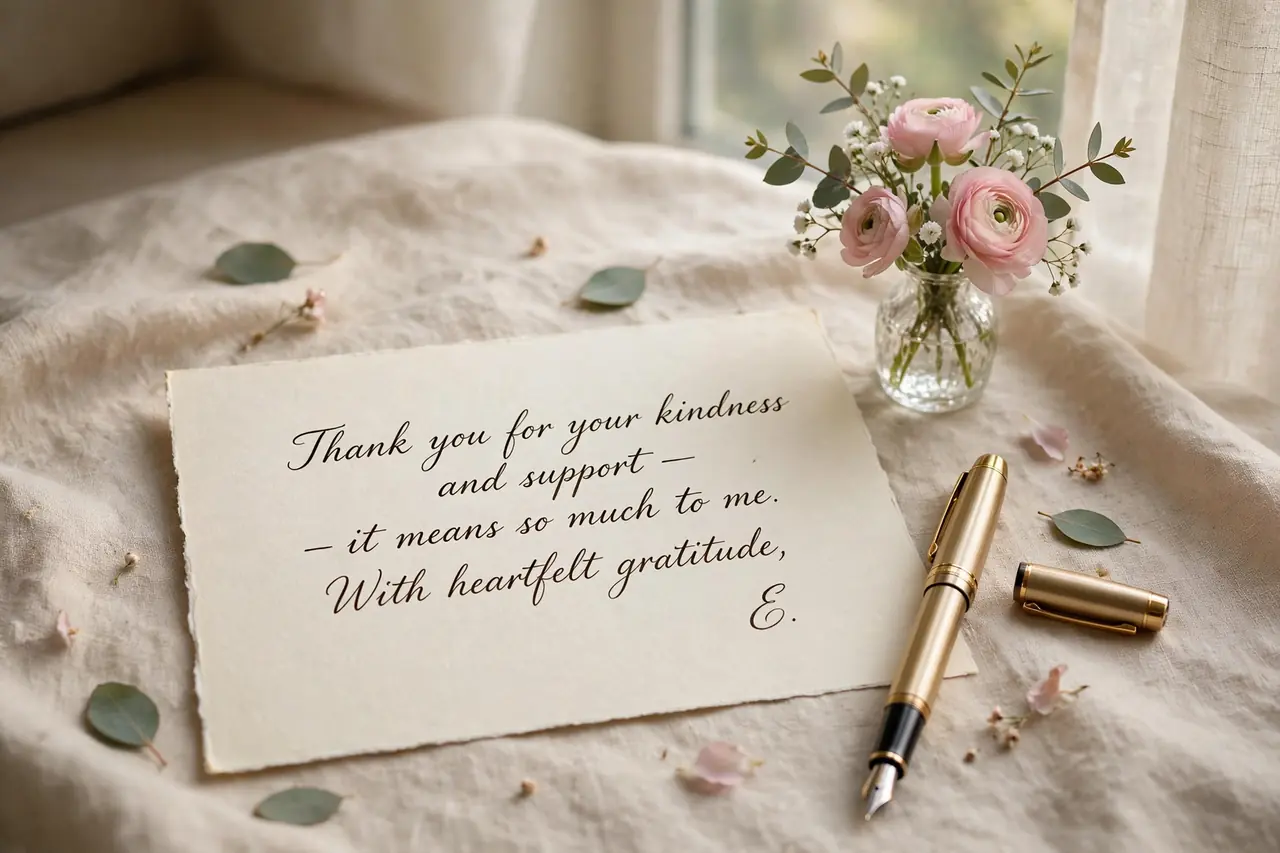
Staring at a blank card, pen in hand, mind completely empty — if you have ever been there, you are in good company. Writing a thank you note feels like it should be simple. Someone did something kind; you feel grateful; you write it down. Yet somehow those three or four sentences become one of the hardest paragraphs in the English language. This guide on how to write a thank you note removes the mystery entirely, giving you a proven structure, real examples for every situation, and the small etiquette details that make your note land beautifully.
Here is the reassuring truth: a great thank you note is not about literary talent. It is about specificity, sincerity, and promptness. Nobody expects poetry. They expect to feel that you noticed what they did and that it mattered to you. Once you learn the simple five-part anatomy every good note follows, you will be able to write a warm, genuine thank you note in under ten minutes — for a wedding gift, a job interview, a teacher, a dinner party, or anything else life throws at you.
Why Thank You Notes Still Matter in a Digital Age
We live in an era of instant communication, where a thumbs-up emoji can acknowledge anything in half a second. So why do thank you notes — especially handwritten ones — still carry so much weight? Because effort is the message. In a world where communication costs nothing, spending ten minutes choosing a card, writing by hand, addressing an envelope, and mailing it is a conspicuous act of care. The recipient knows exactly what it cost you, and that cost is what makes it valuable.
The effects are well documented. Studies on gratitude expression consistently show that people who write thank you notes report higher happiness, and — just as importantly — recipients consistently underestimate how much a thank you note will mean to them and overestimate how awkward it will feel to send one. In other words, your note will be received far more warmly than you fear, and the awkwardness you imagine is mostly in your head.
Thank you notes also have practical power. A prompt, thoughtful note after a job interview keeps you memorable. A sincere note to a mentor deepens the relationship. A warm note to a client reinforces loyalty. In professional life especially, the thank you note is one of the highest-return investments you can make: ten minutes of writing for a lasting impression.
The Anatomy of a Perfect Thank You Note
Every effective thank you note, from a two-sentence text to a full-page letter, contains the same five parts. Learn them once and you will never stare at a blank card again.
Part 1: The Warm Greeting
Open with the person’s name and genuine warmth: “Dear Mrs. Alvarez,” “Dear James,” or for close relationships, “Dearest Mom.” Using their name immediately makes the note personal rather than generic. For formal situations, use titles and last names; for friends and family, first names are perfect.
Part 2: The Specific Thanks
Name exactly what you are thanking them for. Not “thank you for the gift” but “thank you for the beautiful hand-thrown ceramic serving bowl.” Not “thanks for your help” but “thank you for spending your Saturday helping me move the piano.” Specificity proves you paid attention, and paying attention is the sincerest form of flattery.
Part 3: The Personal Connection
Explain what their gift or action means to you, or how you will use or enjoy it. “We used the serving bowl at dinner last night and everyone asked about it.” “Your advice about negotiating the offer gave me the confidence to ask for what I deserved.” This is the sentence that transforms a polite note into a meaningful one — it shows impact.
Part 4: The Forward Look
Add a sentence that looks ahead: an invitation, a hope, or a reference to seeing them soon. “I hope we can have you over for dinner once we are settled.” “I would love to take you to coffee next month and hear more about your trip.” This turns a closing gesture into an opening one, keeping the relationship warm.
Part 5: The Gracious Sign-Off
Close with warmth appropriate to the relationship: “With gratitude,” “Warmly,” “With love,” “Sincerely,” or “Thank you again.” Then sign your name — by hand, always, on a paper note. For couples, both partners can sign, or one can sign for both (“Love, Emma and Daniel”).
How to Write a Thank You Note in 6 Steps
Here is the practical workflow, start to finish.
Step 1: Gather Your Materials
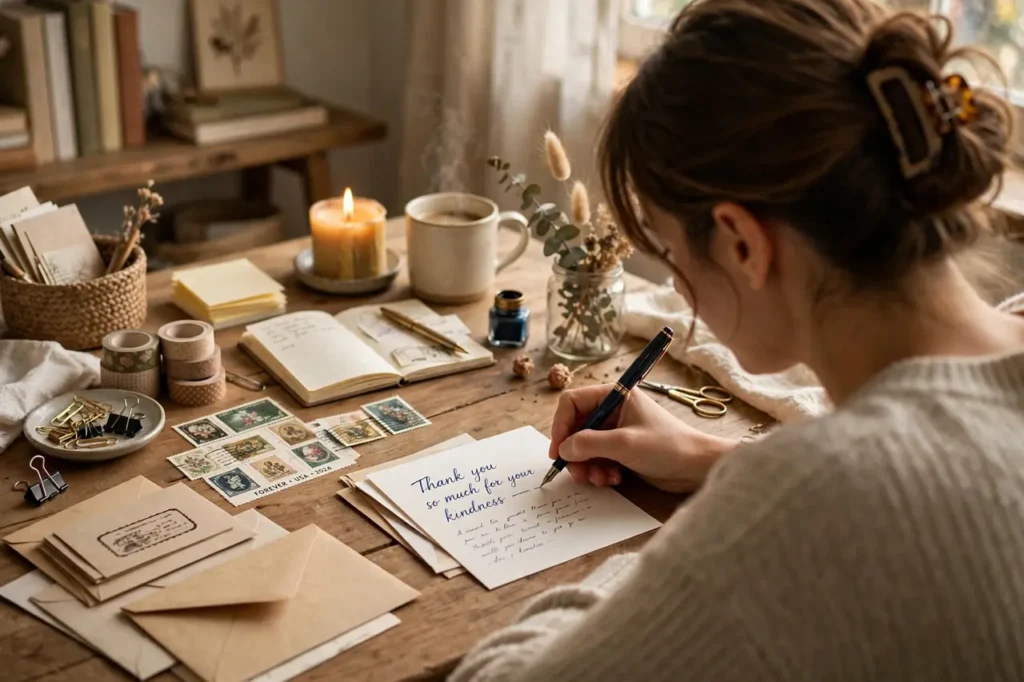
Keep a small stationery kit so writing notes never feels like a project: a set of blank cards or folded notes, good pens that do not smudge, stamps, and your address book. When everything is in one drawer, a thank you note becomes a ten-minute task instead of an errand.
Step 2: Draft the Specific Thanks First
Start with the easiest sentence: what exactly are you thanking them for? Write it plainly. You can polish the language later, but nailing the specific item or action first gives the whole note its anchor.
Step 3: Add the Personal Impact Sentence
Ask yourself: how did this affect me? What will I do with it? What did I learn? Write one or two sentences answering that. This is the heart of the note — do not skip it.
Step 4: Write the Opening and Closing
With the middle done, the greeting and sign-off write themselves. Keep the greeting warm and the closing gracious. If you are stuck on wording, borrow from the opening lines collection later in this guide.
Step 5: Read It Aloud
Read your draft out loud before committing it to the final card. Your ear catches awkward phrasing, repeated words, and stiff formality that your eyes miss. A thank you note should sound like you talking warmly, not like a form letter.
Step 6: Send It Promptly
A thank you note loses power with delay. Aim to send within one to two weeks for gifts and social occasions, and within twenty-four hours for job interviews. A late note is still far better than none — never let embarrassment about timing stop you from sending it.
25 Opening Lines Better Than “Thank You So Much”
The hardest sentence is the first one. Steal any of these openers and adapt them to your situation:
- I was so touched when I opened your gift…
- Your kindness completely made my day…
- I have been meaning to tell you how much I appreciated…
- What a wonderful surprise to receive…
- I cannot tell you how much your help meant…
- Your thoughtfulness never ceases to amaze me…
- Opening your card brought the biggest smile to my face…
- I am still thinking about the lovely evening we spent…
- Your generosity overwhelmed me in the best way…
- Thank you seems too small for what you did…
- I felt so lucky to have you in my corner when…
- Your gift was the highlight of my birthday…
- I have thought about your advice every day since…
- There are no words for how grateful I am that…
- You have such a gift for making people feel special…
- I was blown away by your thoughtfulness…
- It meant the world to me that you…
- Your support came at exactly the right moment…
- I will never forget how you…
- From the bottom of my heart, thank you for…
- You always know exactly what someone needs…
- I am so grateful our paths crossed because…
- Your note / gift / visit was exactly what I needed…
- Thank you for being the kind of person who…
- I feel incredibly fortunate to know someone like you…
Thank You Note Examples for Every Situation
Theory is useful; examples are better. Here are complete sample notes you can adapt, each following the five-part anatomy.
Example: Wedding Gift
Dear Aunt Carol and Uncle Jim,
Thank you so much for the gorgeous stand mixer — and for traveling all the way to celebrate with us. We have already used it twice, and Daniel has declared your gift responsible for the best chocolate chip cookies of his life.
Having you both at the wedding meant everything to us. We loved catching up at the rehearsal dinner and hope we can visit this fall.
With all our love,
Priya and Daniel
Example: Birthday Gift
Dear Marcus,
Thank you for the noise-canceling headphones — you clearly remembered me complaining about my loud commute! I wore them on the train this morning and it felt like pure luxury.
It was so good to see you at the party. Let us grab dinner next month; I want to hear all about the new house.
Thanks again,
Sofia
Example: Job Interview
Dear Ms. Chen,
Thank you for taking the time to speak with me yesterday about the marketing coordinator role. I especially enjoyed our discussion about the upcoming product launch — it confirmed my excitement about the creative direction your team is taking.
Our conversation strengthened my enthusiasm for the position, and I would welcome the opportunity to contribute.
Best regards,
Alex Rivera
For interview notes, email within twenty-four hours is standard, and specificity about something discussed is what makes you memorable.
Example: Teacher Appreciation
Dear Mr. Thompson,
Thank you for an incredible school year. Your history class was the first one where I actually looked forward to homework — the debate project changed how I think about current events.
I will carry what I learned from you into high school and beyond. Thank you for believing in your students.
With gratitude,
Maya
Notes to teachers are keepsakes. If you are writing on behalf of a child, let the child’s voice come through. For more message inspiration, these short quotes for cards can spark the right phrasing, and these card message examples for a husband show how specificity elevates any note.
Example: Dinner Party Host
Dear Elena,
Thank you for the most wonderful dinner party on Saturday. The paella was extraordinary, but what I will remember most is how welcome you made everyone feel.
We would love to return the favor — are you free for dinner at our place on the 14th?
Warmly,
James
Example: Baby Shower Gift
Dear Lisa,
Thank you for the adorable knit blanket and for hosting such a beautiful shower. The blanket is already in the nursery, and I smile every time I see it.
Your friendship has meant so much during this pregnancy. I cannot wait for you to meet the little one!
With love,
Hannah
Example: Professional Favor or Mentorship
Dear Dr. Okafor,
Thank you for reviewing my proposal and for your candid feedback. Your suggestion to reframe the methodology section made the argument twice as strong — the committee approved it yesterday.
I am deeply grateful for your mentorship and hope I can pay your generosity forward with my own students someday.
With sincere appreciation,
David
Example: Sympathy and Support
Dear Karen,
Thank you for the meals, the flowers, and simply for showing up during the hardest weeks of our lives. Your lasagna fed us for days, but your presence fed us in a deeper way.
We are slowly finding our footing, and your kindness is a big part of why. Thank you for being our friend.
With love,
The Bennett Family
Sympathy notes can be brief — even two sincere sentences are enough. Do not worry about perfect wording; presence and acknowledgment are what matter.
Choosing Your Stationery and Tools
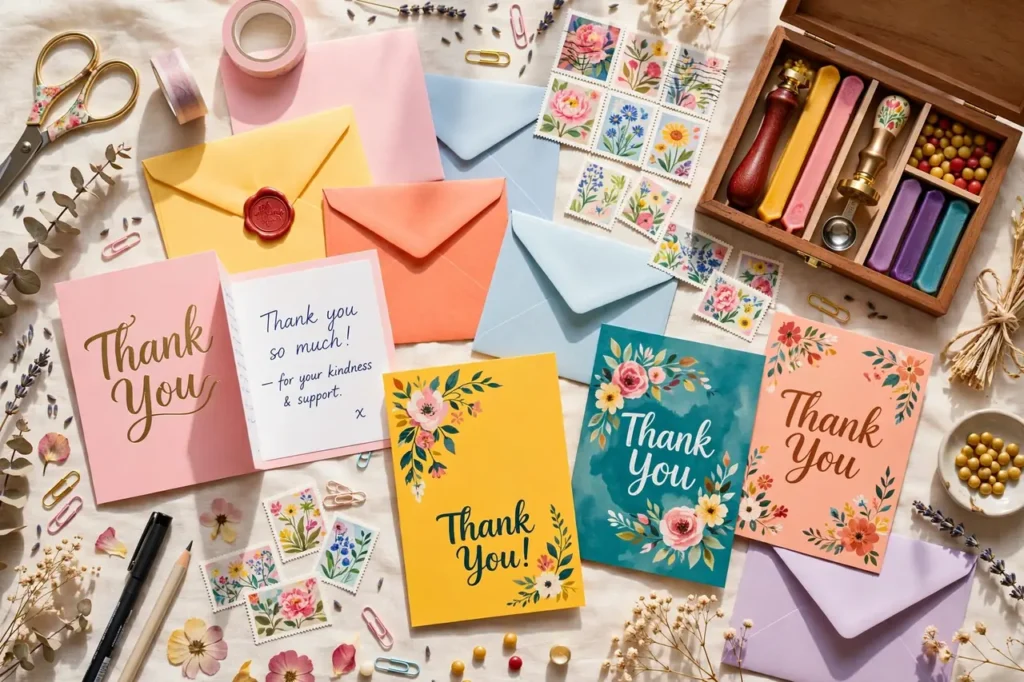
The medium is part of the message. The right stationery elevates your words before they are even read. You do not need expensive custom stationery — you need clean, appropriate materials.
| Stationery Type | Best For | Pros | Watch Out For |
|---|---|---|---|
| Folded blank cards | Everyday thanks, gifts, social occasions | Versatile, affordable in bulk, feels substantial | Avoid flimsy cardstock that shows pen bleed-through |
| Flat correspondence cards | Professional and formal notes | Elegant, traditional, easy to mail | Less writing space — keep notes concise |
| Personalized stationery | Frequent note-writers, professionals | Memorable, impressive, encourages the habit | Higher upfront cost; keep design classic |
| Postcards | Casual thanks, travel, creative flair | Fun, no envelope needed, stamps cost less | Message is visible — keep it light |
| Kids’ handmade cards | Family, teachers, grandparents | Irresistibly charming and personal | Pair with a parent-written note for formal occasions |
For pens, choose a smooth-writing gel or fountain pen in blue or black ink — blue feels personal, black feels formal. Avoid ballpoints that skip, markers that bleed, and (always) pencil. Write on a firm surface, and if your handwriting is shaky, slow down rather than switching to print; slightly imperfect handwriting reads as human and warm.
Handwritten vs. Email vs. Text: When Each Is Right
Not every thank you requires a trip to the mailbox. Match the medium to the moment:
| Medium | Use When | Timing | Impact Level |
|---|---|---|---|
| Handwritten note | Gifts, weddings, showers, hospitality, sympathy, mentorship | Within 2 weeks | Highest — tangible and keepsake-worthy |
| Job interviews, professional favors, quick business thanks | Within 24 hours | High for professional contexts | |
| Text message | Small everyday favors, casual friendships | Same day | Modest — better than silence, less than a note |
| Phone or video call | Deeply meaningful help, emotional situations | Within a few days | Very high — voice carries emotion |
| Social media post | Public thanks, group efforts, celebrations | Within a few days | Moderate — nice supplement, weak substitute |
The rule of thumb: the bigger the gift or gesture, the more formal the medium. A text is perfect for “thanks for the coffee.” A wedding gift deserves paper and a stamp. When in doubt, go one level more formal than feels necessary — nobody has ever been disappointed to receive a handwritten note.
Watch: How to Write a Thank You Note
For a visual walkthrough of thank you note fundamentals — including why handwritten notes beat email for most occasions and how to strike the right tone — this classic guide breaks it all down with charm and clarity.
7 Common Thank You Note Mistakes to Avoid
1. Being vague. “Thanks for everything” says nothing. Name the thing. Specificity is the entire difference between a note that moves someone and one that gets recycled.
2. Making it about you. A little personal news is fine, but the note should center the recipient’s kindness, not your life update. Keep the spotlight on them.
3. Apologizing for the delay at length. If your note is late, one brief line — “Please forgive the belated thanks” — is enough. Three paragraphs of apology make the note about your guilt instead of their generosity.
4. Mentioning the price or value. Never reference how much something cost, even admiringly. “Thank you for the expensive watch” is cringeworthy; “thank you for the beautiful watch I will treasure” is perfect.
5. Using it to ask for something. A thank you note that ends with a request or a sales pitch poisons the gratitude. Keep thanks pure. If you need something, that is a separate conversation.
6. Sending a group thank-you for individual gifts. A mass email thanking everyone for wedding gifts feels efficient and lands as impersonal. Individual gifts deserve individual notes, even if each is only three sentences.
7. Forgetting to actually send it. The most common mistake is the note that lives forever as a draft or sits stamped but unmailed. Put the addressed, stamped envelope by your front door or in your bag — environment design beats willpower.
Thank You Notes for Tricky Situations
Some thank-you situations come with social landmines. Here is how to navigate the awkward ones with grace.
Thanking Someone for Money
Money gifts make many people uncomfortable, but the etiquette is simple: never name the amount, and always say how you will use it. “Thank you for your incredibly generous gift — we are putting it toward our honeymoon in Italy and will think of you when we are there.” Naming the use transforms cash from an awkward transaction into a meaningful contribution to your life. If the money came with no occasion, a warm “your generosity overwhelmed me” plus a specific plan works just as well.
Thanking Someone for Something You Did Not Want
We have all received the well-meaning gift that missed the mark completely. The rule: thank the thought, never critique the item. Focus on the gesture and the relationship. “Thank you for thinking of me — it meant so much to have you at the party.” You are not obligated to display, use, or keep the item; you are only obligated to acknowledge the kindness behind it. Graciousness here is a character test, and passing it costs you nothing.
Group Gifts and Joint Thanks
When a group chips in for one gift, write one note to the group organizer mentioning everyone: “Dear Rachel — please thank Tom, Priya, and Luis for me as well.” If you know all contributors, individual short notes are the gold standard, but a single warm note circulated to the group is perfectly acceptable and far better than silence. For office collections, a note posted or emailed to the team plus a personal word to the organizer covers all bases.
Thanking a Stranger or Service Worker
The Good Samaritan who helped you change a tire, the nurse who was extra kind during a scary procedure, the barista who remembers your order — these people rarely get thanked in writing, which is exactly why a note means so much. Keep it brief and specific: “You probably help dozens of people a day, but the way you calmed me down during my appointment made a real difference. Thank you.” If you can route it through their employer with praise, even better — written compliments to managers can genuinely advance someone’s career.
Frequently Asked Questions About Writing Thank You Notes
How long should a thank you note be?
Three to five sentences is the sweet spot for most occasions. That is enough for a greeting, specific thanks, a personal impact sentence, a forward look, and a sign-off. Longer notes are welcome for deeply meaningful situations — a mentor who changed your career, support during a loss — but never pad a note to seem more grateful. Brevity with specificity beats length with vagueness every time.
Is it too late to send a thank you note?
It is almost never too late. Etiquette experts agree that a late thank you note is vastly better than none — the recipient will be pleased to be remembered, not offended by the delay. Acknowledge it briefly (“I am so sorry this is belated”), express genuine thanks, and move on. Do not let embarrassment compound into permanent silence.
Do I need to send a thank you note for a thank you note?
No — that way lies infinite regress. A received thank you note needs no response beyond the warm feeling it gives you. The exception is if the note itself contained news or a question you want to answer; then reply as you would to any friendly letter, not as a meta-thank-you.
Should kids write their own thank you notes?
Yes, with age-appropriate help. Even toddlers can scribble on a card or dictate a sentence for a parent to write. Elementary-age children can write two or three sentences with guidance. Teaching children to write thank you notes is one of the most valuable gratitude habits you can instill — and grandparents treasure these notes above all others.
What if I do not like the gift?
Thank them for the thought, not the item. Focus on the gesture: “Thank you so much for thinking of me on my birthday — it was wonderful to celebrate with you.” Find something honest to appreciate: the effort, the thought, the visit. Never lie extravagantly about loving something you do not, but never let dislike show either. Graciousness is the whole point.
Can I send a thank you note by email for a wedding gift?
For weddings, handwritten notes remain the gold standard, and guests expect them. That said, an immediate warm email or text (“Your gift arrived and we love it — a proper note is on its way!”) is a lovely bridge while you work through a large stack. The email acknowledges promptly; the handwritten note honors properly. Use both.
How do I write a thank you note to someone I do not know well?
Keep it warm but slightly more formal. Use their title and last name unless invited otherwise, be specific about what you are thanking them for, and keep personal details light. “Dear Mrs. Patterson, thank you for the lovely serving dish. It was so kind of you to think of us, and we look forward to putting it to good use at our first dinner party.” Polite, specific, complete.
Final Thoughts
Learning how to write a thank you note is really learning how to pay attention — to notice kindness, to name it specifically, and to return it in words. The five-part anatomy gives you structure, the examples give you a starting point, and the only remaining ingredient is promptness. Keep stationery on hand, write the specific thanks first, and send it before the week is out.
The people who receive your notes will remember them far longer than you expect. In a disposable-message world, your ten minutes of handwriting is a small act of permanence. So pick up the pen. And if you want to keep building your gratitude vocabulary, explore more ways to express appreciation — from heartfelt messages for a wife to funny card messages that make any note more memorable. Your future self — the one with deeper relationships and a warmer reputation — will thank you.