Learning How to Organize Kids Toys is less about perfect Pinterest playrooms and more about building a system your actual children will actually use. Toy chaos is universal — but it’s solvable. This step-by-step guide walks you through decluttering, choosing storage that works, setting up zones, implementing toy rotation, and teaching kids to maintain the system themselves.
You’ll get room-by-room strategies, storage product guidance, the psychology of why kids don’t tidy (and how to fix it), solutions for small spaces, and answers to the questions parents ask most — including what to do with the mountain of toys after birthdays and holidays. Let’s turn the toy tornado into a system that mostly runs itself.
Why Toy Organization Feels Impossible
First, the reassurance: it’s not you. Toy clutter accumulates because toys enter faster than they leave (birthdays, holidays, grandparents), because kids play by spreading (developmentally normal — they need to see options), and because most storage is designed for adults, not children. A system that requires adult-level executive function will fail with a four-year-old every time.
The fix is designing for reality: fewer toys in circulation, storage a child can operate independently, clear homes for everything, and routines that make tidying automatic. Organization isn’t a one-time purge — it’s a system. Build the system right, and maintenance becomes minutes a day instead of weekend catastrophes.
Step 1: Declutter Ruthlessly (With Strategy)
You can’t organize too many toys — you can only contain them. Start here:
The Four-Box Method
Grab four boxes or bags labeled Keep, Donate, Trash, and Relocate. Go category by category (all the art supplies, all the action figures), not room by room — categories reveal duplicates you’d never notice otherwise. Be honest about the Trash box: broken toys with missing pieces aren’t “maybe fixable,” they’re clutter. The Relocate box catches things that belong elsewhere (upstairs toys, outdoor toys).
Involve Kids (Wisely)
For kids 4+, participation teaches decision-making — but frame it positively: “let’s find toys to share with kids who need them” beats “we’re throwing your stuff away.” Let them choose donations (with gentle guidance), and don’t declutter their treasures secretly — discovering a missing beloved toy destroys trust. For under-4s, declutter while they sleep; they won’t notice, and you’ll keep your sanity.
The “Maybe” Box Trick
For toys you’re unsure about, use a Maybe box: seal it, date it, store it out of sight. If nobody asks for anything in it within 2–3 months, donate the whole box unopened. This bypasses decision paralysis and works remarkably well — most Maybe boxes leave the house untouched.
Set a Target
Aim to reduce to what fits your storage comfortably — not what “should” be enough. A common rule: if you can’t tidy the play area in 15 minutes, you have too many toys in circulation. Remember that decluttering is ongoing: schedule a mini-purge before birthdays and holidays when new toys arrive.
Step 2: Choose Storage Kids Will Use
| Storage Type | Best For | Kid-Friendly Rating |
|---|---|---|
| Open bins and baskets | Everyday toys, categories (cars, dolls, balls) | Excellent — see everything, toss-in cleanup |
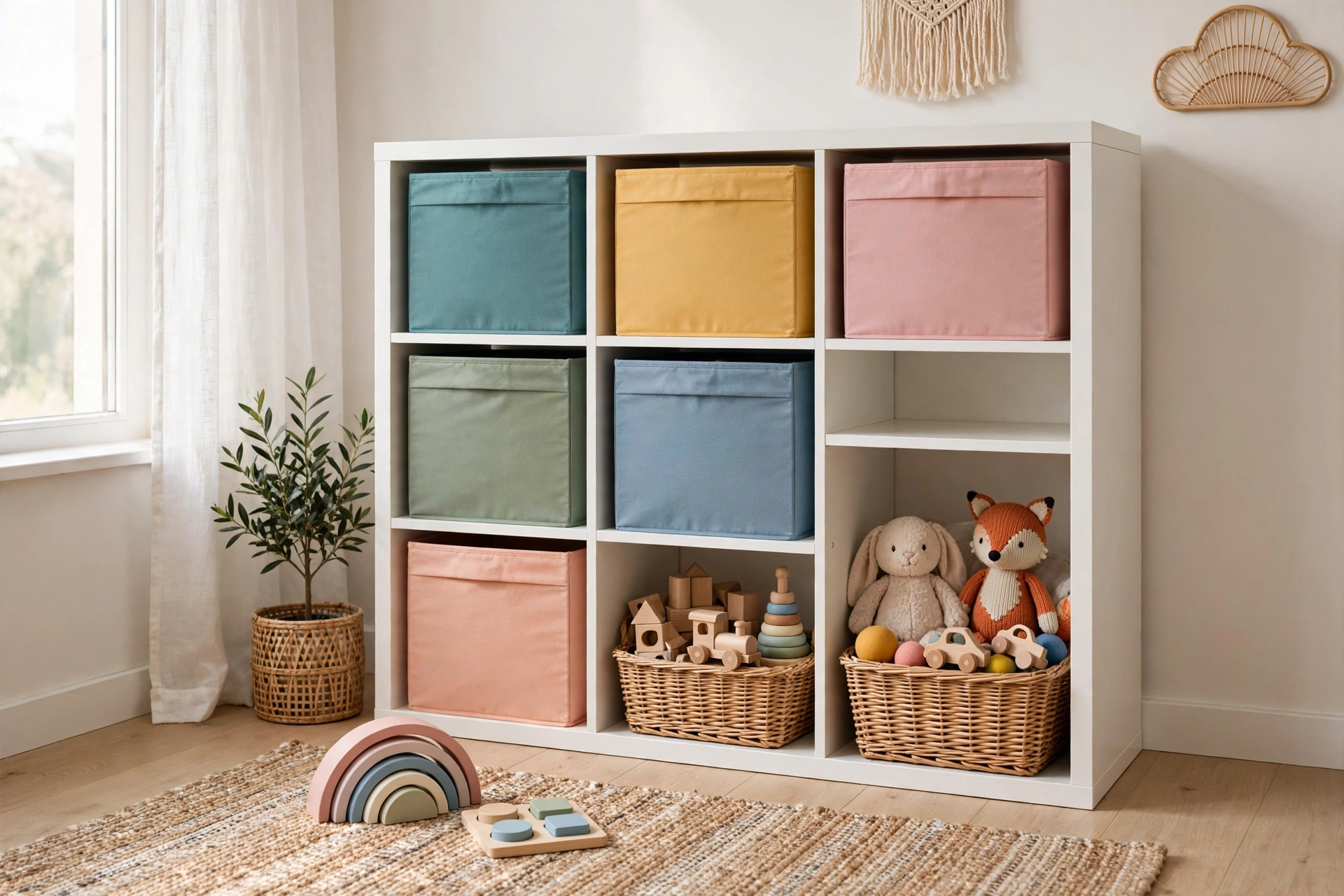
| Cube shelving with fabric bins | Divided categories, books, games | Excellent — labeled bins at kid height |
| Clear stackable containers | Building sets, craft supplies, small pieces | Good — visibility helps, lids need adult help for small kids |
| Drawstring play mats | Building bricks, train sets | Excellent — play anywhere, tidy in seconds |
| Over-door organizers | Small toys, art supplies, accessories | Good — great for small spaces |
| Toy chests | Large plush, dress-up, bulky items | Fair — becomes a jumble; use sparingly |
| Rolling carts | Art supplies, rotating activities | Excellent — mobile and accessible |
Storage Principles That Work
- Open beats closed for daily toys. Lids are barriers — for kids and for tidying speed. Reserve lidded containers for small pieces and infrequently used items.
- Label everything with pictures. Photo labels (a picture of the actual contents) let pre-readers tidy correctly. Kids as young as two can match toys to picture labels.
- Keep it at kid height. If children can’t reach it independently, it’s adult storage, not kid storage. Reserve high shelves for rotation stock and off-limits items.
- One home per toy. Every toy needs exactly one designated spot. “Put it away” only works when “away” is specific and known.
- Contain categories, not individual toys. Sorting every LEGO by color is unsustainable; one bin for “building toys” is maintainable. Match the granularity to your family’s actual tidying energy.
Step 3: Set Up Play Zones
Zones prevent the whole-house toy sprawl. You don’t need a dedicated playroom — zones work in any space:
The Main Play Zone
Designate one primary area (living room corner, bedroom, basement) with the bulk of in-circulation toys. Use a rug or mat to define the boundary visually — “toys stay on the rug” is a rule kids can grasp. Keep this zone’s inventory limited to what the storage there holds.
Specialty Zones
- Art zone: a small table or rolling cart with supplies; cover the surface and keep smocks handy. Art stays here, not on the living room carpet.
- Building zone: a flat surface or mat with building toys nearby. Builders need undisturbed space — protect in-progress creations.
- Reading nook: a basket of books with a cozy seat. Even a corner with pillows works; the ritual matters more than the furniture.
- Active zone: outdoors or a clear indoor area for ride-ons, balls, and movement. Our Indoor Family Activities for Winter guide has active-play ideas for cold months.
Zone Rules That Stick
Keep rules few and positive: “toys live in their zones,” “finish or tidy one activity before starting another” (for older kids), and “we tidy zones before dinner.” Enforce kindly and consistently — and follow the zones yourself. Kids mirror adult behavior more than adult instructions.
Step 4: Implement Toy Rotation
Toy rotation — keeping only a portion of toys available and swapping periodically — is the single highest-impact organization strategy for kids under 8. Benefits: less clutter, longer attention spans (research supports this), renewed excitement with each swap, and easier tidying.
How to Rotate
- Divide toys into 3–4 groups after decluttering, balancing types in each (building, pretend, art, active, puzzles).
- Put one group out in the play zone; store the rest in labeled bins in a closet or garage.
- Swap every 2–4 weeks, or when interest wanes. Involve kids in the swap — it’s exciting, like toy shopping for free.
- Keep favorites permanent. Beloved comfort toys and daily-use items (favorite building set, art supplies) stay out always. Rotate the rest.
- Seasonal swaps align naturally: outdoor toys in summer, puzzles and crafts in winter.
Rotation Storage
Stored groups need protection from damage and discovery: sturdy lidded bins, labeled by group, in a space kids don’t access casually. A garage shelf or closet top works. The “discovery” risk is real — a child who finds the stored toys has just ended the rotation early (which is fine occasionally; it’s all play).
Step 5: Build Tidy-Up Routines
Systems fail without routines. The good news: kids adapt to routines faster than adults do.
- The 5-minute tidy. Set a timer and tidy together before dinner or bedtime. Five focused minutes with everyone helping handles astonishing amounts of mess. Make it a game: beat the timer, sort by color, or play “toy rescue.”
- Cleanup songs and cues. A specific song signals tidy time for young kids — the Pavlovian approach works beautifully under age 6. Older kids respond to consistent timing (“we tidy at 6:30”).
- One-in-one-out. New toy arrives, one leaves (donated). This maintains equilibrium permanently and teaches kids that possessions are managed, not just accumulated. Implement before birthdays and holidays.
- Weekly reset. A 15-minute weekly session (Sunday evenings work well) restores order: return relocated toys to zones, reassess what’s not being played with, wipe down storage.
- Model it. Tidy your own spaces visibly. Kids who see parents maintaining order internalize it as normal, not as punishment.
Solutions for Small Spaces
No playroom? No problem. Small-space strategies: use vertical space (wall shelves, over-door organizers), choose multi-use furniture (ottomans with storage, beds with drawers), rotate more aggressively (fewer toys out at once), use rolling carts that tuck into closets, and embrace the “toy library” mindset — borrow from libraries’ toy collections or swap with friends instead of owning everything. Our Rainy Day Family Activities guide includes compact indoor play ideas for tight quarters.
Managing Gift Influx: Birthdays and Holidays
The post-celebration toy avalanche undoes months of organization — unless you plan for it. Before events: declutter proactively (make space first), share wish lists emphasizing experiences or specific wants (reduces random accumulation), and set expectations with generous relatives (“we’re focusing on books and outdoor toys this year”). After events: implement one-in-one-out immediately, rotate new toys into the system (don’t just pile them on), store some gifts as future rotation surprises, and donate duplicates promptly. For party planning that keeps the focus on fun over stuff, see our Kids Birthday Party Ideas guide. And if holiday deals tempt you to overbuy, our Cyber Monday Toy Deals 2026 coverage helps you shop strategically rather than impulsively.
Typical Storage Costs
| Storage Solution | Typical Price Range |
|---|---|
| Fabric bins and baskets (each) | Typically $5–$15 |
| Cube shelving unit | Typically $30–$80 |
| Clear stackable containers (set) | Typically $15–$40 |
| Rolling art cart | Typically $25–$50 |
| Label maker or picture labels | Typically $10–$30 |
You don’t need to buy everything at once — start with bins and labels, add furniture as the system proves itself. Always verify current prices; storage goes on sale frequently.
Organizing for Kids Who Get Overwhelmed Easily
Some children shut down amid clutter — too many choices, too much visual noise, too much mess to face. For these kids, organization isn’t just nice; it’s necessary for play to happen at all:
- Radically reduce what’s visible. Where other families might keep 30 toys out, overwhelmed kids may thrive with 8–10. Fewer choices mean less decision paralysis and deeper play. Rotate more frequently to keep variety without volume.
- Use closed storage. While open bins suit most kids, easily-overwhelmed children often do better with lidded containers or cabinet doors — out of sight, out of mental load. Label with pictures so “away” stays findable.
- Create a calm-down corner. A small, uncluttered space with a few comfort items (not toys) gives overwhelmed kids somewhere to reset. This isn’t punishment — it’s a tool they learn to use themselves.
- Tidy in micro-steps. “Clean your room” paralyzes; “put the cars in the bin” works. Break tidying into single, concrete tasks, and do the first one together to build momentum.
- Keep routines ultra-consistent. The same tidy time, the same song, the same sequence — predictability reduces the anxiety that clutter triggers. Visual schedules (picture charts of the routine) help enormously.
Watch for the payoff: kids who once froze at the sight of their room start playing independently once the environment stops overwhelming them. The organization serves the child, not the aesthetic.
FAQs
What storage works best for LEGO and small building pieces?
The drawstring play mat is the champion: kids build on it anywhere, then pull the string and hang the whole collection up — tidy in under a minute. For sorted storage, stackable divided organizers (craft or hardware organizers) work for older kids who sort; wide shallow bins work for younger ones who don’t. Avoid deep toy boxes for small pieces — they become archaeological digs. And keep a small “quarantine” bowl for stray pieces found around the house; empty it into the main storage weekly.
How do I organize toys when kids share a room?
Divide by zone rather than by child: each kid gets their own shelf or bins for personal treasures, plus shared bins for communal toys. Label personal storage clearly and establish the rule that personal bins are respected (ask before borrowing). Shared-room siblings often do well with a curtain or shelf divider creating “my side” — autonomy reduces conflict. Rotate shared toys together so both kids feel ownership of the swap, and give each child a small private box that’s entirely theirs, no sharing required.
How do I get my kids to clean up their toys?
Make it easy (open bins, picture labels, kid-height storage), make it routine (same time daily, timer, song), make it together (tidy with them, especially under age 8), and make it positive (games, music, specific praise). Avoid using cleanup as punishment — it poisons the habit. And check your expectations: a 3-year-old “helping” for three minutes is success, not failure.
How many toys should kids have?
Enough to cover play types (building, pretend, art, active, puzzles, books) without overwhelming. A practical test: if tidying takes more than 15 minutes with everyone helping, reduce what’s in circulation. Many families find 20–40 toys out at once is the sweet spot, with the rest rotated or stored. Quality and variety matter more than quantity.
Should I throw away my kids’ toys without asking?
No — secretly discarding children’s belongings breaks trust and can cause genuine distress. Instead: declutter together (age 4+), use the Maybe box for your own uncertain calls, and remove only what’s broken or unsafe without consultation. Teaching kids to let go is valuable; doing it behind their backs teaches that their things aren’t safe.
What is toy rotation and does it really work?
Toy rotation means keeping only a subset of toys available and swapping groups every few weeks. Yes, it works — parents consistently report less clutter, longer play sessions, and renewed enthusiasm. Research on choice overload supports the mechanism: fewer options lead to deeper, more creative play. It requires storage space for the off-duty groups, but the payoff is substantial.
How do I organize toys in a small apartment?
Go vertical (shelves, over-door organizers), rotate aggressively, choose multi-functional furniture with hidden storage, and keep the in-circulation collection small. Rolling carts that tuck into closets are gold. Also consider what you don’t need to own: library toy collections, friend swaps, and experience gifts reduce the physical inventory permanently.
My kids just dump every bin. What am I doing wrong?
Nothing — dumping is developmentally normal, especially under age 5. Kids need to see all options to choose, and dumping is also just fun. Mitigate with fewer bins out at once, larger categories (one “cars” bin, not ten tiny ones), and the 5-minute tidy routine. The goal isn’t preventing mess — it’s making recovery fast. Mess is evidence of play; unrecoverable mess is a systems problem.
How do I handle grandparents who over-gift toys?
With love and directness: share specific wish lists, suggest experience gifts or contributions to bigger items, propose a “one gift” agreement, and explain your space limits honestly. Most grandparents over-gift from love, not defiance — giving them alternatives (museum memberships, lesson funds, college savings contributions) redirects the generosity. Have the conversation before the holidays, not after.
When should I teach kids to organize themselves?
Start immediately — even toddlers can drop toys in an open bin with guidance. Real independence develops gradually: ages 2–3 tidy with heavy help, 4–5 manage simple routines, 6–8 handle zones independently, and 9+ can maintain systems with occasional resets. The key is scaffolding: set up the system so success is easy, then step back as competence grows. Praise the habit, not just the result.
Learning How to Organize Kids Toys is really about designing a home where play is easy and cleanup is easier. Declutter first, choose kid-friendly storage, set up zones, rotate the inventory, and build tiny daily routines — then let the system do the heavy lifting. Start this weekend with one category (just one!), and you’ll be amazed how momentum builds. For more ways to make the most of your play space, explore Indoor Family Activities for Winter and Rainy Day Family Activities.