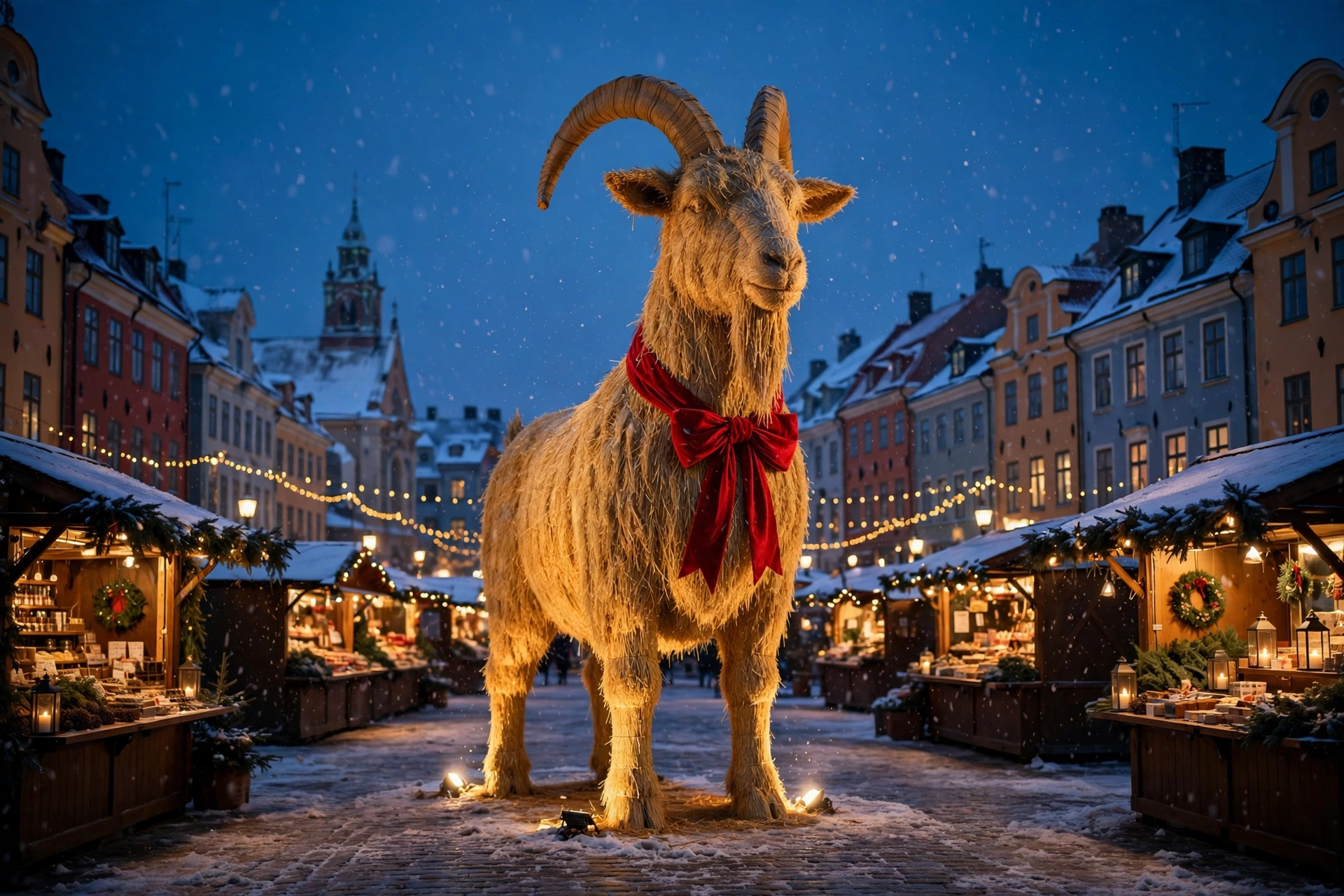
Every December, in the main square of Gävle, Sweden, a giant goat made of straw rises over the Christmas market. It stands some 13 meters tall, weighs several tons, and is one of the most famous Christmas symbols in Scandinavia. It is also, almost certainly, going to be set on fire. Since 1966, the Gävle Goat — Gävlebocken — has been erected, burned, vandalized, rebuilt, guarded, livestreamed, and loved in a cycle of creation and destruction that has made it world-famous. This is the story of Sweden’s Gävle Goat Christmas tradition: a giant straw Yule goat, the arsonists who cannot leave it alone, and the town that keeps building it back.
The Yule Goat: An Ancient Scandinavian Symbol
The Gävle Goat did not come from nowhere. The Yule goat (julbock) is one of Scandinavia’s oldest Christmas symbols, with roots reaching deep into Norse mythology. In the old stories, the thunder god Thor rode a chariot pulled by two goats, Tanngrisnir and Tanngnjóstr — goats he could slaughter for dinner and resurrect the next morning, a detail that made them potent symbols of abundance and renewal.
Over the centuries, the Yule goat evolved through many forms. In medieval and early modern Scandinavia, the julbock was sometimes a frightening figure — a man in goatskins and horns who demanded gifts or threatened mischief, a Scandinavian cousin of the Alpine Krampus. Later, the goat became the gift-bringer itself: in 19th-century Sweden, it was the Yule goat, not Santa Claus, who delivered presents in many households. The American-style Santa (jultomten) only displaced the goat in the 20th century.
Today the Yule goat survives as a beloved Christmas decoration: small straw goats, bound with red ribbon, appear under Christmas trees and in windows across Sweden, Norway, and Finland. They are ornaments now — charming, nostalgic, harmless. The Gävle Goat is what happens when someone decides to build that ornament 13 meters tall in the middle of town.
1966: The Birth of the Gävle Goat
The Gävle Goat was born as a publicity idea. In 1966, Stig Gavlén — an advertising consultant working in Gävle — proposed building a giant version of the traditional straw Yule goat in the town’s main square, Slottstorget (Castle Square), as a Christmas attraction that would draw visitors and shoppers. The local merchants’ association backed the idea, and that December the first Gävlebocken was erected: a straw giant towering over the square.
It burned down on New Year’s Eve — the first year, the first fire. The culprit was never officially identified, though a local became famous for the deed in town lore. The merchants, rather than abandoning the idea, rebuilt. And so the pattern was set: the goat goes up in late November or early December, and then the town holds its breath.
In those early years, the goat was a purely local affair — a big straw decoration in a medium-sized Swedish town, notable mainly for its habit of catching fire. Few outside Gävle had heard of it. That would change with the arrival of the internet, which turned the goat’s annual survival drama into a global spectator sport.
A Timeline of Fire: The Goat’s Greatest Hits
The Gävle Goat’s history is, essentially, a rap sheet. Across nearly six decades, the goat has been destroyed most years — burned, smashed, run over, and once famously stolen. A tour of the highlights:
The early fires (1960s–1970s)
The goat burned in its inaugural year (1966) and repeatedly through the late 1960s and 1970s. Arson methods were straightforward: matches, lighter fluid, a dark night. Security was minimal — it was, after all, a straw decoration, and the town had not yet grasped that it had created a tradition of destruction.
The dramatic decades (1980s–2000s)
As the goat’s fame grew, so did the creativity of its destroyers. The goat was smashed, kicked apart, and run into. Protective measures escalated in response: fireproofing treatments, security guards, fencing, and eventually 24-hour webcams. Each countermeasure became part of the game — the arsonists’ challenge was to defeat the defenses, and defeating them became a point of pride.
The webcam era (1990s–present)
The installation of live webcams transformed the goat into a global phenomenon. Now anyone, anywhere, could watch the straw giant standing in the Swedish winter dark — and the annual question, “Will it survive?”, became an international betting topic. Media outlets from dozens of countries cover the goat’s fate each December. The webcams also serve as security, though determined arsonists have still succeeded on camera.
The survivors
Some years, the goat survives — through a combination of security, weather (wet straw is harder to ignite), and luck. The surviving years are celebrated almost as triumphantly as the burnings; the town has learned to embrace both outcomes. A surviving goat is dismantled after the holidays and, in some years, the straw has been recycled or the structure preserved.
Why Do They Keep Burning It? The Psychology of Goat Arson
The Gävle Goat’s arson problem is genuinely puzzling — and genuinely fascinating. Burning someone else’s Christmas decoration is vandalism, plainly illegal (Swedish courts have prosecuted goat-burners), and widely condemned. Yet it keeps happening, decade after decade. Why?
Part of the answer is the game itself. The goat’s fame has created a perverse incentive structure: burning the Gävle Goat is the most famous act of Christmas vandalism in the world, guaranteed to make international news. For a certain kind of thrill-seeker, that notoriety is the reward. The escalating security — guards, cameras, fireproofing — only raises the stakes and the prestige of success.
There is also a folk-tradition reading. Some cultural commentators have suggested, half-seriously, that the burning has become a tradition in its own right — that Gävle now has two Christmas customs: building the goat and burning it. The town officially condemns the arson while unofficially benefiting from the global attention it brings. It is a strange symbiosis: without the fires, the goat would be a large straw decoration in a Swedish town; with them, it is world-famous.
Deeper still, there may be something archetypal at work. The burning of a straw figure at midwinter echoes ancient European customs — the burning of the Yule log, the torching of winter effigies, the ritual destruction that clears the way for renewal. The goat-burners would not describe their motives in these terms, but the resonance is there: fire, winter, a straw god, a crowd watching. Humans have been burning symbolic figures at the dark of the year for a very long time.
Visiting the Goat: A Pilgrim’s Guide
Seeing the Gävle Goat in person — ideally while it is still standing — is a worthy winter pilgrimage.
When to go
The goat is typically erected on the first Sunday of Advent (late November) in Slottstorget, Gävle’s Castle Square, in a ceremony that draws a crowd. It stands through December and into early January — if it survives. Early December is the sweet spot: the Christmas market is running, the goat is freshly built, and the arson season is young.
Getting there
Gävle is about 100 kilometers north of Stockholm, easily reached by train in under two hours. It makes a straightforward day trip from the capital, though staying overnight lets you see the goat — and the Christmas market — after dark, when the straw giant is floodlit and at its most impressive.
The full Gävle Christmas
Combine the goat with Gävle’s Christmas market, the town’s lights, and a walk along the Gavleån river. And check the goat’s webcam before you travel — not to spoil the suspense, but to confirm there is still a goat to see. If the worst has happened, the town usually rebuilds or displays the charred remains with a certain gallows humor; either way, it is a story.
The Goat in the Internet Age
The webcams changed everything. Installed in the 1990s and 2000s, the live feeds turned a local curiosity into a global reality show with one binary plot: will it burn? Each December, the goat trends on social media; betting pools (formal and informal) track its odds; news outlets run “goat watch” stories; and the town of Gävle receives a volume of international attention wildly disproportionate to its size.
The town has learned to play the game. The goat has official social media accounts. Merchants sell Gävle Goat souvenirs — miniature straw goats, t-shirts, ornaments. The goat’s construction is a public event, and its fate is announced like election results. Gävle, a pleasant industrial city that most tourists would otherwise pass through on the way north, has become a December destination on the strength of a straw animal and its enemies.
The security operation is now serious business. The goat is treated with fire retardant, surrounded by fencing, monitored by cameras, and in some years guarded around the clock. Would-be arsonists face real prosecution — Swedish courts have handed down fines and jail time for goat-burning. The town’s official position is unambiguous: the goat is a beloved symbol, the arson is a crime, and the goal every year is survival.
And yet — the town also knows. Ask a Gävle resident about the goat, and you will often detect a certain pride in the burnings alongside the condemnation. The fires are part of the story now, as much as the straw. A Gävle Goat that no one tried to burn would be a slightly less interesting goat. The town would never say so officially. The town does not have to.
How the Goat Is Built
Constructing a 13-meter straw goat is a serious engineering project. The process, refined over decades, goes roughly like this:
The frame
A wooden (in some years steel-reinforced) skeleton is built to the goat’s dimensions — body, four legs, neck, head, and the characteristic horns and beard. The structure must withstand December weather: snow loads, coastal winds, and the attention of vandals.
The straw
Thousands of bundles of straw are wired and bound to the frame, layered to create the goat’s shaggy coat. The straw is the goat’s visual signature — golden, textured, unmistakable — and also its vulnerability. Fire retardant treatments help but cannot make straw fireproof; they buy time.
The details
The red ribbon — the julbock‘s traditional adornment — is tied around the neck and body. The horns are shaped, the beard attached, the eyes set. The finished goat is floodlit for the season, and the webcams go live. Then the waiting begins.
The Goat’s Relatives: Straw Goats Across Scandinavia
Gävle’s giant is the most famous, but it has kin. Towns across Sweden build large straw goats for Christmas — some nearly as big, none as notorious. The straw Yule goat as a decoration is ubiquitous: the small bound-straw goats under the tree, the goat ornaments on the branches, the julbock in the window. In Finland, straw goats (olkipukki) are equally traditional.
There is also the deeper family: the Yule goat’s mythological relatives. The Norse Thor’s goats, the medieval julbock gift-bringer, the Finnish Joulupukki — the “Christmas Goat” who is Finland’s Santa Claus, his name a fossil of the goat’s former role as gift-bringer. The Gävle Goat stands at the intersection of all these meanings: decoration, deity-echo, and dare.
In Pictures: The Gävle Goat of Sweden
Every Advent, the Swedish city of Gävle raises a 13-metre straw Yule goat in its central square — and every year, the world watches to see whether it survives the season.
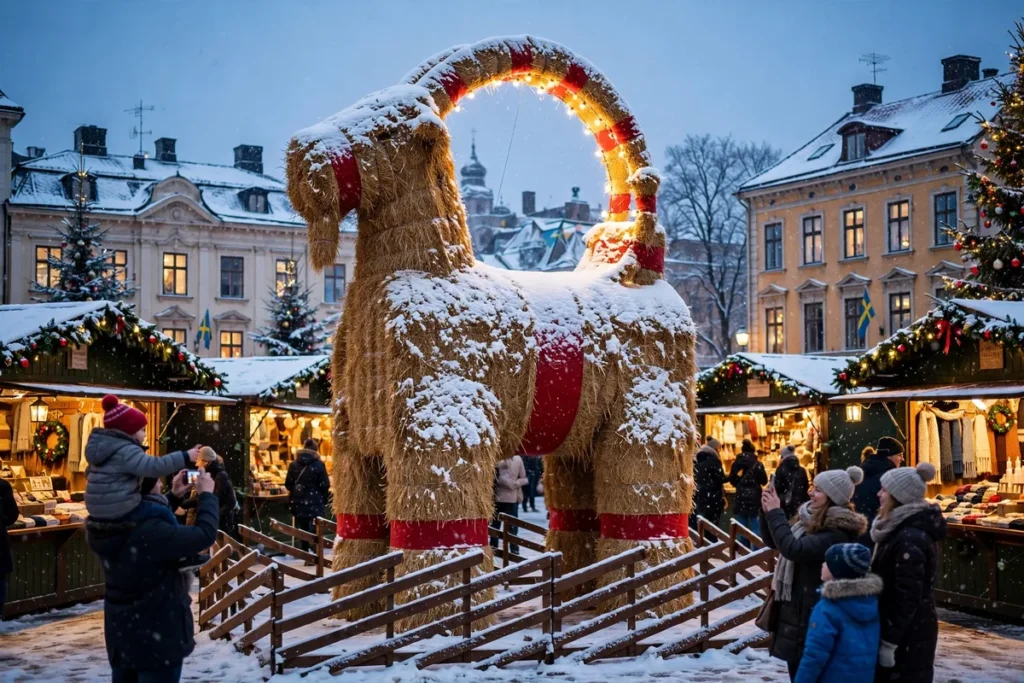
The Gävle Goat in its snowy town square: the giant straw Yule goat among Christmas market stalls as families gather in the falling snow.
Watch: The Gävle Goat of Sweden
The Guardian's documentary “Killing Gävle” follows the annual battle over the straw goat — custodians versus the shadowy figures who burn it — in one of Christmas' strangest traditions.
At a Glance: The Gävle Goat of Sweden
The goat, the burnings, and the worldwide watch over Gävle's Christmas icon.
| Element | What it is | Key detail |
|---|---|---|
| 1966 | The first goat | The straw Yule goat is first built in Gävle and unveiled on the first day of Advent |
| 1969 | The first burning | Three years in, the goat burns for the first time — beginning the annual battle |
| 13 metres | The size | The giant effigy stands about 40 feet (13 metres) tall in the city's central square |
| 1993 | The record | A 16-metre Gävle goat that survived the season became the Guinness World Record holder |
| 37 times | The destructions | The goat has been burned down or damaged dozens of times — roughly every other year on average |
| Two goats | The builders | Since 1986, two groups have each built a goat: the merchants and the Natural Science Club |
| The webcam | The watch | Fans around the world follow the goat's fate each December on the city's live webcam |
Frequently Asked Questions
What is the Gävle Goat?
The Gävle Goat (Gävlebocken) is a giant straw Yule goat — about 13 meters (43 feet) tall — erected each December in Castle Square (Slottstorget) in Gävle, Sweden. Built since 1966, it is famous for being burned down by arsonists in most years of its history.
Why does the Gävle Goat keep getting burned?
Arsonists have targeted the goat since its first year (1966). Motives range from thrill-seeking and notoriety — burning the world’s most famous straw goat guarantees headlines — to a strange folk-tradition momentum. Goat-burning is illegal in Sweden and has been prosecuted, but the fires continue most years.
How tall is the Gävle Goat?
The goat stands approximately 13 meters (about 43 feet) tall and weighs several tons. It is built on a wooden frame covered with thousands of bundles of straw, decorated with the traditional red ribbon.
When is the Gävle Goat erected?
The goat is traditionally erected on the first Sunday of Advent (late November) in Slottstorget, Gävle. It is meant to stand through the Christmas season into early January — though its survival is never guaranteed.
Can I watch the Gävle Goat online?
Yes — live webcams monitor the goat around the clock through December, and the feeds draw viewers from around the world each year. The goat also has official social media accounts announcing its status.
What is a Yule goat?
The Yule goat (julbock) is an ancient Scandinavian Christmas symbol with roots in Norse mythology (the goats that pulled Thor’s chariot). It evolved from a fearsome folk figure to a gift-bringer and finally to the beloved straw Christmas decoration seen across Sweden, Norway, and Finland today.
The Gävle Goat is Sweden’s most combustible Christmas tradition — for the country’s luminous one, read about St. Lucia Day in Sweden. Plan a Swedish winter trip with our best places to spend Christmas, and bring Scandinavian craft home with Christmas decoration ideas. For more fiery folklore from the season, meet Austria’s Krampus.
Year by Year: The Goat’s Most Notorious Moments
The Gävle Goat’s six-decade rap sheet is long, but certain years have entered legend. A tour of the greatest hits:
1966: The inaugural fire
The first goat burned on New Year’s Eve of its first year — establishing, immediately, the pattern that would define it. The town rebuilt, perhaps not yet realizing it was founding a tradition of destruction.
The 1970s: Smash hits
Through the late 1960s and 1970s, the goat burned repeatedly — most years, by most accounts. Arson was simple, security was minimal, and the goat became a local joke with a punchline of flame. One year the goat was reportedly kicked apart; resilience was not yet the town’s strategy.
2001: An American tourist
In one of the most famous incidents, an American tourist was convicted of goat-burning — proof that the arson tradition had gone international. The case made headlines worldwide and cemented the goat’s status as a global news story: people were now traveling to Sweden specifically to burn the goat, or at least to watch.
The 2000s: Escalation
As webcams brought the world to Slottstorget, the attacks grew bolder and the defenses more elaborate. Fire-retardant treatments, security fencing, guard patrols, and eventually live-streamed surveillance turned each December into a high-tech standoff between the town and its anonymous enemies. Some years the goat survived — celebrated as victories; most years it did not.
Survival years
The years the goat survives are remembered almost as fondly as the burnings. Wet weather helps — sodden straw resists ignition — and so do vigilant guards and, occasionally, sheer luck. A surviving goat is dismantled after the season with honors, and the town enjoys a rare December without international headlines about arson.
What the timeline reveals is an arms race with no end in sight. Every countermeasure — the retardant, the fence, the cameras, the guards — has been defeated at least once, and every defeat has produced a better countermeasure. The goat endures because Gävle refuses to stop building it; the fires endure because the goat’s fame makes burning it irresistible. It is a stable, strange equilibrium — and it shows no sign of breaking.
Giant Goats Elsewhere: The Gävle Goat’s Rivals
Gävle’s goat is the most famous, but Sweden has other giant straw goats — and a friendly rivalry simmers. Several towns build large julbockar each December, some approaching Gävle’s scale. None has Gävle’s arson problem, which Gävle residents cite with perverse pride: other towns have goats; Gävle has the Goat, the one the world watches, the one they try to burn.
The rivalry extends to the miniature: the small straw goat ornaments sold across Scandinavia each Christmas are, in a sense, all descendants of the same Yule-goat tradition — bound straw, red ribbon, a place under the tree. Gävle’s gift shops sell miniature Gävlebocken replicas, so visitors can take home a tiny version of the giant — ideally one that will not catch fire on the mantelpiece.
There is also a heartwarming coda to the giant-goat story. In years when the Gävle Goat has been destroyed, donations and messages of support pour in from around the world — proof that the straw giant has genuine well-wishers, not just arsonists and spectators. The goat is loved, and its burnings are mourned, by far more people than ever lift a match. The fires make the news; the love is the real story.
Why the Goat Matters: Tradition, Defiance, and Joy
Step back from the rap sheet and the webcams, and the Gävle Goat is something genuinely moving: a town’s refusal to give up. For nearly sixty years, Gävle has built its goat knowing it will probably burn — and built it anyway, bigger and better each time, with more security, more ceremony, more love. That is not stubbornness. That is faith: in tradition, in community, in the idea that some things are worth doing even when the world keeps setting them on fire.
The goat also embodies a particularly Scandinavian relationship with darkness and humor. The Swedish Christmas is luminous — Lucia’s candles, the Advent stars, the floodlit straw goat — and the goat’s annual immolation is the shadow in the light, the joke in the ceremony. Swedes love their traditions and love puncturing them; the Gävle Goat lets a whole town do both at once, every December.
So watch the webcam this year. Root for the goat. And if it burns — as it probably will — remember that Gävle will build it again, because that is what Gävle does. The goat is straw; the tradition is steel.
Frequently Asked Questions (Continued)
Has anyone been caught burning the Gävle Goat?
Yes — several arsonists have been identified and prosecuted over the decades, including, in one famous case, an American tourist. Swedish courts have imposed fines and jail sentences for goat-burning. Despite this, the fires continue most years, and the perpetrators are often never identified.
What happens to the goat if it survives?
In years when the goat survives the season, it is ceremonially dismantled after the holidays. The straw has sometimes been recycled or composted, and the event of a surviving goat is celebrated by the town as a victory — almost as newsworthy, locally, as a burning.