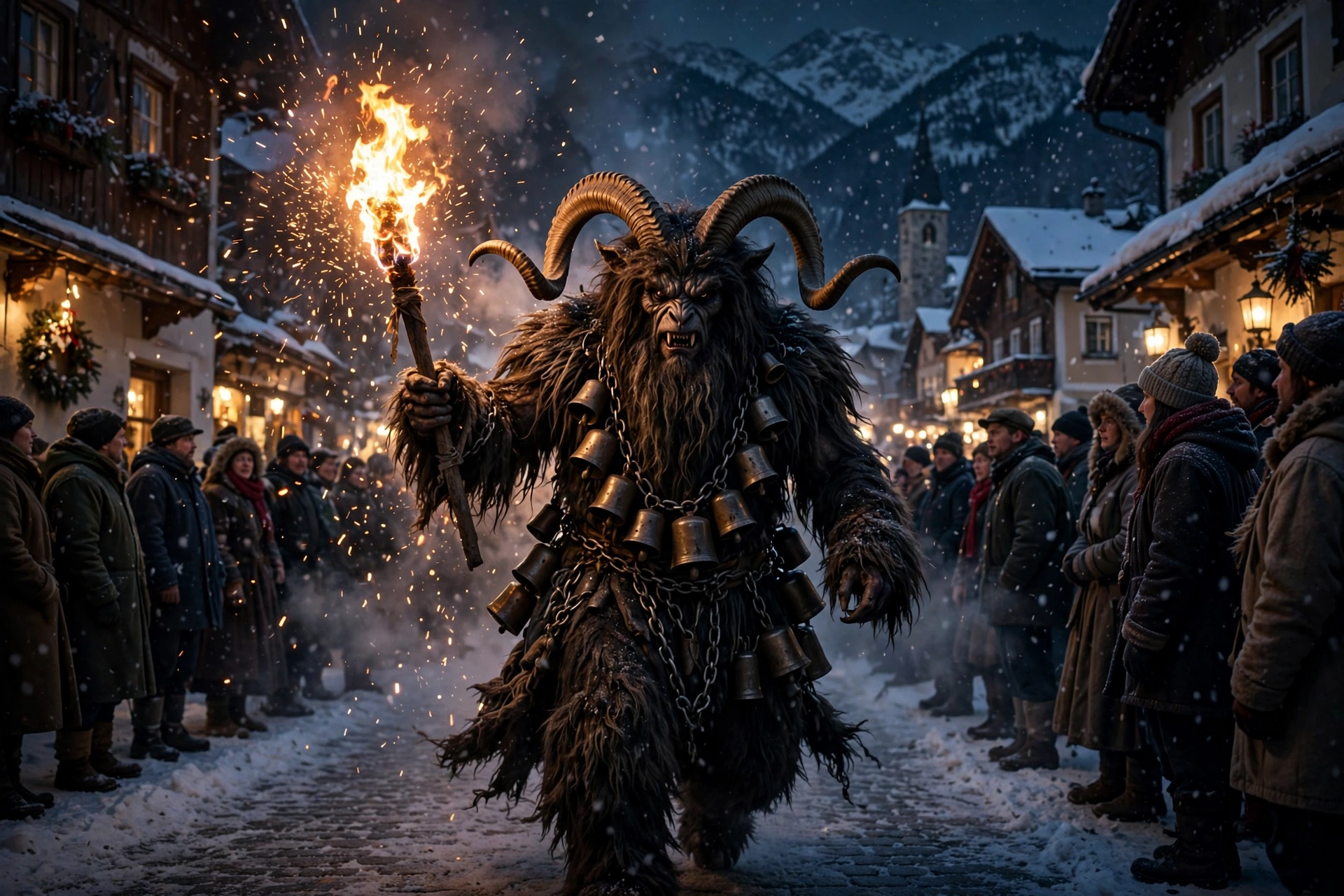
Saint Nicholas rewards the good children. Somebody has to handle the naughty ones — and in the Alpine villages of Austria and southern Germany, that somebody is Krampus: a horned, cloven-hoofed, bell-rattling demon who has haunted the region’s Christmases for centuries. On the night of December 5th, while children elsewhere hang stockings, children in the Alps go to bed knowing that Krampusnacht is underway — and that in the streets below, torchlit processions of fur-clad devils are rattling chains and cracking whips. The Krampus tradition in Austria and Germany is Christmas’s dark mirror: a folklore of fear, noise, and catharsis that has survived church bans, world wars, and the age of the internet to become one of Europe’s most electrifying winter spectacles.
Krampusnacht: December 5th, the Night Before St. Nicholas
To understand Krampus, start with the calendar. December 6th is the feast of St. Nicholas (Nikolaustag), the gift-bringing bishop whose legend underlies Santa Claus. In Alpine tradition, Nicholas does not travel alone: he is accompanied by a dark companion who punishes misbehaving children while the saint rewards the good. That companion is Krampus, and his night is December 5th — Krampusnacht, Krampus Night — the eve of the saint’s feast.
In the traditional house visit, the pair arrives together: Nicholas in bishop’s robes, calm and questioning; Krampus at his side, rattling chains, brandishing a bundle of birch rods (Ruten), and generally terrifying everyone under the age of ten. Children recite poems or prayers for Nicholas; Krampus lurks, a living embodiment of consequences. The birch rods are not merely symbolic in the old custom — a light swat for the naughty was part of the performance — though modern visits are firmly theatrical.
The folklore is vivid about Krampus’s appearance: the shaggy black or brown fur of a goat, cloven hooves, curved horns, a long red tongue, glowing eyes, and iron bells clanking at the waist. He carries chains — said to symbolize the binding of the Devil in Christian tradition — and a wicker basket on his back for carrying away the worst offenders. Parents invoked him year-round: behave, or Krampus will get you. Generations of Alpine children grew up with that warning ringing in their ears.
Where Krampus Comes From: Alpine Folklore Roots
Krampus’s origins are genuinely ancient, though scholars debate the details — and honest writing about him should acknowledge the uncertainty. The horned, fur-clad winter figure almost certainly descends from pre-Christian Alpine midwinter customs: the region’s Perchten traditions, in which masked figures representing winter spirits paraded through villages in the Twelve Nights between Christmas and Epiphany, driving out evil with noise and frightening masks. The name “Krampus” itself likely derives from the Old High German krampen, meaning claw.
What is well documented is the Christian overlay. As the cult of St. Nicholas spread through the Alps in the Middle Ages, the church found itself sharing December with unruly folk customs it could neither fully absorb nor entirely suppress. The solution, in effect, was a compromise: the wild winter spirit was yoked to the saint as his servant and enforcer. Krampus became the shadow that made Nicholas’s light shine brighter — a theological good-cop, bad-cop routine that gave parents a complete disciplinary toolkit.
The church’s relationship with Krampus was never comfortable. Inquisitorial and reformist authorities periodically tried to ban the figure outright — most famously, the Catholic Church in Austria attempted to prohibit Krampus celebrations in the 18th and 19th centuries, and the character was suppressed under certain political regimes in the 20th century. Each ban failed. Krampus kept coming back, because Krampus belonged not to the church but to the villages.
Krampuslauf: The Great Devil Parades
The most spectacular expression of the tradition is the Krampuslauf — the Krampus run — in which dozens or hundreds of costumed Krampusse parade through town after dark, lit by torches, accompanied by drummers, fire performers, and sometimes St. Nicholas himself bringing up the rear. Related Perchtenläufe (Perchten runs) feature the broader family of Alpine masked spirits. These are not quaint folk pageants; they are loud, smoky, adrenaline-charged events that draw thousands of spectators and fill the narrow streets of old towns with costumed devils.
The costumes — Larven (masks) — are works of folk art. Carved from wood, fitted with real goat or ram horns, finished with glass eyes and horsehair, a good Krampus mask is a serious investment, often handmade by specialist carvers and passed down through families. The full costume adds shaggy pelts, massive cowbells, chains, and birch rods. Groups (Passen) train and rehearse, and there is real prestige in running with an established Pass.
Major runs take place across Austria — in Salzburg, Tyrol, Carinthia, and Styria — and in Bavaria and South Tyrol, typically on or around December 5th, with some events extending through the first two weekends of December. The atmosphere is controlled chaos: Krampusse charge the crowd barriers, rattle their bells inches from spectators’ faces, and playfully menace children (who scream with a mixture of terror and delight). Mulled wine flows. It is, by every account, an unforgettable night.
The Krampus Postcard Craze
One of the strangest chapters in Krampus history is the Krampuskarten — Krampus greeting cards — that were wildly popular in Austria and Germany in the late 19th and early 20th centuries. These chromolithographed postcards, exchanged like Christmas cards, depicted Krampus in lurid, often comic scenes: spanking naughty children, dragging them off in baskets, menacing flirtatious couples, or posing with a wink for the camera. The captions ran to rhyming threats and jokes: “Greetings from Krampus!”
The cards reveal how the tradition functioned psychologically. Krampus was frightening, but he was also funny — a licensed mischief-maker, a carnival figure through whom a buttoned-up society could enjoy a little sanctioned menace. The postcards domesticated the demon into a joke shared between adults, even as the live tradition kept frightening children in the streets. Original Krampuskarten are now collector’s items, and their imagery — the leering goat-devil with his birch rods — shaped the modern visual identity of Krampus as much as any folk carving.
Krampus Goes Global
In the last two decades, Krampus has escaped the Alps. Horror films, television episodes, comic books, and a thriving subculture of Krampus art have introduced the horned Christmas devil to audiences who have never heard a cowbell in a mountain village. American cities now host their own Krampus parades and pub crawls — Los Angeles, Philadelphia, Chicago, and others stage annual events — and Krampus costumes are a staple of alternative Christmas parties worldwide.
The global spread has produced the usual tensions. Alpine traditionalists grumble, with some justification, that the Instagram-era Krampus — all absinthe and Hot Topic — has little to do with the village Pass that carved its masks by hand and runs in minus-ten-degree cold. But folklore has always traveled and mutated; the Krampuskarten were themselves a commercial popularization in their day. The core of the tradition — the December run, the bells, the confrontation between fear and festivity — remains intact in its homeland, where the runs grow larger every year.
There is also a serious cultural conversation beneath the spectacle. Ethnologists and psychologists have long been fascinated by Krampus as a mechanism for processing fear: a community that collectively stages its anxieties — about punishment, about the dark, about winter itself — and then, when the run ends and the mulled wine is poured, symbolically masters them. In an age of sanitized, shopping-mall Christmases, the raw, noisy, slightly dangerous energy of Krampusnacht offers something many people did not know they were missing.
Myth vs. Fact: Sorting Out the Krampus Legend
Krampus attracts confident claims — many of them shaky. Here is what holds up.
Myth: Krampus is the devil / Satan himself
The reality: Krampus is a folk figure, not a theological one. While his imagery borrows from Christian depictions of demons (horns, cloven hooves, chains), Alpine tradition treats him as St. Nicholas’s wild servant and enforcer — a distinct character with his own role, not the Devil in a Christmas costume. The chains he carries are sometimes interpreted as symbolizing the binding of evil, which puts him, paradoxically, on the side of order.
Myth: The tradition is thousands of years old and purely pagan
The reality: The masked winter-parade customs of the Alps do likely have pre-Christian roots, but Krampus as the companion of St. Nicholas is a product of the Christian Middle Ages — the pairing only makes sense once Nicholas is in the picture. Claims of a specific ancient “Krampus cult” go beyond the evidence. What is certain is that the figure as celebrated today is a medieval-to-modern folk creation with older ingredients.
Myth: Krampusnacht is December 6th
The reality: Krampusnacht is December 5th — the eve of St. Nicholas Day (December 6th). The pairing mirrors Christmas Eve and Christmas Day: the dark companion’s night comes first, the saint’s feast follows. Many public Krampus runs are scheduled on the weekends around December 5th for practical reasons, but the traditional night is the 5th.
Myth: The birch rods mean Krampus celebrations are about hurting children
The reality: In historical house visits, a light symbolic swat with birch rods (Ruten) was part of the performance — uncomfortable, but theater, not violence. Modern Krampus events are regulated public spectacles; the “menace” is playacting, the rods are props, and organizers take safety seriously. The fear is the point; actual harm is not.
Experiencing Krampusnacht as a Visitor
Seeing a Krampuslauf in person is one of Europe’s great winter experiences — and it rewards a little preparation.
Where and when to go
The heartland is Austria: Salzburg, the Tyrolean towns, Carinthia, and Styria all host major runs, typically on or around December 5th, with many events on the surrounding weekends. Bavaria (southern Germany) and South Tyrol (northern Italy) have strong traditions too. Check local tourism listings for exact dates each year, as schedules vary by town and many events are organized by local Krampus associations (Krampusvereine).
What to expect
Arrive early for a spot near the barriers — the best runs draw big crowds. Dress very warmly: you will be standing outside in Alpine December night air. Expect noise (cowbells, drums, whips), smoke (torches), and Krampusse who will get in your face — that is the show. Children are welcome but be honest about their tolerance for being scared; plenty of Alpine kids grow up loving it, and plenty spend the run hiding behind their parents, which is also traditional.
Etiquette
Do not grab the costumes or pull masks — the runners are athletes in heavy gear working a crowd. Keep a respectful distance from the torchbearers. Buy the mulled wine. And if a Krampus singles you out for a theatrical menacing, play along: a good-natured scream is the correct response, and the runners love an engaged crowd.
Krampus and the Modern Christmas Imagination
There is a reason Krampus resonates right now. The modern Western Christmas, for all its warmth, can feel airless — a loop of identical mall decorations and sentimental advertising. Krampus breaks the loop. He is the reminder that winter was once genuinely frightening, that the dark outside the window was real, and that communities dealt with fear by staging it, facing it together, and then going inside for something warm.
Anthropologists sometimes describe figures like Krampus as “cathartic monsters”: communal creations that let people experience fear in a safe, bounded, even funny context. The child who screams at the Krampuslauf and then laughs about it over hot chocolate has practiced something valuable — the recognition that fear can be faced, survived, and transformed into story. In that sense, Krampus is not the opposite of Christmas. He is its shadow, and shadows are what give light its shape.
So this December 5th, spare a thought for the Alps, where the bells are ringing and the torches are lit. Somewhere in a mountain town, a carved wooden devil is rattling his chains — and Christmas, in all its strange and ancient fullness, is underway.
In Pictures: Krampus Tradition in Austria and Germany
On the night of December 5th, torchlit processions of fur-clad, bell-rattling devils fill Alpine streets — Krampusnacht, Christmas's dark mirror in Austria and southern Germany.
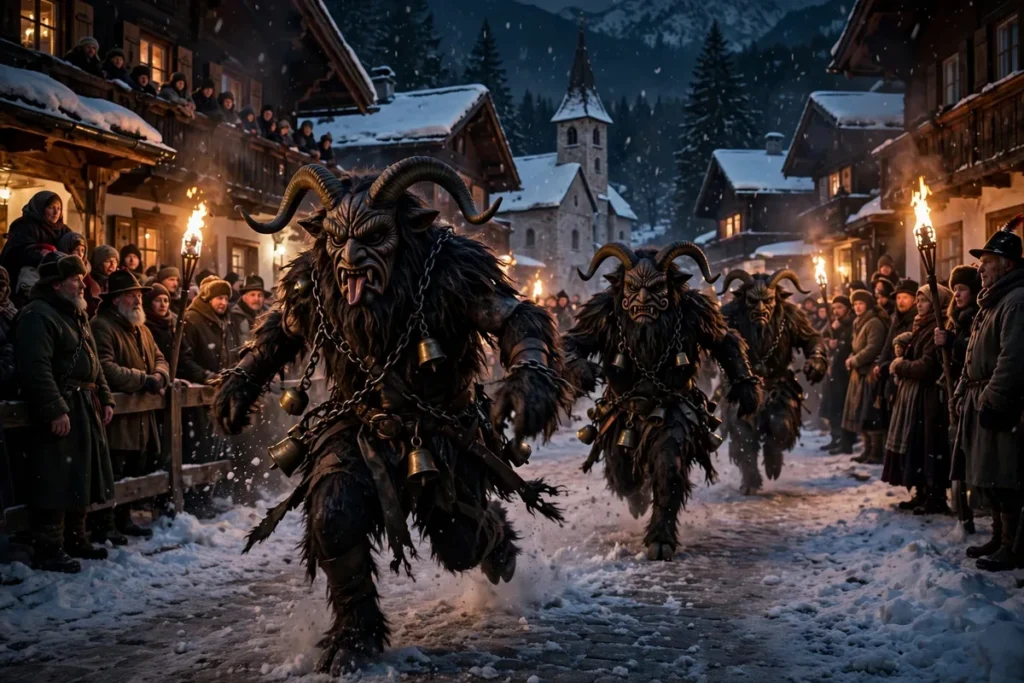
A Krampus run in an Austrian Alpine village: horned, furry figures with chains and bells thundering through torch-lit snowy streets.
Watch: Krampus Tradition in Austria and Germany
EnchufeViral captures the Krampuslauf in Salzburg — hand-carved masks, enormous horns, and thundering cowbells taking over the historic streets for one of the Alps' wildest winter traditions.
At a Glance: Krampus Tradition in Austria and Germany
The demon, his night, and the runs that keep Alpine folklore alive.
| Element | What it is | Key detail |
|---|---|---|
| Krampusnacht | 5 December | Krampus Night — the eve of St. Nicholas Day, when the horned companion of the saint takes to the streets |
| Krampus | The figure | A horned, cloven-hoofed, half-goat demon; his name likely comes from the German “krampen” (claw) |
| St. Nicholas | The counterpart | The gift-bringing bishop rewards good children while Krampus handles the naughty ones — they traditionally arrive together |
| Ruten | The birch rods | Bundles of birch sticks Krampus brandishes to swat misbehaving children — or carries them off in his sack |
| Krampusläufe | The runs | Torchlit parades of hundreds of masked performers in hand-carved wooden masks, fur, horns, bells, and chains |
| Pre-Christian roots | The history | Many folklorists trace Krampus to pre-Christian Alpine winter spirits, later folded into Christian custom |
| Perchten | The relatives | Perchten groups — related Alpine masked figures — march alongside Krampus in many runs |
Frequently Asked Questions
What is Krampusnacht?
Krampusnacht (Krampus Night) is December 5th, the eve of St. Nicholas Day, when the horned folk figure Krampus traditionally visits alongside St. Nicholas. In modern Austria and southern Germany it is marked by torchlit Krampus runs (Krampusläufe) — parades of costumed devils through town streets.
Is Krampus Austrian or German?
Both — the tradition belongs to the Alpine region spanning Austria, southern Germany (Bavaria), South Tyrol in northern Italy, Slovenia, and neighboring areas. Austria is generally considered the heartland, with the highest concentration of major Krampus runs.
What does Krampus look like?
Traditional depictions show a shaggy, goat-like demon with curved horns, cloven hooves, glowing eyes, and a long red tongue, wearing clanking cowbells and chains and carrying birch rods (Ruten) and sometimes a wicker basket for naughty children. Masks are hand-carved from wood with real horns.
Are Krampus parades safe for children?
They are theatrical and regulated, but they are intentionally scary — loud bells, fire, and costumed devils getting close to the crowd. Many Alpine children attend and love it, but parents should gauge their own child’s comfort with being frightened. Watching from a little further back is always an option.
When did the Krampus tradition start?
The masked winter-parade customs of the Alps likely have pre-Christian roots, but Krampus as St. Nicholas’s companion dates to the Christian Middle Ages. The tradition was popularized in its modern form in the 19th century (including the famous Krampus postcards) and has seen a major revival since the late 20th century.
Can I see Krampus outside Austria and Germany?
Yes — Krampus parades and events now take place in many countries, including the United States, driven by the figure’s popularity in horror and alternative culture. But the traditional, community-rooted runs remain an Alpine phenomenon, and seeing one in Austria or Bavaria is a different experience entirely.
The Alps’ dark Christmas pairs fascinatingly with Scandinavia’s festivals of light — compare Krampusnacht with Sweden’s luminous St. Lucia Day traditions. For more on Europe’s winter celebrations, explore the best Christmas markets closer to home, and plan your own seasonal adventures with our guide to the best places to spend Christmas.
The Perchten: Krampus’s Wilder Cousins
Krampus does not run alone in Alpine folklore. He belongs to a larger family of masked winter spirits called the Perchten — and understanding them deepens the Krampus story considerably. The Perchten tradition centers on Frau Perchta (also Percht, Berchta), a fearsome female figure of Alpine legend who roams during the Twelve Nights between Christmas and Epiphany, rewarding the industrious and punishing the lazy — particularly spinners who have not finished their work.
The Perchtenläufe — Perchten runs — feature two hosts: the Schönperchten (“beautiful Perchten”), with ornate, often radiant masks, and the Schiachperchten (“ugly Perchten”), with grotesque horned and fanged faces that make Krampus look restrained. These processions, held in early January in many Alpine towns, are older in form than the December Krampus runs and more explicitly tied to the pre-Christian midwinter rites — the driving-out of winter demons with noise, fire, and terror.
Scholars see Krampus as essentially a specialized Percht — the wild winter spirit domesticated into St. Nicholas’s service, given a December date and a disciplinary job description. The Perchten remained wilder, roaming the Twelve Nights without a saint to supervise them. Together, Krampus and the Perchten represent the full spectrum of Alpine winter folklore: the companion devil of early December and the untamed spirit-hosts of deep winter, bookending the season in masks and bells.
For visitors, the Perchten runs of early January — in towns across Austria’s Pinzgau region, Salzburg province, and Bavaria — are the connoisseur’s choice: less famous than the December Krampusläufe, often more spectacular, and steeped in an atmosphere that feels genuinely ancient. If Krampusnacht is Christmas’s dark mirror, the Perchtenläufe are winter’s raw face.
Krampus on Screen: The Devil’s Hollywood Career
Krampus’s global fame owes an enormous debt to popular culture. The figure’s screen career began in European horror and then exploded internationally. The 2015 American horror-comedy Krampus, directed by Michael Dougherty, introduced the character to mainstream global audiences with a big-budget, darkly comic take on the legend — a dysfunctional family’s Christmas invaded by the horned punisher of the season’s lost spirit. The film was a commercial success and instantly became a cult holiday rewatch.
Television followed: Krampus has appeared in episodes of shows like Supernatural, Grimm (fittingly, given the show’s Germanic folklore premise), and animated series including American Dad!, each version playing the character somewhere on the spectrum from terrifying to hilarious. Comic books, novels, and video games have all taken their turn. The heavy-metal and dark-folk music scenes adopted Krampus as a mascot; alternative Christmas celebrations from Berlin to Brooklyn feature Krampus imagery.
This media afterlife has a feedback effect on the tradition itself. Young Austrians who grew up seeing Krampus in American movies arrive at the village Krampuslauf with fresh eyes — and the runs, in turn, have grown more theatrical, more spectacular, more aware of their audience. Folklore has always been a conversation between the village and the wider world; the conversation is just louder now, and the whole world is listening.
There is a serious cultural-studies point here. Krampus’s appeal to modern audiences — particularly younger ones — reflects a broader hunger for a Christmas with edges. The sanitized, commercial holiday leaves many people cold (sometimes literally, sometimes spiritually), and Krampus offers an alternative: a Christmas that acknowledges darkness, fear, mischief, and consequence. He is the holiday’s id, and the id, it turns out, was thirsty.
The Craft of Fear: How Krampus Masks Are Made
A great Krampus mask (Larve) is a serious piece of folk art, and the carvers who make them are respected craftsmen. The process begins with selecting the wood — typically Swiss pine (Zirbe), prized for its workability and aroma. The carver roughs out the demonic face: the snarling muzzle, the deep eye sockets, the brow ridges that will hold the horns.
The horns are real — goat, ram, or ibex — sourced, cleaned, and fitted to the carved head. Glass eyes are set into the sockets; horsehair or goat hair is added for the shaggy mane; the whole is painted and finished, often with an aged, weathered look that suggests the mask has been running the winter nights for centuries. A finished mask can weigh several kilograms and cost anywhere from hundreds to thousands of euros.
The full costume adds the Gewand — pelts of goat or sheep sewn into a shaggy suit — plus massive cowbells (Schellen) strapped around the waist, chains, and the birch-rod bundle. Runners describe the experience as transformative: once the mask is on, you are not yourself; you are the thing in the dark that children have nightmares about, and the crowd’s fear-joy is intoxicating. Many runners inherit their masks from fathers and grandfathers — the devil, in the Alps, is a family business.