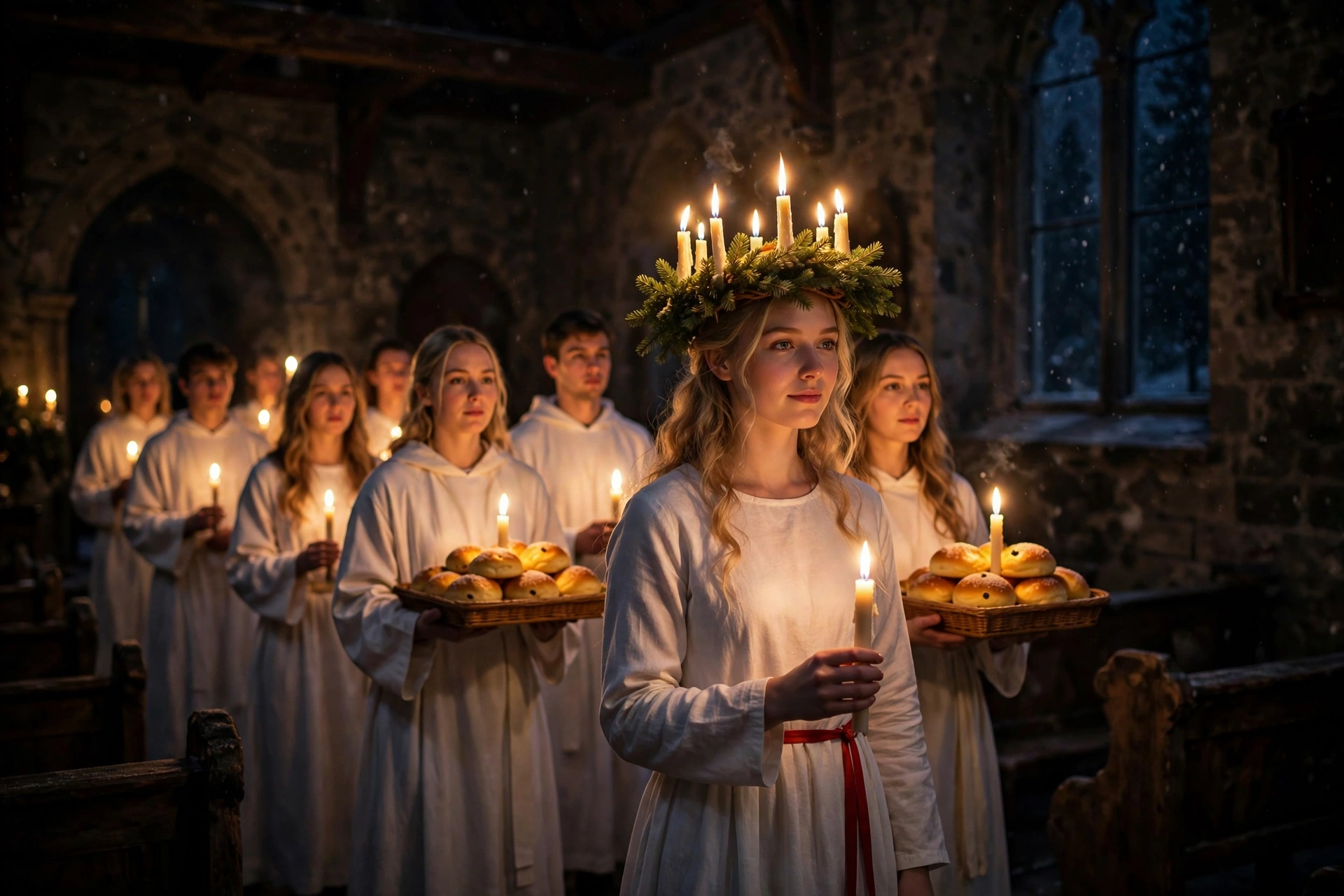
On the morning of December 13th, in the deep darkness of the Swedish winter, a procession of young people in white gowns moves slowly through schools, churches, workplaces, and nursing homes. At its head walks a young woman wearing a crown of lit candles, singing an old melody about light conquering darkness. Behind her follow star boys in tall paper hats, elves, and gingerbread figures, all carrying candles and trays of saffron buns. This is St. Lucia Day — Luciadagen — Sweden’s most luminous winter tradition, and one of the most visually striking Christmas customs anywhere in the world. The St Lucia Day Sweden traditions blend a third-century Christian martyr, ancient Nordic midwinter rites, and a modern celebration of song, light, and community that marks the true beginning of the Swedish Christmas season.
Who Was St. Lucia?
The figure at the heart of the celebration is Saint Lucy of Syracuse, a Christian martyr who died around 304 AD during the Diocletian persecution in Sicily. According to legend, Lucy brought food to Christians hiding in the catacombs, wearing a wreath of candles on her head to keep her hands free for carrying provisions. Her feast day, December 13th, was established in the Christian calendar centuries ago. In a detail that helped the tradition take root in the north, December 13th was also the date of the winter solstice under the old Julian calendar — the darkest day of the year — before the Gregorian calendar reform shifted the solstice to December 21st.
That coincidence of dates was fateful. In Scandinavia, the year already turned on midwinter: the old Norse calendar marked the darkest night with rites to hold back the dark. When the Christian feast of a light-bearing saint landed on what was popularly considered the year’s darkest day, the two merged. Lucia — whose name derives from the Latin lux, meaning light — became the bearer of light in the literal darkness of the Nordic winter, when the sun in northern Sweden may rise for only a few hours, or not at all.
How Sweden Made Lucia Its Own
Lucia’s veneration reached Sweden by the Middle Ages, but the celebration Swedes recognize today took shape much later. The earliest distinctly Swedish Lucia customs appeared in the manor houses and universities of western Sweden in the 1700s, where the eldest daughter of the house would dress in white and serve coffee and buns to the household on the morning of December 13th. From these domestic beginnings, the tradition spread through schools and student associations in the 1800s.
The modern, public form of the celebration dates to 1927, when a Stockholm newspaper organized a public Lucia procession and invited readers to vote for the city’s Lucia. The event was a sensation, and the format — a crowned Lucia leading a singing procession — was quickly adopted by schools, churches, choirs, and towns across the country. By the mid-20th century, Luciadagen had become a genuinely national institution, as fixed in the Swedish calendar as Midsummer.
Today the celebration has evolved in inclusive directions. While the classic Lucia is a young woman with long hair crowned by candles, schools and communities now choose Lucias of all genders and backgrounds, and the emphasis has shifted toward participation and song rather than any single image. The core, however, is unchanged: light, music, and saffron buns in the depths of winter.
The Candle Crown: Sweden’s Most Famous Headpiece
No symbol of Swedish Christmas is more recognizable than the Lucia crown — a wreath of lingonberry sprigs or greenery fitted with holders for real candles. Traditionally the candles are lit, and the Lucia leads her procession with actual flames flickering above her head, an image of extraordinary beauty in a darkened church or school hall. For safety, many modern processions — especially those involving children — use battery-powered LED candles, but adult and professional choirs often still carry the real thing, and the sight of a living Lucia with burning candles remains one of the great tableaux of the Scandinavian winter.
The white gown (kirtle) worn by Lucia and her attendants symbolizes the baptismal robe and, by extension, martyrdom and purity; the red sash around the waist represents martyrdom. Star boys (stjärngossar) wear tall conical hats decorated with stars, a nod to the Star of Bethlehem, and carry star-topped staffs. The procession may also include elves (tomtenissar) and, in children’s processions, gingerbread figures (pepparkaksgubbar) — a charmingly Swedish touch.
Making the crown is itself a small craft tradition. Families and schools wire the greenery, fit the candle holders, and test the balance — a crown that slides is a Lucia’s nightmare. Florists across Sweden do brisk business in Lucia crowns every December, and the finished wreaths, with their ring of white candles, are as much a part of the season’s visual language as the Advent star in the window.
Lussekatter: The Saffron Buns of December 13th
No Lucia morning is complete without lussekatter — saffron-yellow buns shaped into the curled “S” or figure-eight forms associated with the day. The saffron gives the buns their golden color and distinctive flavor, a luxurious spice that signals festivity; historically, saffron was expensive enough that its presence in the dough marked the buns as a true holiday food. Each bun is typically studded with raisins, and the classic shapes have names and regional variations across Sweden.
Lussekatter appear everywhere on December 13th: carried on trays by the Lucia procession, served with coffee at morning gatherings (lussefikat), sold in every bakery in the country, and baked at home in the weeks before. Alongside them come pepparkakor (thin gingerbread cookies, often heart- or star-shaped) and cups of glögg, the spiced mulled wine of the Scandinavian winter. Together they form the edible signature of the day.
The saffron bun tradition extends beyond Lucia Day itself — lussekatter are baked throughout Advent — but December 13th is their high holiday. Swedish food writers note that saffron bun sales spike enormously in the week of Lucia, and the buns’ golden color, echoing candlelight, makes them the perfect edible metaphor for the day’s theme: light in darkness, warmth in cold.
What Happens on Lucia Morning
The classic Lucia celebration unfolds in the early morning, often before dawn. In homes that keep the old custom, the family’s Lucia — traditionally the eldest daughter, now any willing volunteer — rises early, dresses in the white gown and crown, and wakes the household by entering with coffee, lussekatter, and song. In schools, the day’s first lesson gives way to a procession through the corridors. In workplaces, the staff Lucia arrives with buns for the morning fika. In churches and concert halls, choirs perform full Lucia concerts that draw devoted audiences year after year.
The processional song is “Sankta Lucia,” set to the melody of the old Neapolitan boat song “Santa Lucia” with Swedish lyrics about the night walking heavy around yard and farm. The lyrics speak of darkness, of a figure who comes with light, and of hope — and in a darkened hall, sung by young voices moving slowly with candles, the effect is profoundly moving even for visitors who understand not a word.
December 13th also brings Lucia celebrations to some unexpected places. The Nobel Prize banquet in Stockholm, held each year around this season, has traditionally been serenaded by a Lucia procession — a reminder that the custom belongs to the whole nation, from school corridors to the grandest halls. Hospitals, nursing homes, and care facilities receive visits from local Lucia processions, carrying the day’s light to those who cannot go out to meet it.
The Lucia Song and the Music of the Day
Music is the soul of Lucia Day. Processions move to a repertoire of traditional songs, led by “Sankta Lucia” and followed by a mix of Advent hymns, Swedish folk songs, and Christmas carols. Choirs spend weeks rehearsing; for many Swedish schoolchildren, learning the Lucia songs is a core December memory, as fixed as the buns themselves.
“Sankta Lucia” deserves a closer look. Its melody is borrowed from the Neapolitan barcarolle “Santa Lucia,” a song about the waterfront district of Naples — about as far, geographically and climatically, from a Swedish December as one can get. The Swedish lyrics, however, are entirely Nordic: they describe the night lying heavy over the land, and Lucia coming with lighted candles to lift the darkness. The contrast between the lilting Italianate tune and the solemn winter words is part of the song’s strange power. It is sung slowly, in harmony, by candlelight — and it never fails.
Beyond the processional, Lucia concerts are a major feature of the season. Churches and concert halls program dedicated Lucia concerts in the days around December 13th, featuring choirs, soloists, and sometimes orchestras. These are ticketed, well-attended events — the Christmas concert season in Sweden effectively opens with Lucia, and many Swedes attend a Lucia concert every year as faithfully as they bake their saffron buns.
How Lucia Day Is Celebrated Across Sweden Today
While the core elements are national, Lucia Day wears local variations. In schools, the celebration is often organized by the oldest students, with weeks of audition and rehearsal behind the morning’s procession. In churches, the Lucia service may be the best-attended event of Advent. In workplaces, the morning fika on December 13th is sacrosanct — expect lussekatter in the break room and possibly a visiting procession from a local school.
Towns and cities elect or select an official Lucia who leads public celebrations: concerts, visits to hospitals and elder care homes, and appearances at Christmas markets. The selection process varies — some are chosen by public vote, a legacy of the 1927 newspaper contest; others are appointed by choirs or cultural organizations. In recent decades the tradition has opened up: male Lucias, Lucias of diverse backgrounds, and processions organized around inclusion rather than a single ideal have all become part of the modern picture.
For visitors, the most accessible Lucia experiences are the public concerts and church services. Major churches in Stockholm, Gothenburg, and Malmö hold Lucia services that welcome tourists, and many Christmas markets schedule processions. If you are in Sweden on December 13th, plan your morning around it — the processions happen early, and the city afterward smells of saffron and gingerbread.
Baking Lussekatter: A Mini How-To
You do not need to be Swedish to bring Lucia Day into your kitchen. Lussekatter are enriched sweet buns, and while authentic saffron is pricey, a little goes a long way.
The dough
A classic lussekatter dough is a soft, buttery wheat dough enriched with milk, sugar, butter, and egg, flavored with saffron steeped in warm milk or a splash of rum. The saffron should be crumbled and soaked first to release its color — the goal is a deep golden crumb. Knead until smooth and elastic, then let rise until doubled.
The shapes
The iconic shape is the lussebulle “S”: roll the dough into a rope, curl each end into a spiral in opposite directions, and press a raisin into the center of each curl. Variations include the double-S (guldkrok), the figure-eight, and the “Lucia crown” ring. Whatever the shape, the raisin “eyes” are the signature.
Baking and serving
Bake at a hot oven (around 425°F / 225°C) for just 8–10 minutes — saffron buns dry out fast. Serve warm with coffee, tea, or glögg, alongside pepparkakor. For the full Lucia morning effect, serve them on a tray, in a darkened room, by candlelight, while someone sings. It works. It always works.
Lucia Beyond Sweden
Sweden owns the modern Lucia tradition, but December 13th is marked across the Nordic and Baltic region. In Finland — home to a large Swedish-speaking minority — Lucia is celebrated much as in Sweden, with a nationally selected Lucia leading processions in Helsinki. Norway and Denmark observe the day more quietly, often with children’s processions in kindergartens. In Sweden’s diaspora communities, from Minnesota to London, Lucia processions keep the tradition alive far from the Nordic dark.
There is also a charming symmetry in the calendar: in parts of Italy, particularly Sicily — Saint Lucy’s homeland — December 13th is still her feast day, celebrated with church services and, in Syracuse, grand processions carrying her relics. The Sicilian and Swedish celebrations share a saint but almost nothing else, a reminder of how far a tradition can travel and how thoroughly a new home can remake it.
Planning a Visit for Lucia Day
December 13th falls squarely in Sweden’s Christmas-market season, making it an ideal anchor for a winter trip. Stockholm’s Old Town (Gamla Stan) hosts one of the country’s classic Christmas markets, and the city’s churches program Lucia concerts throughout the week. Daylight is scarce — in Stockholm the sun rises around 8:45 AM and sets before 3 PM in mid-December — which only intensifies the atmosphere: the whole city seems designed around candlelight.
Dress for serious cold, book concerts in advance, and lean into the fika culture: December in Sweden runs on saffron buns, gingerbread, and glögg. For more on building a Scandinavian-style holiday at home, see our Christmas decoration ideas — Advent stars and candlelit windows translate beautifully — and if you are planning the trip itself, our guide to the best places to spend Christmas covers the Nordic winter at its finest.
In Pictures: St. Lucia Day in Sweden
On the morning of December 13th, a candle-crowned Lucia leads a white-gowned procession through the Swedish winter darkness — singing of light conquering dark, with saffron buns for all.
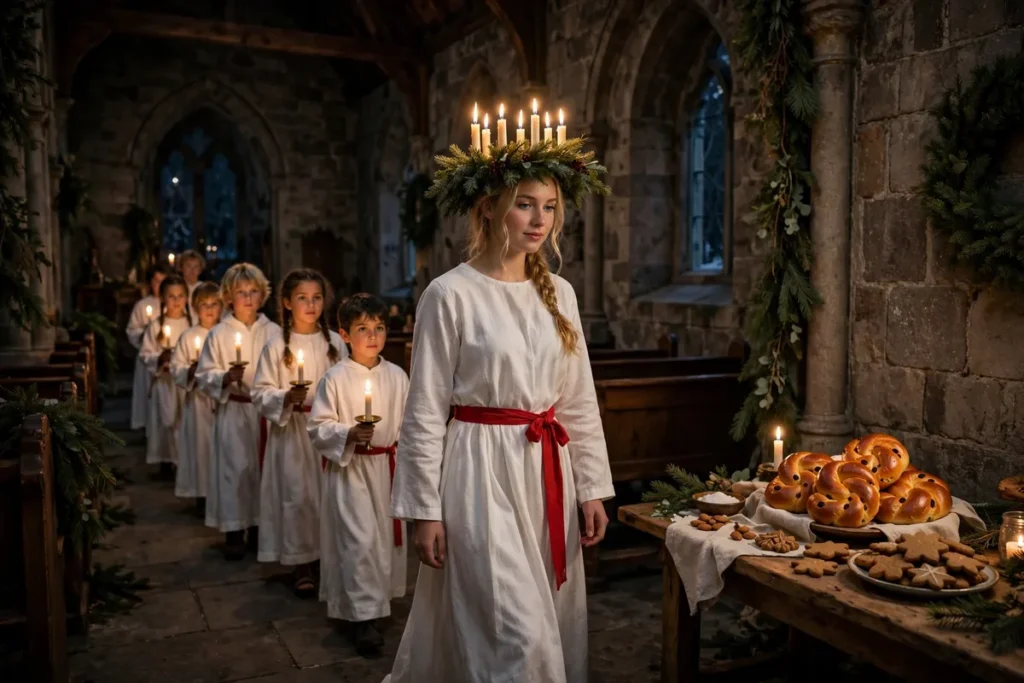
A St. Lucia procession: the candle-crowned Lucia leading children in white robes through a dark church, trays of saffron buns waiting nearby.
Watch: St. Lucia Day in Sweden
EWTN Vaticano explains Sweden's Festival of Light — the December 13th tradition honoring St. Lucia — as Swedish music students bring it to St. Peter's Basilica.
At a Glance: St. Lucia Day in Sweden
The saint, the procession, and the treats of Sweden's most luminous winter tradition.
| Element | What it is | Key detail |
|---|---|---|
| 13 December | The date | Luciadagen — also the winter solstice date under the old Julian calendar, the darkest day of the year |
| Saint Lucy of Syracuse | The figure | Christian martyr who died around 304 AD; legend says she wore a wreath of candles to carry food to Christians in the catacombs |
| The Lucia | The procession leader | A young woman in a white gown wearing a crown of lit candles, leading the singing procession |
| Star boys | The attendants | Boys in white robes and tall star-covered paper hats, said to represent St. Stephen, the first Christian martyr |
| Lussekatter | The buns | Sweet saffron buns shaped like curled cats, studded with raisins — the taste of Lucia Day |
| Pepparkakor and glögg | The treats | Gingerbread biscuits served with Swedish mulled wine (glögg) or coffee alongside the buns |
| The Lucia song | The music | “Sankta Lucia” and “Natten går tunga fjät” — melodies of light overcoming darkness sung in schools, churches, and workplaces |
Frequently Asked Questions
When is St. Lucia Day in Sweden?
St. Lucia Day is celebrated every year on December 13th. The date was historically the winter solstice under the Julian calendar, which is why the festival of a light-bearing saint became attached to the darkest day of the year.
Why does St. Lucia wear candles on her head?
According to legend, Saint Lucy wore a wreath of candles on her head to keep her hands free while carrying food to Christians hiding in the catacombs. The candle crown symbolizes light conquering darkness — the central theme of the Swedish celebration in the depths of winter.
What are lussekatter?
Lussekatter are traditional Swedish saffron buns eaten during Advent and especially on St. Lucia Day (December 13th). They are golden-yellow from saffron, shaped into “S” curls or figure-eights, studded with raisins, and served with coffee or glögg. They are the signature food of the Lucia season.
Who can be Lucia?
Traditionally a young woman — often the eldest daughter in a family celebration — but modern Sweden is flexible. Schools, towns, and organizations now choose Lucias of all genders and backgrounds, and the emphasis is on song and participation. Many communities hold auditions or votes each year.
Is St. Lucia Day a public holiday in Sweden?
No, it is not a public holiday — it is a widely observed cultural celebration. Schools, churches, workplaces, and media all mark the day, but businesses and government offices remain open. The celebrations typically happen in the morning.
What is the Lucia song?
The processional song “Sankta Lucia” uses the melody of the Neapolitan song “Santa Lucia” with Swedish lyrics about night, darkness, and the coming of light. It is sung slowly in harmony by the candlelit procession and is one of the most beloved pieces of music in Swedish Christmas culture.
Sweden’s festival of light is a highlight of the Nordic Christmas — and it pairs naturally with the country’s other great straw-and-fire tradition, the Gävle Goat. For more candlelit inspiration, browse our Christmas activities for families, kids, and couples, and bring the Scandinavian glow home with Christmas decoration ideas built around light in darkness.
The Nobel Connection and Lucia’s Grandest Stages
Few traditions can claim a stage as grand as the Nobel Prize banquet — and Lucia has held it for decades. Each December, as the world’s laureates gather in Stockholm’s Blue Hall for the Nobel dinner, a Lucia procession traditionally performs for the guests, carrying candlelight into one of the most formal rooms on earth. The image is unforgettable: white-gowned singers moving through candlelit splendor while Nobel laureates watch. It is Sweden telling its most distinguished visitors, in the most Swedish way possible, what light means in the dark of the year.
Beyond the Nobel festivities, Lucia processions appear in settings that show how deeply the custom permeates national life. Sweden’s national television broadcasts Lucia celebrations; major newspapers still run Lucia features every December, a century after the 1927 contest that popularized the modern form. Hospitals schedule their Lucia visits like medical rounds — the procession’s arrival is genuinely therapeutic, staff say, for patients who cannot leave their wards. Prisons, military bases, and retirement homes all receive Lucias. The tradition’s genius is its portability: a crown, some candles, a few voices, and any room becomes a chapel of light.
The televised national Lucia concerts deserve special mention. Broadcast from grand churches with professional choirs, they are appointment viewing in many Swedish households — the moment the season is declared officially open. Families who have already seen their children’s school procession will still gather for the broadcast, because the televised Lucia is not a repeat but a culmination: the country’s best voices, in its most beautiful sacred spaces, singing the songs everyone knows by heart.
Making a Lucia Crown: Craft How-To
The candle crown is the most iconic piece of Lucia regalia, and making one is a cherished pre-December craft in Swedish homes and schools. Here is how a traditional crown comes together.
Materials
You will need a base wreath of greenery — traditionally lingonberry sprigs (lingonris), which hold up well and carry a festive red berry — plus florist’s wire, candle holders designed to clip or wire onto a wreath (available from Swedish craft suppliers each December), and white candles, either real or battery LED. For children’s crowns, LED candles are strongly recommended; many schools now require them.
Assembly
Form the greenery into a wreath sized to sit securely on the head — snug enough not to slip during the procession, which involves walking and singing. Wire the candle holders evenly around the wreath, typically five to seven candles. Test the balance on the wearer’s head before the big day; a crown that lists to one side is the classic Lucia mishap. If using real candles, keep a fire-safety plan: an adult attendant, a damp cloth nearby, and hair tied back and away from flames.
The full costume
The classic Lucia wears a long white gown — historically a simple white dress or a baptismal-style robe — with a red sash tied at the waist, symbolizing martyrdom. Star boys wear white gowns with tall, star-decorated conical hats; younger children often go as elves or gingerbread figures in brown tunics. The visual unity of the all-white procession, moving through darkness with points of candlelight, is what makes the spectacle unforgettable — the craft serves the image, and the image serves the meaning.
St. Lucia Day in the Swedish Diaspora
Wherever Swedes have settled, Lucia has followed. In the United States — particularly in Minnesota, Wisconsin, and Chicago, historic centers of Swedish immigration — December 13th brings Lucia processions in Lutheran churches, Scandinavian cultural centers, and schools. The American-Swedish Institute in Minneapolis hosts beloved annual Lucia celebrations; similar events fill the calendars of Swedish-American organizations nationwide.
These diaspora celebrations carry an extra emotional charge. For descendants of immigrants, Lucia morning is a thread back to the old country — the songs learned from grandparents, the saffron buns baked from a great-grandmother’s recipe, the candlelight that connects a Minnesota church basement to a medieval Sicilian martyr via a Stockholm newspaper contest. The tradition adapts — LED candles, rented halls, bilingual programs — but the core survives transplantation intact: light, song, and community in the dark of winter.
London, too, has its Lucia: the Swedish Church in Marylebone hosts processions that draw both expatriates and curious Britons, and Scandinavian Christmas markets across Europe schedule Lucia appearances. The festival of light turns out to be highly exportable — darkness, it seems, is universal, and so is the hunger for light.