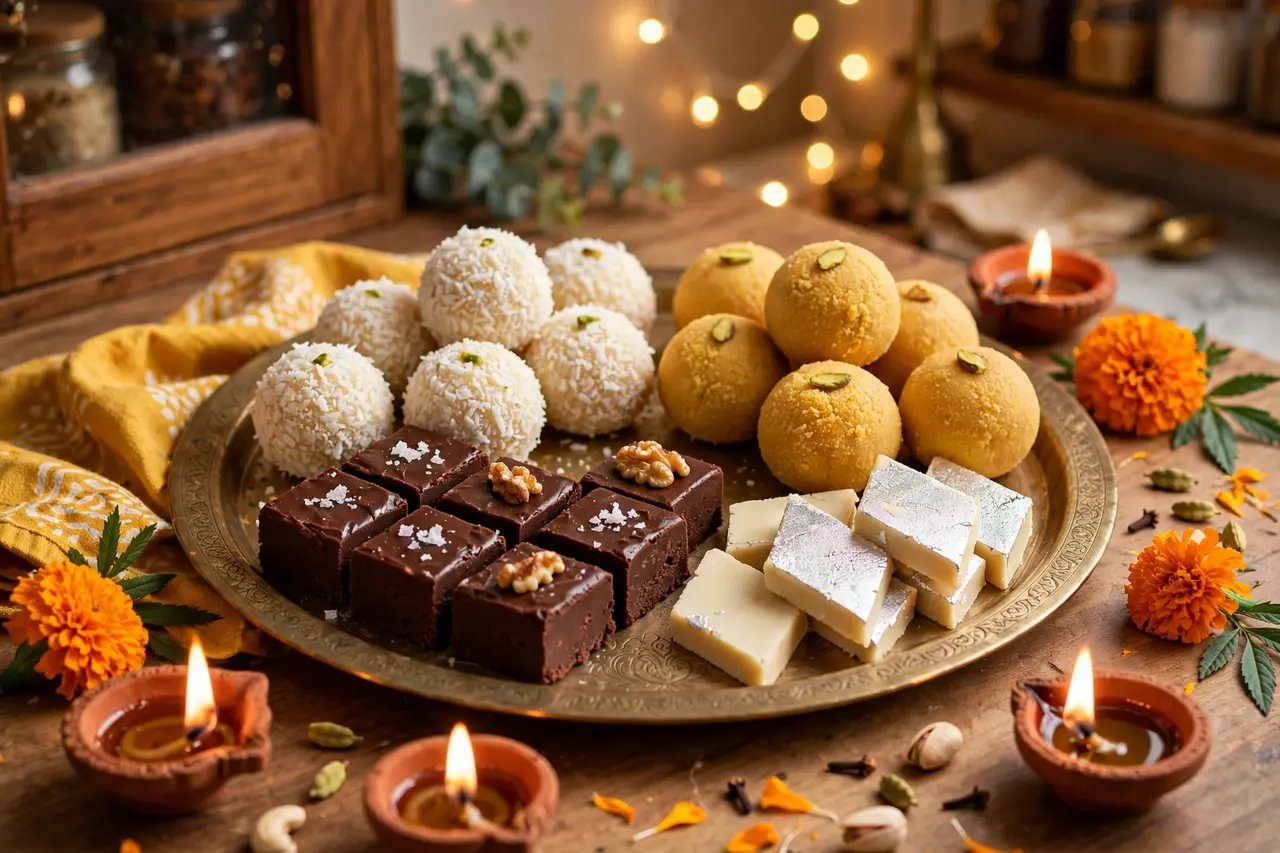
You want homemade Diwali mithai — the pride, the aroma filling the house, the box that makes people gasp — but you do not want a three-hour wrestling match with sugar syrup. These easy Diwali mithai ideas are the answer: 15 genuinely simple sweets, each doable in under an hour, most in under 30 minutes, with zero special equipment and full step-by-step instructions. Inside: the five-ingredient starter sweets, no-cook wonders, 15-minute miracles, microwave mithai, make-ahead strategies, a troubleshooting clinic for every common failure, storage guidance, and a full FAQ. Whether you have never made a sweet in your life or you just need fast, reliable recipes for a crowd, this guide gets homemade mithai on your table with your sanity intact.
The Easy Mithai Manifesto
Traditional mithai has a reputation for difficulty that is only half deserved. Yes, jalebi and soan papdi are expert-level. But a huge family of sweets — ladoos, barfis, kheers, fudges — is genuinely easy, built on simple techniques: mix, heat, shape, chill. The difficulty reputation comes from people starting with the hardest sweets instead of the easiest ones.
The three rules of easy mithai: Rule 1 — start with condensed milk, milk powder, or khoya from a good shop. These shortcuts are not cheating; they are how busy home cooks have made mithai for generations. Rule 2 — master the syrup test. Most “easy” sweets live or die on sugar syrup consistency, and it takes exactly one batch to learn: the one-string test (a drop of syrup between thumb and finger forms a single thread) is the only technique you need. Rule 3 — mise en place. Measure everything before the heat goes on. Mithai moves fast once it starts, and “let me just find the cardamom” is how sweets burn.
Equipment you actually need: a heavy-bottomed pan (non-stick or stainless), a wooden spoon, measuring cups, a baking sheet with parchment, and containers for setting. That is it. No candy thermometer (the cold-water and string tests work fine), no special molds (a greased plate works for barfi), no stand mixer. If your kitchen can make pasta, it can make mithai.
The mindset shift: homemade mithai does not need to look like the sweet shop’s. Slightly rustic ladoos, hand-cut barfi with uneven edges — these signal “made with love,” which is the entire point. Perfection is the sweet shop’s job; yours is warmth. For more beginner-friendly kitchen projects, these homemade food gift ideas build the same skills.
The 15-Minute Miracles: Sweets in a Flash
When Diwali is tomorrow (or today), these are your lifelines — real mithai, real fast.
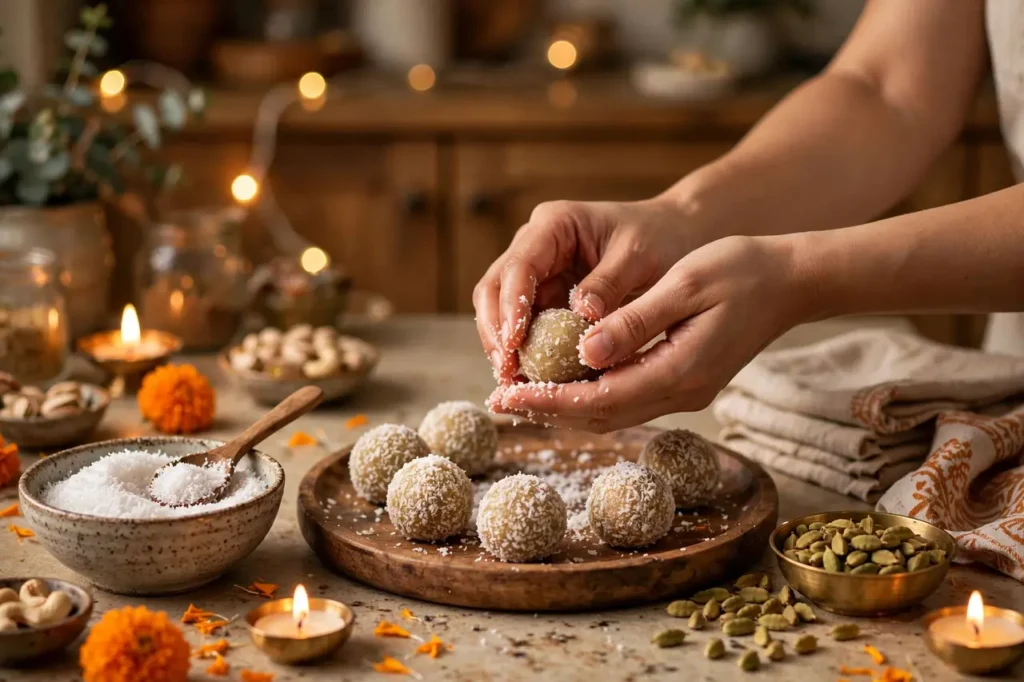
1. Coconut ladoo (15 minutes): Mix 2 cups desiccated coconut with 1 cup condensed milk and ½ teaspoon cardamom powder. Chill 10 minutes, roll into balls, roll in extra coconut. Makes 18–20. That is the entire recipe. Variations: add 2 tablespoons cocoa for chocolate-coconut; stuff each with a single almond; roll in crushed pistachios instead of coconut for the premium look.
2. Chocolate fudge mithai (15 minutes + chill): Melt 2 cups chocolate chips with 1 can condensed milk over low heat, stir in 1 teaspoon cardamom and ½ cup chopped pistachios. Pour into a parchment-lined pan, chill 2 hours, cut into diamonds. Tastes like a mithai-chocolate hybrid; disappears in minutes.
3. Shrikhand (10 minutes + straining): Hang 2 cups plain yogurt in cheesecloth overnight (or use thick Greek yogurt to skip the wait). Whip with ½ cup powdered sugar, ½ teaspoon cardamom, a pinch of saffron soaked in warm milk. Top with pistachios. Serve chilled in small glasses — it looks elegant and tastes like luxury.
4. Microwave kalakand (12 minutes): Mix 1 cup ricotta, 1 cup milk powder, ¾ cup condensed milk, and ½ teaspoon cardamom in a microwave-safe bowl. Microwave 5 minutes, stir, microwave 4 minutes, stir, microwave 3 minutes. Spread in a greased plate, top with pistachios, chill 1 hour, cut into squares. The traditional kalakand takes an hour of stirring; this takes twelve minutes and tastes remarkably close.
5. Rava ladoo / suji ladoo (20 minutes): Roast 2 cups fine semolina in ½ cup ghee until golden and fragrant (10 minutes, low heat — do not rush). Add 1 cup powdered sugar, ½ teaspoon cardamom, 2 tablespoons chopped nuts off the heat. When cool enough to handle, bind with 3–4 tablespoons warm milk and roll. The roasting is the only skill; everything else is mixing.
No-Cook Wonders: Mithai Without Heat
No stove, no stress. These sweets come together with mixing and chilling — perfect for kids, dorm rooms, and anyone whose kitchen is already at capacity.
6. Date and nut energy ladoo (15 minutes): Blend 2 cups pitted dates, 1 cup mixed nuts, 2 tablespoons cocoa, and ½ teaspoon cinnamon in a food processor until it clumps. Roll into balls, roll in desiccated coconut or crushed pistachios. Naturally sweet, no added sugar, and they keep two weeks refrigerated. The health-conscious crowd’s favorite.
7. Oreo-style cookie truffles (15 minutes + chill): Crush 1 pack chocolate sandwich cookies to crumbs, mix with 4 oz cream cheese until it forms a dough. Roll into balls, chill 30 minutes, dip in melted chocolate. Not traditional — but at a Diwali party with kids, these vanish before the kaju katli. Sometimes the festival needs a crowd-pleaser, not a classic.
8. Paan truffles (15 minutes + chill): the sophisticated no-cook sweet. Blend 1 cup desiccated coconut, ½ cup condensed milk, 4–5 chopped paan (betel) leaves, 2 tablespoons gulkand (rose petal preserve), and a drop of green food color. Roll into balls, coat in coconut. Tastes like the end of a great Indian meal in candy form — guests will ask for the recipe.
9. Dry fruit and chocolate clusters (10 minutes + chill): Melt dark chocolate, stir in roasted almonds, pistachios, and dried cranberries. Drop spoonfuls on parchment, chill until set. Rustic, beautiful, and endlessly variable — white chocolate with apricots, milk chocolate with hazelnuts. The easiest “artisan” gift in this guide.
10. Mango shrikhand cups (10 minutes): when mangoes are in season (or good canned pulp is available), fold 1 cup mango pulp into sweetened strained yogurt with cardamom. Layer in glasses with crushed pistachios. Sunshine in a glass — and at Diwali, a taste of summer’s best memory.
The 30–45 Minute Classics: Worth Every Minute
These take a little longer but deliver the authentic mithai experience — the sweets people assume took all day.
11. Besan ladoo (40 minutes): Roast 2 cups gram flour (besan) in 1 cup ghee over low heat, stirring constantly, until deep golden and nutty-smelling (25–30 minutes — this is the whole recipe, do not rush it). Off heat, cool 10 minutes, mix in 1½ cups powdered sugar, 1 teaspoon cardamom, 2 tablespoons chopped nuts. Roll while warm. The test: the roasted flour should smell like toasted nuts, not raw flour. Makes 20–24 ladoos that keep two weeks.
12. Kaju katli (30 minutes): Grind 2 cups raw cashews to a fine powder (pulse, do not over-blend or the oils release). Make a syrup with 1 cup sugar and ½ cup water to one-string consistency. Add the cashew powder, cook 5–7 minutes stirring until it forms a dough. Cool slightly, knead 2 minutes, roll between parchment to ¼-inch, cut into diamonds. The two failure points: overcooked syrup (katli turns chewy) and under-ground cashews (grainy texture). Nail those and you have sweet-shop katli.
13. Gulab jamun from mix (45 minutes): the honest shortcut — a good instant mix plus careful technique beats a bad from-scratch attempt. Follow the package, but: use lukewarm milk (not water) for the dough, rest the dough 15 minutes, fry on LOW heat (275–300°F) until deep golden (8–10 minutes — patience!), and soak in warm (not hot) cardamom-rose syrup for 2+ hours. The low fry is the secret most people miss. See the video below for the full technique.
14. Carrot halwa, weeknight version (40 minutes): the traditional recipe takes 90+ minutes; this one cheats smartly. Sauté 4 cups grated carrots in ¼ cup ghee 10 minutes, add 2 cups milk and cook until absorbed (20 minutes), stir in ¾ cup condensed milk and ½ teaspoon cardamom, cook 5 more minutes. Top with fried nuts. Not quite the slow-cooked original — but 90% of the joy in 40% of the time.
15. Rice kheer (45 minutes, mostly hands-off): Simmer ¼ cup basmati rice in 4 cups whole milk on the lowest heat, stirring every 10 minutes, until the rice dissolves into creaminess (35–40 minutes). Add ½ cup sugar, ½ teaspoon cardamom, saffron, and nuts. Serve warm or chilled. The patience is the recipe — low heat, occasional stirring, and the milk does the work. For more slow-simmered festive desserts, these holiday dessert recipes share the same low-and-slow philosophy.
Watch: Gulab Jamun Made Easy
Watch everyone’s favorite Indian sweet come together step by step — perfect for your first homemade mithai batch.
Microwave Mithai: The Modern Shortcut
The microwave is the easy-mithai secret weapon — it delivers the slow-cooked textures of traditional sweets in a fraction of the time, with far less stirring.
Microwave besan barfi (10 minutes): Mix 2 cups besan, 1 cup ghee, and 1 cup milk powder in a microwave-safe bowl. Microwave 6 minutes, stirring every 2 minutes (it will smell nutty and look golden). Stir in 1½ cups powdered sugar and cardamom, press into a greased pan, chill, cut. All the flavor of the 40-minute stovetop version.
Microwave coconut barfi (8 minutes): Mix 2 cups desiccated coconut, 1 can condensed milk, ½ teaspoon cardamom. Microwave 4 minutes, stir, microwave 3 minutes. Spread in a pan, top with pistachios, chill, cut into diamonds. The condensed milk does the sweetening and binding — you just provide heat and patience.
Microwave doodh peda (10 minutes): Mix 2 cups milk powder, 1 can condensed milk, 4 tablespoons butter. Microwave 4 minutes, stir well, microwave 3 minutes, stir, microwave 2 minutes. Cool until handleable, roll into balls, press a pistachio on top. Pedas are the traditional Diwali sweet; this version takes ten minutes.
Microwave rules: stir at every interval (microwaves heat unevenly — stirring is non-negotiable), use a large bowl (mixtures bubble up), and stop when it looks “almost done” — residual heat finishes the job. Every microwave is different; the first batch is calibration, the second is perfect.
The Troubleshooting Clinic: Every Common Failure, Fixed
Mithai failures feel catastrophic in the moment and are almost always fixable. Here is the emergency room for the most common ones.
| Problem | Cause | Fix |
|---|---|---|
| Ladoos will not hold shape | Mixture too dry or too cool | Add warm milk/ghee a spoon at a time; roll while warm |
| Gulab jamun hard outside, raw inside | Oil too hot | Fry at 275–300°F; low and slow is the only way |
| Gulab jamun cracked while frying | Dough too dry | Add milk a teaspoon at a time; roll crack-free balls |
| Kaju katli chewy instead of melty | Syrup overcooked past one-string | Pull at one-string; if chewy, chop and use as fudge topping |
| Besan tastes raw | Under-roasted flour | Roast until deep golden and nutty-smelling; color = doneness |
| Barfi will not set | Undercooked or too much liquid | Cook 3–5 more minutes; chill longer; freeze 20 min if desperate |
| Syrup crystallized | Stirred after dissolving / no acid | Add a squeeze of lemon juice; reheat gently to dissolve |
| Kheer stuck to the bottom | Heat too high, stirring too rare | Lowest heat, stir every 10 min; do not scrape the burnt layer in |
| Fudge too soft to cut | Undercooked or too much condensed milk | Chill 4+ hours or freeze 1 hour; cut with a hot knife |
| Everything tastes bland | Under-salted / under-spiced | A pinch of salt amplifies sweetness; double the cardamom |
The universal rescue: almost any failed sweet can become a trifle — layer the crumbled result with whipped cream, fruit, and nuts in glasses. “Deconstructed Diwali trifle” sounds intentional, tastes delicious, and no one will ever know it started as a disaster. Confidence is the final ingredient in every recipe.
The salt secret: a tiny pinch of salt in every sweet — even the sweetest ladoo — does not make it salty; it makes the sweetness taste more like itself. This is the professional’s most-guarded open secret, and it works in every recipe in this guide.
Storage and Make-Ahead: The Festival Week Plan
Homemade mithai has no preservatives, which means timing matters. Here is how to have fresh sweets all week without living in the kitchen.
The shelf-life chart: coconut ladoo, besan ladoo, kaju katli, dry fruit ladoo — 1–2 weeks at room temperature in airtight containers. Gulab jamun, rasmalai, shrikhand, kheer — 3–4 days refrigerated (jamun in its syrup; the rest covered). Chocolate sweets, fudge — 2 weeks refrigerated. Date-nut balls — 2 weeks refrigerated. Jalebi — best within hours; do not bother storing.
The production schedule: Weekend before Diwali — make the long-keepers (besan ladoo, kaju katli, dry fruit balls). 2–3 days before — make the medium-keepers (coconut ladoo, fudge, chocolate sweets). Day before or day-of — make the fresh ones (gulab jamun, shrikhand, kheer). Morning-of — fry jalebi if you are ambitious, or buy it fresh from the halwai (no shame; even professionals buy jalebi).
Packaging for gifting: line boxes with parchment, arrange sweets in paper cups (muffin liners work) so they do not touch and stick, include a “made on” date and ingredient list (allergies!), and keep the box closed until giving — every opening costs freshness. For savory balance in your gift boxes, these savory snack ideas pair wonderfully with homemade sweets.
10 More Easy Mithai Ideas: Quick-Fire Round
Fifteen recipes not enough? Here are ten more easy wins — shorter descriptions, same reliability.
16. Peanut chikki bites (20 minutes): the Indian brittle. Melt 1 cup jaggery with 2 tablespoons water to hard-ball stage, stir in 2 cups roasted peanuts, spread on a greased tray, cut while warm. Shattering, caramelly, addictive — and jaggery gives it a depth white sugar never will.
17. Til ladoo (20 minutes): sesame seeds are traditional for winter festivals and work beautifully at Diwali. Roast 2 cups sesame seeds until fragrant, grind coarsely with 1 cup jaggery and cardamom, bind with a spoon of ghee, roll. Nutty, warming, and naturally vegan if you skip the ghee.
18. Badam halwa, cheater’s version (25 minutes): blend 1 cup almonds (soaked and peeled, or use almond flour to skip the peeling) with ½ cup milk into a paste. Cook in ¼ cup ghee 15 minutes, add ½ cup sugar and saffron, cook 5 more. The almond-flour shortcut cuts the labor by two-thirds.
19. Doodh peda, stovetop (20 minutes): cook 2 cups milk powder, 1 can condensed milk, and 3 tablespoons ghee on low, stirring, until it leaves the sides (12–15 minutes). Cool, roll into balls, press with a fork for the classic pattern, top with a pistachio.
20. Rose sandesh (15 minutes + chill): knead 2 cups fresh chenna (or well-drained ricotta as a shortcut) with ¾ cup powdered sugar and 1 teaspoon rose water until smooth. Press into a greased plate, chill 2 hours, cut into diamonds. Delicate, fragrant, and shockingly easy.
21. Chocolate burfi (20 minutes + chill): the kid-pleaser. Melt 1½ cups chocolate with 1 can condensed milk, stir in ½ cup milk powder and cardamom, press into a pan, chill, cut. Top with silver leaf for the festive look — tradition meets chocolate.
22. Anjeer (fig) rolls (15 minutes): blend 2 cups dried figs (soaked 30 minutes) with 1 cup chopped nuts into a sticky mass. Roll into a log in plastic wrap, chill 2 hours, slice into coins. No added sugar, gorgeous cross-section, and they look like they came from a luxury mithai shop.
23. Malai chop (20 minutes + chill): knead fresh chenna with powdered sugar until smooth, roll flat, spread with a filling of chopped pistachios and cardamom, roll up like a Swiss roll, chill, slice. The pinwheel cross-section is stunning on a sweet platter.
24. Suji halwa (20 minutes): the comfort classic. Roast 1 cup semolina in ½ cup ghee until golden (10 minutes), add 2 cups hot water/milk carefully (it splutters), then 1 cup sugar and cardamom. Stir until it leaves the pan. Served warm, it is a hug in a bowl — and the base for a dozen variations (add banana, pineapple, or saffron).
25. Thandai mousse cups (15 minutes + chill): the modern finale. Whip 1 cup heavy cream with 3 tablespoons thandai syrup (or thandai powder + sugar), fold in ½ cup Greek yogurt, pipe into glasses, chill 2 hours, top with pistachios and rose petals. East meets French technique — and it is the dessert guests photograph.
The Homemade Sweet Box: Gifting Your Mithai
Homemade mithai makes the most meaningful Diwali gift — and a well-assembled sweet box looks like a luxury product. Here is how to build one.
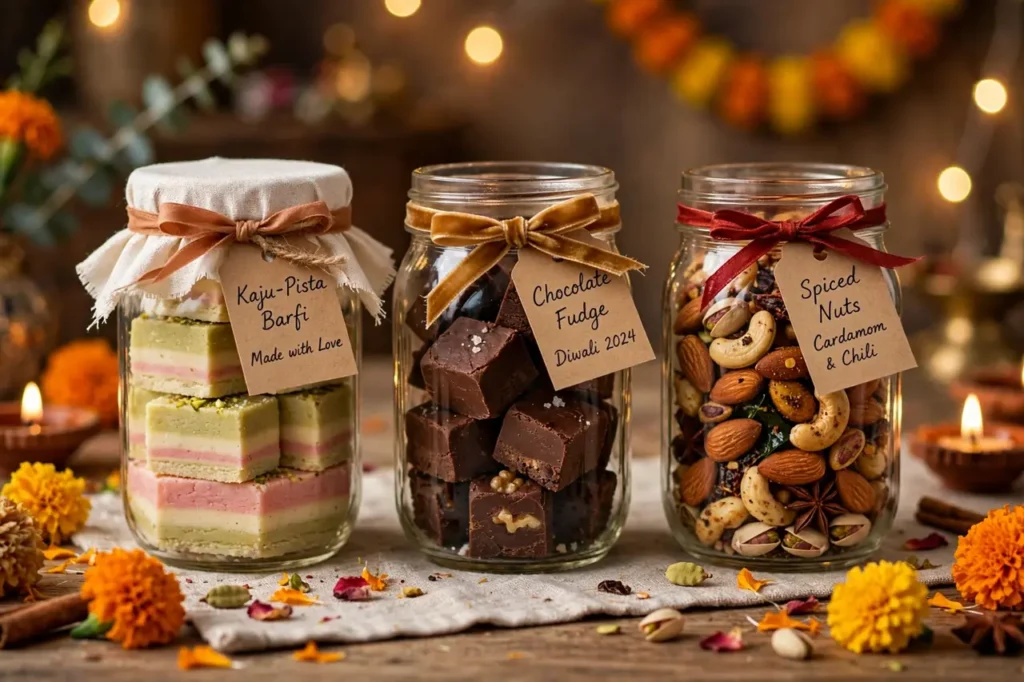
The formula: 3–4 varieties, contrasting colors and textures — something golden (besan ladoo), something white or pale (coconut ladoo or sandesh), something dark (chocolate fudge), something jewel-toned (paan truffles or pistachio-topped katli). Twelve to sixteen pieces total in a 1-pound box. Variety is what makes it look abundant; uniformity is what makes it look professional.
Assembly: line the box with parchment, nest each piece in a mini paper cup (muffin liners cut down, or candy cups), arrange by color in rows or a mandala pattern. Tuck in a few whole pistachios, dried rose petals, or a cinnamon stick for the artisan look. Close the box, tie with ribbon, add a tag: “Homemade with love — [Your Name], Diwali 2026.”
The card inside: list each sweet with its ingredients (allergy transparency is non-negotiable) and the made-on date. Add one line about each — “the besan ladoo is my grandmother’s recipe” — because the story is part of the gift. A homemade sweet box with a story card beats a $50 store box every single time.
Timing: assemble the box the day before giving or the morning of. Dense sweets (ladoo, katli, fudge) hold beautifully; if including anything fresh (shrikhand cups, rasmalai), those travel separately and hand-delivered only. The box should be opened within 2–3 days for peak enjoyment — write “best enjoyed by [date]” on the card.
Frequently Asked Questions
What is the easiest Diwali sweet for a complete beginner?
Coconut ladoo — desiccated coconut, condensed milk, cardamom; mix, chill, roll. Fifteen minutes, three ingredients, nearly impossible to ruin. After that, try shrikhand (whipped strained yogurt) and microwave kalakand. These three build every skill you need for the harder sweets: mixing, shaping, chilling, and patience.
How do I know when sugar syrup is at one-string consistency?
Cool a drop slightly, then press it between your thumb and forefinger and pull apart — a single thread should form before breaking. No thread: keep cooking. Multiple threads or a hard ball: you have gone too far (add a splash of water and reheat gently). The whole window is about 60–90 seconds, so test frequently once the syrup thickens.
Can I make Diwali sweets without condensed milk?
Yes — condensed milk is a shortcut, not a requirement. Traditional recipes use khoya (reduced milk solids), which you can make by simmering full-cream milk until thick (45–60 minutes) or buy from Indian groceries. Jaggery can replace sugar in most recipes for a deeper flavor. The shortcut exists for speed; the traditional path exists for purists. Both produce delicious sweets.
Why did my gulab jamun turn out hard?
Three usual suspects: the dough was over-kneaded (mix gently, just until combined — gluten development makes them dense), the frying oil was too hot (high heat browns the outside before the center cooks; fry low and slow at 275–300°F for 8–10 minutes), or the balls had cracks (dry dough — add milk a teaspoon at a time and roll smooth, crack-free spheres). Also soak in warm, not hot or cold, syrup.
How far ahead can I make Diwali mithai?
Ghee-based sweets (besan ladoo, kaju katli, mysore pak) — make up to 2 weeks ahead, stored airtight at room temperature. Coconut and chocolate sweets — up to 1 week. Dairy-fresh sweets (rasmalai, shrikhand, kheer, gulab jamun) — 2–4 days refrigerated, made as close to serving as possible. Fry jalebi fresh; it does not keep.
What are good no-cook Diwali sweets?
Date and nut ladoos (food processor + rolling), paan truffles, chocolate-nut clusters, Oreo-style truffles, and mango shrikhand cups. No-cook sweets are perfect for kids to help with, for dorm rooms, and for anyone whose stove is already occupied with dinner. They keep well and travel beautifully in gift boxes.
Can I make sugar-free Diwali mithai at home?
Yes — date-sweetened ladoos (dates + nuts + cocoa, no added sugar), stevia or monk-fruit sweetened kheer and shrikhand (add the sweetener off-heat to taste), and nut-based sweets that rely on dried fruit for sweetness. Start with recipes where sugar is a background player, not the structure — syrup-based sweets (jalebi, gulab jamun) are hardest to adapt because the syrup is structural.
What equipment do I need to make mithai at home?
A heavy-bottomed pan, a wooden spoon, measuring cups, parchment paper, and containers for setting — that is genuinely it. No candy thermometer (use the string test), no special molds (a greased plate works for barfi), no stand mixer. If your kitchen can make pasta, it can make mithai. A food processor helps for nut grinding but a good blender works.
How do I package homemade mithai as gifts?
Line gift boxes with parchment, nest each sweet in a paper cup so pieces do not touch, include a “made on” date and a full ingredient list (nut allergies!), and keep boxes closed until the moment of giving. Dense sweets (ladoo, katli, barfi) travel well; delicate ones (rasmalai, shrikhand) are for hand-delivery only. A handwritten label — “Maya’s Diwali Besan Ladoo” — makes it personal.
My mithai failed. Can I save it?
Almost always. Crumbly or misshapen sweets become trifle layers (with cream and fruit in glasses), overcooked fudge becomes ice cream topping, bland sweets get a rescue pinch of salt and extra cardamom, and anything truly unsalvageable becomes “deconstructed” — served in a glass with a confident name. The only real failure is the batch you throw away in frustration; repurpose with pride.
Your Kitchen, the Sweet Shop
The best easy Diwali mithai ideas prove a simple truth: homemade does not mean hard. Fifteen minutes gives you coconut ladoo. Thirty gives you kaju katli. An hour gives you besan ladoo that tastes like childhood. Start with the easy wins, keep the troubleshooting table bookmarked, embrace the rustic look, and remember the salt. This Diwali, let your kitchen smell of ghee and cardamom, let your boxes be full, and let someone ask “you made these?” — because that question, asked with wide eyes over a warm gulab jamun, is the whole reward. Happy Diwali, and happy sweet-making.