Store-bought gifts say “I spent money.” Handmade gifts say “I spent time” — and time is the one currency that cannot be faked, rushed, or price-compared. These DIY Diwali gift ideas are organized by skill level and time investment, from 15-minute mason-jar gifts to weekend craft projects: hand-poured candles, painted diyas, infused oils, homemade mithai, gift hampers you assemble yourself, custom gift boxes, and packaging techniques that make everything look boutique. Every project includes a materials list, realistic cost, time estimate, and a difficulty rating — plus a master timeline so your crafting stays joyful instead of becoming a 2 AM panic. Whether you are a seasoned crafter or someone whose last art project was in third grade, there is a project here with your name on it.
Why DIY Wins at Diwali
Diwali is uniquely suited to handmade gifts, more than any other festival. The celebration itself is handmade — rangoli drawn by hand, diyas lit one by one, sweets rolled and shaped in home kitchens. A handmade gift does not just fit the festival; it participates in it. When you hand someone a candle you poured or a box of ladoos you rolled, you are giving them a piece of your own celebration, not just an object.
The economics are unbeatable too. A hand-poured soy candle costs $3–$5 in materials and reads as a $20–$25 gift. A jar of spiced nuts costs $4 and looks like $15. A painted diya set costs $2 in materials and carries more festive meaning than most $20 store gifts. DIY is not the budget option that looks cheap — it is the premium option that happens to be cheap, because the value is in the labor, and your labor is free.
The honesty rule of DIY gifting: give handmade gifts proudly, never apologetically. “I made this for you” is a flex, not a confession. The only DIY gifts that disappoint are the ones given with “sorry, I did not have time to shop” energy. Own the craft — sign it, date it, and present it like the artisan object it is.
Know your limits: the fastest way to ruin DIY gifting is overcommitting. Pick projects you can actually finish, in quantities you can actually produce, on a timeline with buffer built in. One beautiful handmade gift beats three half-finished projects and a stressed, glue-gunned giver. The skill-level table below is your guardrail — start where you are, not where Pinterest thinks you are.
DIY Projects by Skill Level and Time
| Project | Difficulty | Time per gift | Cost per gift | Looks like |
|---|---|---|---|---|
| Spiced nut / trail mix jars | Beginner | 10 min | $3–$5 | $12–$15 |
| Masala chai kits | Beginner | 10 min | $3–$5 | $12–$18 |
| Painted diyas | Beginner | 20 min + drying | $1–$3 | $10–$15 set |
| Infused oils / flavored salts | Beginner | 15 min + steeping | $4–$6 | $15–$20 |
| Hand-poured soy candles | Easy | 20 min + setting | $3–$6 | $20–$25 |
| Homemade mithai boxes | Easy–Medium | 45–60 min/batch | $5–$8 | $20–$30 |
| Bath salts / sugar scrubs | Easy | 15 min | $2–$4 | $12–$18 |
| Decorated gift hampers | Easy | 30 min | $15–$30 | $50–$80 |
| Handmade dry fruit boxes | Medium | 45 min | $4–$8 + contents | $25–$40 |
| Block-printed wrapping / cards | Medium | 30 min/batch | $1–$2 | Priceless touch |
| Knitted / crocheted items | Advanced | Hours | $5–$10 | $40+ |
| Custom photo gifts | Easy (digital) | 30–60 min design | $8–$20 print | $30–$50 |
How to read this table: if you have never crafted, stay in the top half — every “Beginner” and “Easy” project here is genuinely foolproof with the instructions below. “Medium” projects need one practice run before the real batch. “Advanced” is for crafters who already own the skills; Diwali crunch time is not the moment to learn knitting.
Kitchen DIYs: Gifts People Actually Eat
Edible DIY gifts are the safest handmade category — they get consumed, so there is no clutter guilt, and everyone understands the effort. These five projects cover the full range from dead-simple to showpiece.
Spiced nut jars (10 minutes, $3–$5): toss 2 cups mixed nuts with 1 tablespoon oil, 1 teaspoon each of cumin, coriander, and chili powder, plus salt. Roast at 350°F for 12 minutes, cool completely, and pack in mason jars. Variations: honey-roasted (add 2 tablespoons honey before roasting), chaat masala (toss with chaat masala and a squeeze of lime after roasting), or sweet cinnamon (cinnamon + brown sugar). Tie with twine, add a hand-lettered label — “Priya’s Diwali Masala Cashews” — and you have a gift with a name on it, literally.
Masala chai kits (10 minutes, $3–$5): layer in a jar or tin: 4 tablespoons Assam tea, 2 tablespoons crushed cardamom, 1 tablespoon dried ginger, 2 teaspoons cloves, 2 cinnamon sticks, 1 teaspoon black peppercorns. Include a brewing card: “Simmer 2 teaspoons per cup with milk and water, 5 minutes, sweeten to taste.” The card is what elevates this from “bag of spices” to “curated kit” — presentation of knowledge is part of the gift.
Infused oils (15 minutes + 1 week steeping, $4–$6): fill a clean bottle with good olive oil, add 2 sprigs rosemary, 4 garlic cloves, and 1 teaspoon chili flakes (or lemon peel + thyme for a brighter version). Seal, steep one week in a cool dark place, strain if you like. The bottle looks like a boutique food shop find. Critical: use dried herbs or acidify properly — fresh garlic in oil at room temperature is a food-safety risk, so either refrigerate and label “keep refrigerated, use within 2 weeks” or stick to dried ingredients for shelf-stable gifts.
Homemade mithai (45–60 minutes per batch, $5–$8): coconut ladoo is the beginner’s miracle — 2 cups desiccated coconut, 1 cup condensed milk, ½ teaspoon cardamom; mix, chill 30 minutes, roll into balls, and roll in extra coconut. Besan ladoo takes more skill (roasting the gram flour to the exact right color) but tastes like childhood. Chocolate fudge with cardamom and pistachios is the crowd-pleaser for mixed groups. Pack in festive boxes with parchment liners, and include a “made on” date — homemade sweets have a 4–5 day room-temperature life, so time the batch for 1–2 days before giving. For more edible-gift inspiration, these homemade food gift ideas include twenty-five more kitchen projects.
Flavored salts and sugars (10 minutes, $2–$4): mix coarse sea salt with dried rose petals and cardamom (for a chai salt), or sugar with vanilla bean and orange zest (for a festive baking sugar). Pack in small jars or test tubes. These are the perfect “plus one” — tuck one into every gift you give, and suddenly every gift has a handmade element.
Craft DIYs: Beautiful Objects, Modest Skills
You do not need to be “crafty” — you need a flat surface, an afternoon, and the willingness to make the first ugly one. Every project below includes the beginner-proof version.
Hand-poured soy candles (20 minutes + setting, $3–$6): melt soy wax flakes in a double boiler (or a pouring pitcher in a pot of water), add candle fragrance oil at 6–10% by weight when the wax is around 185°F, secure a wick in your container with a wick sticker, pour at around 135°F, and let set 24 hours. Festive scent blends: sandalwood + cardamom, mogra (Indian jasmine), spiced chai (cinnamon + clove + vanilla), marigold + honey. Use heat-safe containers — ceramic cups, small brass bowls, mason jars. Safety non-negotiables: never leave melting wax unattended, keep a thermometer in the wax, and do your first pour as a test before the batch. One $25 candle-making starter kit produces 8–10 candles — a per-unit cost under $3 for gifts that read as $20+.
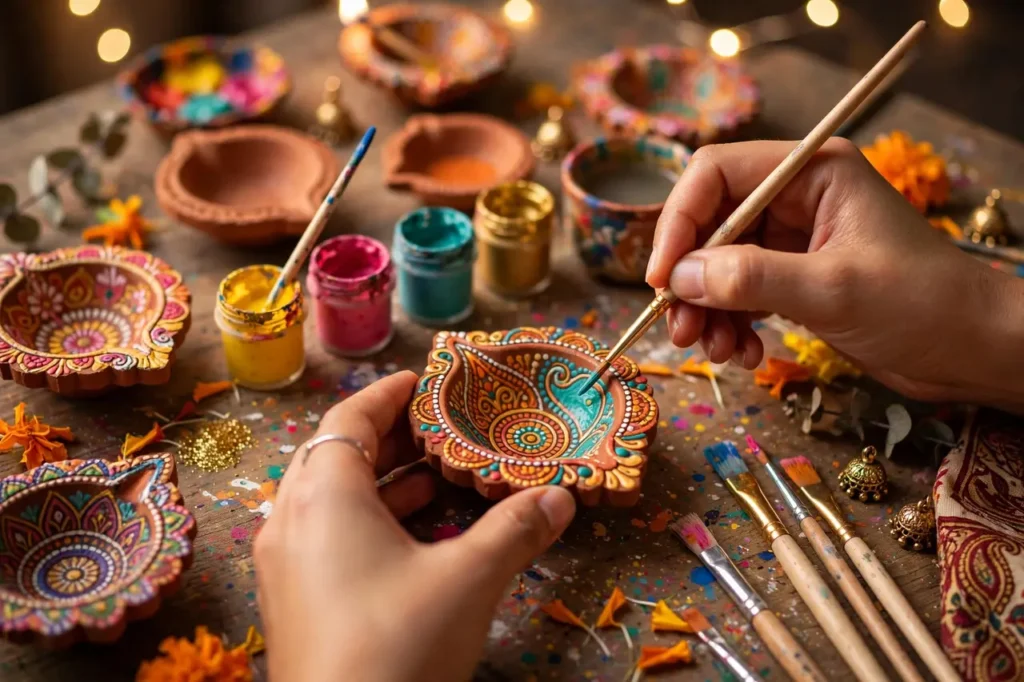
Painted diyas (20 minutes + drying, $1–$3): buy plain clay diyas in bulk (pennies each at Indian groceries), paint with acrylics — traditional motifs (dots, paisleys, borders) or modern geometrics in gold, maroon, and teal. Seal with a clear acrylic sealer so the paint survives handling. Beginner trick: paint the whole diya one metallic color, then add simple dot patterns with the end of a paintbrush — it looks intricate and takes minutes. Pair with LED tea lights (never real flame in a painted diya you are gifting — paint fumes) for a complete, safe gift set.
Bath salts and sugar scrubs (15 minutes, $2–$4): bath salts — 2 cups Epsom salt, ½ cup sea salt, 1 tablespoon carrier oil, 15–20 drops essential oil, plus dried rose petals or food coloring for festivity. Sugar scrub — 1 cup sugar, ½ cup coconut oil, essential oil, in a jar. These take fifteen minutes, cost almost nothing, and feel like a spa gift. Label with ingredients (people with allergies need to know) and a use-by suggestion.
Handmade dry fruit boxes (45 minutes, $4–$8 plus contents): the showpiece project — build or decorate a keepsake box for dry fruits. The simplest impressive version: take a sturdy cardboard box, cover it with decorative paper or fabric using Mod Podge, line the inside with tissue, add dividers from cardstock, and fill with dry fruits in small piles or paper cups. A fancier version uses a wooden box with a hinged lid, stained or painted. Watch the technique in action below, then make it your own with your family’s colors and motifs. For more handmade-gift frameworks, browse these DIY gift ideas — the methods transfer directly to Diwali.
Watch: Handmade Dry Fruit Gift Box Tutorial
See how to make a beautiful handmade dry fruit box from simple materials — the perfect DIY Diwali gift project.
Assembling DIY Gift Hampers
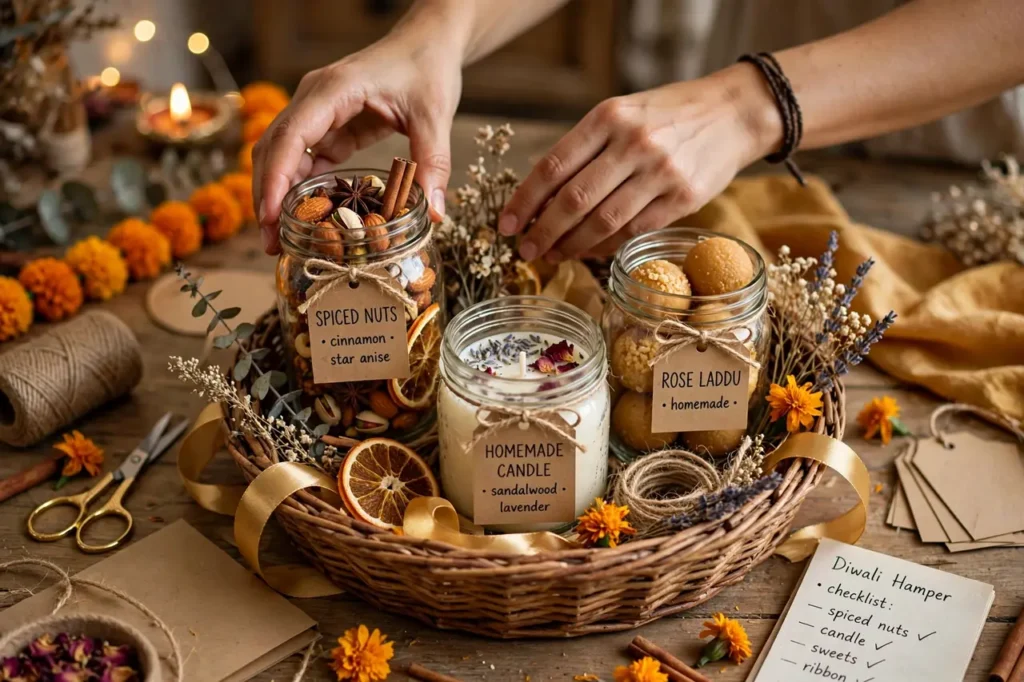
The hamper is where DIY gifting peaks — a curated collection of your handmade items (plus a few purchased anchors) in a beautiful container. It looks like a $60–$80 artisan gift and costs $15–$30 to assemble.
The $20 “Taste of My Kitchen” hamper: spiced nut jar ($4), chai kit ($4), homemade ladoo box ($6), flavored salt ($2) — in a jute tray or basket ($4). Total: ~$20. Theme it: “everything in this box came from my kitchen this week.”
The $25 “Light and Calm” hamper: two hand-poured candles ($8), bath salts ($3), painted diya pair with LED lights ($5), incense set ($4) — in a fabric-lined box ($5). Total: ~$25. Theme: “for slow Diwali evenings.”
The $30 “Festive Table” hamper: infused oil ($5), flavored salt duo ($4), artisan-style chocolate you tempered or decorated ($8), rangoli stencil kit you assembled ($6), decorated diyas ($4) — in a wooden crate ($5, reusable). Total: ~$30. Theme: “everything for your Diwali table.”
Assembly technique: line the container with tissue or a fabric napkin, place the tallest item at the back, arrange by color (group warm tones, group cool tones), fill every gap — empty space reads as skimpy, so use shredded paper, dried flowers, or fabric scraps. Wrap the whole thing in cellophane, tie with ribbon, and add a card listing the contents with a one-line story for each (“the chai blend is my grandmother’s ratio”). The story card is what makes a hamper feel curated rather than assembled.
Packaging: The DIY Multiplier
In DIY gifting, packaging is not decoration — it is translation. It translates “I made this in my kitchen” into “this is an artisan object.” Spend 20% of your DIY budget here; it triples perceived value.
The $10 packaging kit (outfits 15–20 gifts): kraft boxes in two sizes, natural twine and one velvet ribbon in a festive color, tissue paper in cream and one accent color, blank tags, a gold pen for hand-lettering, and dried flowers or eucalyptus sprigs. Buy all of it at a craft store in one trip — never pay boutique prices for packaging materials.
Labeling like a brand: give your DIY line a name — “Maya’s Diwali Kitchen” or “The Sharma Family Candle Co.” — and put it on every tag with the item name, ingredients (for edibles), and the date made. A brand name, even a playful one, signals intentionality. Include a one-line story: “poured on Sunday while listening to old Kishore Kumar songs.” People keep these tags.
Wrapping techniques that read expensive: the fabric wrap (furoshiki) — a square of festive fabric becomes both wrapping and gift; the double-box — tissue inside a kraft box inside a slightly larger decorative box, for the full unboxing theater; the wax seal — an $8 seal stamp used on every tag forever; the dried-flower tuck — a single stem under the twine, costs pennies, looks like a stylist did it. These creative gift wrapping ideas include step-by-step techniques that work for any festival.
The DIY Timeline: From Idea to Finished Gifts
DIY disasters are always timeline disasters — someone trying to pour forty candles the night before Diwali. Work backwards from the festival and give every project its proper window.
| When | Do this | Why now |
|---|---|---|
| 6 weeks out | Choose projects, buy all materials, do one test run of each | Test runs reveal the real time cost and the ugly first attempt |
| 4–5 weeks out | Batch-produce the long-lead items (candles, infused oils that need steeping) | Oils need a week to steep; candles need a day to cure |
| 3 weeks out | Batch-produce dry goods (spiced nuts, chai kits, bath salts, painted diyas) | Shelf-stable items can sit; get them done early |
| 1 week out | Make fresh edibles (mithai, baked goods); assemble hampers | Fresh food has a 4–5 day window; hampers assemble fast once components exist |
| 2–3 days out | Wrap, tag, and pack everything; write the cards | Wrapping always takes twice as long as you think |
The batch principle: never make one of anything. The setup — melting wax, laying out paints, preheating the oven — is the expensive part in time; each additional unit is cheap. Making twelve candles takes about twice as long as making two, not six times. Pick fewer project types and make more of each.
The 20% buffer rule: whatever time you think a project takes, add 20% — and then plan to finish everything three days before you need it. Drying, curing, and “oh no, the wax seized” all eat time. The buffer is what keeps DIY joyful instead of frantic.
DIY Gifting for Kids (Projects to Make With Them)
Some of the best DIY Diwali gifts are made with kids rather than for them — the project becomes the memory, and grandparents reliably rank kid-made gifts above everything else.
Age-appropriate projects: ages 3–5 can do handprint diya cards, sticker-decorated gift bags, and (supervised) sprinkle-topped chocolate bark. Ages 6–9 can paint diyas, assemble trail mix jars, and make simple greeting cards with real messages. Ages 10+ can pour candles (with adult supervision for hot wax), bake cookies, and design labels on a computer. The rule: the child should do the parts they can do well, and an adult handles safety-critical steps silently — the gift should look like the child made it, because they did, with invisible scaffolding.
The grandparent effect: a slightly lopsided painted diya from a six-year-old, presented with enormous pride, will be displayed more prominently than any $50 gift. Do not “fix” kid-made gifts into perfection — the wobble is the point. Sign and date them; grandparents keep these for decades.
Troubleshooting: When DIY Goes Wrong
Every crafter has a disaster story. Here are the common ones and the fixes, so a mishap does not become a missed gift.
Candle problems: sinkholes around the wick — poke relief holes and do a second pour; wet spots (wax pulling from the jar) — cosmetic only, or warm the jar before pouring next time; weak scent — you under-dosed fragrance oil or poured too hot; tunneling — the wick is too small for the container. None of these ruin the gift — a slightly imperfect candle still reads as handmade-charming, which is the aesthetic anyway.
Food problems: ladoos will not hold shape — the mixture needs more chilling, or a spoonful more condensed milk as binder; fudge too soft — it needed longer cooking or more chocolate; spiced nuts burned — the oven runs hot; roast at 325°F and check at 8 minutes. When a batch truly fails, pivot: crumble failed ladoos over ice cream as “Diwali crumble,” rebrand burnt nuts as “extra-roasted.” Confidence covers a multitude of sins.
Time problems: you are behind schedule with three days to go. Triage ruthlessly: finish what is 80% done, simplify what is 50% done (a plain candle beats an unfinished decorated box), and abandon what has not started — replace it with a purchased gift plus a heartfelt card. A finished simple gift beats an unfinished ambitious one every time. And buy a backup: keep two or three nice store-bought gifts on hand as insurance. There is no shame in a hybrid strategy.
Matching DIY Projects to Recipients
The right project depends on who is receiving it. Use this quick guide when you are deciding what to make for whom.
For parents and grandparents: lean edible and comforting — mithai boxes, chai kits, spiced nuts. Older recipients appreciate gifts they can consume and enjoy without learning anything new, and food carries the deepest nostalgia. A box of coconut ladoo made from a family recipe will outperform any craft project for this generation.
For friends: go fun and shareable — candles in scents you chose for them, bath salts, flavored oils. Friends appreciate the personality in the gift; pick the project that lets your taste show. A friend who loves cooking gets the infused oil; the stressed-out friend gets the bath salts and a candle.
For coworkers and neighbors: keep it polished and neutral — spiced nut jars, chai kits, simple candles. Professional DIY should look artisanal, not intimate. Beautiful packaging matters most here; it signals that the gift is thoughtful, not overly familiar.
For kids’ teachers and hosts: small, beautiful, and consumable — a single hand-poured candle, a small mithai box, a jar of flavored salt. These are gratitude gifts, and the handmade element says “I went out of my way” in exactly the right measure.
Frequently Asked Questions
What are the easiest DIY Diwali gifts for beginners?
Spiced nut jars, masala chai kits, painted diyas, and flavored salts — all take 10–20 minutes, cost $1–$6 per gift, and are genuinely foolproof. If you can stir, pour, and tie twine, you can make all four. Start with one project, make a test batch, and only then commit to quantity.
How much do DIY Diwali gifts cost to make?
Most projects cost $1–$8 per gift in materials: candles $3–$6, spiced nuts $3–$5, painted diyas $1–$3, bath salts $2–$4, mithai boxes $5–$8. Buying materials in bulk (wax by the 10-pound bag, jars by the case, diyas by the hundred) cuts costs 30–50%. Budget about 20% extra for packaging — boxes, ribbon, tags — which triples perceived value.
How far in advance should I start DIY Diwali gifts?
Start 6 weeks out: choose projects, buy materials, and do a test run. Batch-produce long-lead items (infused oils, candles) 4–5 weeks out, dry goods (nuts, salts, painted diyas) 3 weeks out, fresh edibles (mithai) 1 week out, and wrap everything 2–3 days before. Finish three days before you need the gifts — drying, curing, and mishaps all eat time.
Are handmade gifts appropriate for professional contacts?
Yes, with curation: food gifts (spiced nuts, chai kits, mithai boxes) and candles are universally safe for colleagues and clients. Keep them taste-neutral, beautifully packaged, and labeled with ingredients. Avoid overly personal handmade items (knitted clothing, portraits) for professional relationships — the gift should feel artisanal, not intimate.
What if my DIY gift does not look perfect?
Perfect is not the goal — handmade-charming is. Slight variations signal “a person made this,” which is the entire value proposition. That said, keep standards: clean jars, straight labels, no glue strings, no smudges. The bar is “would I be proud to give this,” not “would this pass factory inspection.” And never apologize for handmade — “I made this for you” is a flex.
Can kids help make DIY Diwali gifts?
Absolutely — and gifts made with kids are often the most cherished, especially by grandparents. Ages 3–5 can decorate cards and bags; 6–9 can paint diyas and assemble jars; 10+ can bake and pour candles with supervision. Let the child do what they can do well, handle safety steps invisibly, and do not “fix” their work into perfection — the wobble is the point.
How do I package DIY gifts so they look professional?
The $10 packaging kit: kraft boxes, twine plus one velvet ribbon, tissue in cream and one accent color, blank tags, a gold pen, dried flowers. Give your line a playful brand name, label everything (ingredients for food, scent for candles), and add a one-line story card. Consistent color palette and minimal design read as boutique at any budget.
What are good DIY Diwali gifts for large groups?
Pick one project and batch-produce: spiced nut jars, candles, or painted diya sets for 15–20 people. Batching is efficient — twelve candles take about twice as long as two. Keep every gift identical to avoid comparison issues, personalize only the card, and start early enough that the batch does not become a 2 AM marathon.
Is it safe to gift homemade food?
Yes, with basic care: label all ingredients (allergies), note the made-on date, and respect shelf life — most homemade mithai lasts 4–5 days at room temperature, spiced nuts 2–3 weeks sealed. For infused oils with fresh garlic or herbs, refrigerate and label “use within 2 weeks,” or use dried ingredients for shelf-stable gifts. When in doubt, keep it simple and fresh.
What should I do if I run out of time for my DIY projects?
Triage: finish what is nearly done, simplify what is half-done, abandon what has not started. A finished simple gift beats an unfinished ambitious one. Keep two or three nice store-bought gifts as backup insurance — a hybrid strategy (some handmade, some purchased) is completely respectable. The festival will not grade your crafting; it will remember that you showed up with love.
Made by Hand, Given with Heart
The best DIY Diwali gift ideas are not the most impressive ones — they are the ones you actually finish, given proudly to people who will feel the hours in them. Start early, batch smart, package beautifully, and never apologize for handmade. Long after the store-bought gifts are forgotten, someone will still have your candle on their shelf, your ladoo recipe on their fridge, your painted diya on their altar. That is the thing about gifts made by hand: they carry the maker with them. Happy crafting — and happy Diwali.