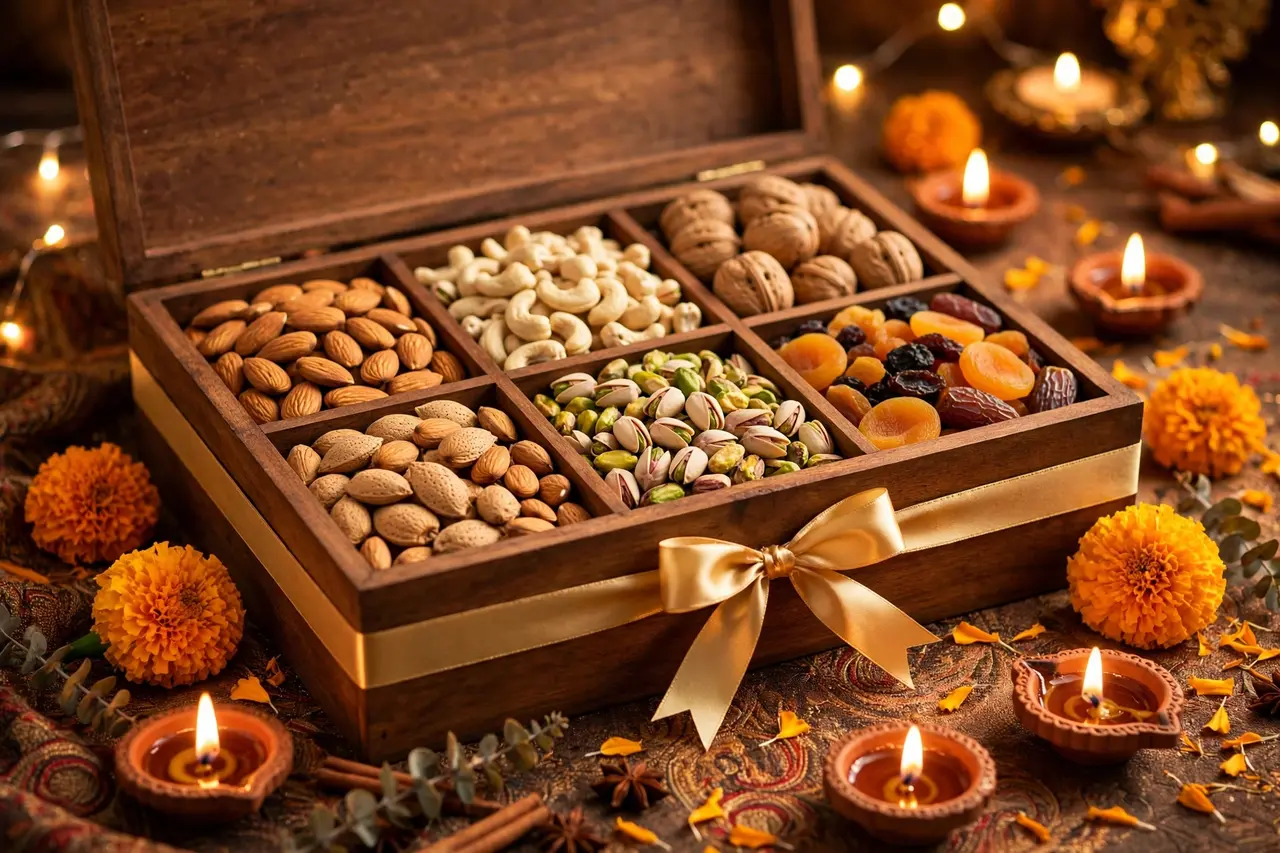
Of all the Diwali gifts ever given, the dry fruit box is the undefeated champion — traditional, healthy, shareable, and appropriate for literally everyone from your boss to your grandmother. But “dry fruits” covers a universe of quality levels, and the difference between a memorable gift and a forgettable one is entirely in the details. These Diwali dry fruit gift ideas are the complete guide: how to choose premium nuts and dried fruits, what to pay, how to spot quality, hamper designs at every budget, creative presentations beyond the boring box, flavored and roasted variations, packaging that wows, and a full FAQ. Whether you are buying one box or outfitting fifty, this guide makes you the person whose dry fruit gift actually gets talked about.
Why Dry Fruits Are the Perfect Diwali Gift
Every gift category has a weakness. Sweets go stale. Decor gathers dust. Gadgets get outdated. Dry fruits have none of these problems: they are traditional (exchanging nuts and dried fruits at Diwali predates most modern gift categories by centuries), healthy (protein, fiber, good fats — the rare festive gift a doctor would approve), shareable (a box opens conversations; a gadget opens alone), and universally appropriate (no sizing, no taste risk, no religious complications).
They are also quietly economical. Bought in bulk and packed well, dry fruits deliver the highest perceived-value-per-dollar of any traditional Diwali gift. A $20 box of well-chosen, beautifully presented nuts reads as a $35 gift — because quality nuts are expensive at retail, and everyone knows it. The recipient does the mental math in your favor.
The freshness factor: unlike mithai, which has a days-long window, properly stored dry fruits stay fresh for months. This makes them the ideal early-purchase gift (buy 3–4 weeks ahead with zero stress), the ideal shipped gift (no spoilage in transit), and the ideal corporate gift (no last-minute freshness panic). If your Diwali gifting has any logistical complexity at all, dry fruits simplify it.
Know Your Dry Fruits: The Quality Guide
Not all almonds are created equal. The dry fruit aisle has dramatic quality tiers, and knowing them is the difference between a gift that impresses and one that gets quietly re-gifted. Here is what to look for in each major category.
| Dry fruit | What premium looks like | What to avoid | Gift-worthy price/lb |
|---|---|---|---|
| Almonds (badam) | Large, uniform Mamra or California nonpareil; sweet, crisp bite | Shriveled, bitter, or rancid-smelling kernels | $9–$14 |
| Cashews (kaju) | Whole W240/W320 grade, creamy white, unbroken | Broken pieces, yellowed or soft kernels | $10–$15 |
| Pistachios (pista) | Large, naturally split shells; vibrant green kernels | Closed shells, dull brown kernels, excess salt dust | $12–$18 |
| Walnuts (akhrot) | Light-colored halves, mild sweet flavor | Dark, bitter, rubbery halves (old stock) | $10–$14 |
| Raisins (kishmish) | Plump, golden or dark, no added sugar needed | Hard, crystallized, or overly sticky clusters | $5–$8 |
| Dried figs (anjeer) | Soft, honey-sweet Afghan or Turkish figs | Rock-hard or sour figs | $10–$16 |
| Dried apricots | Soft Turkish apricots, deep orange, no sulfites preferred | Brick-hard or neon-orange dyed pieces | $8–$12 |
| Dates (khajur) | Medjool — large, soft, caramel-like | Dry, fibrous, or fermented-tasting dates | $8–$14 |
The sniff test: fresh nuts smell sweet and nutty; rancid nuts smell like paint or old oil. Always smell bulk nuts before buying in quantity — one bad bag ruins a whole hamper. Buy from high-turnover sources (Indian groceries during festival season, warehouse clubs) where stock moves fast.
Roasted vs. raw: raw nuts last longer and suit traditional tastes; roasted nuts (dry-roasted, no oil) taste more indulgent and feel more “gift.” For gifting, lightly roasted and lightly salted is the crowd-pleaser — but keep a raw option for health-conscious recipients. Flavored nuts (masala, honey-roasted, chocolate-covered) are the modern upgrade; buy them from reputable makers, not the dusty corner of a discount shelf.
Organic and premium grades: worth it for the gift tier. Mamra almonds, W240 cashews, and Medjool dates cost 30–50% more than standard grades and taste dramatically better. At gift quantities (250–500g), the absolute difference is a few dollars — the cheapest quality upgrade in all of gifting.
Dry Fruit Gift Ideas by Budget
Dry fruit gifts scale beautifully from $10 to $100+. The structure stays the same; only the grades, quantities, and containers change.
The $10–$15 gesture: 250g of mixed roasted nuts in a festive pouch or small box. Perfect for wide circles — neighbors, colleagues, acquaintances. Buy nuts in bulk (5-pound bags), divide into 250g portions, and pack in cellophane bags with ribbon. Per-unit cost: $4–$6. Perceived value: $12–$15.
The $20–$30 classic: 500g premium mixed nuts (almonds, cashews, pistachios) in a decorative gift box, plus a small packet of dried berries or figs for color. This is the standard Diwali dry fruit gift — appropriate for friends, extended family, and professional contacts. A divided box (each nut in its own compartment) reads significantly more premium than a mixed jumble, for zero extra cost.
The $40–$60 deluxe: 750g–1kg of top-grade nuts and exotic dried fruits (Medjool dates, Afghan figs, dried cranberries, roasted hazelnuts) in a wooden or metal keepsake box, with a small jar of honey or a chocolate bar tucked in. For parents, in-laws, and important clients. The keepsake box is the multiplier — it lives on as storage long after the nuts are gone.
The $75+ grand: saffron threads, premium Mamra almonds, whole pistachios, chocolate-covered nuts, and exotic additions (macadamias, pine nuts) in a handcrafted trunk or luxury gift chest. For the most important relationships. At this tier, include a card describing the contents — “Mamra almonds from Afghanistan, Medjool dates, Iranian saffron” — because provenance is part of the luxury.
Bulk-buying math: a 5-pound bag of almonds at a warehouse club costs roughly half the per-pound price of 250g gift packs. For ten or more gifts, bulk buying cuts your nut costs 40–50% — which either saves serious money or funds the upgrade to premium grades. These homemade food gift ideas pair perfectly with bulk nuts for hamper assembly.
Creative Dry Fruit Presentations (Beyond the Boring Box)
The standard dry fruit box is fine. These presentations are memorable — same nuts, completely different impression.
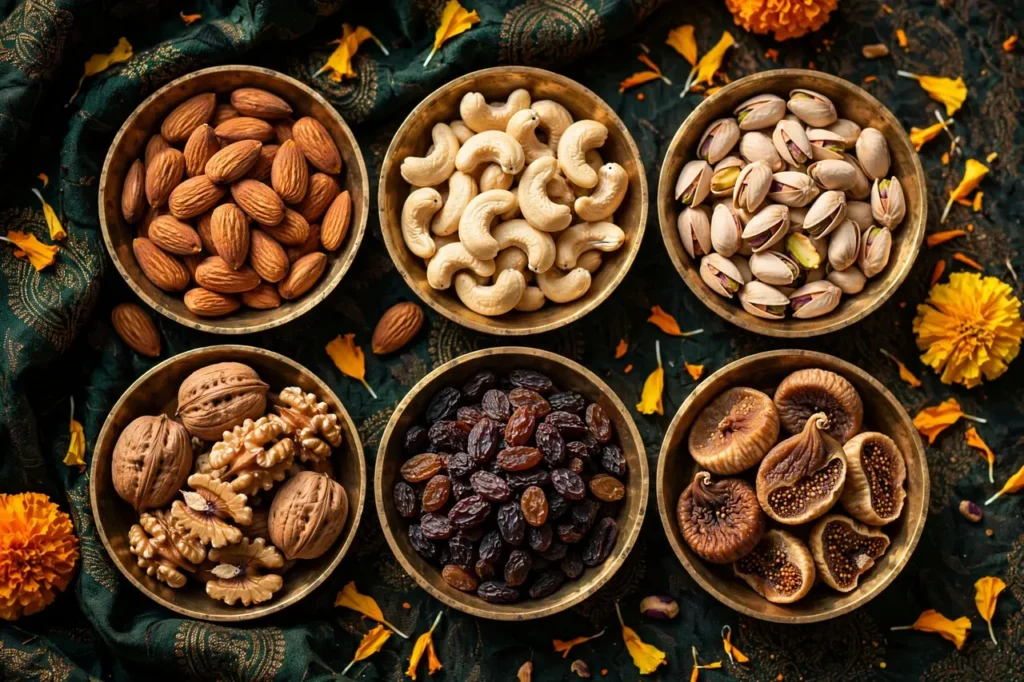
The thali presentation: arrange nuts in small brass or steel bowls on a decorative thali (platter), cover with a sheer dupatta or cellophane, tie with ribbon. It looks like a royal offering because it essentially is one. Cost of the thali: $8–$15, reusable forever. This is the presentation for in-laws and elders — it speaks their visual language.
The mason jar rainbow: layer different nuts and dried fruits in visible stripes in a large mason jar — green pistachios, golden raisins, brown almonds, orange apricots. It is gorgeous, it shows off quality, and it costs nothing extra. Add a wooden scoop tied to the jar and a hand-lettered label.
The chocolate-dipped upgrade: dip dried apricots, figs, and orange peel in dark chocolate, let set on parchment, and pack in a box. This 30-minute project transforms $8 of dried fruit into a $25 artisan gift. Drizzle with white chocolate for the boutique look. (Keep refrigerated if your kitchen is warm; chocolate bloom is cosmetic but avoidable.)
The spiced nut gift: roast mixed nuts with your signature spice blend (see the DIY guide for ratios), pack warm in jars, label with the recipe name. “Auntie’s Diwali Masala Mix” beats generic mixed nuts every time — the personal recipe is the gift inside the gift.
The dry fruit and honey pairing: a jar of premium nuts plus a jar of raw honey with a wooden dipper, in a small crate. Simple, beautiful, and the honey elevates the whole thing from “snack” to “pantry luxury.” For wrapping techniques that make any of these shine, see these creative gift wrapping ideas.
Watch: How to Pack a Dry Fruit Hamper at Home
See a step-by-step tutorial for packing a stunning dry fruit hamper at home — professional wrapping techniques included.
Flavored and Roasted Variations Worth Trying
Plain nuts are classic; flavored nuts are conversation. These variations turn a standard gift into something people ask about.
Masala roasted: the Indian-spiced standard — cumin, coriander, chili, amchur, black salt. Roast raw nuts at 350°F for 10–12 minutes with oil and spices. Universally loved, unmistakably festive.
Honey-roasted: toss nuts with honey and a pinch of salt before roasting; finish with a dusting of sugar while warm. Sweet, crunchy, addictive. Add chili flakes for honey-chili, the sweet-heat combination everyone fights over.
Chai-spiced: cinnamon, cardamom, ginger, clove, and brown sugar on roasted almonds or cashews. Tastes like the festival in nut form. Package with a chai kit for a themed gift.
Chocolate-covered: almonds, hazelnuts, and dried fruits dipped in dark, milk, or white chocolate. The most giftable of all variations — it reads as confectionery, not health food, which broadens the appeal to kids and skeptics.
Savory herb: rosemary, thyme, garlic, and sea salt on mixed nuts — the sophisticated, wine-pairing option for foodie friends. Less traditional, more dinner-party.
Storage note for flavored nuts: homemade flavored nuts keep 2–3 weeks in airtight containers at room temperature. Make them no more than a week before gifting for peak crunch. Commercially packed flavored nuts last months — for shipped gifts, buy commercial; for hand-delivered, homemade wins on taste.
The Nutrition Card: A Thoughtful Addition
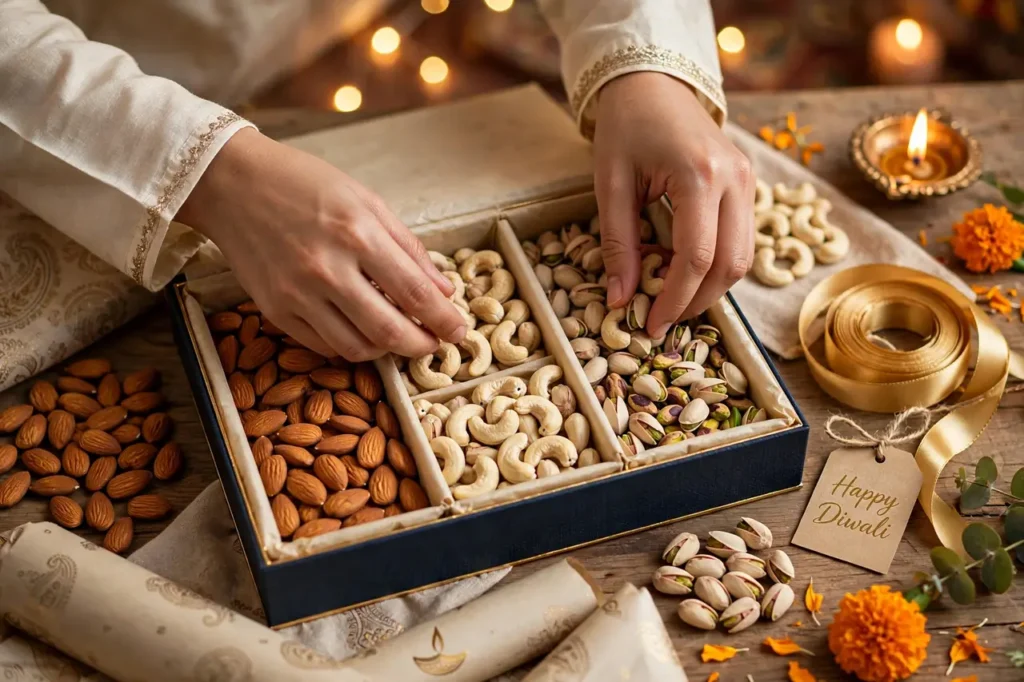
Here is a small touch that elevates any dry fruit gift: a card listing what is inside and why it is good. It takes five minutes, costs nothing, and transforms “a box of nuts” into “a curated wellness gift.” Health-conscious recipients especially appreciate it — and in an era of ingredient awareness, transparency is a luxury signal.
| Nut / fruit | Key nutrients | One-line card copy |
|---|---|---|
| Almonds | Vitamin E, magnesium, protein | “For glowing skin and steady energy” |
| Walnuts | Omega-3s, antioxidants | “Brain food — quite literally” |
| Pistachios | Protein, fiber, B6 | “The mindful muncher’s nut” |
| Cashews | Magnesium, zinc, iron | “Creamy comfort, mineral-rich” |
| Dates | Fiber, potassium, natural sugars | “Nature’s caramel — instant festive energy” |
| Figs | Fiber, calcium, iron | “Honey-sweet and bone-friendly” |
| Raisins | Iron, antioxidants | “Tiny but mighty” |
How to use it: print or handwrite the card, tuck it into the box lid. For diabetic or health-focused recipients, this card does double duty — it shows you chose with their health in mind, which is the most thoughtful form of personalization. (Note: this is general nutrition information, not medical advice — keep the copy light and celebratory, not prescriptive.)
Buying Guide: Where and When to Buy
Indian grocery stores: the best prices on almonds, cashews, pistachios, and raisins during festival season — often 30–40% below mainstream retail. Quality is generally excellent because turnover is high. Shop 3–4 weeks before Diwali; the popular grades sell out.
Warehouse clubs: unbeatable per-pound prices on bulk bags (3–5 lbs). Ideal when you are assembling ten or more gifts. Split bags with family if the quantity is too much for one household.
Online specialty retailers: best for premium grades (Mamra almonds, Medjool dates, Iranian saffron) and for pre-packed luxury gift boxes when you do not want to assemble. Read reviews mentioning freshness and festival delivery times.
Farmers markets and nut shops: the connoisseur’s choice — you can taste before buying, and small roasters often have exceptional flavored varieties. Prices are higher, but for two or three special gifts, the quality difference is worth it.
What to buy when: bulk nuts 4 weeks out (prices rise closer to the festival), containers and packaging 3 weeks out, flavored/roasted varieties 2 weeks out (peak freshness), chocolate-covered items 1 week out. Dry fruits are the rare gift category where early buying has zero downside — sealed nuts keep for months.
Regional Dry Fruit Traditions Across India
Dry fruit gifting is not one tradition — it is many, and knowing the regional nuances helps you gift with cultural fluency, especially for diverse family and friend circles.
North India: the classic shagun box — almonds, cashews, pistachios, and raisins, often with a silver coin tucked in for auspiciousness. Punjabi families pair dry fruits with pinni or panjiri; the gift is as much about the blessing as the nuts. Presentation tends toward the ornate: brocade boxes, metallic finishes, generous quantities.
South India: dry fruits appear alongside seer (the traditional gift ensemble) — often with betel leaves, areca nuts, coconut, and blouse pieces for the women of the family. The emphasis is on completeness of the offering rather than luxury of any single item. Packaging is typically simpler; the ritual matters more than the box.
West India: Gujarati and Maharashtrian families favor dry fruit and mithai combinations, with a strong tradition of the faral (festive snacks) exchange. Gift boxes often include roasted chana, sesame chikki, and spiced nuts alongside the premium dry fruits — the mix of humble and luxurious is the point.
East India: Bengali families traditionally emphasize mishti (sweets) over dry fruits, but premium nuts appear in the Bijoya/Diwali gift exchange, often paired with the year’s new calendar or diary. The gift is forward-looking — nuts for health in the year ahead.
The diaspora blend: outside India, families mix traditions freely — a box might hold Mamra almonds, Medjool dates, chocolate-covered espresso beans, and wasabi peas side by side. This fusion is not dilution; it is the tradition evolving. When gifting across regional lines, the mixed premium box is the safest universal choice — it honors every tradition without presuming any single one.
The Corporate Dry Fruit Gift Guide
Dry fruits are the backbone of corporate Diwali gifting — professional, safe, scalable, and appropriate across cultures. But corporate scale brings its own rules.
Volume logistics: for 50+ recipients, work with a gifting vendor or wholesaler 6–8 weeks out — custom boxes, logo ribbons, and bulk pricing all need lead time. For smaller teams (under 20), assemble in-house: buy nuts in bulk, pack in uniform boxes, add a company card. The in-house route costs 30–40% less and feels more personal, but it costs a weekend of someone’s time — budget for that honestly.
Tier smartly: most companies run two or three tiers — leadership/clients (premium box, $40–$60), team members ($25–$35), and wide distribution ($12–$20). Keep tiers visually distinct so a $15 box is never mistaken for a $50 one, and never let tier differences become public knowledge. Discretion is part of the professionalism.
Dietary and cultural safety: dry fruits are among the safest corporate food gifts — no alcohol, no meat, no major religious complications. Still, label everything (nut allergies are the one real risk — and a serious one). Include an ingredient card in every box, and keep a few non-food alternatives for recipients with nut allergies. The allergy-safe backup is not optional at corporate scale; it is duty of care.
Delivery: corporate gifts should arrive the week before Diwali, not during it — offices empty out, and a gift arriving to a closed office is a wasted gift. For remote employees, ship to home addresses 2 weeks ahead with tracking. Include a card signed by leadership (a real signature, even if it is one of fifty — or a genuinely warm printed message if volume makes signing impossible).
How to Spot Stale Stock (and What to Do About It)
The dry fruit gift is only as good as its freshness, and festival-season demand means some sellers push old stock. Protect your gift with these checks.
Buy from turnover, not from displays: the most beautiful pyramid of nuts in a shop window may have been sitting there for months. Ask for stock from the back, check packaging dates on sealed bags, and prefer sellers who are visibly restocking — high turnover is the best freshness guarantee there is.
The sensory checklist: look — kernels should be plump and evenly colored, not shriveled or dark-spotted. Smell — fresh nuts smell sweet and clean; any paint-like, sharp, or musty odor means rancidity, and rancid nuts cannot be saved. Taste — one kernel tells you everything; it should be crisp and sweet, not soft, bitter, or stale. Touch — dried fruits should be pliable, not rock-hard or weeping syrup.
If you bought in bulk and something is off: do not mix questionable nuts into gift boxes hoping no one notices — they will. Use subpar nuts for your own cooking (rancid nuts are genuinely unpleasant and should be discarded, but merely stale ones work in baked goods), and replace the gift stock. The cost of replacing a $12 bag of almonds is trivial compared to the cost of a gift that tastes old.
Reviving slightly stale nuts: nuts that are merely a little soft (not rancid) can be refreshed — spread on a baking sheet at 350°F for 8–10 minutes, cool completely, and they will crisp up remarkably. This works for your own snacking and for flavored-nut projects, but for gifting, start with fresh stock. A gift should never need reviving.
Frequently Asked Questions
How much dry fruit should I gift for Diwali?
Standard gift quantities: 250g for acquaintances and wide circles, 500g for friends and extended family, 750g–1kg for parents, in-laws, and important contacts. Quality matters more than quantity — 250g of premium Mamra almonds impresses more than 500g of mediocre mixed nuts. When in doubt, go smaller and better.
What is the best dry fruit combination for a Diwali gift?
The classic quartet — almonds, cashews, pistachios, and raisins — suits every recipient and every budget. For a premium upgrade, add Medjool dates, dried figs, and dried cranberries for color and variety. Keep the mix balanced: two parts nuts to one part dried fruit is the pleasing ratio, and a divided box (each item separate) reads more premium than a mixed jumble.
How do I keep gifted dry fruits fresh?
Store in airtight containers in a cool, dark place — most nuts keep 3–6 months, dried fruits 6–12 months. Refrigeration extends nut life (especially walnuts, which go rancid fastest); bring to room temperature before serving for best flavor. If you are the giver, buy from high-turnover sources and pack as close to gifting as practical.
Are dry fruits a good gift for diabetics?
Nuts (almonds, walnuts, pistachios) are generally well-suited — high in healthy fats and protein, low in carbs. Dried fruits (dates, raisins, figs) are high in natural sugars, so keep them minimal or skip them for diabetic recipients. When in doubt, give a nut-only box with the nutrition card, or choose a non-food gift. Never guess at medical suitability — a nut-only assortment is the safe default.
What is the difference between Mamra and California almonds?
Mamra almonds (traditionally from Afghanistan/Iran) are smaller, more wrinkled, and richer in oil — many consider them sweeter and more flavorful. California almonds (like Nonpareil) are larger, more uniform, and milder. Mamra costs 30–50% more and is the connoisseur’s gift choice; California almonds are excellent everyday quality. For a gift, Mamra is worth the upgrade.
How can I make a dry fruit gift look premium on a budget?
Three moves: buy in bulk and divide (cuts nut costs 40–50%), use a divided or compartmentalized box (reads premium for free), and invest in presentation — tissue lining, ribbon, a handwritten card, and the nutrition card. A $15 box of bulk nuts in a beautiful $5 box with a thoughtful card reads as a $35 gift.
Should I roast the nuts before gifting?
Lightly roasted nuts taste more indulgent and feel more “gift” than raw — dry-roast at 350°F for 10–12 minutes, no oil needed. But roasted nuts have a shorter shelf life (2–3 weeks vs. months for raw) and the roast must be fresh to impress. For gifts given within a week, roast; for shipped or early-bought gifts, give raw premium nuts and let freshness be the luxury.
What containers work best for dry fruit gifts?
Divided gift boxes (each nut separate) for the classic look; mason jars for the modern rainbow-layered look; brass or steel bowls on a thali for traditional elegance; wooden keepsake boxes for the deluxe tier. Whatever you choose, it must seal well — stale nuts are the fastest way to ruin the impression. Avoid flimsy plastic that crushes in transit.
Can I ship dry fruit gifts internationally?
Usually yes — commercially sealed nuts and dried fruits generally clear customs, unlike homemade food. Check the destination country’s specific restrictions (some restrict certain agricultural products), declare contents honestly, and allow 3–4 weeks. For guaranteed delivery, order from a retailer in the recipient’s country. Dry fruits are among the safest food gifts to ship.
What do I pair with a dry fruit gift to make it special?
A jar of raw honey with a wooden dipper (the classic pairing), a small box of artisan chocolate, a specialty tea sampler, a brass diya, or a handwritten nutrition card. One thoughtful companion item transforms “a box of nuts” into a curated gift. For the full effect, present the pairing in a single hamper with a unifying theme — “the healthy indulgence box.”
The Gift That Never Misses
The best Diwali dry fruit gift ideas are not complicated: buy quality nuts from a high-turnover source, choose grades worth giving, present them beautifully, and add one personal touch — a card, a pairing, a family recipe. Do that, and your dry fruit box will not be the forgettable default. It will be the one people mention when they talk about this year’s Diwali. In a festival of lights, the humble nut — chosen well and given with care — shines as bright as any diya. These thoughtful gift ideas for couples pair beautifully with a dry fruit hamper for newly married friends celebrating their first Diwali together.