Diwali is often described as a festival of lights, but at its heart it is a festival of prayer. Before the sweets are shared and the fireworks begin, millions of families gather around their home altars to offer blessings and prayers — to Goddess Lakshmi for prosperity, to Lord Ganesha for the removal of obstacles, to Lord Kubera for the guardianship of wealth, and to the divine light itself for the triumph of good over evil. This guide brings together Diwali blessings and prayers for every moment of the festival: morning invocations, evening aarti, powerful mantras with their meanings, and ready-to-share blessing messages for the people you love.
Whether you are performing the full Lakshmi Puja or simply want to understand what is being chanted around you, you will find both the words and their meanings here. Prayer during Diwali is not about perfection of ritual — it is about intention. A sincere heart matters more than a perfect pronunciation, and this collection is built to help you pray with understanding.
The Spirit of Diwali Prayer
Prayer on Diwali serves a unique purpose. Unlike daily worship, which maintains the rhythm of devotion, Diwali prayers are invocations of renewal. Families invite Lakshmi — the goddess of wealth, fortune, and prosperity — into freshly cleaned and decorated homes, symbolically opening their doors to abundance. Ganesha is worshipped first, as always, to clear the path. The prayers acknowledge a simple truth: prosperity without wisdom is hollow, and wisdom without gratitude is incomplete.
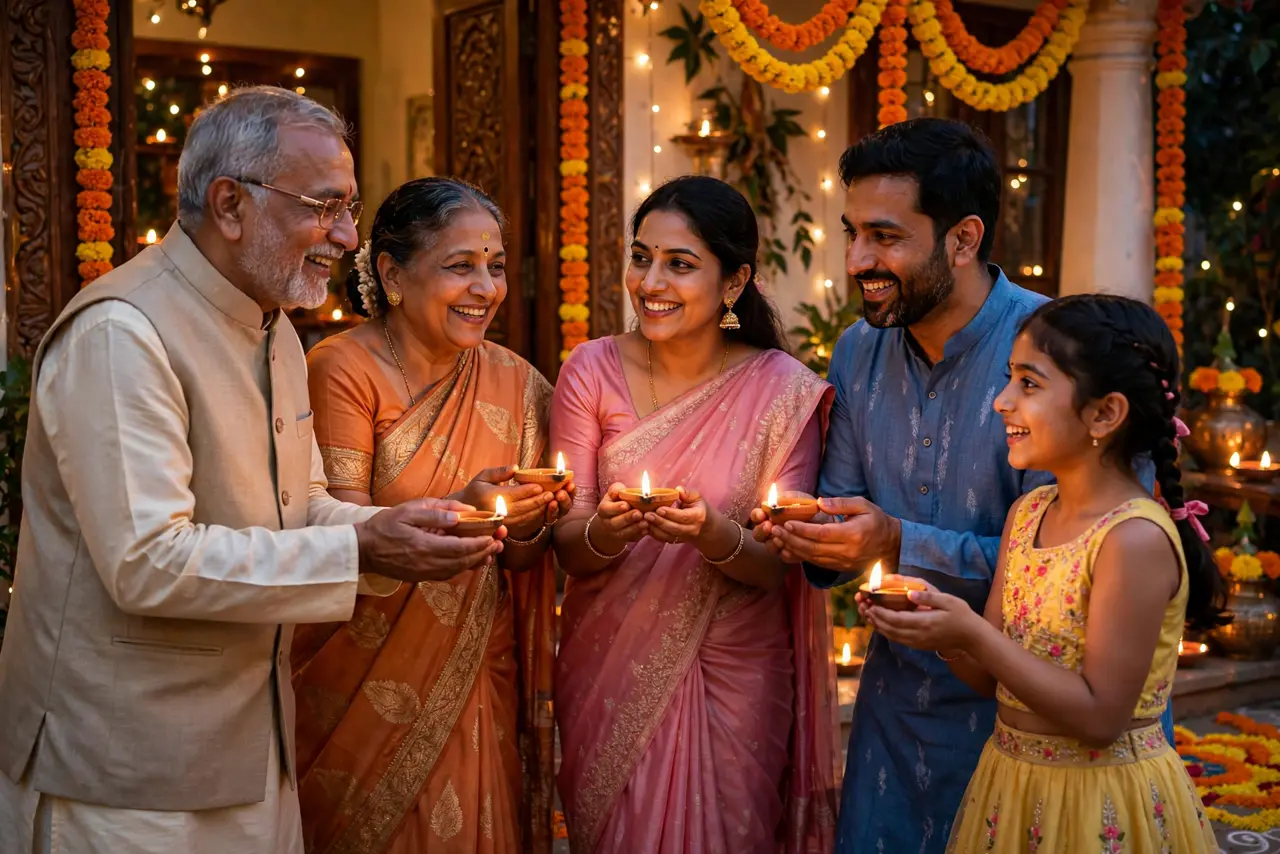
The most powerful aspect of Diwali prayer is its communal nature. Grandparents chant verses they learned from their grandparents; children learn their first aarti; the whole family bows together. In that shared devotion, the festival’s deepest blessing is realized — not wealth, but togetherness. Keep this in mind as you read: every prayer below is an invitation, not a performance.
Morning Prayers for Diwali Day
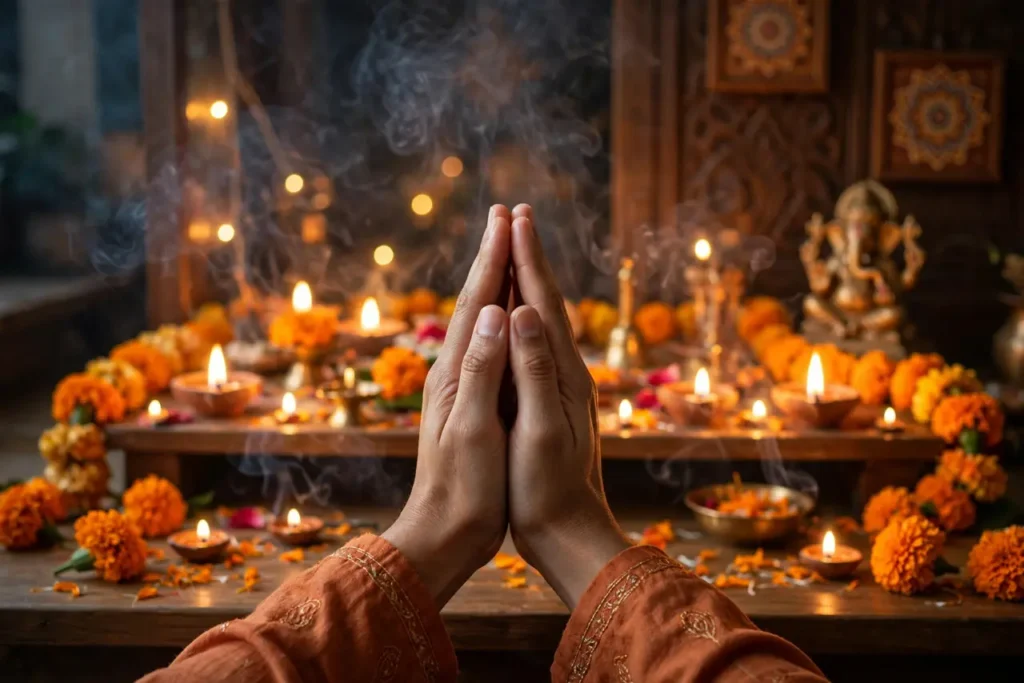
Begin the festival with these short morning invocations. They take only a few minutes and set the spiritual tone for the entire day.
1. Surya Namaskar Prayer (Salutation to the Sun). Stand facing east as the sun rises and say: “Om Suryaya Namah. O divine Sun, source of all light and life, as you rise on this festival of lights, fill my day with your energy and my heart with your warmth. Remove the darkness of ignorance from my mind as your rays remove darkness from the world.”
2. Lakshmi Morning Invocation. “Om Mahalakshmyai Namah. Goddess Lakshmi, on this most auspicious day, I welcome you into my home and heart. Bless my family with health, my work with success, and my life with contentment. May I use prosperity wisely and share it generously.”
3. Ganesha Morning Prayer. “Om Gan Ganapataye Namah. Lord Ganesha, remover of obstacles, I bow before you at the start of this holy day. Clear my path of difficulties, grant me wisdom in my decisions, and bless every new beginning I undertake.”
4. Prayer for the Home. “O divine light, as I clean and decorate my home today, clean and decorate my heart as well. Remove the dust of old grudges, polish the corners of forgotten gratitude, and let every room of my life glow with your presence.”
5. Family Blessing Prayer. “May every member of my family be blessed today — the elders with health, the young with wisdom, the workers with success, and the children with joy. Keep us united in love as we celebrate your festival of light.”
The Lakshmi Puja: Prayers and Their Meanings
The centerpiece of Diwali is the Lakshmi Puja performed on the main night. Here are the essential prayers of the ceremony, with plain-English explanations of what each one means.
Dhyana (Meditation on the Goddess). Before the puja begins, the family meditates on Lakshmi’s form — seated on a lotus, holding lotuses, with gold coins flowing from her hand. The prayer: “I meditate on Goddess Mahalakshmi, radiant as molten gold, seated on the lotus of the heart, bestower of all auspiciousness.” This stillness prepares the mind; the goddess is invited into a calm home, not a chaotic one.
Avahana (Invitation). “O Goddess Lakshmi, consort of Vishnu, I invite you to this sacred space. Come with your full grace and reside here tonight.” The family visualizes the goddess arriving — this is why homes are cleaned and lit: no one invites a honored guest into a dark, untidy house.
Shodashopachara (The Sixteen Offerings). The traditional puja offers sixteen items — water for washing feet, water for sipping, bath water, clothing, sandalwood paste, flowers, incense, lamp, food, betel nut, and more. Each offering is accompanied by a short prayer acknowledging that everything we have comes from the divine and is returned in gratitude. You do not need all sixteen; even five offerings made with devotion complete the spirit of the ritual.
Lakshmi Ashtottara (108 Names). Chanting the 108 names of Lakshmi — “Om Prakrityai Namah, Om Vikrityai Namah…” — is the heart of the puja. Each name reveals an attribute: she is nature, she is transformation, she is the earth, she is nourishment. If 108 feels long, even eleven names chanted slowly carry the same devotion.
Pushpanjali (Flower Offering). The family offers flowers with the prayer: “With these flowers I offer my heart’s devotion. Accept my worship, O Mother, and bless this household.” Children especially love this part — it is their moment to participate directly.
Essential Diwali Mantras with Meanings
Mantras are the sound-form of prayer. Here are the most important Diwali mantras, written in transliteration with their meanings explained.
Om Shree Mahalakshmyai Namah. “Salutations to the great Goddess Lakshmi.” The simplest and most direct Lakshmi mantra, perfect for beginners. Chant it 11, 21, or 108 times during the puja.
Om Gan Ganapataye Namah. “Salutations to Lord Ganesha.” Chanted first in every puja to remove obstacles. On Diwali, it ensures the Lakshmi Puja proceeds without hindrance.
Lakshmi Gayatri Mantra. “Om Mahalakshmyai Cha Vidmahe, Vishnu Patnyai Cha Dheemahi, Tanno Lakshmi Prachodayat.” Meaning: “We meditate on the great Goddess Lakshmi, the consort of Vishnu; may she inspire and illuminate our intellect.” This is the most revered Lakshmi mantra, chanted for both material and spiritual prosperity.
Om Shreem Hreem Shreem Kamale Kamalalaye Praseed Praseed. “O Lakshmi, seated on the lotus, be pleased, be pleased with me.” A powerful bija (seed-syllable) mantra combining Shreem (Lakshmi’s seed sound) with a direct plea for grace. Traditionally chanted 108 times on Diwali night.
Om Kuberaaya Namah. “Salutations to Kubera, treasurer of the gods.” Kubera is worshipped alongside Lakshmi on Diwali as the guardian of wealth. This mantra asks not just for wealth but for its protection.
Asato Ma Sadgamaya. “Lead me from the unreal to the real.” From the Brihadaranyaka Upanishad, this is Diwali’s philosophical anthem: “Lead me from darkness to light, from death to immortality.” Many families chant it as the diyas are lit.
Om Deepajyotish Paramjyotir. “Salutations to the light of the lamp, which is the supreme light.” Chanted while lighting the first diya, acknowledging that the small flame represents the infinite divine light.
Sarva Mangala Mangalye. “O most auspicious of all that is auspicious, O Lakshmi, fulfiller of all purposes, protectress of those who surrender — salutations to you, O Narayani.” A beloved Lakshmi stotra verse sung during the aarti.
The Diwali Aarti: “Om Jai Lakshmi Mata”
The aarti is the emotional climax of the puja — the family circles a lit lamp before the goddess while singing her praise. “Om Jai Lakshmi Mata” is the most widely sung Diwali aarti. Its verses praise Lakshmi as the dweller of Vaikuntha, the mother of the universe, the remover of sorrow, and the giver of the fourteen jewels of creation. The refrain “Om Jai Lakshmi Mata” — victory to Mother Lakshmi — is sung with growing joy as the lamp circles.
If you are new to the aarti, do not worry about perfect pronunciation. Stand with the family, hold the thali if offered, and sing what you can. The aarti’s power is in collective devotion — dozens of voices, one flame, moving in circles. After the aarti, the lamp’s flame is shared: each person cups their hands over it and draws the warmth to their face, receiving the goddess’s blessing directly.
Evening Prayers for the Festival Nights
Diya Lighting Prayer. As you light each diya in the evening, say silently: “As this flame rises, may my hopes rise. As this light spreads, may my love spread. As this darkness flees, may my fears flee.”
Gratitude Prayer. “O divine, before I ask for anything tonight, I thank you for everything — for the roof above me, the food before me, the family around me, and the breath within me. What I have is already abundance.”
Forgiveness Prayer. “If I have wronged anyone this year, knowingly or unknowingly, I ask forgiveness. If anyone has wronged me, I release it tonight. Let no shadow of resentment dim the festival of lights.”
Protection Prayer for Children. “May the divine light guard my children as they play among the fireworks. Keep them safe, keep them joyful, and let them remember this night with happiness all their lives.”
Closing Prayer of the Night. “The diyas will burn out, but the light remains in our hearts. Bless our sleep, guard our dreams, and wake us to a new year of grace. Shubh Deepavali.”
Diwali Blessing Messages to Share
These blessings work as messages, card inscriptions, or spoken words when you meet someone during the festival.
1. May the divine light of Diwali bless you with health, wealth, and happiness. Shubh Deepavali!
2. Blessed Diwali! May every prayer you offer tonight return to you as a blessing.
3. May Goddess Lakshmi’s blessings fill your home and Lord Ganesha’s wisdom guide your path.
4. Wishing you a Diwali blessed with divine grace and abundant joy.
5. May the sacred flames purify your heart and the divine blessings enrich your life.
6. Blessed Deepavali! May your devotion be rewarded with prosperity and peace.
7. May heaven’s light shine upon you and your family this holy festival.
8. Praying that all your righteous wishes are fulfilled this Diwali. Blessings to you!
9. May the goddess smile upon your home tonight and always. Shubh Deepavali!
10. Blessed Diwali! May your aarti rise with hope and return as happiness.
11. May divine blessings rain upon you like the sparks of Diwali fireworks.
12. Wishing you a festival blessed with togetherness, gratitude, and grace.
13. May the light you kindle tonight burn bright in your life all year. Blessings!
14. Blessed Diwali! May your home be a temple of joy and your heart an altar of peace.
15. May every diya you light carry a prayer, and every prayer carry a blessing.
Blessings for Specific People
For parents: “May the divine bless you with long life and good health. Your prayers have protected me all my life; tonight I pray for you. Shubh Deepavali, Mom and Dad.”
For children: “May you grow in wisdom and kindness, may your dreams be bright, and may the goddess always watch over you. Blessed Diwali, my dear.”
For a new couple: “May your first Diwali together be the first of a hundred. May Lakshmi bless your new home and your new life with abundance. Congratulations and Shubh Deepavali!”
For someone unwell: “Praying for your swift recovery this Diwali. May the healing light of the festival restore your strength. You are in my prayers tonight.”
For someone grieving: “I know this festival feels different this year. May the gentle light of remembrance comfort you, and may you feel surrounded by love. Holding you in my prayers.”
For a friend starting a business: “May Ganesha clear every obstacle and Lakshmi bless every venture. Your courage deserves success. Blessed Diwali and a prosperous new beginning!”
For a student: “May Saraswati’s wisdom and Lakshmi’s fortune both favor you this year. Study hard, dream big. Shubh Deepavali!”
Puja Items Checklist
A simple Lakshmi Puja needs less than you think. Here is everything for a heartfelt ceremony:
| Item | Purpose in the Puja | Simple Substitute |
|---|---|---|
| Idols or pictures of Lakshmi and Ganesha | The focus of worship | Printed images work perfectly |
| Diyas and oil/ghee with cotton wicks | Sacred light offering | Tealight candles |
| Flowers and garlands (marigold) | Decoration and offering | Any fresh flowers |
| Incense sticks and camphor | Purifying fragrance | A scented candle |
| Fruits, sweets, and dry fruits | Naivedya (food offering) | Whatever sweets you have |
| Rice grains, kumkum, turmeric | Auspicious markings and offerings | Coloured rice or powder |
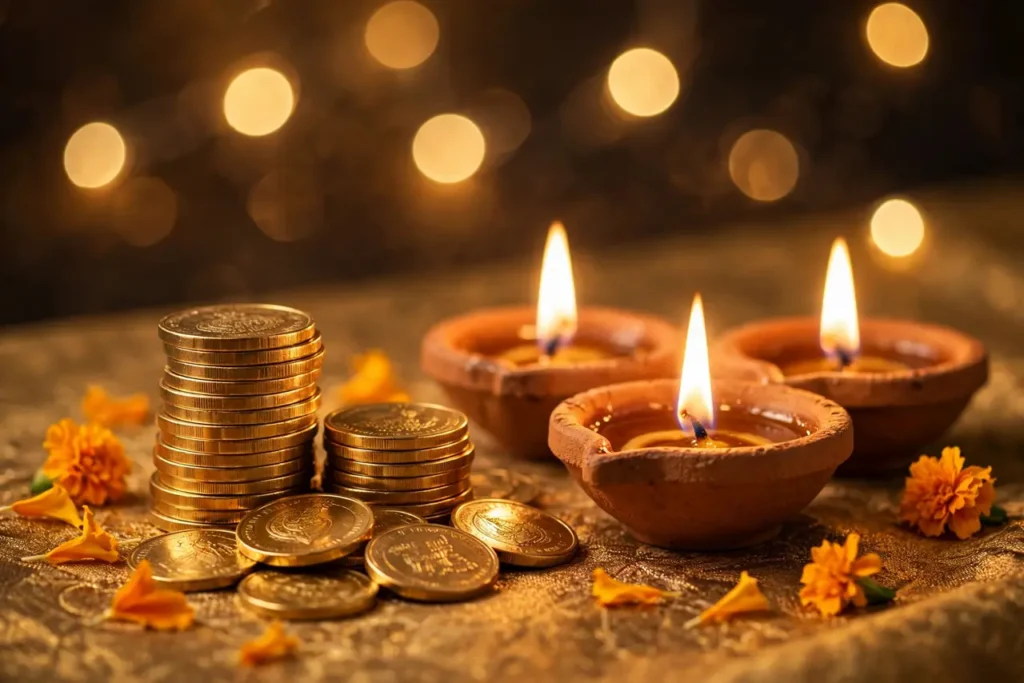
| Coins or currency notes | Symbol of wealth to be blessed | Any coins |
| Kalash (water pot) with mango leaves | Invitation of divine energies | A simple glass of water |
| Aarti thali | Circling the sacred flame | Any flat plate |
| Bell | Marking sacred moments | Clapping works too |
How to Perform a Simple 15-Minute Diwali Puja
Short on time or new to the ritual? This condensed puja captures the full spirit in fifteen minutes. First, bathe and wear clean or new clothes — outer cleanliness mirrors inner readiness. Set up a clean surface with the idols or pictures, place diyas on either side, and arrange flowers, incense, and sweets before them.
Light the diyas and incense. Join your palms and chant “Om Gan Ganapataye Namah” eleven times, then “Om Shree Mahalakshmyai Namah” eleven times. Offer flowers at the feet of the deities, then offer the sweets and fruits. Sing or listen to the “Om Jai Lakshmi Mata” aarti while circling a lit diya before the idols. Finally, bow with folded hands and speak your personal prayer — your own words, your own hopes. Distribute the offered sweets as prasad. That is a complete puja: invitation, praise, offering, and gratitude.
Diwali Prayers for Children to Learn
The festival is how most Hindu children learn their first prayers. These simple verses are easy to memorize and beautiful to chant together as a family.
Shubham Karoti Kalyanam. “Shubham karoti kalyanam, arogyam dhana sampada, shatru buddhi vinashaya, deepa jyoti namostute.” Meaning: “I salute the light of the lamp, which brings auspiciousness, health, and wealth, and destroys hostile intentions.” Traditionally chanted while lighting the evening diya — many children learn this before any other prayer.
Deepa Jyoti Parabrahma. “Deepa jyoti parabrahma, deepa jyoti janardana, deepo me hara tu papam, deepa jyoti namostute.” Meaning: “The lamp’s light is the supreme divine; may it remove my sins. I salute the lamp’s light.” A gentle, forgiving prayer perfect for young hearts.
Vakratunda Mahakaya. “Vakratunda mahakaya, surya koti samaprabha, nirvighnam kuru me deva, sarva karyeshu sarvada.” Meaning: “O curved-trunked, mighty-bodied one, radiant as a million suns, remove all obstacles from my endeavors, always.” Ganesha’s beloved verse, chanted before the Lakshmi Puja begins.
Twameva Mata Cha Pita Twameva. “Twameva mata cha pita twameva, twameva bandhushcha sakha twameva, twameva vidya dravinam twameva, twameva sarvam mama deva deva.” Meaning: “You alone are my mother and father, my kin and friend, my knowledge and wealth — you are everything to me, O God of gods.” A prayer of total surrender that children find deeply comforting.
Teaching tip: do not correct pronunciation harshly. Let children chant alongside elders, absorbing the rhythm before the words. Understanding grows with repetition, and the feeling of belonging matters more than accuracy in the early years.
Regional Prayer Traditions on Diwali
Bengal’s Kali Puja: On Diwali night, Bengal worships the fierce goddess Kali with all-night vigils. Devotees chant the Kali mantras — “Om Kreem Kalikayai Namah” — offer red hibiscus flowers, and stay awake until dawn, when the goddess is believed to be most present. The prayers here are intense and ecstatic, a stark contrast to Lakshmi’s serene worship.
Tamil Nadu’s dawn prayers: The South’s Diwali prayers happen before sunrise on Naraka Chaturdashi. Families chant the Vishnu Sahasranamam or simple Krishna bhajans after the ritual oil bath, greeting the dawn that commemorates Narakasura’s defeat. Temple bells ring in the dark; the prayers literally welcome the light.
Gujarat’s Chopda Pujan: Merchant families perform a special puja of their account books, invoking Lakshmi and Saraswati over fresh ledgers. The prayer “Om Shree Lakshmi Narayanaya Namah” is written on the first page, and the books themselves become objects of worship — a beautiful fusion of commerce and devotion.
Punjab’s Bandi Chhor Divas: Sikh families recite Gurbani — hymns from the Guru Granth Sahib — and the story of Guru Hargobind’s liberation. The Golden Temple’s illumination is accompanied by continuous kirtan (devotional singing) through the night.
Maharashtra’s Vasu Baras: The festival opens by honoring cows with prayers and offerings, acknowledging the animals that sustain agrarian life. The prayer “Om Gau Mata Namah” expresses gratitude to the cow as a symbol of nurturing abundance.
Watch: Step-by-Step Lakshmi Puja Ritual
A clear, complete walkthrough of the Diwali Lakshmi Puja — ideal for first-timers and families wanting to get every step right.
Explore More
Deepen your festival practice with DayZora’s related guides. Our New Year blessings and prayers carry the same spirit of renewal into January, the history of Christmas origins explores how another festival of light took shape, and our Christmas morning traditions guide shows how families everywhere build sacred rituals around celebration.
The Science of Sound: Why Mantra Chanting Calms the Mind
Modern research offers a fascinating footnote to the ancient practice of Diwali chanting. Studies on rhythmic vocalization show that repetitive chanting — like the 108 repetitions of a Lakshmi mantra — slows the heart rate, synchronizes breathing, and shifts brain activity toward calmer patterns. The mala (prayer beads) adds tactile rhythm; the family circle adds social bonding; the lamp’s flicker adds visual focus. The puja is, among other things, a masterclass in collective mindfulness designed millennia before the term existed.
The Sanskrit sounds themselves are engineered for resonance. “Om” begins with the open “ah” of the abdomen, moves through the “oo” of the chest, and closes with the “mm” of the skull — a single syllable that massages the entire vocal resonator. “Shreem,” Lakshmi’s seed syllable, combines sibilance with nasal resonance in a pattern chanters describe as “golden.” Whether or not one accepts the metaphysics, the physiology is real: ten minutes of mantra chanting measurably calms the nervous system. The rishis were, among other things, brilliant psychologists.
Creating Your Family’s Prayer Tradition
The most precious Diwali prayers are often not in any book — they are the ones your family invents. Consider establishing three family customs this year. First, a gratitude round before the puja: each person names one blessing from the past year. Children love this, and it reframes the festival from getting to giving thanks. Second, a family sankalpa (resolve): one shared intention written on paper and placed before the goddess — a collective wish the whole family works toward. Third, a blessing circle after the aarti: elders place hands on each child’s head and speak a personal blessing aloud. These spoken blessings become core memories; adults decades later can still quote their grandmother’s Diwali words verbatim.
Record the aarti singing on your phone — not for social media, but for the family archive. Years from now, hearing those voices together will be worth more than any photograph. Tradition is not the enemy of technology; it is what gives technology something worth preserving.
Frequently Asked Questions
What prayers are said on Diwali?
The core Diwali prayers are the Lakshmi Puja (invitation, sixteen offerings, 108 names, and aarti), the Ganesha invocation chanted first, the Lakshmi Gayatri mantra, and the “Om Jai Lakshmi Mata” aarti. Families also say personal prayers of gratitude, forgiveness, and blessing.
What is the main mantra for Diwali?
“Om Shree Mahalakshmyai Namah” (salutations to Goddess Lakshmi) is the simplest and most widely chanted Diwali mantra. The Lakshmi Gayatri — “Om Mahalakshmyai Cha Vidmahe, Vishnu Patnyai Cha Dheemahi, Tanno Lakshmi Prachodayat” — is the most revered longer mantra for the festival.
How do you perform Lakshmi Puja at home?
Clean the worship space, set up idols or pictures of Lakshmi and Ganesha, light diyas and incense, invoke Ganesha first, then invite Lakshmi with flowers and offerings, chant her mantras, perform the aarti by circling a lamp, and share the offered sweets as prasad. A sincere 15-minute puja is complete and valid.
What time should Diwali prayers be performed?
The main Lakshmi Puja is performed in the evening during the auspicious muhurta (usually after sunset during Pradosh Kaal). Morning prayers can be simple invocations at sunrise. Exact muhurta timings vary by year and location — check a local panchang.
Can I pray on Diwali if I am not Hindu?
Yes. Diwali’s prayers of light, gratitude, and good-over-evil are universal in spirit. You can light a diya, say a personal prayer of thanks, and join the festival’s spirit without performing the full Hindu ritual.
What is the meaning of “Om Jai Lakshmi Mata”?
It means “Victory to Mother Lakshmi.” The aarti’s verses praise her as the mother of the universe, dweller in every pure heart, remover of sorrow, and giver of wealth and wisdom. Families sing it while circling a lamp before her idol.
Which gods are worshipped on Diwali?
Primarily Goddess Lakshmi (wealth and prosperity) and Lord Ganesha (remover of obstacles), worshipped together on the main night. Lord Kubera (guardian of wealth) is also honored, and regional traditions add Kali, Krishna, or Rama worship on specific days.
What should I offer during Diwali Puja?
Traditional offerings include flowers (especially marigold and lotus), sweets, fruits, dry fruits, rice, kumkum, incense, and lit diyas. Coins or currency are placed before the goddess to be blessed. Offer whatever you have with devotion — sincerity matters more than quantity.
How long does the Diwali Puja take?
A full traditional puja with sixteen offerings and 108 names takes 45–60 minutes. A sincere simplified puja takes about 15 minutes. Both are valid — what matters is devotion, not duration.