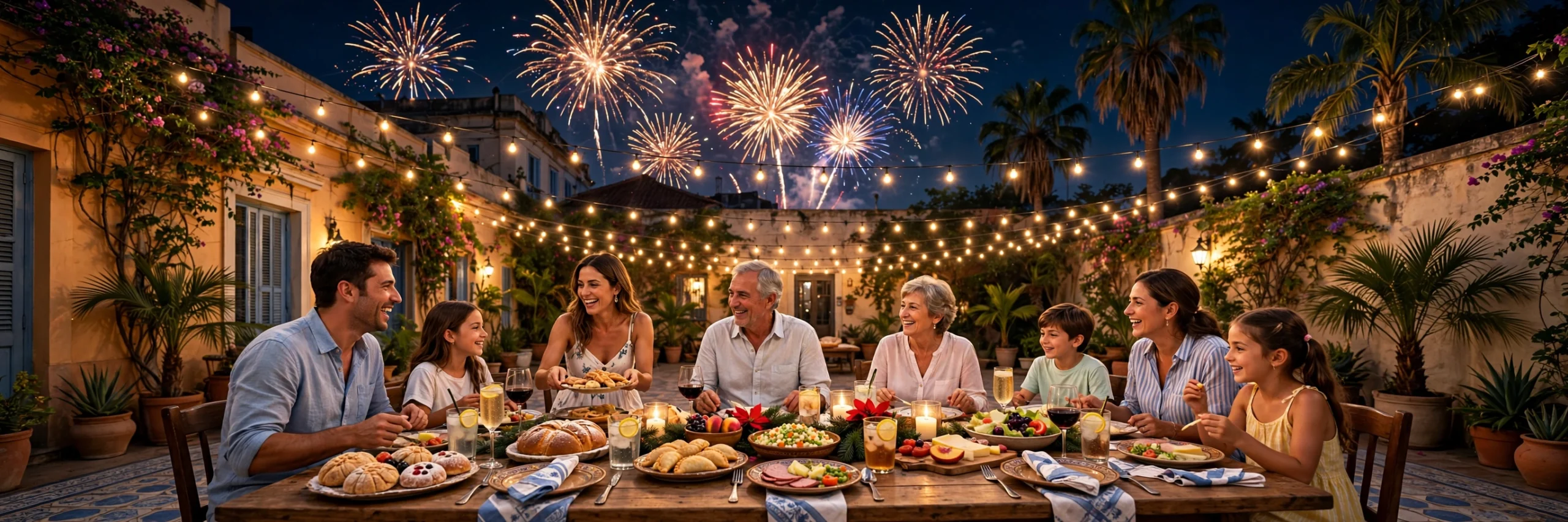
Christmas traditions in Argentina flip everything the Northern Hemisphere knows about the holiday on its head. Here, Christmas arrives at the height of summer: Santa wears no heavy coat, the Christmas “breeze” is a warm evening wind, and the great Nochebuena feast is served on patios and in gardens under the stars. Families dine at midnight, toast with ice-cold cider as fireworks explode overhead, and celebrate the birth of Christ in temperatures that often top 30°C (86°F). It is Christmas, Argentine style — and it may be the most joyful summer party on earth.
What makes Christmas traditions in Argentina so captivating is how completely the country has adapted a winter holiday to a summer reality without losing an ounce of its magic. The Italian and Spanish immigrants who shaped Argentine culture brought their pan dulce, turrón, and nativity scenes; Argentina added the asado, the midnight brindis (toast), and the gloriously late-night rhythm of its social life. The result is a celebration that feels both familiar and wonderfully strange to Northern visitors. This guide walks you through the entire Argentine Christmas — hour by hour, dish by dish — so you can understand it, celebrate it, or even recreate it at home.
Summer Christmas: Understanding the Argentine Season
The first thing to grasp about Christmas traditions in Argentina is the season itself. December in Buenos Aires means long, hot days, jacaranda trees in purple bloom, and porteños escaping to the coast on weekends. Schools break for summer holidays in mid-December, and the whole country shifts into vacation mode. Christmas lands in the middle of this summer exodus — which is precisely why Argentine celebrations are built around the night.
The heat shapes everything. Heavy winter dishes are reimagined as cold or room-temperature feasts; celebrations happen outdoors after dark; and the traditional Christmas imagery — snow, fireplaces, sleighs — exists purely as decoration, cheerfully disconnected from the weather outside. Argentine children grow up with a delightful cognitive dissonance: they sing about a snowy Navidad while sweating through December, and they wouldn’t have it any other way. For a wider look at how the Southern Hemisphere handles the holiday, see our roundup of summer Christmas traditions around the world.
The Nochebuena Timeline: An Argentine Christmas Eve, Hour by Hour
Christmas Eve — Nochebuena — is the main event in Argentina, far bigger than Christmas Day. The celebration follows a distinctly Argentine schedule that runs deep into the night. Here’s how it typically unfolds:
Late Afternoon: Preparations and the First Guests
By late afternoon, the work is mostly done: the vitel toné is chilled, the asado meats are prepped, tables are set on the patio or in the garden. Guests begin arriving as the heat of the day softens — extended family, neighbors, friends. Children, dressed in their new Christmas clothes, fizz with anticipation. Cold drinks appear: lemonade, sodas, and the first bottles of sidra (sparkling cider) chilling on ice.
9 PM – Midnight: The Great Feast
Dinner is served late — typically starting around 9 or 10 PM — and it is a sprawling, leisurely affair. Unlike the hurried meals of other cultures, the Argentine Nochebuena dinner unfolds over hours, with conversation flowing as freely as the wine. Multiple courses appear in no great rush; nobody watches the clock because everyone knows the real deadline: midnight.
Midnight: The Brindis and the Fireworks
As midnight approaches, excitement builds. Glasses are filled — sidra for the traditionalists, champagne for the modern — and at the stroke of twelve, the brindis: the great Christmas toast. “¡Feliz Navidad!” rings out as glasses clink, hugs are exchanged all around, and then the sky explodes. Fireworks — a massive part of Argentine Christmas — light up the night in every neighborhood, from professional displays to backyard rockets. The noise is tremendous, the sky is ablaze, and for a solid half-hour, Argentina celebrates as one.
After the fireworks, Papá Noel’s gifts are opened (more on that below), and the party continues. It is entirely normal for an Argentine Nochebuena celebration to run until 3 or 4 in the morning. Christmas, here, is a marathon of joy.
The Argentine Christmas Table: Vitel Toné, Asado & Pan Dulce
The food of Christmas traditions in Argentina reflects the country’s immigrant heritage and its summer climate — a feast of cold cuts, salads, grilled meats, and Italian-inspired sweets.
Vitel Toné: The Star of the Table
If one dish defines the Argentine Christmas, it’s vitel toné — thinly sliced cold veal (or beef) dressed in a creamy tuna-caper-mayonnaise sauce, garnished with capers and sometimes hard-boiled eggs. Brought by Italian immigrants (it’s a relative of vitello tonnato), it has become utterly Argentine in its Christmas association. Served cold, it’s perfect for a summer feast, and no Nochebuena table is complete without it. Families guard their recipes; the sauce’s exact proportions are a matter of fierce debate.
The Asado Christmas
Many families center their Nochebuena on the asado — Argentina’s legendary barbecue. The parrillero (grill master, often the family’s patriarch) tends chorizos, morcillas, vacio, and asado de tira over slow embers while the family gathers around. A Christmas asado is the ultimate expression of Argentine hospitality: generous, unhurried, and deeply social. The grill becomes the evening’s hearth, the place where stories are told and the night’s rhythm is set.
Cold Dishes for Hot Nights
The summer heat has shaped a repertoire of cold Christmas dishes: ensalada rusa (Russian salad with potatoes, carrots, peas, and mayonnaise), lengua a la vinagreta (pickled tongue), matambre (rolled stuffed flank steak, served cold in slices), and pionono (rolled sponge cake with savory or sweet fillings). These dishes can be prepared in advance — essential when the cook also wants to enjoy the party — and they suit the climate perfectly.
Pan Dulce, Turrón, and Mantecol: The Sweet Finish
Dessert is where the Italian and Spanish heritage shines brightest. Pan dulce — the tall, fruit-studded sweet bread — is the undisputed king of Argentine Christmas sweets; supermarkets stack them by the thousand in December, and families debate the best brands with sommelier-like seriousness. Turrón (nougat, in soft and hard varieties), mantecol (a peanut-based halva-like confection), and confites (sugared almonds) fill the table. Fresh fruit salad (ensalada de fruta), served ice-cold, provides the refreshing counterpoint. Similar Italian-inspired sweets anchor the holidays across the Atlantic — see our guide to Italian Christmas dinner traditions for the old-country roots.
Sidra and the Christmas Toast
The traditional Christmas drink is sidra — sparkling apple cider, served ice-cold. At midnight, the pop of sidra bottles is the soundtrack of the brindis. Clericó — a refreshing sangria-like punch of white wine and chopped fruit, served over ice — is another summer-Christmas classic, perfect for the long hot evening. Wine flows freely with dinner, as at any Argentine gathering, and the celebration’s beverages are chosen for refreshment as much as festivity.
Decorating for a Summer Christmas
Argentines decorate with enthusiasm, embracing the charming contradiction of winter imagery in summer heat. Christmas trees — almost always artificial — go up in early December, dressed in lights, ornaments, and tinsel. The pesebre (nativity scene) holds a place of honor in many homes, often quite elaborate, with the Baby Jesus placed in the manger at midnight on Nochebuena.
Outdoor decorating is big: houses and apartment balconies are outlined in lights, and neighborhoods glow through December. Public displays are impressive — Buenos Aires’ main avenues, the Obelisk area, and shopping districts shine, while cities like Córdoba, Rosario, and Mendoza mount their own lightings. The decorations stay up through early January, bridging Christmas and the Three Kings Day (Día de Reyes) on January 6th, which is still celebrated with gifts for children in many families.
Midnight Magic: Fireworks, Globos, and Papá Noel
The midnight hour is the emotional peak of Christmas traditions in Argentina, and it has its own rituals. The fireworks are the most spectacular element — and a point of growing public debate, as concerns for pets, people with sensitivities, and safety have led many municipalities to restrict or ban loud pyrotechnics in recent years, with silent or low-noise alternatives gaining ground. Check local regulations if you’re celebrating in Argentina; the trend is toward celebration that’s kinder to ears and animals.
The globos — large paper hot-air balloons, sometimes called “globos de Navidad” — are another beloved midnight tradition in some regions: colorful tissue-paper balloons released into the night sky, floating upward with the heat of a small flame. Where still permitted (regulations vary by locality), they create a breathtaking sight: dozens of glowing orbs ascending into the summer night.
Papá Noel (Santa Claus) brings gifts to Argentine children, with presents opened after the midnight brindis. The timing — gifts at midnight rather than Christmas morning — is one of the tradition’s distinctive features, and it means Christmas “morning” for Argentine children actually begins in the wee hours, amid fireworks and celebration. For gift inspiration with a global flavor, browse our best Christmas gifts guide.
Christmas Day: Leftovers, Family, and the Beach
After the marathon of Nochebuena, Christmas Day in Argentina is blissfully low-key. Families sleep in, then gather for a relaxed lunch of leftovers — cold vitel toné, leftover asado reheated or served cold, ensalada rusa, and pan dulce. The pace is slow, the mood is contented, and the afternoon often involves a pile-up of cousins, card games, and naps.
For many, Christmas Day means the beach or the pool. With summer in full swing, coastal cities like Mar del Plata fill with holiday vacationers, and even in Buenos Aires, those with access to a pool or a quinta (country house) spend the day in the water. It’s a Christmas Day ritual that Northern Hemisphere visitors find delightfully surreal: swimming off Christmas dinner.
New Year’s Eve: The Season’s Second Peak
Argentines don’t let the season end quietly. New Year’s Eve — Año Nuevo — is nearly as big as Nochebuena, with its own late-night feast, midnight brindis, and fireworks. Many of the same dishes reappear (no one minds second helpings of vitel toné), and the rituals mirror Christmas: dinner from 9 PM, toast at midnight, fireworks, dancing until dawn.
New Year’s brings its own superstitions: wearing new underwear (pink is traditional in some regions, red or yellow in others), eating twelve grapes or raisins at midnight, and toasting with champagne. In some neighborhoods, effigies are burned at midnight, symbolically clearing out the old year. The holiday season finally winds down after Día de Reyes (January 6th), when children receive small gifts from the Three Wise Men — a tradition kept alive especially by grandparents.
Regional Variations: From Patagonia to the Northwest
Argentina’s vast geography gives its Christmas regional accents. In Patagonia, the southern summer brings nearly endless daylight — Christmas dinner in Bariloche or Ushuaia happens under a sky that barely darkens, a magical experience. In the Northwest (Salta, Jujuy), indigenous and colonial traditions blend: the pesebres are particularly elaborate, and local foods like tamales and humitas join the Christmas table. In Mendoza, wine country celebrates with its own vintages flowing freely; in Córdoba, the sierras provide a backdrop for outdoor celebrations.
The Argentine diaspora — in Spain, the United States, Italy, and beyond — recreates these traditions faithfully: the midnight brindis, the vitel toné (veal hunted down in foreign butchers), the pan dulce shipped from home. Like the Brazilian Christmas Eve feast described in our guide to Christmas traditions in Brazil, the Argentine Nochebuena proves that summer Christmases are not a compromise — they’re a celebration perfected for the season.
How to Celebrate an Argentine-Style Christmas at Home
You don’t need to be in Buenos Aires to borrow the best of Christmas traditions in Argentina. Here’s how to host your own Nochebuena:
- Serve dinner late — aim for a 9 PM start and let the evening unfold slowly.
- Make vitel toné — poach veal or beef eye of round, slice thin, and dress with a sauce of tuna, mayonnaise, capers, and anchovies. Serve cold.
- Stock sidra — sparkling cider, served ice-cold, for the midnight toast.
- Do the midnight brindis — gather everyone at midnight for a proper toast, even if fireworks aren’t in the cards.
- Serve pan dulce — available at Latin bakeries and increasingly in mainstream supermarkets each December.
- Take it outside — if your climate allows, dine al fresco under string lights.
- Open gifts at midnight — embrace the Argentine timing for maximum magic.
For more festive gathering inspiration, our Christmas activities for families collection has ideas for all ages and climates.
The Immigrant Roots of the Argentine Christmas
To understand Christmas traditions in Argentina, you have to understand immigration. Between the late 19th and mid-20th centuries, millions of Italians and Spaniards arrived in Argentina, joined by Germans, Poles, Ukrainians, and others — and each community brought its Christmas customs. The pan dulce and vitel toné are Italian; the turrón is Spanish; the stollen-like sweets in some communities are German. The Argentine Christmas is, at its core, a beautiful synthesis: old-world recipes and rituals transplanted to the Southern Hemisphere and transformed by the summer sun.
This immigrant heritage is still visible in regional pockets. In towns founded by German immigrants, like Villa General Belgrano in Córdoba, Christmas markets with a Central European flavor draw visitors each December. Ukrainian and Polish communities maintain their own Christmas Eve customs alongside the Argentine mainstream. And the Italian influence remains dominant nationwide — Argentina’s Christmas sweets aisle is essentially an Italian pasticceria transplanted to South America. The result is a holiday that honors many homelands while belonging entirely to Argentina.
Christmas in Buenos Aires: Lights, Shopping, and Summer Nights
Buenos Aires at Christmas is a sight to behold. The city’s grand avenues — 9 de Julio, Corrientes, Santa Fe — blaze with decorations, and the shopping districts stay open late through December as porteños hunt for gifts and new Nochebuena outfits. The traditional Christmas markets and ferias offer artisan goods, and the city’s many parrillas and restaurants serve special Nochebuena menus for those celebrating away from home.
What makes the porteño Christmas distinctive is its nightlife energy. Christmas Eve in Buenos Aires doesn’t wind down — it ramps up. After the family dinner and midnight brindis, young people head out to clubs and parties that run until dawn; the city’s legendary nightlife simply absorbs the holiday. Christmas Day finds the city’s parks and plazas full of families, and the riverside areas packed with picnickers. For visitors, Buenos Aires offers the most cosmopolitan version of the Argentine Christmas — and the summer weather means every celebration can spill outdoors.
Music, Television, and the Season’s Entertainment
Argentine Christmas entertainment blends the traditional with the thoroughly modern. Villancicos are sung in schools and churches, but December’s soundtrack is dominated by cumbia, cuarteto (Córdoba’s beloved genre), and pop — the music of the season’s countless parties. Television airs Christmas specials, and Argentine films and shows with holiday themes get their annual rewatch.
The season’s social calendar is relentless: office parties, friend-group dinners (the traditional “despedida de año” — year-end farewell gatherings), neighborhood celebrations, and club events fill every December weekend. Argentines treat December as a month-long social season, and the cumulative effect is a national mood of celebration that builds steadily toward Nochebuena. It’s exhausting and exhilarating in equal measure — and it’s one of the things visitors remember most about Christmas traditions in Argentina.
Día de Reyes: The Season’s Quiet Finale
The Argentine holiday season doesn’t truly end until January 6th — Día de Reyes, the Epiphany, when the Three Wise Men are said to bring gifts to children. While Nochebuena is the main event, many families, especially those with grandparents keeping the old customs, maintain the Reyes tradition: children leave their shoes out (sometimes with water and hay for the camels) on the night of January 5th and wake to find small gifts. It’s a gentler, quieter coda to the season’s exuberance — a final morning of childhood magic before summer vacation settles into its long, lazy rhythm and the decorations come down. In this, Argentina keeps faith with a tradition shared across the Spanish-speaking world, closing its summer Christmas the way it began it: with family, sweetness, and wonder.
In Pictures: Christmas in Argentina
In Argentina, Christmas Eve means a late summer feast, midnight fireworks and paper lanterns rising into the warm night.
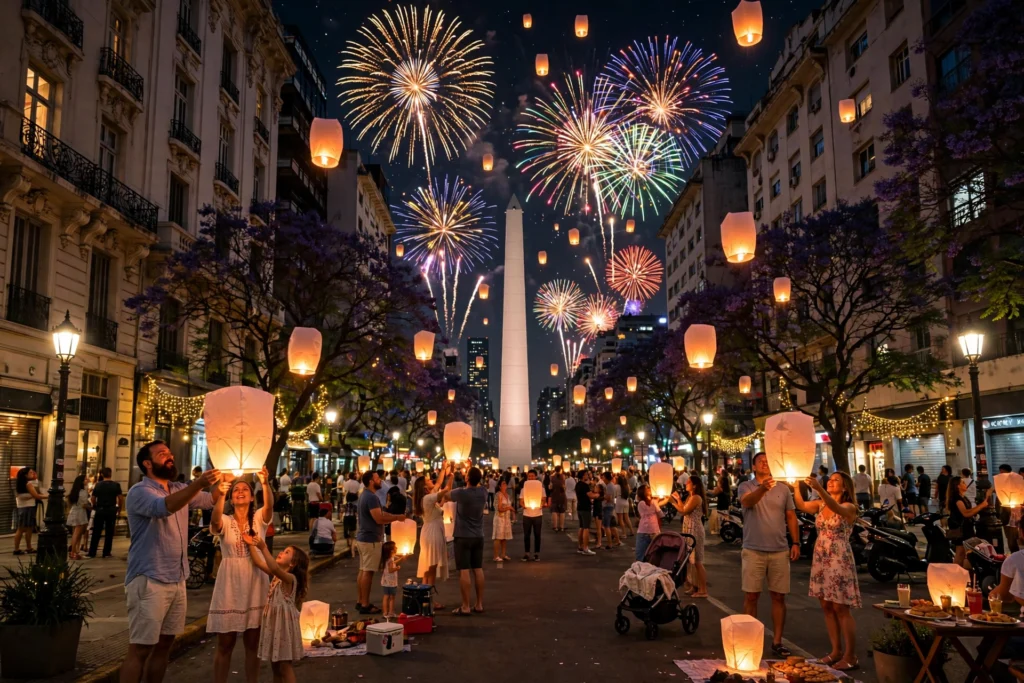
Buenos Aires at midnight on Christmas Eve: fireworks over the skyline as families release glowing globos into the summer night.
Watch: Christmas in Argentina
CGTN en Español reports on how Argentina celebrates — the arbolito, pan dulce, Mantecol and vitel toné covered in this guide. (Video in Spanish.)
At a Glance: Christmas in Argentina
Argentina's Christmas calendar, from the tree-raising to Three Kings Day.
| Tradition | Date | Key detail |
|---|---|---|
| Arbolito (Christmas tree) | Put up 8 December | Erected on Día de la Inmaculada Concepción; artificial trees are the norm in Argentina |
| Nochebuena feast | Night of 24 December | A late dinner from around 9pm: asado, vitel toné (veal in tuna-caper sauce, an Italian-immigrant heritage dish), pan dulce and sidra |
| Midnight fireworks & globos | Midnight, 24–25 December | A toast, fireworks over the cities and floating paper lanterns; Papá Noel's gifts appear while children watch the sky |
| Misa de Gallo | Midnight, 24 December | Christmas Eve midnight Mass, a major Catholic tradition, where 'Noche de Paz' is sung |
| Día de Reyes | 6 January | The tree stays up until this day; children leave shoes out for the Magi, with water and hay for their camels |
| Christmas Day | 25 December | A sleep-in, leftovers and family time — many head to the beach as summer holidays begin |
Frequently Asked Questions
Why is Christmas in summer in Argentina?
Argentina lies in the Southern Hemisphere, where the seasons are reversed: December marks the beginning of summer. Christmas therefore falls during the hottest, longest days of the year, with temperatures often exceeding 30°C (86°F). Argentine Christmas traditions — late-night outdoor feasts, cold dishes, swimming on Christmas Day — have evolved to embrace the summer climate.
What do Argentines eat for Christmas?
The traditional Argentine Nochebuena (Christmas Eve) feast features vitel toné (cold sliced veal in tuna-caper sauce), asado (barbecue), cold dishes like ensalada rusa and matambre, and Italian-inspired sweets including pan dulce, turrón, and mantecol. The midnight toast is made with ice-cold sidra (sparkling cider).
What is vitel toné?
Vitel toné is Argentina’s signature Christmas dish: thin slices of cold poached veal (or beef) dressed in a creamy sauce made from tuna, mayonnaise, capers, and anchovies. Introduced by Italian immigrants as vitello tonnato, it has become inseparable from the Argentine Christmas table and is served cold — perfect for a summer feast.
When do Argentines open Christmas gifts?
Argentine children traditionally open their gifts at midnight on Christmas Eve, right after the brindis (midnight toast) and fireworks — rather than on Christmas morning. Papá Noel (Santa Claus) is the gift-bringer, and many families also celebrate Día de Reyes (Three Kings Day) on January 6th with additional small gifts.
What is the brindis at Argentine Christmas?
The brindis is the traditional midnight toast on Nochebuena: as the clock strikes twelve, everyone raises a glass of sidra (sparkling cider) or champagne, exchanges hugs and “¡Feliz Navidad!” wishes, and then watches the fireworks. It is the emotional centerpiece of Christmas traditions in Argentina.
Do Argentines celebrate with fireworks at Christmas?
Yes — fireworks at midnight on Nochebuena are a huge tradition, though growing concerns about pets, safety, and noise have led many Argentine municipalities to restrict loud pyrotechnics in recent years. Low-noise and silent alternatives are increasingly popular, and visitors should check local regulations before purchasing fireworks.