Christmas traditions in Brazil flip the Northern Hemisphere script: picture Santa Claus arriving in swim shorts, midnight feasts served in 30°C heat, and fireworks exploding over crowded tropical beaches. In the largest country in South America, Christmas — or Natal — is a high-summer celebration shaped by Portuguese colonial roots, African and Indigenous influences, and a modern, joyful Brazilian spirit. Roughly 65 percent of Brazilians identify as Catholic, so the holiday carries deep religious meaning, but it is celebrated with a warmth and exuberance that feels distinctly Brazilian.
This complete guide to Christmas in Brazil walks you through everything: Papai Noel and how he differs from Santa Claus, the legendary ceia de Natal Christmas Eve feast, the Missa do Galo midnight mass, beach and fireworks traditions, dazzling events like Gramado’s Natal Luz festival, and regional variations from the Amazon to São Paulo. Whether you’re visiting Brazil for the holidays or want to bring a taste of Brazilian Christmas to your own home, you’ll find authentic customs, food ideas, and practical tips here.
What Makes Christmas Traditions in Brazil So Different
Christmas in Brazil is a summer holiday. December 25 falls in the middle of the Brazilian summer, with temperatures in Rio de Janeiro and Salvador often climbing above 30°C (86°F), while even São Paulo and the south enjoy warm, long evenings. That single fact reshapes almost every tradition: outdoor celebrations dominate, air-conditioned shopping malls fill with Christmas décor, and the classic imagery of snow and sleighs is happily reimagined in a tropical key.
The holiday also sits inside Brazil’s festive season. Christmas flows directly into New Year’s Eve — Réveillon — one of the biggest parties on the planet, and then into Carnival season just weeks later. December in Brazil is one long celebration, and Christmas is its warm, family-centered opening act. If you’re curious how other warm-weather countries handle the holidays, our guide to summer Christmas traditions around the world puts Brazil in global context.
Another defining feature is Brazil’s Catholic heritage. Christmas is first and foremost a religious holiday for most families: nativity scenes (presépios) are the most important decoration in many homes, midnight mass is packed, and the season opens with Advent. But Brazilian Catholicism is famously festive — faith and party coexist comfortably, and Christmas embodies that blend better than almost any other holiday.
Papai Noel: Brazil’s Santa Claus
Brazilian children wait for Papai Noel — literally “Father Christmas” — who looks much like the Santa Claus of the United States and Europe: red suit, white beard, jolly laugh. But Brazilian illustrations and shopping-mall Papai Noels often come with a tropical twist: you may spot him in a lighter suit, arriving by boat, or posing with beach backdrops rather than snowy ones.
Papai Noel delivers gifts on Christmas Eve, and Brazilian children typically open presents at midnight on December 24–25, right after the Christmas Eve dinner. In many families, the gifts appear “magically” while everyone is at the table or at midnight mass. Shopping malls across Brazil host elaborate Papai Noel grottos from November onward, where children queue for photos — a tradition as beloved in São Paulo as in small towns of the interior.
The gift-giving culture has a distinctly Brazilian ritual of its own: amigo secreto (secret friend), the Brazilian version of Secret Santa. Friends, coworkers, and extended families draw names and exchange gifts, often with a playful guessing game before the reveal. Amigo secreto is a fixture of Brazilian December office parties and family gatherings alike.
Presépios: The Heart of Brazilian Christmas Decorations
If one decoration defines Christmas traditions in Brazil, it is the presépio — the nativity scene. Brazilian presépios range from simple ceramic figures on a side table to elaborate miniature villages with lights, running water, and mossy landscapes. In many Catholic homes, setting up the presépio is a cherished family ritual, and it takes pride of place over the Christmas tree.
Christmas trees (árvores de Natal) are common too, usually artificial pines decorated with baubles, lights, and tinsel — the tropical climate makes real evergreens impractical. Cities compete with spectacular public displays: São Paulo’s Ibirapuera Park hosts one of the country’s most famous Christmas tree displays, a giant floating tree on the park’s lake surrounded by lights and music, drawing millions of visitors each December.
Street and home decorations lean bright and colorful. You’ll see pisca-pisca (twinkling lights) strung across balconies and storefronts, and in the northeast, decorations often incorporate local crafts and tropical motifs. For inspiration on styling your own tree, see our Christmas decoration ideas.
The Ceia de Natal: Brazil’s Christmas Eve Feast
The single most important Christmas tradition in Brazil is the ceia de Natal — the Christmas Eve supper, served late on December 24 and stretching past midnight. This is the holiday’s centerpiece: extended family gathers around a laden table, toasts are raised at midnight, gifts are exchanged, and the meal can last for hours.
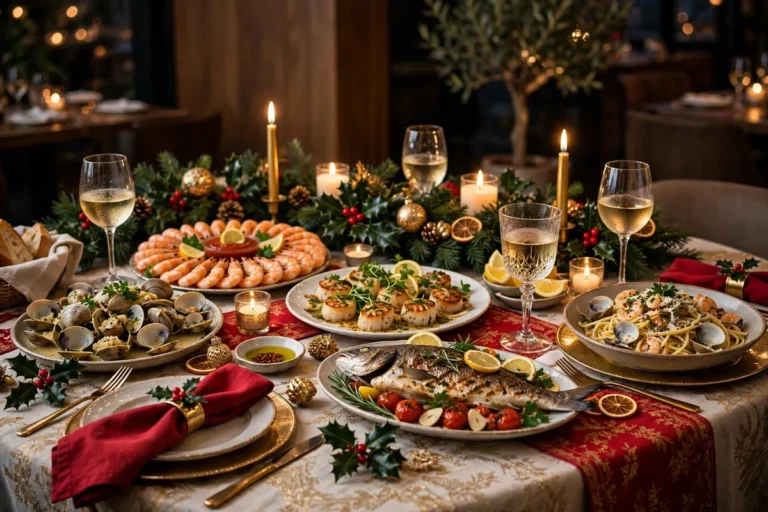
The star of the ceia is usually roast turkey (peru) or chester — a specially bred large chicken developed in Brazil that has become a Christmas staple. The bird is often stuffed with farofa, a toasted cassava-flour mixture with bacon, sausage, eggs, and olives that is arguably Brazil’s most beloved side dish. Around it you’ll find rice with raisins, salpicão (a shredded-chicken salad with mayonnaise, corn, peas, and potato sticks), roasted pork, codfish dishes in Portuguese-influenced families, and tropical fruit salads.
Desserts are a highlight. Rabanada — Brazil’s answer to French toast, made with sliced bread soaked in milk and eggs, fried, and rolled in cinnamon sugar — is the quintessential Christmas sweet. Panetone, the Italian fruit-studded sweet bread, was adopted so enthusiastically that Brazil is now one of the world’s biggest consumers of it; chocotone (chocolate-chip panetone) is a local favorite. Pavê, pudim de leite, and fresh tropical fruits round out the table. Looking for centerpiece ideas for your own feast? Browse our Christmas dinner ideas for inspiration.
Drinks flow freely: sparkling wine and champagne for the midnight toast, caipirinhas for the brave, and vinho quente or spiced drinks in the cooler south. The meal is loud, joyful, and abundant — Brazilians cook for an army even when the guest list is modest.
Missa do Galo: The Rooster’s Mass
For Brazil’s Catholic majority, Christmas includes the Missa do Galo — the “Rooster’s Mass,” Brazil’s name for midnight mass. The name comes from an old legend that a rooster crowed at midnight on the night of Christ’s birth, announcing the event to the world. Churches across Brazil fill to capacity on Christmas Eve night, with services that blend solemn liturgy and joyful Brazilian music.
Many families attend Missa do Galo before the ceia de Natal, returning home near midnight for the feast and gift exchange. In smaller towns, the mass is followed by processions, fireworks, and community gatherings in the church square — the religious and the festive flowing together seamlessly.
Fireworks, Beaches, and Outdoor Celebrations
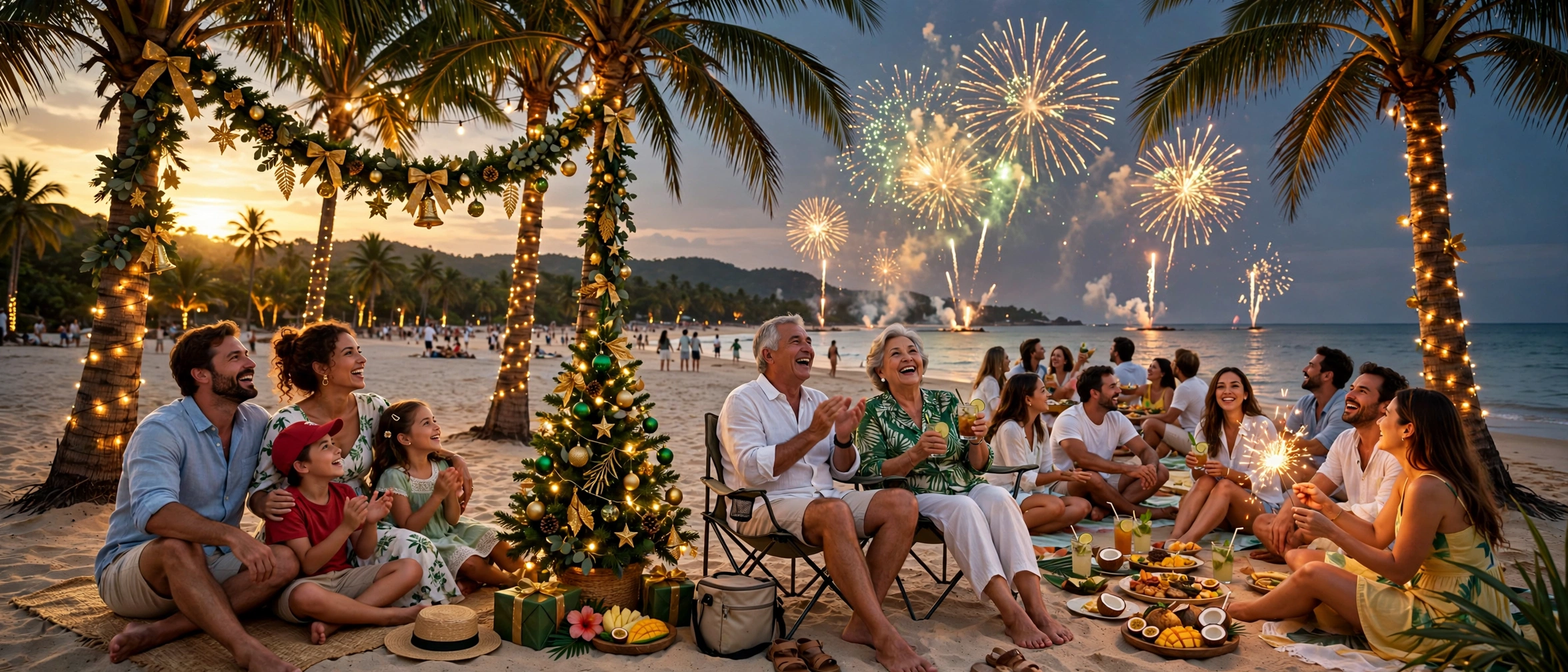
Summer weather pushes Brazilian Christmas outdoors. In coastal cities, it’s common for families to head to the beach on Christmas Day — a picnic on the sand, a swim, and Christmas lunch with an ocean view. Fireworks light up the sky at midnight on Christmas Eve in many cities, a preview of the even bigger Réveillon displays a week later.
Public Christmas celebrations are major events. Gramado, a mountain town in Rio Grande do Sul with strong German heritage, hosts Natal Luz (Christmas of Lights) — one of the world’s largest Christmas festivals, running from late October/early November through mid-January with parades, concerts, theatrical shows, and millions of lights. It’s a bucket-list destination that shows how seriously Brazil takes the season. For more on spectacular holiday destinations, see our best places to spend Christmas.
In the Amazon, the city of Belém hosts the Círio de Nazaré-adjacent Christmas festivities with river processions, while northeastern cities like Recife and Fortaleza blend Christmas with forró music and outdoor concerts. Each region stamps the holiday with its own culture.
The Music of Brazilian Christmas
Brazilian Christmas has its own soundtrack. Traditional carols like “Noite Feliz” (Silent Night) and “Então é Natal” — the Portuguese version of John Lennon’s “Happy Xmas (War Is Over),” popularized by Simone — are inescapable in December. Churches and community groups organize cantatas de Natal (Christmas cantatas), and TV networks air Christmas specials that are national events.
In Afro-Brazilian communities, Christmas music blends with samba, maracatu, and congada rhythms — particularly in the Folia de Reis (Feast of Kings) celebrations that extend the Christmas season into early January. These traveling folk groups, dressed in colorful costumes, go door to door singing and playing in honor of the Three Kings, a tradition with deep roots in colonial Brazil.
Regional Christmas Traditions Across Brazil
Brazil’s size means Christmas varies enormously by region. In the South (Rio Grande do Sul, Santa Catarina), German and Italian immigrant heritage shows in Christmas markets, Weihnachten-style celebrations, and cooler-weather customs — Gramado’s Natal Luz is the crown jewel. In the Northeast, Christmas is pure summer: beach parties, forró, and outdoor nativity plays (pastoris). In Minas Gerais, the baroque colonial towns of Ouro Preto and Diamantina host candlelit Christmas concerts in 18th-century churches that feel frozen in time.
In São Paulo, Latin America’s largest city, Christmas means spectacular shopping-mall displays, the famous Ibirapuera Christmas tree, and Avenida Paulista’s light show. In Rio de Janeiro, the floating Christmas tree of Lagoa Rodrigo de Freitas — one of the world’s tallest floating trees — draws crowds to the lagoon through December. In the Amazon, riverside communities celebrate with boat processions and festivals honoring both the Nativity and local traditions.
How to Celebrate a Brazilian-Style Christmas at Home
Want to bring the spirit of Christmas traditions in Brazil to your own home? Here’s a practical checklist:
1. Host the ceia at midnight. Serve the big meal late on Christmas Eve — roast turkey or chicken, farofa (toasted cassava flour with bacon and eggs), rice with raisins, salpicão salad, and tropical fruit. Don’t skip the rabanada for dessert.
2. Make panetone the centerpiece. Buy or bake a panetone (or chocotone) and serve it with coffee after midnight — it’s the taste of Brazilian Christmas.
3. Set up a presépio. Build a nativity scene as your main decoration, with the Christmas tree as backup. Add twinkling pisca-pisca lights everywhere.
4. Play amigo secreto. Organize a Secret Santa gift exchange with the guessing game before the reveal.
5. Toast at midnight. Raise sparkling wine at midnight on Christmas Eve, exchange hugs and “Feliz Natal!” wishes, then open gifts. For beautiful message ideas, see our 100 Christmas wishes and messages.
6. Take it outside. If your climate allows, move the party to the patio, the beach, or the backyard — Brazilian Christmas is an outdoor holiday.
7. Play the music. Queue up “Então é Natal,” “Noite Feliz,” and some bossa nova Christmas tunes.
Brazil’s southern neighbor celebrates the season with its own summer flair — discover Christmas traditions in Argentina for a fascinating comparison.
Christmas Shopping Season and the 13th Salary
Christmas traditions in Brazil have a powerful economic engine: the 13th salary (décimo terceiro salário) — a mandatory extra month’s pay Brazilian workers receive in December. This annual bonus transforms December into Brazil’s biggest shopping month, funding gifts, feasts, travel, and the famous amigo secreto exchanges.
Brazilian retail goes all-out: shopping malls unveil elaborate Christmas decorations in November, stores extend hours, and Black Friday (adopted enthusiastically in recent years) kicks off the season. Street markets sell everything from presépio figurines to fireworks. Gift-giving is generous — Brazilians prioritize family gifts, and children can expect multiple presents from parents, grandparents, godparents (padrinhos), and uncles.
The godparent relationship (padrinho/madrinha) deserves special mention: godparents play a central role in Brazilian family life, and Christmas gifts from godparents are a cherished expectation for children. The bond is celebrated at Christmas with visits, gifts, and blessings — one of the warmest threads in Brazil’s festive fabric.
From Natal to Réveillon: Christmas Flows into New Year’s
In Brazil, Christmas and New Year’s Eve form one continuous celebration. Just six days after the ceia de Natal comes Réveillon — Brazil’s legendary New Year’s Eve, when millions dress in white (for peace), gather on beaches, and watch some of the world’s most spectacular fireworks. Rio’s Copacabana Réveillon draws over two million people; Salvador, Fortaleza, and Florianópolis host their own massive beach parties.
The white-clothing tradition, the jumping of seven waves at midnight (making a wish with each), and offerings to Iemanjá (the Afro-Brazilian queen of the sea) on February 2’s doorstep — these year-end rituals are inseparable from the Christmas season in the Brazilian imagination. December 25 to January 1 is one long holiday: many businesses run on skeleton crews, families travel to the coast, and the whole country exhales. Christmas is the family heart of the season; Réveillon is its ecstatic public soul.
After New Year comes Folia de Reis (January 6, Epiphany) — the Feast of Kings — when traveling folk groups in colorful costumes sing door to door, closing the Christmas cycle. In many towns, the presépio stays up until Dia de Reis, and the season officially ends only then.
In Pictures: Christmas in Brazil
Brazil's Natal is a summer festival — a midnight feast, Papai Noel in the heat and one of the world's longest-running Christmas events.
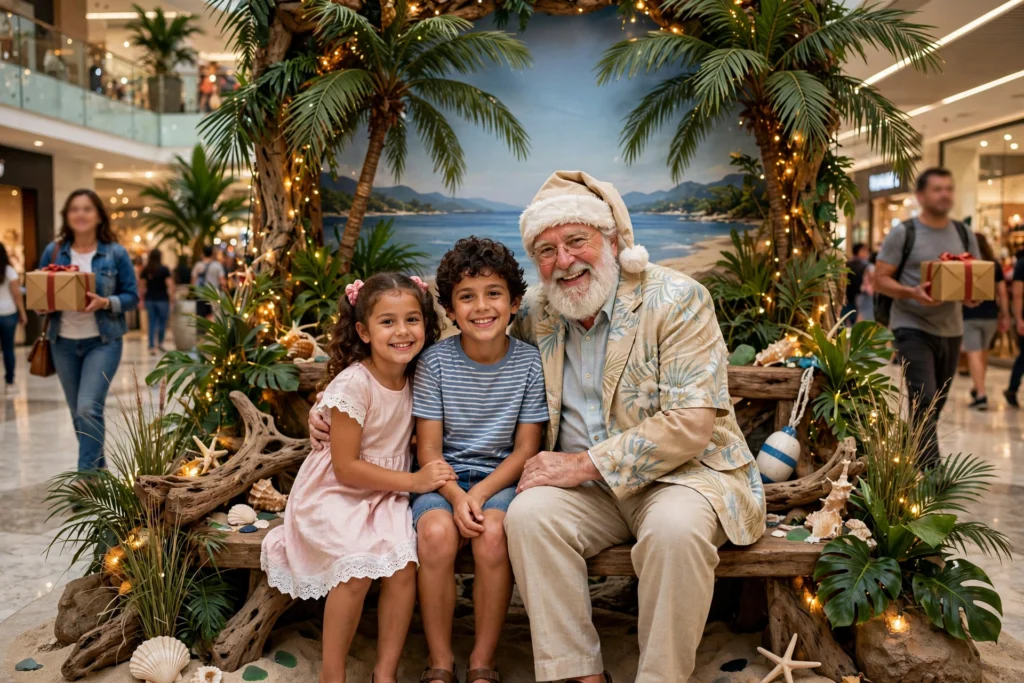
A Papai Noel grotto in a São Paulo shopping mall: Santa in a lighter tropical suit with children, palm-tree décor and panetone boxes all around.
Watch: Christmas in Brazil
A Brazilian creator documents Christmas back home — the festive food, family gatherings and a tropical summer Christmas.
At a Glance: Christmas in Brazil
Brazil's Christmas and New Year calendar, from the ceia to Réveillon.
| Tradition | Date | Key detail |
|---|---|---|
| Ceia de Natal | Night of 24 December, past midnight | The centerpiece feast: roast turkey or chester, farofa, rice with raisins and salpicão |
| Missa do Galo | Night of 24 December | 'Rooster's Mass' — the midnight mass, named for the legend that a rooster crowed at Christ's birth |
| Papai Noel | Gifts opened at midnight, 24 December | Brazil's Santa; adults typically exchange gifts via amigo secreto (Secret Santa) |
| Natal Luz, Gramado | Late October/early November to mid-January | Began in 1986 as a small concert; now Brazil's largest Christmas event with around 1.5 million visitors a year |
| 13th salary (décimo terceiro) | November/December | A mandatory extra month's pay, paid in instalments — the engine of December shopping |
| Réveillon | 31 December | White clothing for peace, massive beach fireworks (Copacabana draws millions) and jumping seven waves |
| Floating Christmas tree | December | Rio's Lagoa Rodrigo de Freitas hosts one of the world's tallest floating Christmas trees |
| Rabanada | Christmas season | Brazilian French toast rolled in cinnamon sugar — the quintessential Christmas sweet |
Frequently Asked Questions
How do Brazilians celebrate Christmas?
Brazilians celebrate Christmas primarily on Christmas Eve (December 24) with the ceia de Natal — a late-night family feast featuring roast turkey or chester, farofa, rice, salads, and desserts like rabanada and panetone. Many attend Missa do Galo (midnight mass), exchange gifts at midnight with “Feliz Natal!” wishes, and set off fireworks. Christmas Day (December 25) is for relaxing, beach trips, and leftovers. The season flows into Réveillon (New Year’s Eve) beach parties a week later.
Is it summer during Christmas in Brazil?
Yes — Christmas in Brazil falls in summer. December temperatures typically range from 25–35°C (77–95°F) across most of the country, with the south being slightly milder. This shapes everything: outdoor celebrations, beach Christmases, lighter festive food, and Santa (Papai Noel) imagery adapted to tropical settings. It’s one of the world’s great summer Christmases, alongside Argentina and South Africa.
What do Brazilians eat for Christmas dinner?
The ceia de Natal centers on roast turkey (peru) or chester (a large Brazilian chicken breed), served with farofa (toasted cassava flour with bacon, sausage, and eggs), rice with raisins, salpicão (shredded chicken salad), roasted pork, and tropical fruit salads. Desserts include rabanada (Brazilian French toast with cinnamon sugar), panetone or chocotone, pavê, and pudim de leite. Sparkling wine and champagne flow for the midnight toast.
Who brings gifts at Christmas in Brazil?
Papai Noel (Father Christmas) brings gifts to Brazilian children, delivering them on Christmas Eve night — gifts are traditionally opened at midnight after the Christmas Eve dinner. Adults exchange gifts through amigo secreto (Secret Santa) drawings among friends, coworkers, and family. Godparents (padrinhos) give particularly important gifts to their godchildren.
What is Natal Luz in Gramado?
Natal Luz (Christmas of Lights) in Gramado, Rio Grande do Sul, is one of the world’s largest Christmas festivals, typically running from late October/early November through mid-January (check official dates for 2026). The German-heritage mountain town stages parades, concerts, theatrical spectaculars, and millions of lights, drawing millions of visitors. It’s Brazil’s premier Christmas destination and a bucket-list event for holiday lovers.
How do you say Merry Christmas in Brazil?
“Feliz Natal!” — pronounced roughly “feh-LEEZ nah-TAL.” You’ll hear it everywhere from mid-December: in stores, on TV, at the midnight toast, and in messages. The common New Year greeting is “Feliz Ano Novo!” For message inspiration in any language, see our 100 Christmas wishes and greetings.
Brazilian Christmas Crafts and DIY Decorations
Brazilian Christmas décor is gloriously handmade, and crafting is part of the season’s joy. The presépio is the great DIY project: families build nativity scenes from clay, wood, papier-mâché, or even recycled materials, adding miniature houses, palm trees, and tiny lights. In the Northeast, barro (clay) figurines painted in bright colors are a beloved folk art — making or buying them supports local artisans.
Other beloved crafts: paper lanterns and origami stars for the tree, popcorn-and-cranberry garlands with a tropical twist (try dried orange slices and cinnamon sticks), and hand-painted baubles with Brazilian motifs — parrots, palm trees, Christ the Redeemer. Children make Papai Noel figures from paper plates and cotton balls in school, and Advent calendars filled with brigadeiros (chocolate truffles) count down December deliciously.
For the table: hand-embroidered table runners with Christmas motifs, banana-leaf place settings for an outdoor ceia, and candle centerpieces with tropical flowers. The Brazilian aesthetic is abundant and joyful — more is more, and handmade beats store-bought every time.
Christmas in Brazil for Kids: Traditions Children Love
Brazilian children experience a Christmas full of magic. The season starts with writing letters to Papai Noel — shopping malls set up special mailboxes, and some “reply” with printed letters. School Christmas plays (autos de Natal) and nativity pageants run through December, with children dressing as angels, shepherds, and the Holy Family.
On Christmas Eve, the excitement peaks: the ceia de Natal with the whole extended family, the midnight countdown with sparkling cider for the kids, fireworks lighting up the sky, and then — presents! Brazilian kids also love amigo secreto among cousins, Christmas stockings (meias de Natal) hung by the tree, and beach days on December 25 with new toys.
The Folia de Reis (January 6) brings costumed folk groups to neighborhoods — children follow the parades, mesmerized by the music and colors. And throughout the season, Christmas TV specials, panetone for breakfast, and the general electricity of Brazilian December make it the most wonderful time of the year for kids. For family activity ideas that work in any climate, see our 75 Christmas activities for families.
Brazilian Christmas Drinks: From Quentão to Champagne
No guide to Christmas traditions in Brazil is complete without the drinks. Champagne and sparkling wine (espumante) rule the midnight toast — Brazil produces excellent sparkling wines in the Serra Gaúcha. Caipirinhas flow at casual gatherings, and vinho quente (mulled wine with spices and fruit) warms cooler southern evenings.
Traditional festive drinks include quentão — a hot, spiced cachaça punch with ginger, cinnamon, and citrus peel, served at junina-style winter festivals and Christmas gatherings in the south — and rabo de galo cocktails. For kids: guaraná soda, fresh coconut water, and tropical fruit juices (mango, passion fruit, cashew fruit). Coffee — strong, sweet Brazilian cafezinho — accompanies panetone and rabanada through the season. The Brazilian Christmas toast is generous, frequent, and always shared: Saúde!