In Catalonia, in northeastern Spain, children spend December lovingly feeding a hollow log — leaving it orange peels, bits of bread, and sweets each night — and then, on Christmas Eve, they beat it with sticks while singing a song that commands it to defecate presents. This is the Caga Tió Catalonia Christmas log tradition: the “pooping log” (caga tió literally means “poop, log!”), one of the strangest, funniest, and most beloved Christmas customs in Europe.
To outsiders, it sounds like a prank. To Catalans, it’s sacred childhood magic — as essential to December as the tree or the nativity. The Tió, a smiling log wearing a traditional Catalan barretina cap and tucked under a blanket, “eats” all month and then, when properly beaten and serenaded, produces a bounty of candies, nuts, and small gifts from beneath its blanket. It’s scatological, it’s heartwarming, and it’s completely serious to the millions of children who believe in it.
This family guide explains everything about the Caga Tió Catalonia Christmas log: what it is, where it came from, exactly how families celebrate it step by step (including the famous song), how it coexists with Santa Claus, and how you can bring the tradition into your own home — no matter where in the world you live. You’ll also see how it fits alongside Catalonia’s wider Spanish Christmas dinner traditions and the January Three Kings celebrations.
What Is the Caga Tió?
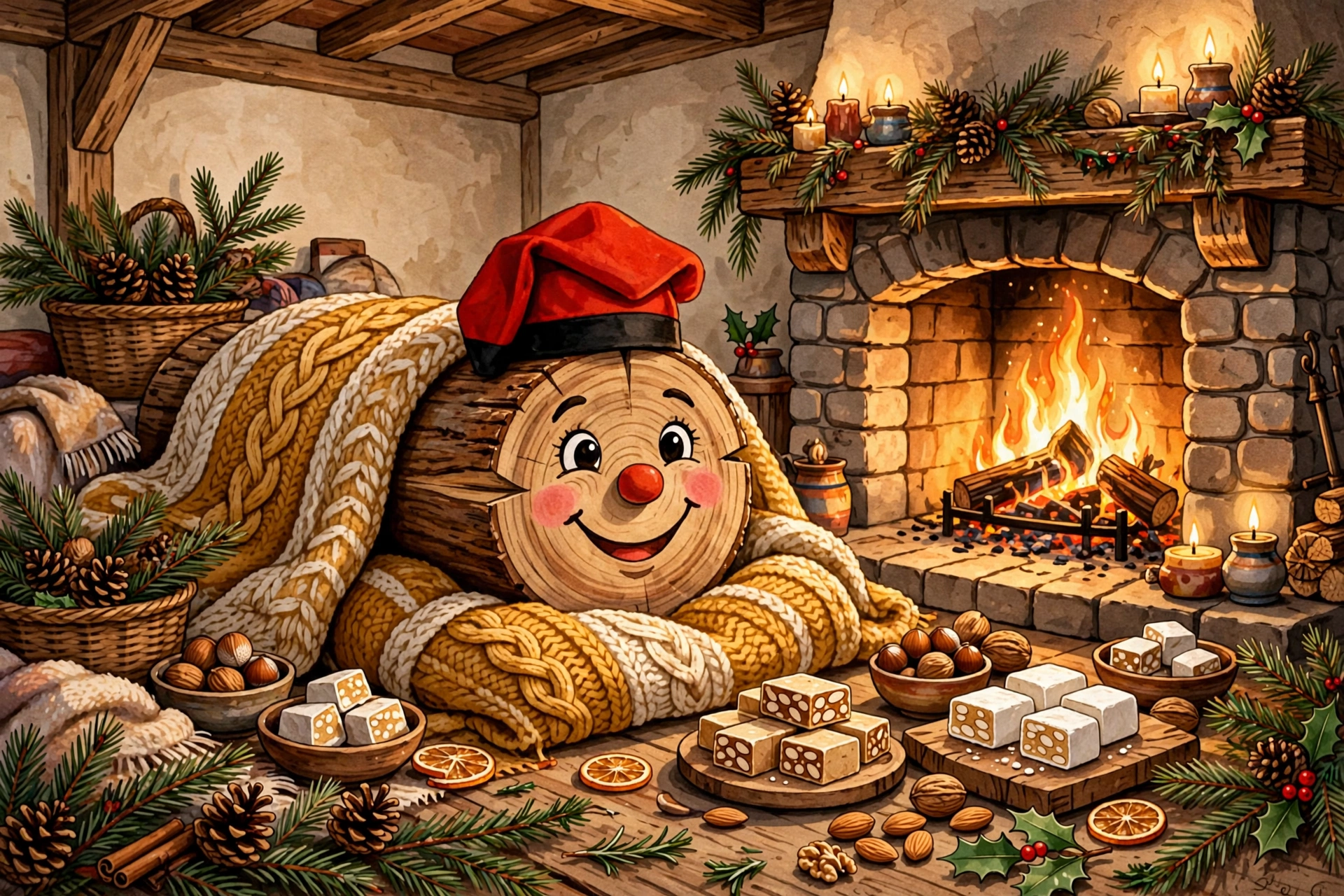
The Caga Tió — also called the Tió de Nadal (“Christmas log”) in more polite company — is a short, hollow log, typically 30 to 50 centimeters long, with a cheerful painted face on one end, two stick legs at the front, and a red barretina (the traditional Catalan wool cap) perched on top. From early December until Christmas, it lives in the family home, usually in a corner of the living room, covered with a blanket to “keep it warm.”
The premise, as explained to children, is simple: the Tió is hungry, and if you feed it well — leaving it bits of food each night — it will grow fat and happy. Then, on Christmas Eve (in most families; some do it on Christmas Day), the children gather around, sing the traditional song commanding it to poop, and beat it gently with sticks. An adult discreetly slips treats under the blanket, and when the blanket is lifted — miracle of miracles — the Tió has “cagado” (pooped) a pile of turrón (nougat), candies, dried figs, nuts, and small toys.
The ritual repeats in rounds: sing, beat, lift the blanket, collect the treats, cover it again. Each round produces a little more, until finally the Tió produces its traditional last gift — an onion, a head of garlic, or a salted herring — signaling that it is well and truly empty. The children laugh, the treats are shared, and Christmas has officially begun.
For Catalan families, the Tió is not a joke at Santa’s expense but a parallel magic. Children can believe in both wholeheartedly, and most do. The log’s earthy, homemade charm — it’s literally a piece of firewood with a face — gives it a warmth that no department-store Santa can match.
The Origins of Catalonia’s Pooping Log
The Caga Tió Catalonia Christmas log is far older than it looks. Its roots lie in the rural Catalan winter traditions of centuries past, when the log was not a children’s toy but a symbol of nature’s generosity. In the old agrarian calendar, the Yule log represented the dormant fertility of winter: families would keep a log in the hearth, and its “gifts” — originally, in some accounts, sweets and dried fruits — symbolized the abundance that nature would return in spring.
Ethnographers trace the “pooping” element to ancient associations between excrement and fertilization. In a farming society, manure was precious — the thing that made fields fertile. A log that “poops” treats is, symbolically, a log that fertilizes the household with abundance. The beating, too, has old roots: striking the log was a way of “waking” its dormant life force, similar to rituals found in winter traditions across Europe. What children experience as hilarious nonsense is, anthropologically speaking, a fertility rite in party clothes.
The tradition as families know it today — the face, the barretina, the blanket, the song — crystallized in the 19th and early 20th centuries, as Catalonia’s rural customs were romanticized and standardized during the region’s cultural renaissance (Renaixença). Under Franco’s dictatorship, when Catalan language and culture were suppressed, the Caga Tió became a quiet act of cultural resistance: a distinctively Catalan custom, celebrated in Catalan, in Catalan homes. That history gives the log a political resonance it still carries — the Tió is not just cute, it’s Catalan.
Similar log traditions exist in neighboring regions — Aragón has its own version — but the Caga Tió in its classic form is unmistakably and proudly Catalan, now celebrated well beyond Catalonia’s borders as one of Spain’s most famous regional Christmas customs.
How to Celebrate Caga Tió: Step by Step
Want to do it properly? Here’s the full ritual, as practiced in Catalan homes:
Step 1: Adopt Your Tió (Early December)
The Tió arrives in early December — traditionally around the Feast of the Immaculate Conception on December 8, though many families bring it home with the Christmas decorations. If you’re buying one, choose a log with a friendly face and a proper barretina; if you’re making one, any stout log (hollowed slightly at the back to hold treats) works, with a painted or paper face, stick legs, and a small red cap. Place it in a visible spot and cover it with a blanket “so it doesn’t get cold.”
Step 2: Feed It Every Night (December 8–24)
This is the children’s daily job and the heart of the tradition’s charm. Each evening, the kids leave the Tió little offerings: orange peels, bits of bread, nuts, pieces of turrón, a saucer of water. Parents play along solemnly, noting in the morning that the Tió “ate everything” (the evidence discreetly disposed of). Some families keep a little ritual dialogue — “Has the Tió eaten? Is it getting fat?” — building anticipation night by night. The feeding teaches care, routine, and delayed gratification, wrapped in silliness.
Step 3: The Beating Ceremony (Christmas Eve or Christmas Day)
On the big night — Christmas Eve (Nit de Nadal) in most families, Christmas Day in some — everyone gathers around the Tió. The children take up sticks (light ones! this is theater, not violence) and, on cue, begin to beat the log’s back while singing the song. An adult, positioned behind the log under cover of the blanket and the general chaos, slips the first round of treats underneath.
Step 4: Sing the Song
The beating is done to the traditional cançó del caga tió, sung in Catalan, getting louder and more enthusiastic with each verse. (Full lyrics and translation below.) Between verses, the blanket is lifted to reveal what the Tió has produced; the children shriek, collect the candy, and the blanket goes back on for another round. Typically there are three or four rounds, with the hauls getting smaller each time.
Step 5: The Grand Finale
The last round is the punchline every Catalan child knows is coming but pretends to dread: under the blanket appears an onion, a head of garlic, or a salt herring — the Tió’s way of announcing it is completely, definitively empty. (In some families, it’s a piece of coal or a potato.) Everyone laughs, the Tió is thanked and put away until next year (or, in the old rural version, burned in the fireplace), and the family moves on to Christmas dinner. Tradition complete.
The Caga Tió Song: Lyrics and Meaning
The song is the soul of the ritual, and Catalan children learn it before they can read. The most common version goes:
Caga tió,
caga torró,
avellanes i mató,
si no cagues bé
et daré un cop de bastó.
Caga tió!
In English, roughly: “Poop, log / poop nougat, / hazelnuts and fresh cheese, / if you don’t poop well / I’ll hit you with a stick. / Poop, log!” There are many regional variants — some demand neules (rolled wafers) and dried figs, some threaten more colorfully — but the structure is constant: a shopping list of treats, a mock threat, and the imperative refrain.
What the song really is, beneath the scatology, is a children’s incantation — in the same family as the rhymes kids chant to make rain stop or to decide who’s “it.” Its power comes from repetition, rhythm, and the delicious transgression of shouting about poop at the top of your lungs with full parental approval. Linguists note that for many Catalan children, the song is among their earliest sustained experiences of the Catalan language as a living, joyful thing — which is no small part of why the tradition survived repression.
Non-Catalan families adopting the tradition often sing a translated version, but purists insist the magic is in the original. The good news: the tune is simple, the words are short, and children master it in minutes. Phonetic guides abound, and butchering the pronunciation is considered part of the fun.
Caga Tió vs. Santa Claus: How They Coexist
Visitors often ask: doesn’t the pooping log compete with Santa Claus? In Catalonia, the answer is a serene no — because the gift-giving calendar has room for everyone. The Caga Tió handles small treats on Christmas Eve or Christmas Day. The Patge pages and, increasingly, Santa Claus (Pare Noel) may contribute on the 25th. But the main gift-giving event in Catalonia, as in all of Spain, is the Three Kings’ Day on January 6, when the Reis Mags (Melchior, Gaspar, and Baltasar) deliver the big presents.
This layered system means Catalan children enjoy one of the longest gift seasons in the world: Tió treats on the 24th, possible Santa gifts on the 25th, and the Kings’ grand delivery on January 6th. Rather than competing, the traditions stack — each with its own magic, its own night, its own story. The Tió’s gifts are understood to be small and sweet; no child expects a bicycle from a log.
The coexistence also reflects Catalonia’s cultural position: simultaneously Catalan, Spanish, and global. The Tió is the intimate, local, family magic; the Kings are the grand, national, traditional magic; Santa is the imported, commercial, global magic. A Catalan Christmas holds all three without contradiction — a pretty good metaphor for the culture itself.
Caga Tió Myth vs. Fact
Like any famous tradition, the Caga Tió Catalonia Christmas log has accumulated myths. Let’s sort them:
Myth: It’s an ancient pagan poop ritual. Fact-ish: The roots are genuinely old — the Yule log and its fertility symbolism predate Christianity — but the cute faced log with the barretina is a 19th/20th-century formulation. It’s old, but not that old in its current form.
Myth: All of Spain does this. Fact: It’s specifically Catalan (with cousins in Aragón). Most Spaniards outside Catalonia know of it the way Americans know of regional customs elsewhere — with affectionate bewilderment. Ask an Andalusian about the Caga Tió and you’ll get a laugh and a story.
Myth: The beating is violent. Fact: It’s pure theater — light taps with small sticks, accompanied by singing and laughter. The “threat” in the song is as serious as the threats in “London Bridge.” No logs are harmed.
Myth: It’s dying out. Fact: Quite the opposite. The Tió has never been more popular: mass-produced Tiós sell in department stores, designer versions appear in boutiques, and the tradition has spread beyond Catalonia as Spain’s most exportable Christmas quirk. If anything, globalization gave the log a second life.
Myth: Kids are traumatized when they learn the truth. Fact: Catalan adults report the revelation ranking somewhere between “mildly funny” and “fond memory.” Because the Tió’s magic is so openly, joyfully absurd — a pooping log! — most children transition to co-conspirator status with pride rather than disillusionment, graduating to hiding the treats for younger siblings.
Where to Find Your Own Tió
In Catalonia, Tiós are everywhere in December: Christmas markets (Barcelona’s famous Fira de Santa Llúcia outside the cathedral sells them by the hundred), department stores, toy shops, and supermarkets. Prices range from a few euros for a basic log to artisanal versions costing considerably more. The Fira de Santa Llúcia, running from late November to Christmas Eve, is the classic place to choose one in person.
Outside Spain, options are growing. Online retailers — including major marketplaces — ship Tiós internationally, and the tradition’s internet fame means craft sellers offer handmade versions year-round. But honestly, the best Tió is a homemade one: find a stout log, paint a face, add stick legs and a red cap (a baby sock works in a pinch), and drape it with a blanket. The tradition’s DIY spirit is the point — the original Tiós were literally firewood.
For families adopting the custom abroad, a few tips: start the feeding ritual on December 8 to build anticipation; keep the treats small and traditional (nuts, dried fruit, chocolate coins, turrón if you can find it); learn the song in Catalan for authenticity points; and end with the onion for the full comedic effect. Pair it with Christmas decorations that nod to its rustic origins — natural materials, simple crafts — and you’ve got a celebration no one will forget.
Caga Tió in Catalan Culture: More Than a Log
To understand the Caga Tió Catalonia Christmas log fully, you have to understand what it means to be Catalan. Catalonia is a region with its own language, its own institutions, and a powerful sense of distinct identity within Spain — and the Tió has become one of its most potent cultural symbols precisely because it is untranslatable, unexportable in spirit, and celebrated in Catalan.
During the Franco dictatorship (1939–1975), public use of the Catalan language was suppressed, and regional traditions were discouraged. Families kept the Tió alive in private — in kitchens and living rooms, in whispered Catalan — and the log absorbed a political charge it never asked for. When democracy returned and Catalan culture flowered again, the Caga Tió emerged as a beloved emblem of survival: proof that you can ban a language from the schools, but you can’t stop children from singing about a pooping log at Christmas.
Today the Tió is everywhere in Catalan public life. Schools organize Tió ceremonies; towns hold communal cagatiós; Barcelona’s Christmas markets sell designer Tiós alongside traditional ones; Catalan television runs Tió-themed programming; and the log appears in advertising, political cartoons, and contemporary art. Major Catalan cultural figures have claimed it, chefs have made Tió-shaped desserts, and each December a new crop of novelty Tiós — football-club Tiós, celebrity Tiós — hits the shops.
For Catalan children growing up outside Catalonia — in the diaspora, or in mixed-language households — the Tió often becomes the anchor of their Catalan identity: the thing that makes Christmas theirs in a way no generic Santa can. Linguists note that the song is frequently a child’s longest memorized text in Catalan, learned with more enthusiasm than any classroom exercise could inspire. A pooping log, it turns out, is a formidable language teacher.
The Tió also embodies a particular Catalan sensibility: earthy, irreverent, and democratic. Where other Christmas figures are majestic (kings), moral (Santa’s naughty-or-nice), or divine (the Christ child), the Tió is gloriously low — a piece of firewood that eats scraps and poops candy. There’s no hierarchy to it, no judgment, no grandeur. It’s the people’s Christmas magic, and Catalans love it all the more for being unimpressive. In a culture that prizes seny (common sense) alongside its romanticism, the Tió is common sense made festive: feed something all month, and at Christmas it gives back.
In Pictures: Caga Tió, Catalonia's Christmas Log
In Catalonia, Christmas presents come from a smiling log: children feed the Caga Tió all December, then sing and beat it with sticks until it “poops” out candies and treats.
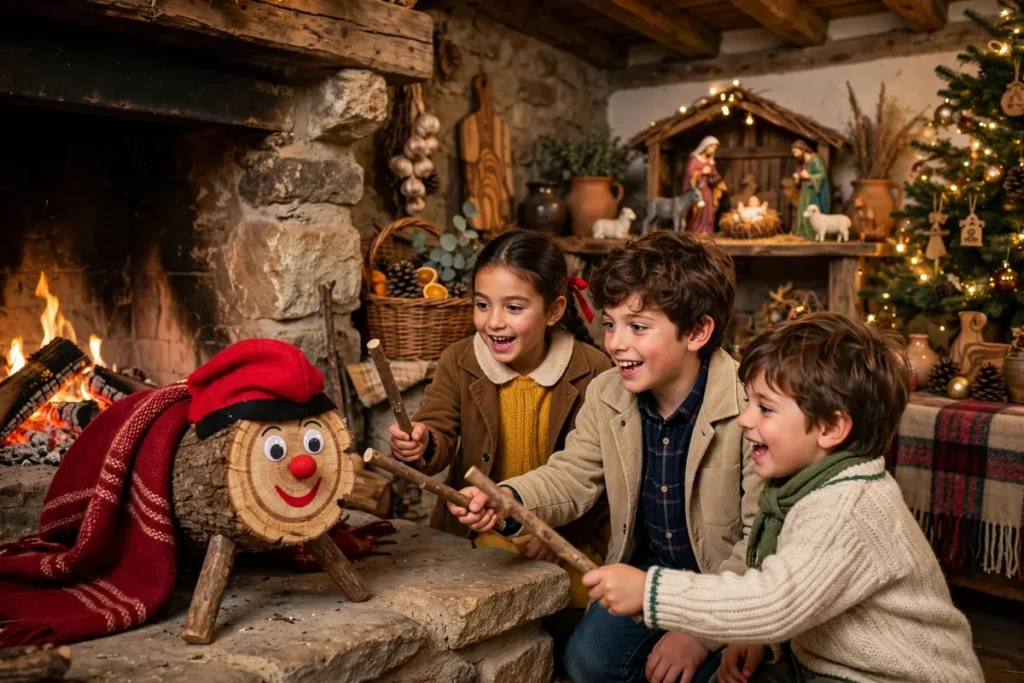
The Caga Tió in a Catalan farmhouse: a painted log with a red barretina hat under its blanket, children with sticks gathered around for the big night.
Watch: Caga Tió, Catalonia's Christmas Log
A Catalan family's own Caga Tió celebration — feeding, singing, and the moment the tió de Nadal delivers its presents.
At a Glance: Caga Tió, Catalonia's Christmas Log
The feeding, the beating, and the presents of the tió de Nadal.
| Element | What it is | Key detail |
|---|---|---|
| Tió de Nadal | The log | A hollow log standing on two short legs, with a painted smiling face and a red barretina hat |
| 8 December | Feeding starts | Children begin feeding the log orange peels, dry bread, and leftovers on the Feast of the Immaculate Conception |
| The blanket | The care | The log is kept covered with a blanket through December — so it doesn't catch cold |
| The song | The ritual | On Christmas Day, children beat the log with sticks while singing the traditional “Caga tió” song |
| The payoff | The presents | The log “poops” candies, nuts, turrón, and small toys, which families share |
| The salt herring | The finale | When the presents run out, the tió leaves a salt herring, a piece of garlic, or an onion |
| Old times | The history | In older times the Caga Tió was just a dead piece of wood — the face and hat are recent additions |
Frequently Asked Questions
What does “caga tió” mean?
It’s Catalan for “poop, log!” — caga is the imperative of cagar (to poop), and tió means log or stump. The more polite name is Tió de Nadal (Christmas log). Catalan speakers use both; children, naturally, prefer the rude one.
When do families do the Caga Tió ceremony?
Most families perform the beating-and-singing ceremony on Christmas Eve (Nit de Nadal), December 24, typically before or after dinner. Some families do it on Christmas Day instead. The feeding ritual runs through December, traditionally starting around December 8.
What treats does the Tió “poop”?
Traditional hauls include turrón (Spanish nougat), dried figs, hazelnuts and almonds, neules (thin rolled wafers), candies, chocolate coins, and small toys. The final round traditionally produces an onion, garlic head, or salt herring to signal the log is empty.
Is the Caga Tió only in Catalonia?
Essentially, yes — it’s a Catalan tradition, with closely related log customs in parts of Aragón. It’s famous throughout Spain and increasingly known internationally, but as a living household tradition it belongs to Catalonia, where it’s celebrated in the Catalan language as an expression of regional identity.
How does Caga Tió fit with the Three Kings?
They handle different nights: the Tió delivers small treats on Christmas Eve/Day, while the Three Kings (Reis Mags) bring the main gifts on the night of January 5–6. Many families also incorporate Santa Claus on December 25. Catalan children simply enjoy an extended gift season.
Can non-Catalan families adopt this tradition?
Absolutely — Catalans are generally delighted to share it. Make or buy a log, feed it through December, learn the song (even in rough Catalan), and perform the ceremony on Christmas Eve. It’s one of the most adoptable Christmas traditions in the world: low cost, high joy, unforgettable for kids.
The Bottom Line
The Caga Tió Catalonia Christmas log is proof that the best Christmas traditions are the ones that make children laugh until they cry — and then, years later, make adults tear up remembering. It’s earthy where other traditions are ethereal, homemade where others are commercial, and defiantly, joyfully Catalan. Whether you’re in Barcelona choosing a log at the Fira de Santa Llúcia or in Ohio painting a face on firewood, the magic works the same: feed it, sing to it, beat it gently, and let it poop its little heart out. Bona nit de Nadal!