Bhai Dooj 2026: Tilak Ceremony, Rituals, and Gift Ideas for Brothers
The five-day Diwali festival ends the way the best things do — with family. Bhai Dooj, falling on Wednesday, November 11, 2026, is the day sisters pray for their brothers’ long life and brothers pledge their protection in return. If Raksha Bandhan is the festival where the brother ties the promise, Bhai Dooj is the one where the sister leads the ritual: she prepares the thali, applies the tilak, performs the aarti, and feeds her brother with her own hands.
This complete guide covers Bhai Dooj 2026 end to end: the date and its legends, the tilak ceremony step by step, what goes on the puja thali, gift ideas for brothers at every budget (and thoughtful gifts for sisters, since the exchange runs both ways), how to celebrate when siblings live in different cities or countries, feast menu ideas, and the mistakes to avoid. Whether your brother lives next door or twelve time zones away, this is how to make the day count.

What Is Bhai Dooj? Date and Meaning
Bhai Dooj (also called Bhau Beej in Maharashtra, Bhai Tika in Nepal, and Yam Dvitiya in parts of North India) is celebrated on the Dwitiya tithi — the second day of the bright fortnight of Kartik — the fifth and final day of Diwali. In 2026, that is Wednesday, November 11.
The name is literal: bhai (brother) + dooj (the second day). The day’s essence is the sibling bond formalized as ritual — the sister as the protector through prayer, the brother as the protector through pledge. In an era when siblings often live continents apart, Bhai Dooj has become one of the year’s most emotionally loaded reunions: the festival’s closing chord, played in the key of family.
The legend of Yama and Yamuna
The best-known origin story belongs to Yama, the god of death, and his twin sister Yamuna, the river goddess. Yama visited his sister on Dwitiya; Yamuna welcomed him with a tilak on his forehead, garlanded him, performed aarti, and fed him a feast with her own hands. Overwhelmed, Yama granted her a boon — and she asked that any brother who receives his sister’s tilak and feast on this day be blessed with a long life, and any sister who performs it be blessed with prosperity. Yama agreed, and the custom was born. The story’s quiet message: even death pauses for a sister’s love.
Krishna and Subhadra
A second legend ties the day to Krishna and his sister Subhadra. After Krishna slew the demon Narakasura, Subhadra welcomed her victorious brother with aarti, tilak, flowers, and sweets — the archetypal sister’s welcome. Many families in the Braj region and Maharashtra honor this version, and it is why the day’s rituals emphasize the sister welcoming the brother as an honored guest.
The Tilak Ceremony: Step by Step
The ceremony is traditionally performed in the morning or before the afternoon meal. The brother visits the sister’s home (or the family gathers at the parents’ home), and the sister leads every step.
Preparing the puja thali
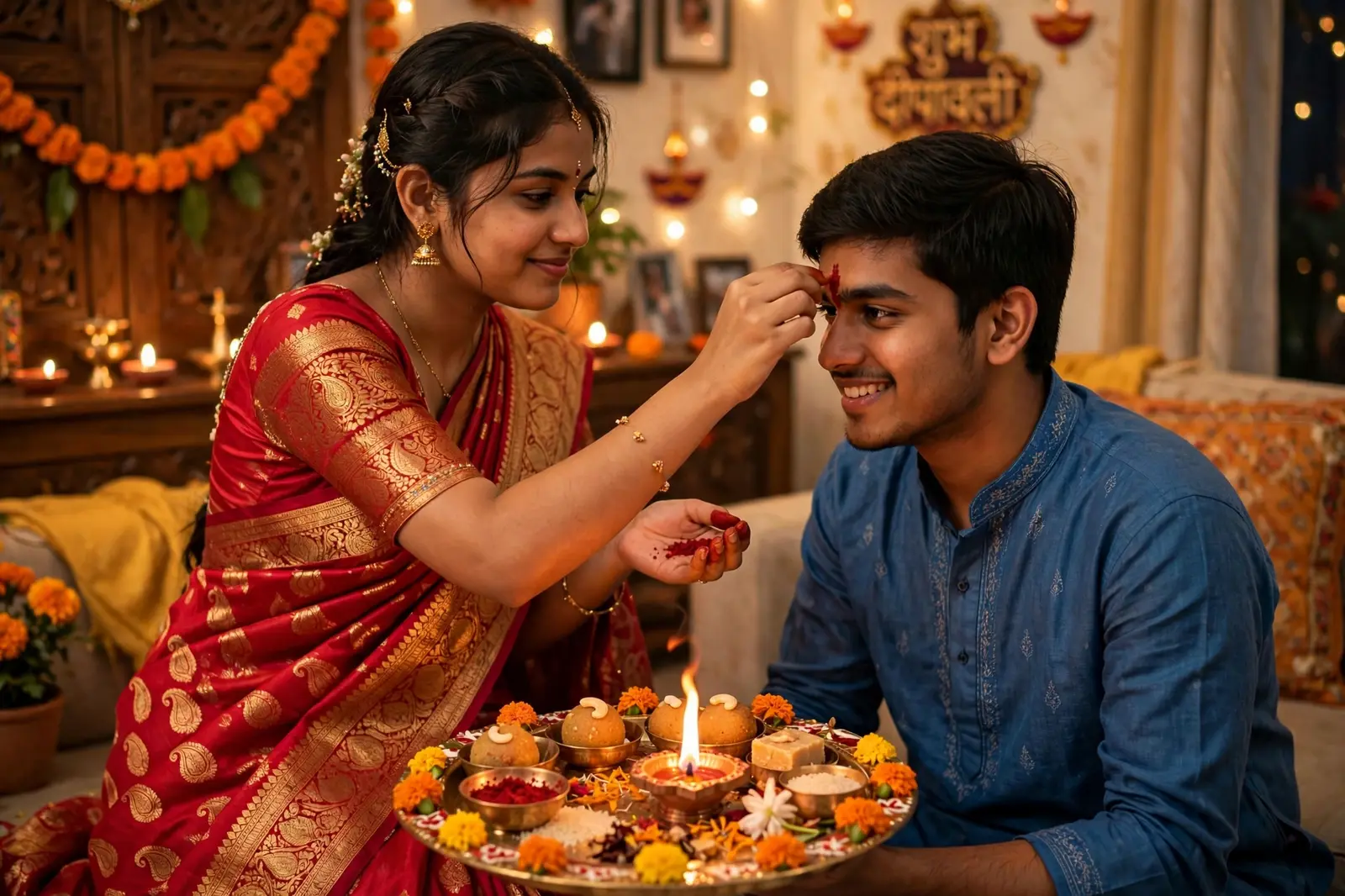
The sister prepares a decorated thali containing: roli (red kumkum powder) mixed with a little rice or water into a paste; akshata (unbroken rice grains); a ghee or oil diya; incense sticks; fresh flowers or a garland; sweets (mithai) and dry fruits; a coconut; and a small gift or envelope for the brother. The thali itself is often decorated — a rim of marigold petals, a swastika drawn in roli at the center. Many sisters also prepare a kalava (sacred red-yellow thread) to tie on the brother’s wrist.
The ceremony
- The brother is seated facing east or north, on a clean asana. The sister faces him.
- She applies the tilak: a vertical mark of roli paste on his forehead, then presses a few grains of akshata onto it. (In Maharashtra’s Bhau Beej, the sister may also apply a crescent of sandalwood; in Nepal’s Bhai Tika, a seven-color saptarangi tika.)
- She performs aarti — circling the lit diya before his face three times — while praying aloud or silently for his long life, health, and prosperity.
- She ties the kalava on his right wrist and places the garland around his neck.
- She feeds him sweets with her own hands — the first bite is hers to give — followed by dry fruits.
- The brother touches his sister’s feet (in many families) or embraces her, pledges his lifelong protection and support, and presents his gift.
- The family shares the Bhai Dooj meal together.
The prayers and the vow
There is no single fixed mantra; the sister’s prayer is traditionally personal and spoken — for her brother’s deerghayu (long life), arogya (health), and sukh-samriddhi (happiness and prosperity). The brother’s vow in return is equally personal: to stand by his sister in difficulty, to honor her, to remain present in her life. In many families, this exchange — more than the gifts — is the day’s emotional peak. Say it plainly and mean it; the ritual gives you the words, but the sincerity is yours to supply. If you need help finding the right words for a card or message, our Happy Diwali wishes and quotes collection has lines that work beautifully for siblings.

Gift Ideas for Brothers: By Budget
The Bhai Dooj gift is the brother’s answer to the sister’s prayer — it should feel considered, not perfunctory. Below are ideas organized by budget, with the perennial winners in each tier.
| Budget | Gift Ideas | Best For |
|---|---|---|
| Under $25 | Quality wallet or cardholder; gourmet chocolate box; a bestselling book in his genre; personalized photo mug or frame; premium dry-fruit box | Students, young earners — thoughtfully done, the thought genuinely counts |
| $25–$75 | Wireless earbuds; a good fragrance; leather belt or sleek backpack; board game or puzzle set; artisanal sweets hamper; fitness accessories | The sweet spot for most siblings — useful, enjoyable, memorable |
| $75–$150 | Smartwatch or fitness band; quality headphones; a weekend experience (concert, game tickets); premium grooming kit | Milestone years, the brother who “has everything” |
| $150+ | Tablet or e-reader; designer accessories; a short trip together; contribution toward something he’s saving for (bike, camera, course) | Big occasions — often better as a joint family gift |
| Priceless tier | A handwritten letter; a framed childhood photo; a playlist of “our songs”; cooking his favorite meal; a day cleared entirely for him | Every budget — pair with any tier above for maximum impact |
Personalized gifts that land
The gifts brothers remember are rarely the most expensive — they are the most specific. A custom illustration of a shared childhood memory; a watch engraved with a date only the two of you know; a “brother survival kit” box packed with inside jokes; a video montage of family clips with a voiceover. Personalization signals the one thing money cannot buy: attention. If your brother is the sentimental type, the priceless tier above will outperform anything with a price tag.
Experience gifts
For the brother who has everything, give time: tickets to a match or concert you attend together, a cooking class, a weekend road trip, a stargazing night, or simply a full day with phones off doing whatever he wants. Shared experiences become the stories siblings retell for decades — the gift keeps appreciating.
What to avoid
Skip the generic: a last-minute gift card with no note, anything obviously re-gifted, or a “funny” gift that is actually thoughtless. And match the gift to the relationship — an overly extravagant gift can create awkwardness if the sibling dynamic is modest; sincerity scales better than spending.
Gift Ideas for Sisters (From Brothers)
The exchange runs both ways, and brothers should come prepared — the sister’s gift traditionally follows her aarti and is presented with the protection pledge. Strong options: jewelry (even a simple silver piece carries the day’s symbolism); a silk scarf or handloom saree/dupatta; a spa or salon voucher; a premium skincare set; a Kindle or books by her favorite author; a donation to a cause she cares about made in her name; or — the perennial winner — an envelope with cash and a heartfelt note, which she will spend exactly as she wishes. The note matters as much as the gift: a few honest lines about what she means to you will be kept long after the gift is used up.
Celebrating Bhai Dooj Long-Distance
Millions of siblings now celebrate across cities and continents. Distance changes the logistics, not the meaning.
The video-call ceremony
Schedule a video call for the morning of November 11 (mind the time zones — India is 9.5–13.5 hours ahead of the US). The sister performs the tilak symbolically: she can apply roli to the brother’s photo on screen, or simply hold the aarti thali up and pray while he sits with folded hands on his end. It feels awkward for about thirty seconds and then feels completely right. Ship the sweets and the gift in advance so they arrive before the day — opening them together on camera is the next best thing to being there.
Gifts across borders
International shipping in early November is tight — order by late October. Digital options close the gap: e-gift cards for his favorite store, a subscription (streaming, audiobooks, gaming), an online experience (a masterclass, a virtual concert), or money transferred with a voice note. The voice note is the secret weapon — hearing your sibling’s voice saying the words beats any wrapping paper.
When you cannot connect live
Record a video message: perform the aarti on camera, say the prayer aloud, show the thali. He watches it on the day, applies his own tilak, and the ritual still lands. Siblings in the military, in hospitals, or in truly opposite time zones have kept Bhai Dooj alive this way for years.
The Bhai Dooj Feast: Menu Ideas
The day ends around a table, and the sister traditionally cooks (or orders) her brother’s favorites. A classic Bhai Dooj spread: a rich main — paneer butter masala or dal makhani, jeera rice or biryani, tandoori rotis or naan; two or three sides — aloo-gobi, raita, a fresh kachumber salad; and the sweets that close the festival — gulab jamun, rasmalai, or the Diwali mithai still in the house. For a lighter modern menu: a build-your-own chaat bar (crowd-pleasing and interactive), grilled paneer tikka skewers, and kulfi for dessert. If the siblings are celebrating with friends too, our celebration ideas with friends — parties, games, and menus — adapts beautifully to a sibling-plus-friends Bhai Dooj gathering.

Regional Variations of Bhai Dooj
Maharashtra: Bhau Beej
In Maharashtra, Bhau Beej carries special weight — brothers are formally invited to the sister’s home, and the meal is elaborate. The sister draws a special chowk (decorated square) for the brother to sit in, and the aarti includes five lamps. The day is also associated with the legend of Yamuna and Yama in its fullest telling.
Nepal: Bhai Tika
Nepal’s Bhai Tika, part of the five-day Tihar festival, features the spectacular saptarangi tika — a seven-colored tilak applied to the brother’s forehead — and the makhamali garland of globe amaranth flowers, which never fades, symbolizing long life. Sisters of all ages, including cousins, participate.
Bengal: Bhai Phonta
In West Bengal, Bhai Phonta centers on the sister applying phonta (a sandalwood-paste mark) and chanting the traditional rhyme praying for her brother’s longevity — “Bhaiyer kopale dilam phonta, Jomer duare porlo kanta” (I put the mark on my brother’s forehead; thorns fall at Yama’s door). The feast is the day’s heart.
Uttar Pradesh and Bihar: the moon
In parts of UP and Bihar, sisters traditionally break their fast only after sighting the moon on Bhai Dooj evening — adding a layer of devotion to the day’s rituals.
Tips for a Memorable Bhai Dooj 2026
Confirm the plan early: With November 11 falling on a Wednesday, coordinate leave, travel, or the video-call slot at least two weeks ahead. Mid-week festivals need deliberate planning.
Prep the thali the night before: Roli paste, akshata, diya, flowers, sweets, gift — laid out on November 10th evening so the morning is calm.
Write the note by hand: Whether it accompanies a gift or stands alone, a handwritten card outlasts every object. Say the specific thing, not the generic thing.
Include the whole family: Bhai Dooj works best as a family gathering — parents, spouses, kids, cousins. The sibling ritual is the center; the family meal is the frame.
Photograph the tilak moment: Years from now, the photo of the tilak being applied will be the one you keep. Take it before the sweets, while everyone is still composed.
Keep the budget honest: If money is tight, say so cheerfully and give time instead — a cooked meal, a day together, a long letter. Our budget celebration ideas prove that thoughtfulness and economy are natural partners.
Mistakes to Avoid
- Treating it as an afterthought: Bhai Dooj is not Diwali’s epilogue — it is the festival’s emotional finale. Give it its own morning.
- Forgetting the time zones: For long-distance siblings, a missed call window is the day’s most common heartbreak. Confirm the time in both zones, in writing.
- Skipping the prayer: The tilak without the spoken prayer is decoration. Say the words — for his long life, out loud.
- The brother arriving empty-handed: The pledge of protection is sealed with a gift. Even a small, thoughtful one. Never arrive with nothing.
- Rushing the meal: The feast is the ritual’s completion. Linger. This is the last festival table of the season — treat it that way.
Bhai Dooj 2026: Hour-by-Hour Day Plan
With November 11 falling on a Wednesday, the day needs deliberate scheduling — especially if siblings are traveling or connecting across time zones.
- Morning (8:00–9:30 AM): The sister prepares the thali (or confirms it from the night before), lays out festive clothes, and starts the feast cooking — anything slow (dal, kheer) goes on first. The brother travels or confirms arrival time.
- Late morning (10:30 AM–12:00 PM): The tilak ceremony — unhurried, phones aside except for the one taking photos. Aarti, tilak, kalava, sweets fed by hand, the pledge, the gifts.
- Lunch (12:30–2:00 PM): The Bhai Dooj feast — the week’s most personal meal. No rushing; this table is the ritual’s completion.
- Afternoon (2:00–4:00 PM): Family time — the part with no agenda. Old photos, old stories, the annual sibling argument about who was the parents’ favorite. Let it breathe.
- Evening: Pack prasad and leftovers for departing siblings. The festival’s five days close as they opened — with food pressed into hands at the door.
- For video-call celebrations: Fix the call slot in both time zones at least a week ahead (a 10 AM IST ceremony is 11:30 PM EST the previous night — plan accordingly). Ship gifts and sweets to arrive by November 10.
Messages to Write in Bhai Dooj Cards
The right words matter as much as the gift. A few lines you can copy, adapt, or use as starting points:
- The classic: “On Bhai Dooj, I pray for your long life, good health, and every happiness — and I promise, as always, to stand by you. Thank you for being my first friend and my forever protector.”
- From a sister: “They say a sister’s prayer on Bhai Dooj reaches the gods. Mine reached you years ago — you’ve been my blessing ever since. Shubh Bhai Dooj, bhaiya.”
- From a brother: “Your tilak has protected me every year of my life. This Bhai Dooj, my gift is small and my promise is large: I will always show up. Love you, didi.”
- The funny one: “Happy Bhai Dooj to the person who stole my clothes, my snacks, and my parents’ attention — and who I’d still choose as my sibling in every lifetime.”
- For distance: “Miles can’t dim a diya, and they can’t dim us. Doing the aarti over video call this year — same prayer, same love, slightly worse lighting. See you soon.”
- The short and sweet: “Tilak lagaya, aarti utari, khana khilaya — aur ab meri baari: thank you for everything. Shubh Bhai Dooj!”
Pair any of these with a longer note in your own words — the specific memory, the private joke, the thing you’ve never quite said. Cards get kept; gifts get used. For more lines in this spirit, browse our Happy Diwali wishes collection.
Bhai Dooj for Newly Married Sisters
The first Bhai Dooj after a sister’s wedding carries special emotion — it is often the first festival she celebrates from her new home. Traditions vary: in many families the brother visits his married sister’s home for the ceremony, and the in-laws’ family is included in the feast — a gracious gesture that builds the new extended bond. The gift this year is traditionally more substantial (jewelry, a saree, or a meaningful household gift), and the brother’s pledge of protection takes on new weight: she has a new family now, and his promise says he remains her family too. If distance makes a visit impossible, the video-call ceremony plus a shipped gift box — sweets, the thali items, a handwritten letter — keeps the first-year tradition alive. Newly married brothers, for their part, should ensure their wives are woven into the day: the sister-in-law relationship often deepens fastest over Bhai Dooj’s shared rituals.
Bhai Dooj Gift Wrapping: The Presentation
Siblings notice wrapping. A few ideas that elevate any gift: wrap in festive paper with a marigold tucked under the ribbon; use a reusable fabric wrap (furoshiki-style) in Diwali colors — the wrap becomes part of the gift; attach a dried-flower sprig and a handwritten tag with one line from your card; for cash gifts, use a decorative shagun envelope rather than a plain one, and slip in a childhood photo. If shipping, add a small box of homemade sweets on top — the first thing seen when the box opens should taste like home.
Watch: Swastik Rangoli Design for Diwali 2026
A fresh rangoli at the door completes the Bhai Dooj morning. This video shows an easy swastik rangoli design for Diwali 2026:
Frequently Asked Questions About Bhai Dooj 2026
When is Bhai Dooj in 2026?
Wednesday, November 11, 2026 — the Dwitiya tithi of Shukla Paksha in Kartik, the fifth and final day of the Diwali festival. The tilak ceremony is traditionally performed in the morning or before the afternoon meal.
What is the difference between Bhai Dooj and Raksha Bandhan?
Both celebrate the brother-sister bond, but the ritual lead differs: on Raksha Bandhan (August) the sister ties a rakhi on her brother’s wrist; on Bhai Dooj (November, closing Diwali) she applies tilak, performs aarti, and feeds him with her own hands. Bhai Dooj is the more prayer-centered of the two.
What goes on the Bhai Dooj thali?
Roli paste, akshata (unbroken rice), a lit diya, incense, flowers or a garland, sweets and dry fruits, a coconut, and the brother’s gift. Many sisters add a kalava (sacred thread) to tie on his wrist.
How can we celebrate Bhai Dooj if we live in different countries?
Do the ceremony over video call — the sister performs a symbolic tilak and aarti on camera while the brother participates from his end. Ship sweets and gifts to arrive before November 11, or send digital gifts with a heartfelt voice note. If live connection is impossible, record the ceremony as a video message.
What should a brother gift his sister on Bhai Dooj?
Jewelry, a silk scarf or handloom piece, a spa voucher, books, a donation to her favorite cause in her name — or the classic envelope with cash and a heartfelt handwritten note. The note matters as much as the gift.
Is Bhai Dooj only for blood siblings?
No. Cousins, close family friends, and chosen siblings all participate — anyone bound by the brother-sister relationship of care and protection. The ritual honors the bond, not the bloodline.
The Bottom Line
Bhai Dooj 2026 — Wednesday, November 11 — is Diwali’s tender finale: a tilak, a prayer spoken aloud, a meal cooked with love, and gifts that say what words sometimes cannot. Prepare the thali the night before, do not rush the ceremony, write the note by hand, and linger at the table. The lamps of the previous four days were for prosperity, light, and gratitude; this last day is for the people. That is the order the festival intends — and it is a good order for a life, too.
And when the thali is put away and the last sweet shared, take a moment to notice what the five days built: a cleaner home, a fuller table, prayers said out loud, and siblings who looked each other in the eye and meant it. Festivals end; the bond they renew does not have to. Start the group chat thread now — “Bhai Dooj plans?” — and watch how fast everyone replies. Some bonds only need a date on the calendar to come alive again. Shubh Bhai Dooj.