Finding the Best STEM Toys for Kids can feel like its own engineering challenge: thousands of boxes shout “STEM” from toy-store shelves, but only a fraction genuinely teach science, technology, engineering, or math. The good news is that the right STEM toy does something remarkable — it turns playtime into the kind of hands-on experimentation that builds problem-solving skills, persistence, and curiosity that last far beyond childhood.
This guide cuts through the marketing noise. We explain what actually makes a toy educational, rank 15 standout STEM toys across age groups, break down typical price ranges, and share how to choose toys that match your child’s developmental stage. Whether you’re shopping for a curious preschooler or a budding teenage engineer, you’ll find options that teach real skills while still being genuinely fun to play with.
Why STEM Toys Matter More Than Ever
STEM toys are more than a trend — they answer a real shift in how kids learn. Classrooms increasingly emphasize inquiry-based learning, where children figure things out through trial and error rather than memorization. The best STEM toys bring that same approach home. A child building a bridge from a construction set is testing physics concepts. A kid programming a robot to navigate a maze is learning sequencing, debugging, and logical thinking. A preschooler pouring water through different-sized funnels is doing early volume experiments.
Research on play-based learning consistently shows that children retain concepts better when they discover them through hands-on play. STEM toys also build what educators call “productive struggle” — the willingness to fail, adjust, and try again. That mindset transfers to school subjects and, eventually, to careers. Importantly, STEM toys work best when adults play along occasionally: asking “what do you think will happen if…” turns a good toy into a great learning experience. You don’t need an engineering degree — curiosity and a few open-ended questions are enough.
What Makes a Toy a Great STEM Toy
Before you buy, it helps to know what separates a genuine STEM toy from a plastic gadget with a science sticker on the box. Use these four criteria:
1. It Teaches a Real Skill, Not Just a Fact
A toy that quizzes kids on planet names teaches trivia. A toy that lets kids build a working solar-system model and figure out why planets orbit at different speeds teaches physics. Look for toys where the child does the thinking: designing, testing, predicting, and measuring. The best STEM toys have a “what happens if I change this?” loop built in.
2. It Is Open-Ended
Toys with one correct answer get boring fast. The strongest STEM toys can be used many ways: building sets that become castles one day and cranes the next, coding toys with dozens of possible programs, chemistry sets with multiple experiments. Open-ended toys grow with your child and get played with far longer, which also makes them a better value.
3. The Challenge Matches the Age
A toy that’s too easy becomes shelf decor; one that’s too hard becomes a source of tears. Age recommendations on the box exist for a reason — they reflect fine-motor demands, reading level, and attention span. That said, ranges are guidelines, not laws: a puzzle-loving 6-year-old may thrive with a set rated 8+, while a 10-year-old new to robotics should start with a beginner kit. When in doubt, start simpler. Early success builds the confidence kids need to tackle harder challenges.
4. It Is Built to Survive Real Play
STEM toys get dropped, stepped on, and left outside. Look for sturdy materials, replaceable parts, and kits that don’t rely on a single fragile component. Read reviews specifically for durability complaints — a brilliant experiment kit that breaks on day two teaches only disappointment. Also check whether the toy needs consumables (batteries, refills, an app subscription), since those affect the real cost of ownership.
The 15 Best STEM Toys for Kids
These picks span science, technology, engineering, and math, and cover ages 3 through 14. Each earns its spot by teaching genuine skills through genuinely fun play.
1. Beginner Coding Robot
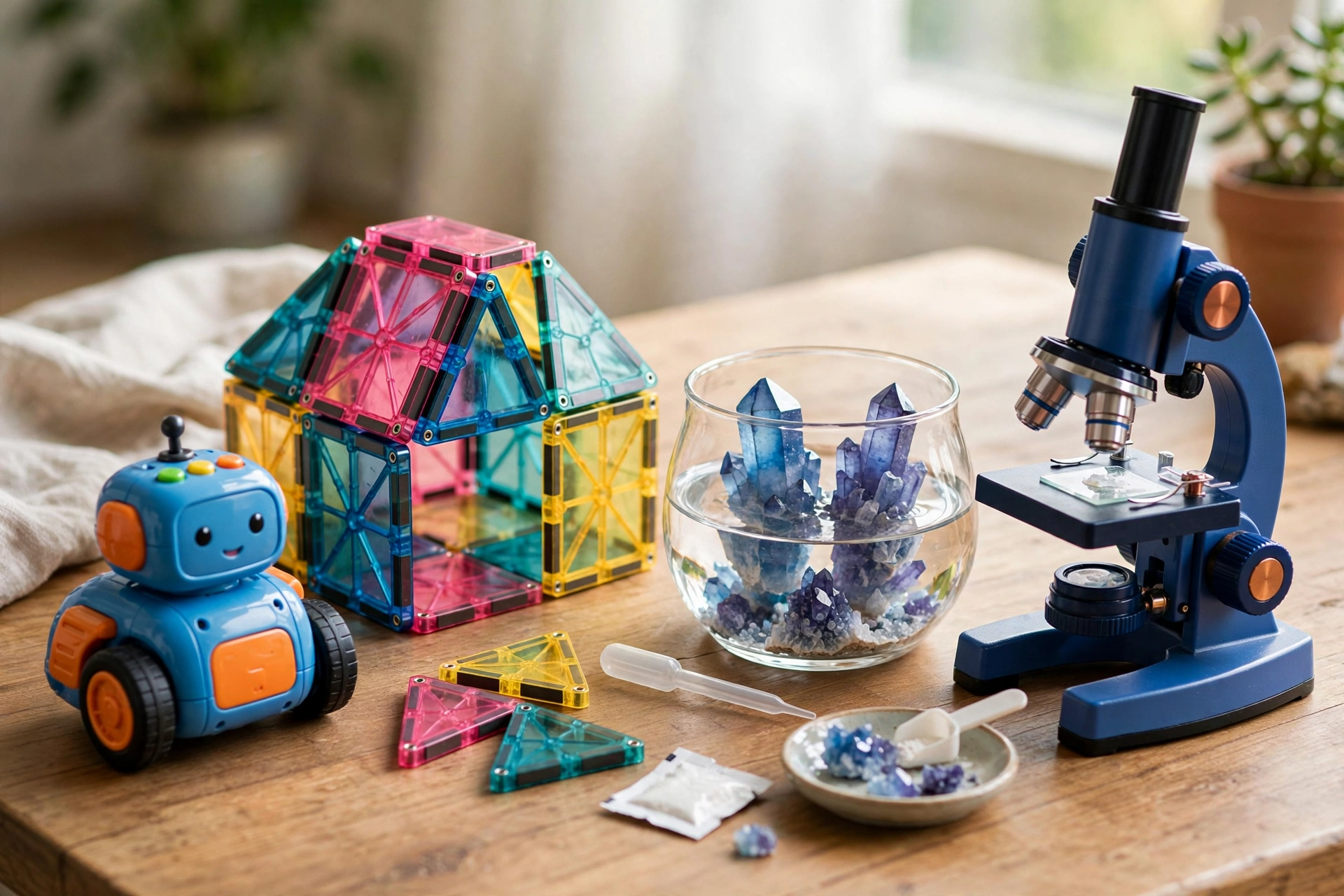
A screen-free coding robot is the ideal first step into programming for ages 4 to 7. Kids press arrow buttons on the robot’s back to plan a route, then watch it roll — learning sequencing, cause and effect, and debugging when the robot bumps into a wall instead of reaching the target. Because there’s no tablet required, the play stays tactile and focused. Look for robots with obstacle-course accessories and expandable challenge cards so the difficulty can grow with your child.
2. App-Enabled Advanced Robot Kit
For ages 8 and up, an app-connected robot kit introduces real coding languages through block-based programming that graduates to text-based code. Kids build the robot themselves, then program it to dance, navigate mazes, or respond to voice commands. These kits teach engineering (assembly, sensors, motors) and computer science simultaneously. Check that the companion app is still actively supported before buying — abandoned apps are the number-one complaint with tech toys.
3. Magnetic Building Tiles
Magnetic tiles are the rare toy that works beautifully from age 3 to age 10. Toddlers click colorful shapes together; older kids engineer towers, bridges, and geometric domes. They teach geometry, symmetry, magnetism, and structural thinking without any instructions at all. They’re also nearly indestructible and expandable — buy a starter set, then add pieces on birthdays. If you buy one STEM toy for a preschooler, make it this.
4. Classic Interlocking Brick Sets
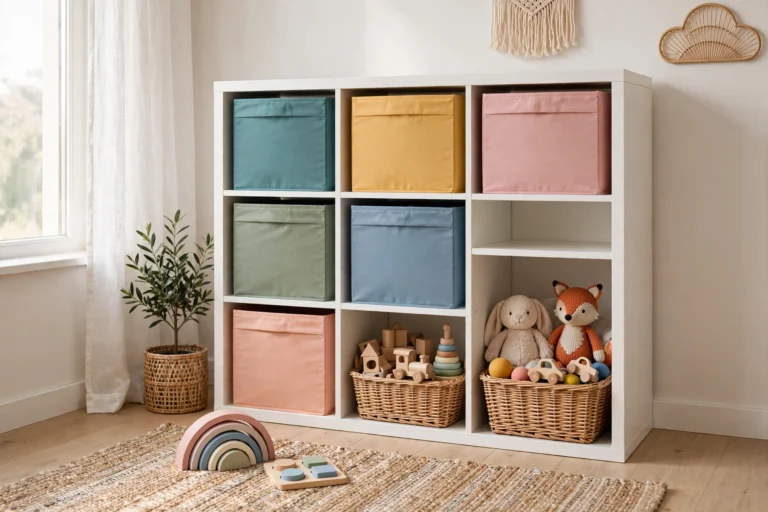
The original engineering toy remains one of the best. Themed sets teach kids to follow complex multi-step instructions — itself a STEM skill — while free-build bins develop creativity and spatial reasoning. For older kids, robotics-ready brick systems add motors and sensors. The ecosystem is enormous, which means endless expansion options and strong resale value. Tip: sort bricks by color and size in stackable bins; organized bricks get built with far more often.
5. Beginner Chemistry Set
A well-designed chemistry kit lets kids ages 8+ run dozens of safe, colorful experiments: color-changing reactions, crystal growing, pH testing with cabbage juice. The best kits frame each experiment with the “why” — explaining acids, bases, and polymers in kid-friendly language. Adult supervision is required, and you should verify the kit meets current toy safety standards. One caution: avoid kits heavy on single-use chemicals with no refills; the best value comes from kits with repeatable experiments.
6. Crystal Growing Kit
Crystal growing kits are patience made visible. Over several days, kids watch crystals form on a base, learning about saturation, evaporation, and molecular structure. It’s a perfect first “long experiment” for ages 6 to 10, teaching that real science takes time. The finished crystals make genuinely pretty keepsakes. For the best experience, follow the instructions precisely — crystal growing is one experiment where shortcuts reliably fail, which is itself a good lesson.
7. Beginner Microscope Set
A real (not toy) beginner microscope opens up an invisible world for ages 7 and up. Prepared slides get kids started instantly, but the magic happens when they prepare their own: onion skin, pond water, a feather. Look for at least 100x–400x magnification, a sturdy metal body, and an LED light source. Pair it with a simple field guide or a free printable observation journal so kids record what they see like real scientists.
8. Engineering Marble Run
Marble runs are physics playgrounds. Kids design tracks with twists, drops, and funnels, then test whether the marble makes it — iterating on slope angles and momentum intuitively. They’re outstanding for ages 4 to 9 and work even better as a family activity, since adults genuinely enjoy optimizing runs too. Wooden sets last for decades and look beautiful; plastic sets offer more pieces and features per dollar. Either way, buy bigger than you think you need — small sets frustrate.
9. Snap-Circuit Electronics Kit
Snap-together circuit kits let kids ages 8+ build working doorbells, radios, and light shows without any soldering. Color-coded components snap onto a grid following project diagrams, teaching circuits, switches, resistors, and capacitors through doing. The project manuals typically include 50 to 100+ builds, so the kit stays fresh for months. It’s one of the best introductions to electrical engineering available at any price.
10. Math Strategy Board Games
Don’t overlook games: the best math board games teach probability, resource management, and strategic planning while the whole family plays. Games involving dice teach probability intuitively; resource-trading games teach negotiation and arithmetic; pattern games build algebraic thinking. They’re also the most social STEM toys on this list. Choose games rated for your child’s age where turns move quickly — long, slow games lose young players before the math lesson lands.
11. Build-Your-Own Volcano and Earth Science Kit
Earth science kits — volcano eruptions, fossil digs, rock tumblers — give ages 5 to 9 their first taste of geology and chemistry. The volcano eruption never gets old, but the better kits go further: fossil excavation blocks teach patience and paleontology, and rock tumblers turn rough stones into polished gems over a few weeks. These kits shine as birthday or holiday gifts because the “wow” moment is immediate.
12. Beginner Telescope
A beginner telescope turns a clear night into an astronomy lesson. For ages 8 and up, even a modest telescope reveals the Moon’s craters, Jupiter’s moons, and Saturn’s rings — sights that genuinely awe kids. Look for a stable mount (wobbly tripods ruin the experience), at least 70mm aperture, and simple setup. Start with the Moon: it’s bright, easy to find, and spectacular. A free stargazing app helps kids identify what they’re seeing.
13. Coding Board Game
Coding board games teach programming logic — sequencing, loops, functions, debugging — with zero screens, making them ideal for ages 5 to 9 and for families limiting device time. Players lay down command cards to guide a character through a maze, then “run” the program and debug when it goes wrong. They’re affordable, portable, and excellent for classrooms and homeschool co-ops. Look for games with expansion packs so the challenge scales.
14. Renewable Energy Experiment Kit
Solar and wind experiment kits let kids ages 8+ build working solar cars, wind turbines, and water-powered generators. Beyond the engineering, these kits spark conversations about where energy comes from — science with real-world stakes. The best kits include a multimeter or simple measurement tools so kids can compare outputs and run genuine experiments (“does the solar car go faster in direct sun or shade?”). A sunny backyard is the ideal laboratory.
15. Advanced Robotics and Engineering Set
For ages 10 to 14, a serious robotics or engineering set — programmable controllers, motors, sensors, structural parts — is the capstone STEM toy. Kids design, build, and code machines that solve real challenges, from line-following robots to automated arms. These sets mirror actual engineering workflows and pair beautifully with school robotics clubs or competitions. They’re an investment, but for a kid showing sustained interest, nothing else comes close.
Best STEM Toys by Age
Age is the single most important filter when shopping. This table matches developmental stages to the toy types that fit them best:
| Age Group | Best STEM Toy Types | Skills Being Built |
|---|---|---|
| 3–4 (Preschool) | Magnetic tiles, simple marble runs, water and sand play sets, large-piece building sets | Fine motor control, cause and effect, early geometry, sensory exploration |
| 5–7 (Early Elementary) | Screen-free coding robots, coding board games, crystal growing kits, beginner building sets | Sequencing, pattern recognition, patience, following multi-step instructions |
| 8–10 (Upper Elementary) | Chemistry sets, snap circuits, beginner microscopes, telescopes, earth science kits | Scientific method, measurement, hypothesis testing, basic electronics |
| 11–14 (Tweens and Teens) | Advanced robotics kits, renewable energy kits, app-programmed robots, engineering challenge sets | Coding, systems thinking, data analysis, project planning |
Typical Price Ranges for STEM Toys
STEM toys span every budget. These are typical price ranges you’ll see at major retailers — always verify current prices before buying, since toy prices shift frequently with sales and seasons:
| Category | Typical Price Range | Notes |
|---|---|---|
| Board games and coding card games | Typically $15–$35 | Best value per hour of play; great gifts |
| Crystal kits, volcano kits, fossil digs | Typically $15–$40 | Single-theme kits; check for refill availability |
| Magnetic tile sets | Typically $30–$100 | Price scales with piece count; start with 50–100 pieces |
| Screen-free coding robots | Typically $40–$80 | Look for expandable challenge content |
| Chemistry and science experiment kits | Typically $25–$60 | Factor in consumable refills |
| Snap-circuit electronics kits | Typically $35–$100 | More projects = better long-term value |
| Beginner microscopes and telescopes | Typically $50–$150 | Don’t go cheaper — optics quality matters |
| Advanced robotics kits | Typically $100–$350 | Check app support longevity before investing |
Remember that price doesn’t predict learning. A $20 coding board game that gets played fifty times outperforms a $200 robot gathering dust. Watch for holiday sales — STEM toys are heavily discounted from November through December — and check price history if you’re buying outside sale season.
How to Choose STEM Toys That Actually Teach
- Match the toy to the child’s current obsession. A dinosaur-loving 7-year-old will devour a fossil dig kit; a car-obsessed 9-year-old will live inside a solar car kit. Interest is the engine of learning — the “STEM” label matters less than the hook.
- Read the 3-star reviews. Five-star reviews are enthusiasm; one-star reviews are often user error. Three-star reviews tell you what’s genuinely mediocre: flimsy parts, confusing instructions, or experiments that only work once.
- Check what’s in the box — fully. Some kits need batteries, a smartphone, or common household supplies (vinegar, baking soda) not included. Knowing the true out-of-box requirements prevents Christmas-morning disappointment.
- Prefer kits with real instructions over app-only guidance. Physical manuals survive dead tablets and don’t require accounts, updates, or Wi-Fi. App-enhanced toys are fine, but the core play shouldn’t depend on software that could be discontinued.
- Buy for the child you have, not the child you imagine. An advanced robotics kit is wasted on a kid who currently loves pretend play — but that same child might adore a doctor-themed science kit. Meet them where they are; the engineering phase may come later.
- Consider storage and cleanup. Marble runs with 200 pieces and chemistry kits with tiny vials need homes. If a toy is a pain to put away, it won’t come out often. Favor sets with storage cases or plan a dedicated bin before it arrives.
- Look for the “second play” factor. Before buying, ask: what will my child do with this on day 30? Toys with variable outcomes, expandable parts, or creative modes have it. Single-experiment kits often don’t — enjoy them as gifts, not investments.
Getting the Most Out of STEM Toys at Home
Buying the toy is step one; how it’s introduced matters just as much. Start by building or experimenting together the first time — your involvement signals that this is worth attention, and you can model the “I wonder what happens if…” thinking that makes STEM play click. Then step back: kids learn more from productive struggle than from being shown the answer. Resist fixing the marble run for them; ask questions instead.
Create a dedicated tinkering space if you can — even a card table in a corner. STEM projects often span multiple days (crystals growing, long builds), and having to pack everything away each night kills momentum. Keep a “scientist notebook” nearby where kids can sketch designs and record results; it builds real scientific habits and becomes a treasured keepsake. Finally, connect the play to the real world: after the volcano erupts, look up real volcano footage; after the telescope night, visit a planetarium show. Toys open the door — the world beyond is the real classroom.
FAQs
What age should kids start with STEM toys?
As early as age 3. Preschool STEM looks like magnetic tiles, water play, and simple building — no screens or instructions needed. The key is matching the toy to developmental stage: toddlers explore cause and effect, early elementary kids learn sequencing and patterns, and older kids can handle the scientific method and real tools. There’s no “too early” for hands-on discovery.
Are expensive STEM toys better than cheap ones?
Not necessarily. Price often reflects piece count, branding, or electronics rather than learning value. A $20 coding board game can teach more programming logic than a $150 robot if the child actually plays it repeatedly. Focus on open-endedness, age fit, and the child’s interest rather than the price tag. That said, avoid the very cheapest optics (microscopes, telescopes) — poor quality there genuinely ruins the experience.
Do STEM toys need to be electronic?
No — some of the best STEM toys have no batteries at all. Magnetic tiles, marble runs, building sets, and crystal kits teach engineering and science through pure physical play. Screen-free options are often better for younger kids, building focus and fine-motor skills that app-based toys skip. Electronics add value mainly for coding and robotics at ages 8 and up.
How do I know if a STEM toy is safe?
Check the age grading on the packaging and follow it — it’s based on choking hazards and developmental safety testing. Look for ASTM F963 compliance (the U.S. toy safety standard) on the box, avoid toys with small detachable magnets or easily accessible button batteries for young children, and check the CPSC website for recalls before buying secondhand. When in doubt, stick with reputable brands that clearly display age grading and safety certifications on the packaging.
My child loses interest in toys quickly. Will STEM toys be different?
They can be, if you choose open-ended toys over single-purpose kits. A child who abandons a one-experiment volcano kit in a week may play with magnetic tiles for years because the play possibilities keep changing. Also try rotating toys: store half, bring them out weeks later, and they feel new again. And remember — playing together dramatically extends any toy’s lifespan.
Are STEM toys good for girls?
Absolutely — and it’s worth saying explicitly because marketing still skews STEM toys toward boys. Girls benefit identically from building, coding, and experimenting, and diverse representation in STEM starts with equal access to the toys. When shopping, ignore the color of the box and focus on the child’s interests. Many excellent STEM toys come in gender-neutral designs.
Can STEM toys help with school subjects?
Yes. Building toys develop the spatial reasoning that underlies geometry; coding toys teach the logical sequencing behind math word problems; science kits make classroom concepts concrete. Teachers consistently report that kids with hands-on STEM play experience grasp new concepts faster because they’ve already met the ideas through play. Think of STEM toys as pre-teaching through fun.
What’s the best STEM toy to start with for a complete beginner?
For ages 3–5: magnetic tiles. For ages 5–8: a screen-free coding robot or coding board game. For ages 8–12: a snap-circuit electronics kit or beginner chemistry set. Each of these is affordable, widely available, age-appropriate, and proven to hold kids’ attention. Start with one, watch what your child gravitates toward, and expand in that direction.
The Best STEM Toys for Kids aren’t the flashiest boxes on the shelf — they’re the ones your child reaches for again and again, the ones that prompt “let’s try it a different way,” and the ones that make learning feel like play. Start with your child’s interests, buy for their actual age and stage, and don’t be afraid to get on the floor and experiment alongside them. For rainy-day inspiration on extending that play, see our Rainy Day Family Activities guide, and if you’re shopping for younger kids specifically, our Toddler Activities roundup and Kids Birthday Party Ideas guide will help you plan play they’ll love.