Bedroom Curtain Ideas: 8 Looks From Blackout to Sheer Elegance (2026)
Bedroom curtains do triple duty: they control the light that determines sleep quality, provide the privacy that makes the room feel safe, and contribute the softness that makes bedrooms feel like retreats rather than boxes. Yet most bedrooms settle for a single sad panel or the landlord’s blinds — wasting the window’s potential as the room’s softest, most impactful design element. The right curtains transform both the sleep and the style.
This guide presents eight bedroom curtain ideas for every need: blackout for sleep, layered looks for style, sheers for soft light, smart solutions for odd windows, and renter-friendly options. You’ll get a curtain-type comparison table, the measuring and hanging toolkit, a sleep-and-light spotlight, mistakes that ruin bedroom curtains, and answers to common questions. For the window-treatment basics, see our curtain principles — and for the full room, our small living room ideas.
Curtain Planning: Sleep, Privacy, and Style
Plan bedroom curtains around the sleep priority first: how dark does the room need to be? If you need true blackout (shift workers, light sleepers, streetlights), the curtain system must achieve near-total darkness — blackout curtains plus wraparound rods or side channels, with no light gaps at the edges. If you just need dimming, standard lined curtains suffice. Assess the current light: visit the bedroom at night with lights off and note every light source (streetlights, neighbor windows, electronics). The curtain plan must defeat them all — sleep quality depends on darkness more than any other factor.
Measure for the designer hang: rod width = window width plus 8–12 inches (4–6 per side) for full coverage and the stacked-back look; rod height = 4–6 inches above the frame (or ceiling-mounted for maximum height); curtain length = to the floor (puddling 1–2 inches for luxury, or just kissing the floor for clean looks) — never sill-length in bedrooms except above radiators or furniture. The full, high, wide hang makes windows look larger and ceilings higher; the skimpy narrow hang does the opposite. Decide the layering: blackout + sheer (the versatile combination), blackout alone (maximum sleep), or decorative + blackout roller (the modern solution).
8 Bedroom Curtain Ideas
From sleep-optimizing blackout to sheer elegance, these eight ideas cover every bedroom window need.
Step 1: 1. True Blackout for Sleep
The idea: a blackout curtain system that achieves near-total darkness — the sleep-optimizing window treatment. True blackout requires more than ‘blackout’ labeled curtains: wraparound rods (that return to the wall, eliminating side gaps), curtains wide enough to overlap generously, and lengths that puddle slightly or seal to the sill. The result is the cave-dark room that maximizes melatonin production and sleep quality.
The system: blackout curtains with thermal backing ($60–$150 per window), a wraparound rod ($30–$50), and side gap solutions (the curtains should extend 4–6 inches beyond the frame on each side). Test at night with lights off — any light leak gets addressed (extra width, a valance over the top gap, or side channels). For the ultimate, add a blackout roller shade underneath ($40–$80) — the layered blackout that’s truly impenetrable.
This is the health-first curtain: sleep science is clear that light disrupts sleep architecture, and the blackout bedroom produces measurably better rest. It’s also the shift-worker and light-sleeper essential. The style doesn’t suffer — blackout curtains come in every fabric and color; the function is in the backing and the installation, not the visible face. Sleep-first design starts at the window, and true blackout is its foundation.
Step 2: 2. The Layered Sheer + Blackout
The idea: sheer curtains for daytime softness layered with blackout curtains for nighttime darkness — the versatile combination that serves both style and sleep. Sheers diffuse daylight into the soft glow that makes bedrooms feel dreamy; blackouts close for the dark nights. The double rod ($40–$70) holds both layers, and the daily ritual (sheers by day, blackouts by night) becomes part of the room’s rhythm.
The styling: sheers in white or ivory (the light-diffusing classics), blackouts in the room’s palette (the color story). The sheers stay closed most of the day for privacy with light; the blackouts draw at night for sleep. The layered look is inherently luxurious — the depth of two fabrics reads as designed and intentional, the boutique-hotel window treatment.
This is the best-of-both-worlds solution and the most popular bedroom curtain in 2026. The versatility justifies the double-rod investment: privacy without darkness by day, darkness without compromise by night, and the styled depth that single layers lack. For bedrooms that need both beautiful daylight and true nighttime dark, the layered approach is the answer. It’s also the most forgiving — the sheers hide the blackouts’ utilitarian backing.
Step 3: 3. Floor-to-Ceiling Drama
The idea: curtains hung from ceiling-mounted tracks or rods at the ceiling, falling the full height to puddle on the floor — the dramatic vertical emphasis that makes ceilings feel higher and windows grander. The full-height hang is the designer move that transforms standard windows into architectural features. Cost: ceiling track ($30–$60) plus full-length curtains ($80–$200 per window).
The technique: mount the track at the ceiling (not the wall above the window), size curtains to the full ceiling-to-floor measurement plus 1–2 inches for puddling. The puddling is deliberate luxury — the fabric pooling on the floor signals opulence. Choose fabrics with good drape (linen-look, velvet, heavy cotton); stiff fabrics don’t puddle gracefully. The full-height curtain should be wide enough for generous gathering — skimpy full-height looks worse than standard.
This idea suits bedrooms with standard 8-foot ceilings most dramatically (the height gain is most visible), and it’s the solution for short windows that need presence. The ceiling mount also works where wall space above the window is limited. The drama is real: floor-to-ceiling curtains make the bedroom feel like a suite, not a room. It’s the window treatment with the most architectural impact per dollar.
Step 4: 4. Velvet Luxe
The idea: velvet curtains — the ultimate luxury fabric, with the depth, light absorption, and tactile richness that defines opulent bedrooms. Velvet’s pile catches light in ways flat fabrics can’t, creating the luminous depth that’s inherently glamorous. In 2026, velvet in rich tones (emerald, navy, terracotta, charcoal) is the statement curtain for primary bedrooms. Cost: $100–$250 per window for quality velvet.
The practical case: velvet’s weight provides excellent draping and natural light-blocking (often 80–90 percent without blackout backing); add blackout lining for true darkness. The fabric insulates (thermal benefit in winter) and absorbs sound (the quiet luxury). Choose cotton velvet for the best drape and longevity; polyester velvets are budget-friendly but less rich. Maintain with occasional steaming — velvet crushes and needs reviving.
Velvet suits glam, traditional, and moody-modern bedrooms — anywhere luxury is the goal. It’s the fabric that makes the window the room’s jewelry. Pair with the room’s metal accents (brass curtain rods, gold mirror frames) for the cohesive opulence. The commitment is real (velvet is dry-clean, not washable), but the daily pleasure of velvet curtains — the look, the feel, the light — justifies it for those who love luxury. This is the curtain for bedrooms that should feel like occasions.

Step 5: 5. Linen-Look Relaxed
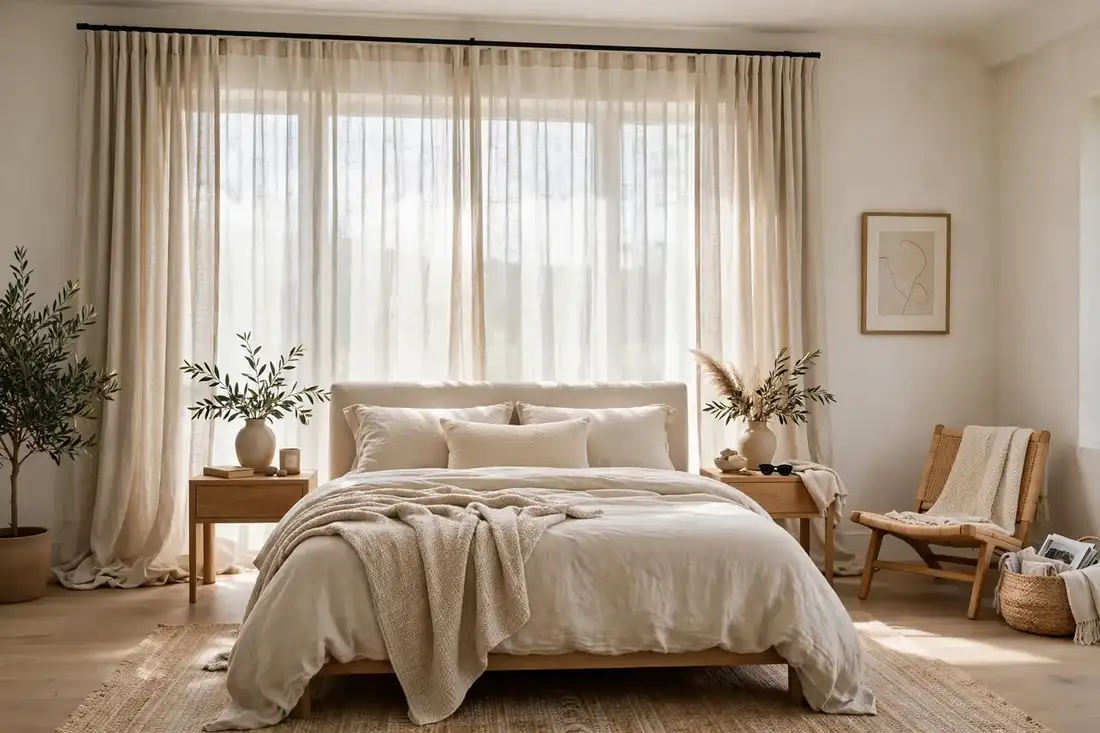
The idea: linen-look curtains in natural tones — the relaxed, organic-modern window treatment that brings effortless elegance. The texture and natural drape suit the bedroom’s retreat function perfectly: soft, breathable, calming. In 2026, the organic-modern bedroom (linen curtains, wood furniture, natural textures) is the dominant style, and linen-look curtains are its foundation. Cost: $60–$150 per window.
The practical notes: true linen wrinkles (the relaxed charm — embrace it or choose linen-look blends that resist wrinkling), provides moderate light filtering (add blackout lining or a separate blackout layer for sleep), and needs the full high-wide hang to look intentional rather than skimpy. Washability varies — check labels; many linen-looks are machine washable, true linen often isn’t.
This idea suits the calm bedroom: the spa-like, natural, serene space. It pairs with wood tones, natural textures, and muted palettes — the organic composition. The relaxed elegance is the point: linen-look curtains don’t try to impress, they invite rest. For the bedroom as sanctuary (not showroom), this is the curtain. The natural texture also photographs beautifully — the subtle slubs and weave catch light in ways flat fabrics don’t.
Step 6: 6. The Smart Top-Down/Bottom-Up
The idea: top-down/bottom-up cellular shades — the intelligent window treatment that provides privacy at the bottom while admitting light at the top (or vice versa). For street-facing bedrooms, it’s the perfect solution: the lower portion covers for privacy, the upper portion opens for daylight. The cellular construction also insulates (the honeycomb traps air), adding thermal and sound benefits. Cost: $80–$200 per window, custom-sized.
The versatility is unmatched: full up for the view, full down for privacy, bottom-up for the classic privacy-with-light, top-down for the unusual light-from-above. Cordless operation (essential for child and pet safety) is standard in quality versions. The clean, tailored look suits modern and transitional bedrooms; the fabric range includes blackout options for the sleep-prioritized.
This is the problem-solving curtain for difficult windows: street-facing (privacy + light), odd sizes (custom-made), or the bedroom that needs precise light control. It’s less decorative than curtains — the tailored minimalism — but more functional than any curtain. Pair with decorative side panels for the styled look: the shade does the work, the panels provide the softness. For the bedroom window that must do everything, top-down/bottom-up is the engineering answer.
Step 7: 7. Renter-Friendly No-Drill
The idea: beautiful bedroom curtains with zero holes — tension rods, adhesive hooks, and clip solutions that transform rental windows reversibly. The landlord’s blinds get hidden (not removed), the window gets style, and the deposit stays safe. Cost: $40–$100 per window, all portable to the next apartment.
The toolkit: spring tension rods inside the window frame ($15–$25 — the workhorse), heavy-duty adhesive hooks for rod support ($10 — rated for the curtain weight), clip rings that attach to existing rods ($12 — instant style change), and wraparound tension solutions for blackout. The tension rod must be rated for the curtain weight — blackout curtains are heavy; the rod must be heavy-duty.
Style without compromise: the no-drill constraint doesn’t limit the look — full-length curtains on tension rods, layered sheers, even the puddled luxury (with adequate rod strength). Document the before (photos of original blinds), get written approval for adhesive hooks if the lease is strict, and keep all originals. The renter’s window can be the best-dressed in the building; it just needs the reversible toolkit. And every piece moves to the next apartment — the investment compounds across rentals.
Step 8: 8. The Statement Pattern
The idea: bold patterned curtains — botanical, geometric, abstract — as the bedroom’s art. Since the bed is the room’s largest surface, the curtains are the second-largest — the pattern here defines the room’s personality. A bold curtain pattern transforms a neutral bedroom into a designed space, providing the color story and visual interest that plain walls lack. Cost: $70–$180 per window.
The design rules: the pattern scale should suit the room (large prints for spacious bedrooms, smaller for cozy ones), the palette should coordinate with bedding (pull one color through for cohesion), and the pattern should be the room’s star — keep walls and bedding quieter to let the curtains perform. The pattern’s repeat matters: large repeats need more fabric for matching, so buy extra.
This is the personality injection: the curtain pattern is where taste shows most visibly after bedding. It’s also the easiest bold move to reverse (curtains change in minutes), making it ideal for testing dramatic style. For the neutral bedroom that needs life, the statement curtain is the answer — the window becomes art, the room becomes designed, and the transformation takes an afternoon. Bold windows, confident room.
Bedroom Curtain Types Compared
Light control, style, cost, and best use for each curtain approach.
| Curtain Type | Light Control | Typical Cost/Window | Best For |
|---|---|---|---|
| True blackout system | Near-total darkness | $90 – $200 | Sleep priority, shift workers |
| Sheer + blackout layered | Versatile (soft to dark) | $100 – $220 | Best all-around |
| Floor-to-ceiling | Varies by fabric | $110 – $260 | Drama, height emphasis |
| Velvet | Very good (heavy) | $100 – $250 | Luxury, glam bedrooms |
| Linen-look | Moderate (filtering) | $60 – $150 | Relaxed, organic-modern |
| Top-down/bottom-up shade | Precise control | $80 – $200 | Street-facing, odd windows |
| Renter no-drill | Varies | $40 – $100 | Rentals, no holes |
| Statement pattern | Varies by fabric | $70 – $180 | Personality, neutral rooms |
Bedroom Curtain Toolkit
Measuring, mounting, and styling tools for perfect bedroom curtains.
- Steel tape measure: Window width, height, and the critical drop measurement (rod to floor). The high-wide-long formula needs accurate numbers — measure twice.
- Wraparound curtain rods: For blackout systems: rods that return to the wall, eliminating the side light gaps that defeat blackout curtains. The $40 detail that makes blackout true.
- Double curtain rods: For layered sheer + blackout: the two-rod system that holds both layers independently. The versatility infrastructure.
- Ceiling-mount track: For floor-to-ceiling drama: tracks that mount at the ceiling for the full-height hang. Smooth gliding for the daily open-close.
- Tension rods (heavy-duty): The renter’s solution: spring-tension rods rated for curtain weight. Inside-mount for zero damage, full style.
- Level: Rods must be level — the eye catches sloped curtains instantly. Check before drilling or tensioning, not after hanging.
- Stud finder + anchors: For wall-mounted rods holding heavy curtains (velvet, blackout): studs or rated anchors. Curtain rods pull outward; the mounting must resist.
- Steam iron/steamer: Remove packaging wrinkles before hanging — wrinkled curtains read as cheap regardless of price. The 15-minute step that elevates every curtain.
- Tie-backs + holdbacks: For the styled open look: fabric tie-backs or wall-mounted holdbacks that gather curtains elegantly. The detail that makes open curtains look intentional.
- Light-gap solutions: Side channels, top valances, and sill seals for the blackout perfectionist. The final 5 percent that achieves true darkness.
5 Bedroom Curtain Mistakes to Avoid
- Too-short curtains. The high-school-dorm look: curtains ending at the sill or hovering above the floor. Floor-length (or puddled) is the adult, designed look — length is the cheapest luxury.
- Narrow rod, skimpy coverage. The rod barely wider than the window, curtains that can’t close fully or stack awkwardly. The high-wide formula (8–12 inches wider, 4–6 higher) is the fix.
- Ignoring the sleep requirement. Beautiful sheers in a streetlit bedroom: style without function. Assess the darkness need first, then choose the beautiful version of what works.
- Wrong fabric for the need. Unlined linen where blackout is needed, heavy velvet where breezy sheers suit. Match the fabric’s properties to the room’s requirements, not just its looks.
- Forgetting the hardware. Flimsy rods bowing under velvet, plastic hooks on silk curtains — the hardware must match the curtain’s weight and style. The rod is the foundation; don’t economize there.
Safety Notes
Curtain safety centers on cords and mounting: use cordless window treatments wherever children or pets are present — corded blinds and curtains are a strangulation hazard, and the CPSC has documented the fatalities. Ensure wall-mounted rods are secured to studs or rated anchors; a falling rod with heavy blackout curtains injures. Keep curtains clear of heaters, radiators, and candles — fabric near heat sources is a fire risk. For ceiling-mounted tracks, verify the ceiling structure can bear the load.
Installation safety: stable step stool or ladder (never overreach, never use the bed as a ladder), proper drill use (know what’s behind the wall — pipes and wires), and eye protection when drilling. For motorized/smart curtains, follow electrical safety (low-voltage systems are DIY-friendly; hardwired motors need electricians). If the window is a designated emergency egress, ensure curtains don’t obstruct escape — the beautiful window that blocks exit is a hazard. Our home maintenance checklist covers the window safety checks worth running.

Pro Tips for a Flawless Result
- Hang high and wide. The designer formula: 4–6 inches above the frame, 8–12 inches wider. The window looks larger, the ceiling higher, the room grander — for $0 extra.
- Steam before hanging. Fifteen minutes with a steamer removes the packaging wrinkles that make new curtains look cheap. It’s the fastest upgrade in window treatments.
- Double up for luxury. Two panels per side (instead of one) create the full, gathered luxury look. Skimpy curtains are the most common curtain regret.
- Match the lining. The lining color affects the room’s light: white lining brightens, colored lining tints. Choose deliberately — it’s visible in daylight from outside too.
- Test the darkness. Nighttime lights-off test: can you see your hand? If yes, the blackout needs work — address the gaps, not just the fabric.
The Sleep-Light Connection: Why Curtains Matter More Than You Think
Light is the most powerful regulator of human sleep — more influential than noise, temperature, or mattress quality. The mechanism is melatonin: light exposure (even through closed eyelids) suppresses melatonin production, fragmenting sleep architecture and reducing deep sleep. Streetlights, neighbor security lights, early dawn, and even LED standby lights all contribute. The bedroom curtain isn’t decoration; it’s sleep medicine. Studies consistently show that darker bedrooms produce better sleep efficiency, and the effect size is comparable to many sleep interventions.
The practical threshold: the bedroom should be dark enough that you can’t see your hand at arm’s length. Most bedrooms fail this test dramatically — the ‘blackout’ curtains from the home store leak light at the top, sides, and bottom, delivering perhaps 70 percent darkness when 95 percent is needed. The true-blackout system (wraparound rods, generous overlap, sealed edges, optionally layered with a blackout shade) is what achieves the threshold. It’s more installation than purchase — the curtains matter less than the gap elimination.
Beyond darkness, curtains regulate the light that wakes you: the ideal is darkness until your chosen wake time, then bright light (the sunrise alarm or opened curtains). Smart curtain systems (motorized openers on schedules, $100–$200 per window) automate this — closing at bedtime, opening at dawn. It’s the circadian-optimized bedroom: dark nights, bright mornings, automatically. For shift workers, the system inverts (dark days); the principle is the same — light on schedule, darkness on schedule.
The curtain-sleep connection reframes the entire window treatment decision: the first question isn’t ‘what looks good?’ but ‘how dark does my sleep need?’ Style follows the sleep requirement, not the reverse. And the investment framing changes too — the $150 blackout system that improves 365 nights of sleep yearly is the highest-ROI purchase in the bedroom, outperforming the $1,000 mattress upgrade in cost-per-better-night. Curtains are sleep infrastructure disguised as decor; treat them accordingly.
Watch: Bedroom curtain ideas
Frequently Asked Questions
What curtains are best for bedrooms?
The layered sheer + blackout combination is the best all-around: sheers for daytime softness and privacy, blackouts for nighttime darkness. For sleep-prioritized rooms, the true-blackout system (wraparound rod, sealed gaps). For style-prioritized rooms, the fabric that suits the decor with blackout lining added.
How long should bedroom curtains be?
Floor-length: just kissing the floor for clean modern looks, or puddling 1–2 inches for luxury traditional. Never sill-length (except above radiators/furniture). Measure from the rod (hung 4–6 inches above the frame, or at the ceiling) to the floor — the full drop is what makes curtains look designed.
Are blackout curtains worth it?
Unequivocally for sleep quality — darkness is the most powerful sleep regulator, and the $90–$200 blackout system improves 365 nights yearly. It’s the highest-ROI bedroom purchase. Ensure true blackout (gap elimination matters more than the fabric label) for the full benefit.
Can I have curtains without drilling in a rental?
Yes: heavy-duty tension rods inside the frame, adhesive hooks rated for the weight, and clip rings on existing rods. The no-drill toolkit achieves the full high-wide-long look reversibly. Document befores, get written approval for adhesives if required, and keep all originals.
Should bedroom curtains match the bedding?
Coordinate, don’t match exactly: pull one color from the bedding into the curtains (or vice versa) for cohesion without uniformity. The matchy-matchy set looks showroom; the coordinated palette looks designed. The curtain can also introduce the accent color that the bedding then echoes.
How do I clean bedroom curtains?
Check labels: many cotton and polyester curtains are machine washable (gentle, cold); linen-look often is; velvet is usually dry-clean only; sheers wash delicately. Vacuum with the upholstery attachment quarterly between washes. Blackout backing degrades with frequent washing — spot-clean when possible, wash annually.
The Bottom Line
Eight curtain ideas, one principle: the bedroom window treatment must serve sleep first and style second — and the best solutions serve both beautifully. Whether you choose true blackout, the layered sheer-blackout, floor-to-ceiling drama, or renter-friendly no-drill, the method is the same: assess the darkness need, measure for the high-wide-long hang, choose the fabric for the requirement, and eliminate the gaps.
Start tonight with the darkness test — lights off, hand at arm’s length. Then choose the system that delivers the dark your sleep deserves, in the style your room wants. For the complete bedroom transformation, our before-and-after guide above is your roadmap — and the window is where the transformation starts. Related reading: best time to buy furniture.