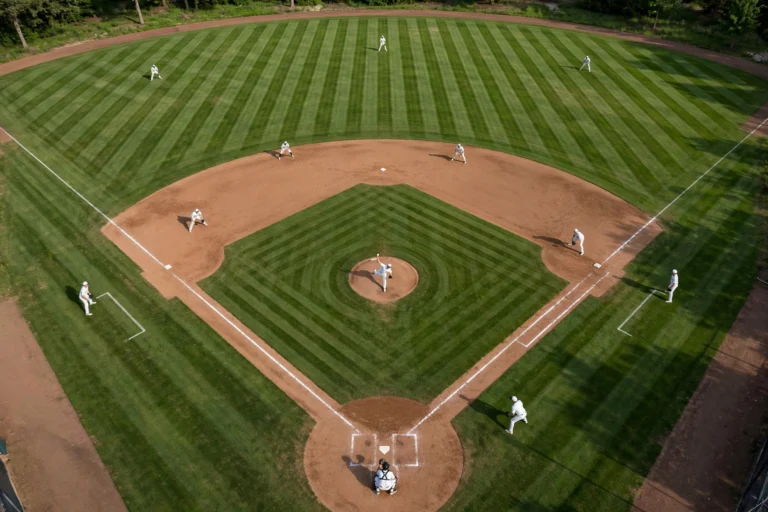
Baseball has the richest vocabulary in American sports — a century and a half of slang, official terms, and broadcast shorthand that can leave new fans lost. This baseball terminology glossary is your complete decoder ring: 100+ essential terms organized by category, from basic scoring language to the colorful slang announcers love. Bookmark it, and no broadcast will ever confuse you again.
Terms are grouped so you can learn them in context: the fundamentals first, then pitching, hitting, fielding, baserunning, strategy, and finally the slang that makes baseball conversations fun.
Essential Game Terms
- At-bat (AB): A batter’s turn at the plate that ends in a hit, out, or error — walks and sacrifices do not count as at-bats.
- Run: A point scored when a runner touches all four bases in order.
- Hit: When the batter reaches base safely on a batted ball (single, double, triple, or home run).
- Out: When the defense retires a batter or runner — three outs end a half-inning.
- Inning: One of nine (or more) game segments; each has a top (visitors bat) and bottom (home team bats).
- Plate appearance (PA): Every completed turn batting, including walks and sacrifices — broader than an at-bat.
- Lineup / batting order: The fixed sequence in which players bat, set before the game.
- On deck: The batter scheduled to hit next, waiting in the on-deck circle.
- In the hole: The batter after the on-deck batter — two spots away.
- Count: The balls-and-strikes tally on the current batter (e.g., 3-2 is a “full count”).
- Walk (base on balls, BB): The batter advances to first after four balls.
- Strikeout (K): Three strikes; the batter is out. A backward K (ꓘ) denotes a called third strike.
- Error (E): A defensive misplay that should have been an out; charged by the official scorer.
Pitching Terms
- Strike zone: The area over home plate between the batter’s knees and mid-torso where pitches are strikes.
- Ball: A pitch outside the zone not swung at.
- Foul ball: A batted ball landing in foul territory; counts as a strike unless the batter already has two.
- Wild pitch (WP): A pitch so errant the catcher cannot handle it with ordinary effort — charged to the pitcher; runners may advance.
- Passed ball (PB): Like a wild pitch, but the catcher’s fault.
- Balk: An illegal pitcher motion with runners on; all runners advance one base.
- Hit by pitch (HBP): Batter hit by a pitch is awarded first base.
- Shutout: A complete game in which the pitcher allows zero runs.
- No-hitter: A game with no hits allowed (walks and errors permitted).
- Perfect game: A no-hitter with no batter reaching base at all — 27 up, 27 down.
- Save (SV): Credited to a reliever who finishes a close win under specific conditions.
- Blown save: A reliever enters in a save situation and surrenders the lead.
- Hold: A reliever maintains a lead in a save situation but does not finish the game.
- Quality start: A start of at least 6 innings allowing 3 or fewer earned runs.
- Bullpen: The relief pitchers collectively, and the area where they warm up.
- Ace: A team’s best starting pitcher.
- Closer: The reliever who pitches the ninth inning of close games.
- Setup man: The reliever who typically pitches the eighth inning before the closer.
- Spot starter / opener: A pitcher used unconventionally — an opener pitches the first inning or two before the planned “starter” enters.
- Pitch count: The number of pitches thrown; high counts lead to removal (usually around 100 for starters).
- Brushback pitch: A high, inside pitch meant to move the batter off the plate — legal gamesmanship.
- Intentional walk (IBB): Pitching deliberately outside the zone to walk a dangerous hitter (now signaled, no pitches thrown).
Hitting Terms
- Single / double / triple: Hits on which the batter reaches first, second, or third base.
- Home run (HR, “dinger,” “tater”): A fair ball clearing the outfield fence; the batter circles the bases.
- Grand slam: A home run with the bases loaded — four runs on one swing.
- Inside-the-park home run: A home run scored without the ball leaving the park — pure speed and chaos.
- Walk-off: Any play that ends the game with a home-team win in the bottom of the final inning.
- RBI (run batted in): A run credited to the batter whose action caused it to score.
- Bunt: Tapping the ball softly into play, usually to advance a runner (sacrifice) or beat the defense (bunt for a hit).
- Sacrifice fly (sac fly): A fly ball out deep enough to score a runner from third — the batter is credited with an RBI, no at-bat charged.
- Line drive (“frozen rope”): A hard-hit ball traveling on a flat trajectory.
- Ground ball / grounder: A batted ball rolling along the ground.
- Fly ball / pop-up (pop fly): A batted ball hit high in the air; pop-ups stay in the infield.
- Blooper / Texas Leaguer: A softly hit fly ball that drops between infielders and outfielders for a hit.
- Dribbler / swinging bunt: A weakly hit ball that trickles fair — often beats the defense.
- Exit velocity: The speed of the ball off the bat, measured in mph — the core of modern hitting analysis.
- Launch angle: The vertical angle of the batted ball — the second half of the modern hitting revolution.
- Barrel: The analytically ideal combination of exit velocity and launch angle.
- Slump: An extended period of poor hitting.
- Streak: Consecutive games with a hit (or other achievement).
- Pinch hitter: A substitute batter; the replaced player leaves the game.
- Switch hitter: A batter who hits from both sides of the plate.
- Cleanup hitter: The fourth batter in the lineup, traditionally the top power threat.
- Leadoff hitter: The first batter — typically fast, with a good eye.
Fielding Terms
- Putout: Credited to the fielder who records an out.
- Assist: Credited to fielders who throw to the putout (e.g., shortstop to first baseman).
- Double play (DP): Two outs on one continuous play — most commonly 6-4-3 or 4-6-3.
- Triple play: Three outs on one play — extremely rare.
- Force play: The runner must advance, so the fielder need only touch the base.
- Tag play: The runner is not forced; the fielder must tag them with the ball.
- Tag up: Runners retouch their base after a caught fly ball before advancing.
- Cutoff man: The infielder who intercepts outfield throws to redirect them.
- Relay: A multi-throw sequence from outfield to infield to nab a runner.
- Web gem: A spectacular defensive play (from the glove “webbing”).
- Diving catch / sliding catch: Self-explanatory heroics.
- Shift: Repositioning fielders based on hitter tendencies (extreme infield shifts now limited by rule).
- Charging: An infielder rushing in on a slow roller or bunt.
- Backhand: Fielding a ball on the glove side with the back of the glove facing the target.
- Short hop: A throw that bounces just before reaching the fielder — the hardest to handle.
- In-between hop: The dreaded bounce that is neither short nor long — fielders’ nightmare.
Baserunning Terms
- Stolen base (SB): Advancing a base while the pitcher delivers to the plate.
- Caught stealing (CS): Thrown out attempting a steal.
- Pickoff: The pitcher (or catcher) throws to a base to catch a leading runner.
- Lead: The distance a runner takes off the base before the pitch.
- Hit and run: The runner breaks with the pitch and the batter must make contact — high risk, high reward.
- Delayed steal: Breaking for the next base a beat late, catching the defense napping.
- Suicide squeeze: Runner on third breaks for home as the pitch comes; the batter must bunt — if he misses, the runner is dead.
- Safety squeeze: Like the suicide squeeze, but the runner waits to see the bunt land fair first.
- Tagging / tag up: (See fielding) — retouching before advancing on a fly ball.
- Rundown (“pickle”): A runner caught between bases while fielders throw back and forth.
- Ghost runner: The automatic runner placed on second base to start extra innings in the regular season.
- Pinch runner: A speedster substituted to run for a slower player.
Strategy and Situation Terms
- Small ball: Manufacturing runs via bunts, steals, and sacrifices rather than home runs.
- Long ball: The opposite — winning via home runs.
- Platoon: Alternating two players at one position based on pitcher handedness.
- Matchup: The tactical pairing of pitcher/hitter handedness and tendencies.
- High-leverage situation: A game moment where the outcome swings win probability sharply — late, close, runners on.
- Mop-up duty: Pitching in a blowout to save the real relievers.
- Bullpen game: A game started and finished entirely by relievers.
- Opener: A reliever starting the game for an inning or two before the planned bulk pitcher.
- Double switch: A classic NL-era substitution maneuver (rarer in the universal-DH era).
- Intentional walk strategy: Walking a star to face a weaker hitter or set up a force play.
- Playing the infield in: Infielders move closer to home to cut off a run — at the cost of range.
- Corners in / guards the lines: Late-game alignments to prevent extra-base hits or bunt singles.
- Magic number: Combined wins and rival losses needed to clinch a playoff spot.
- Wild card: A playoff berth for a non-division-winner.
- Pennant: The league championship — winning the AL or NL.
- Clinch: To mathematically secure a playoff berth or division title.
Broadcast and Slang Terms
- Can of corn: An easy fly ball — supposedly from grocers tipping cans off high shelves.
- Ducks on the pond: Runners in scoring position waiting to be driven in.
- Golden sombrero: Four strikeouts in a game (a “platinum sombrero” is five).
- Mendoza line: A .200 batting average — the threshold of offensive respectability.
- Tools of ignorance: Catcher’s gear — the old-timers’ joke.
- Hot corner: Third base, where screamers arrive fastest.
- Texas Leaguer: (See hitting) — also used as slang for a cheap hit generally.
- Chin music: A high, inside pitch — the musical kind nobody wants to hear.
- Gas / cheese / heat: A fastball, especially a fast one.
- Filthy / nasty / wicked: A pitch with devastating movement.
- Paint the corners: Pitching precisely to the edges of the strike zone.
- Meatball: A fat pitch down the middle — what hitters dream about.
- Ducks / rally: A scoring rally — “rally caps” worn inside-out are the fan ritual.
- Walk-off: (See hitting) — also used for any game-ending play, not just homers.
- Bench-clearing: When both dugouts empty — usually just posturing, occasionally more.
- Tater / dinger / bomb / moonshot: Home run synonyms, in ascending order of majesty.
- Wheels: Speed — “he’s got wheels.”
- Leather: Fielding skill — “flashing the leather.”
- Dime: A perfect throw — “he dropped a dime to second.”
- Seeing-eye single: A ground ball that threads through infielders.
- Baltimore chop: A high-bouncing grounder (often off hard infields) that beats the throw.
- Cellar / basement: Last place in the standings.
- Pennant race: The stretch-run battle for the division or playoff spot.
- September call-up: A minor leaguer promoted when rosters expand.
- Rubber game: The deciding game of a three-game series.
- Sweep: Winning every game of a series.
- Split: Each team winning half a doubleheader or series.
- Southpaw: A left-handed pitcher.
- Utility / super-utility: A player who fills multiple positions.
- Journeyman: A veteran who has played for many teams.
- Prospect / phenom: A young player expected to become a star.
- Bust: A highly touted prospect who does not pan out.
- Late bloomer: A player who breaks out later than expected.
Stats Terms Every Fan Should Know
- Batting average (AVG): Hits ÷ at-bats. .300 is excellent.
- On-base percentage (OBP): How often a batter reaches base by any means.
- Slugging (SLG): Total bases ÷ at-bats — measures power.
- OPS: OBP + SLG — the quick all-in-one offensive rating.
- ERA: Earned runs allowed per 9 innings.
- WHIP: Walks + hits per inning pitched.
- WAR: Wins Above Replacement — estimated wins a player adds vs. a replacement-level player.
- BABIP: Batting average on balls in play — used to judge luck vs. skill.
- OPS+ / ERA+: Stats adjusted for park and league, where 100 is average.
- Save situation: The official conditions under which a save can be earned.
- Quality start: (See pitching) — 6+ innings, 3 or fewer earned runs.
Umpire and Officiating Terms
- Blue / ump: Slang for the umpire (from the traditional blue uniform shirt).
- Called strike vs. swinging strike: A called strike is ruled by the umpire without a swing; a swinging strike comes from a miss or foul.
- Checked swing appeal: When the home-plate umpire asks a base umpire whether the batter offered at the pitch.
- Ejection (“tossed”): An umpire removing a player, coach, or manager from the game — usually after an argument.
- Replay review / challenge: Managers can challenge certain calls for video review; the replay official in the league office makes the final ruling.
- Neighborhood play: The (now review-limited) tradition of middle infielders getting the out call at second on double plays without fully touching the bag.
- Strike ’em out, throw ’em out: A double play where the catcher strikes out the batter and throws out a stealing runner — the catcher’s signature play.
- Automatic ball/strike (ABS): The electronic strike-zone system being tested and phased in — “robot umps” for balls and strikes, with human umpires still calling everything else.
How to Use This Glossary
Do not try to memorize all of this baseball terminology at once. Instead, use it as a companion: when an announcer says something puzzling, look it up here. Within a few weeks of games, the core terms will be second nature, and the slang will start making you smile. Baseball’s language is part of its charm — every generation adds new phrases while the classics (“can of corn,” “Texas Leaguer”) survive for a century.
Want to go deeper? Pair this glossary with our kid-friendly concerts approach to introducing young fans to live events — the same gentle on-ramp works for a first ballgame. Planning that first trip? Our first concert guide shares the first-timer logistics mindset that applies to any live event, and a family movie night featuring a classic baseball film is the perfect way to preview the vocabulary before hearing it live at the park.
Frequently Asked Questions
What does “can of corn” mean in baseball?
It is slang for an easy, routine fly ball — supposedly from old-time grocers tipping cans of corn off high shelves into their aprons. Announcers use it for catches that require no effort.
What is the Mendoza line?
A .200 batting average, named for a light-hitting shortstop of the 1970s. Falling below it marks a hitter as struggling badly; “above the Mendoza line” is the minimum standard of offensive respectability.
What does “paint the corners” mean?
Pitching precisely to the edges of the strike zone — the “corners” of the zone. It is high praise for a pitcher’s command, since borderline pitches are the hardest to hit and the hardest to lay off.
What is a “golden sombrero”?
Slang for striking out four times in one game. Five strikeouts earns the dreaded “platinum sombrero.” It is the rare baseball term every fan hopes never applies to their favorite player.
What does WAR mean in baseball?
Wins Above Replacement — an estimate of how many more wins a player contributes compared to a readily available replacement-level player. It is the most popular all-in-one stat for comparing players across positions and eras.