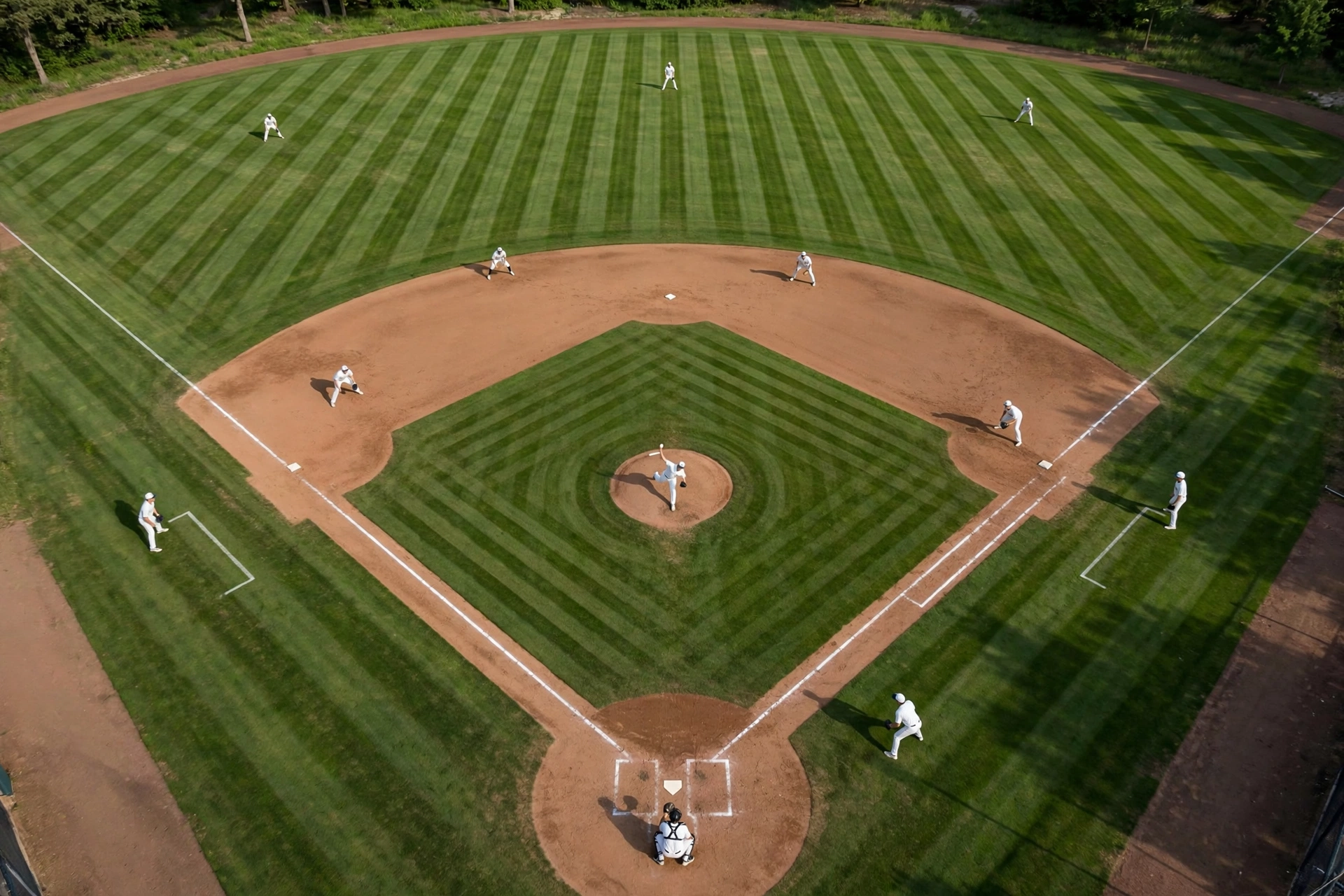
Every baseball broadcast assumes you know who the shortstop is and why the catcher wears all that gear. This baseball positions guide fixes that — a complete tour of all nine defensive positions, what each player does, the skills each role demands, how the positions are numbered for scorekeeping, and how to choose a position if you or your child is starting to play. Whether you are a new fan decoding the game or a parent helping a young player find their spot on the field, this is your definitive reference.
The Nine Positions at a Glance
Nine players take the field on defense. Each position has a standard number used in scorekeeping — a 6-4-3 double play means shortstop to second baseman to first baseman. Memorize the numbers and box scores become readable:
| No. | Position | Abbrev. | Location |
|---|---|---|---|
| 1 | Pitcher | P | Mound, 60’6″ from home plate |
| 2 | Catcher | C | Crouched behind home plate |
| 3 | First baseman | 1B | Near first base |
| 4 | Second baseman | 2B | Between first and second |
| 5 | Third baseman | 3B | Near third base (“hot corner”) |
| 6 | Shortstop | SS | Between second and third |
| 7 | Left fielder | LF | Left outfield |
| 8 | Center fielder | C | Center outfield |
| 9 | Right fielder | RF | Right outfield |
The Battery: Pitcher and Catcher
1. Pitcher (P)
The pitcher initiates every play, standing on the mound 60 feet 6 inches from home plate. The job: throw pitches the batter cannot hit squarely, using velocity, movement, and deception. Starters pitch every fifth day and aim for 5–7+ innings; relievers pitch shorter stints in high-leverage spots; closers handle the ninth inning of close games.
Key skills: arm strength and durability, command (throwing strikes where intended), a varied pitch arsenal, composure under pressure, and the ability to field the position — covering first on grounders to the right side, backing up bases, and holding runners. The mental game is enormous: pitchers study hitters’ weaknesses, sequence pitches to disrupt timing, and must forget the last home run instantly.
Body type & profile: Tall pitchers generate downward plane on pitches; smaller pitchers succeed with movement and command. There is no single prototype — crafty soft-tossers and flamethrowers coexist in every bullpen.
2. Catcher (C)
The catcher crouches behind home plate and is involved in every single pitch — no position touches the ball more. Catchers call the game (choosing pitches via signs), frame borderline pitches to steal strikes, block balls in the dirt, throw out would-be base stealers, and direct the entire defense like a quarterback.
Key skills: toughness (foul tips, collisions, and 120+ games in a crouch), a quick release and accurate arm, pitch-framing soft hands, game-calling intelligence, and leadership. Catchers must know every pitcher’s arsenal, every hitter’s weakness, and the game situation at all times.
Why it matters: Teams treat catcher as a premium defensive position — a great defensive catcher transforms a pitching staff. It is the most physically demanding position and the hardest to fill, which is why good catchers are so valued.
The Infield: 1B, 2B, 3B, SS
3. First Baseman (1B)
The first baseman anchors the infield’s right side and handles more throws than anyone — nearly every groundout ends with a throw to first. The signature skills are picking throws (scooping low or wide throws out of the dirt) and stretching for errant balls. First basemen also field grounders, hold runners on base, and cut off throws.
Profile: Often tall (a big target for throws) and usually a power hitter — teams hide a defensively limited slugger at first. Left-handed throwers are common here (and essentially only here, catcher, and the outfield, since throws flow counterclockwise).
4. Second Baseman (2B)
The second baseman patrols the area between first and second, turns double plays (taking the feed at second and relaying to first while a runner slides in), covers first base on bunts, and backs up throws. Quick feet, soft hands, and fearlessness around the bag define the position.
Profile: Typically smaller, agile, quick-twitch athletes. The double-play turn — catching, transferring, and throwing while avoiding the sliding runner — is the position’s signature art.
5. Third Baseman (3B) — “The Hot Corner”
Third base is called the hot corner because right-handed pull hitters rocket balls directly at it with minimal reaction time. Third basemen need lightning reflexes, a cannon arm (the longest infield throw, across the diamond), and no fear. They charge bunts and slow rollers, guard the line against extra-base hits, and start many 5-4-3 double plays.
Profile: Strong arms are non-negotiable; quick first steps matter more than pure sprint speed. Many third basemen are power hitters — the position demands offense and defense.
6. Shortstop (SS)
The shortstop is the captain of the infield and usually the team’s best pure athlete. Positioned between second and third, the shortstop covers the most ground of any infielder, fields balls in the hole (deep between third and short), turns double plays from the other side, and backs up throws across the infield. Range, arm strength, and acrobatic throwing on the run are the hallmarks.
Profile: The premium position for young athletes — if a kid is the best player on the team, they usually play shortstop. Elite shortstops who also hit are franchise cornerstones.
Middle Infield Chemistry
The second baseman and shortstop function as a unit: they coordinate who covers second on steals, execute double-play feeds in both directions, and communicate on pop-ups between them. Watch them before each pitch — the subtle positioning dance (one shading toward the bag, the other toward the hole) reveals the pitch type and game situation to trained eyes.
The Outfield: LF, CF, RF
7. Left Fielder (LF)
The left fielder handles fly balls and line drives to left, backs up third base on throws, and fields balls in the left-field corner. Of the three outfield spots, left traditionally demands the least arm strength (shorter throws), so teams often place strong hitters with average defense here.
Key skills: reading balls off the bat (the crucial first step), route efficiency, and reliable catching. Left fielders see plenty of action from right-handed pull hitters.
8. Center Fielder (CF)
The center fielder is the outfield’s captain and covers the most ground of any defender — the vast expanse from gap to gap. Center fielders call off corner outfielders on catchable balls (“I got it!”), back up both corner outfielders, and are typically the fastest players on the team. A great center fielder robs extra-base hits weekly and makes difficult plays look routine.
Profile: Elite speed is the entry ticket; the best also hit for average and steal bases. Center field is where five-tool athletes live.
9. Right Fielder (RF)
The right fielder needs the strongest outfield arm — the throw from right field to third base is the longest in the outfield, and runners test it constantly. Right fielders handle slicing fly balls (which curve away from left-handed throwers’ natural motion patterns), back up first base on throws, and see heavy action from left-handed pull hitters.
Profile: Cannon arm first, everything else second. Many legendary power hitters have manned right field.
The Designated Hitter (DH)
The DH bats in place of the pitcher but does not field. Used across all of MLB since 2022, the DH spot lets veteran sluggers extend their careers and gives managers a pure offense slot. It is technically a lineup role rather than a defensive position — but for this baseball positions guide, it completes the picture of who stands where (or in the DH’s case, sits in the dugout until their at-bat).
Utility Players and Position Flexibility
Modern rosters prize utility players who can handle multiple positions — a super-utility player might play second, short, third, and all three outfield spots in a single week. Positional flexibility lets managers rest starters, play matchups, and survive injuries without roster moves. For young players, learning two or three positions multiplies their chances of making teams at every level.
Defensive Spectrum: Easiest to Hardest
Scouts rank positions by defensive difficulty — the defensive spectrum. From hardest to easiest: catcher, shortstop, center field, third base, second base, right field, left field, first base, DH. The practical meaning: it is easier to move down the spectrum (shortstop to third base) than up. A shortstop can usually learn third; a first baseman cannot usually learn shortstop. This is why young stars start at premium positions and slide down as they age.
Choosing a Position: Advice for Players and Parents
For Young Players
- Try everything early: Youth coaches should rotate kids through positions. Early specialization is a mistake — the best shortstop at age 10 might be a catcher at 16.
- Match temperament to position: Love being in the middle of everything? Catcher, shortstop, or pitcher. Patient and observant? Outfield. Thrive under direct pressure? Closer.
- Arm strength sorts positions: As players grow, throwing ability increasingly determines infield vs. outfield placement. Long toss and proper mechanics matter more than raw strength at young ages.
- Left-handed? You are limited to pitcher, first base, or outfield (catcher is theoretically possible but vanishingly rare). Embrace it — lefty pitchers are always in demand.
For Parents
Support the position your child enjoys, not the one you think is prestigious. Catcher gear is expensive but catchers always find teams. Pitching lessons help every position (throwing mechanics are universal). And remember: at young ages, the best development comes from playing — positions sort themselves out with reps. If you are organizing team activities around the season, our kids’ birthday party ideas can inspire a team celebration, while free family events and the best family events in the USA roundup offer great family outings built around young athletes’ schedules.
How Positioning Changes by Situation
Positions are starting points, not fixed spots. Watch how fielders move:
- With a power hitter up: Outfielders play deep; corners guard the lines.
- With a slap hitter up: Infielders creep in; outfielders shade shallow.
- With a runner on first, no outs: First and third basemen charge for the bunt; middle infielders cheat toward second for the double play.
- Late and close, tying run on second: Infield plays in — cutting off the run at home matters more than preventing a single.
- Shift (limited): Since 2023, MLB requires two infielders on each side of second base, but outfielders and shaded positioning still adjust dramatically by hitter.
Position-by-Position Skill Summary
| Position | Most Important Skill | Second Skill | Typical Offensive Profile |
|---|---|---|---|
| Pitcher | Command & pitch arsenal | Composure | N/A (DH era) |
| Catcher | Game-calling & toughness | Arm / framing | Varies; defense-first acceptable |
| First base | Picking throws | Stretch & footwork | Power hitter |
| Second base | Quick transfer / DP turn | Range | Contact, speed |
| Third base | Reflexes | Arm strength | Power + average |
| Shortstop | Range | Arm strength | Best all-around athletes |
| Left field | Reads off the bat | Reliable hands | Power bat, average glove |
| Center field | Speed / range | Route efficiency | Average, speed, defense |
| Right field | Arm strength | Reads on slice | Power + arm |
How to Read Defensive Stats
Modern broadcasts show defensive metrics that go beyond errors. Here is what matters in this baseball positions guide context:
- Fielding percentage: The classic stat — plays made divided by chances. Simple but blind to range (a slow fielder who never reaches balls can have a perfect percentage).
- Range-based metrics: Stats like Outs Above Average measure how many plays a fielder makes versus an average player at the position, crediting great range and penalizing statues. These are the numbers analysts trust most.
- Caught stealing percentage (catchers): Throwing out runners is measurable — elite catchers erase a third or more of steal attempts.
- Framing metrics (catchers): How many borderline pitches a catcher converts into called strikes. The best framers save their teams dozens of runs per season.
- Arm ratings (outfielders): Throw velocity and accuracy on competitive plays — the reason runners stop testing certain right fielders.
You do not need these to enjoy a game, but when a broadcast flashes a defender’s advanced stats, you will now know which skills they actually measure.
Why Defense Wins in October
Regular-season narratives revolve around home runs, but postseason baseball — with elite pitching suppressing offense — is routinely decided by defense. A run saved in a 2-1 October game outweighs a run scored in a 9-4 July blowout. Teams built up the middle (catcher, shortstop, second base, center field) consistently outperform expectations when games tighten, because premium defenders erase the marginal hits that decide low-scoring games. When evaluating contenders, look past the sluggers: the teams that catch everything tend to be the teams still playing in late October.
Position Battles to Watch Each Spring
Every spring training features competitions that illustrate positional value perfectly: two prospects fighting for the starting shortstop job, a veteran learning a new outfield corner to extend his career, a converted infielder trying catcher. These battles reveal how organizations weigh offense versus defense at each spot — a team might accept a weaker bat at shortstop for elite range while demanding a big bat at first base. Watching position battles with this guide’s framework turns March box scores into genuinely interesting reading.
Frequently Asked Questions
What are the 9 baseball positions?
Pitcher (1), catcher (2), first baseman (3), second baseman (4), third baseman (5), shortstop (6), left fielder (7), center fielder (8), and right fielder (9). The designated hitter (DH) bats but does not field.
What is the hardest position in baseball?
Catcher is widely considered the hardest — it demands physical toughness, game-calling intelligence, and involvement in every pitch. Shortstop and center field round out the most demanding defensive positions.
What position should my child play?
At young ages, try them everywhere. Match temperament and developing skills to positions over time: athletic kids often start at shortstop or center field, strong arms point toward pitching or third base, and kids who love being involved in every play thrive at catcher.
Why can’t left-handed players play shortstop or third base?
They physically could, but the throwing angles work against them — a lefty’s momentum carries away from first base on the throw, costing precious time. Baseball’s counterclockwise flow (batter runs to first on the right side) favors right-handed throwers on the left side of the infield.
What do the position numbers mean?
Each position has a standard scorekeeping number (1=pitcher through 9=right fielder). Scorers record plays numerically — “6-4-3” is a double play from shortstop to second baseman to first baseman.
Which position gets the most action?
The catcher touches the ball on every pitch, and the pitcher initiates every play — but in terms of batted balls, shortstop and second base see the most action among fielders, since most hitters pull or hit grounders up the middle. Center fielders cover the most territory per play.
What is a utility player?
A utility player is a rostered athlete capable of playing multiple positions competently. Super-utility players handle both infield and outfield spots, giving managers flexibility for rest days, matchups, and injuries without roster moves.
How do I keep score with position numbers?
Scorekeepers record each play numerically by position: write the sequence of fielders involved (e.g., 6-4-3 for shortstop to second to first). Pick up an official scorecard at the ballpark — the numbered diamond diagram on it maps directly to the 1–9 system in this guide.