

City information last reviewed: September 26, 2026.
New York rewards a trip built around neighborhoods: a museum morning beside Central Park, an afternoon across the river in Brooklyn, and a late dinner after a Broadway show. The difficulty is rarely finding something to do. It is deciding what belongs together, how much walking is realistic, and which reservations deserve a place in a short visit.
This New York City travel guide is for first-time visitors who want the landmarks without spending the entire trip in lines or on trains. It covers Manhattan and useful starting points in Brooklyn, Queens, the Bronx and Staten Island, with advice on choosing a base, paying for transit, eating well and leaving room for discoveries. Start with the neighborhood table and map, choose one major paid experience each day, then use the three-day outline as a flexible introduction. For a longer visit, follow the linked one-week itinerary rather than trying to fit every suggestion below into a weekend.
New York City at a Glance
On mobile, swipe the table sideways to see every column.
| Planning question | DayZora recommendation |
|---|---|
| Best for | Museums, theater, architecture, neighborhood food and waterfront walks |
| Ideal stay | 4–5 nights for a first visit; a week allows more borough exploration |
| Best time to visit | Spring and fall for walking; winter for indoor culture, with holiday exceptions |
| Main airports | JFK, LaGuardia (LGA), Newark Liberty (EWR) |
| Getting around | Subway and buses, walking, occasional taxi; ferries for specific waterfront journeys |
| Car needed | Usually no for this city itinerary |
| Budget level | Generally high; free public spaces help balance paid attractions |
| First-time bases | Midtown near useful subway lines; Upper West Side for park/museum priorities |
City Map and Geographic Planning
Swipe within the map or open the full-size map. Numbers identify locations, not a visit sequence.
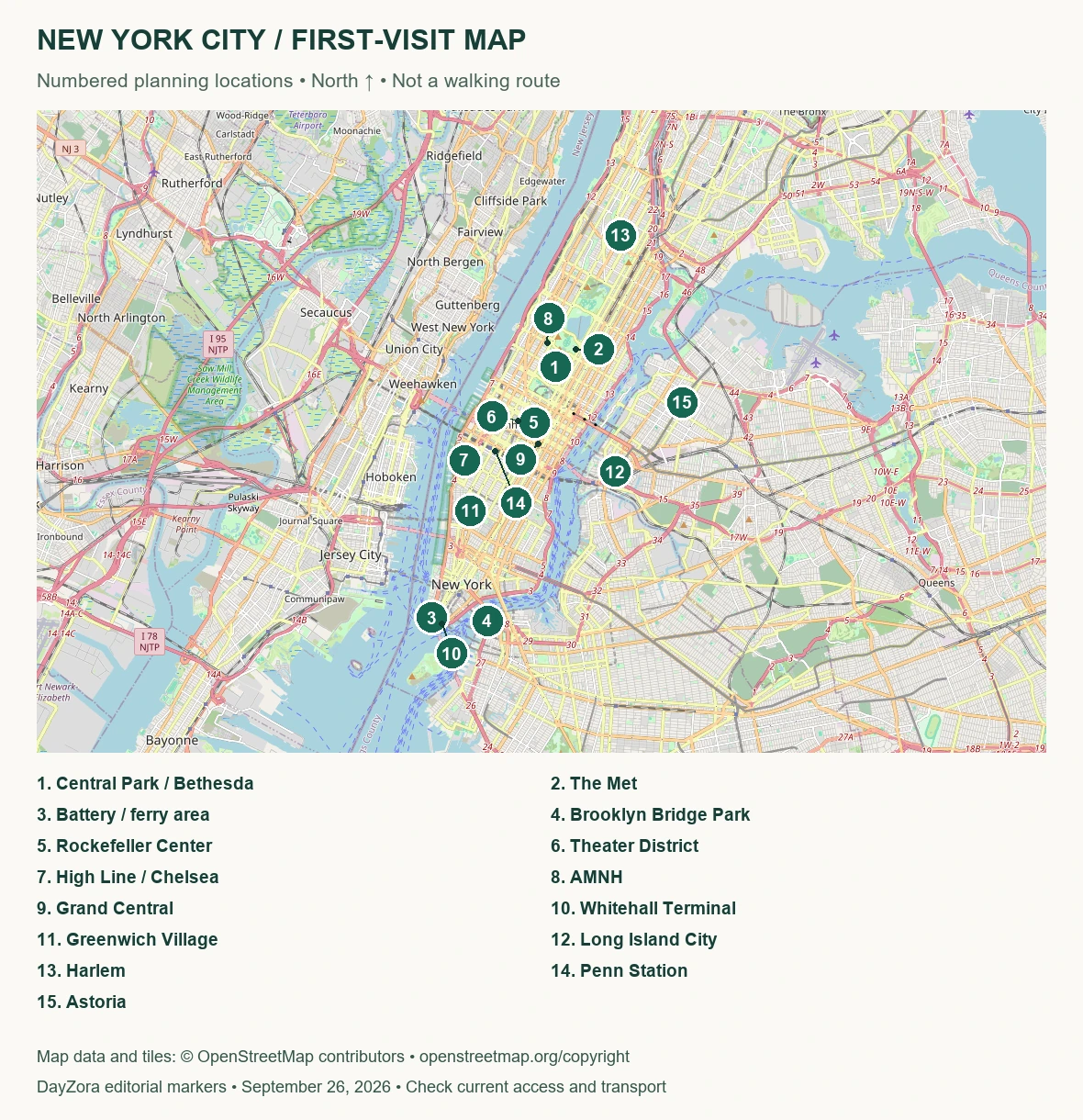
Manhattan is long enough that “we will just walk” can consume half a day. Group Lower Manhattan and the Brooklyn waterfront; put the Met with the east side of Central Park; combine the High Line with Chelsea. Queens and the Bronx deserve deliberate outings rather than a rushed detour between Manhattan reservations. The map marks representative neighborhood centers and attraction locations, not neighborhood boundaries or exact accessible entrances.
Best Things to Do in New York City
1. Explore Central Park beyond its southern entrance
The park provides a change of pace from the street grid: wooded paths, open lawns, water and carefully composed views. Choose a short route through the Mall and Bethesda Terrace, or spend longer walking toward the Reservoir. A park visit pairs naturally with one adjacent museum; crossing back and forth between both museum sides adds distance. Families can trade a long sightseeing walk for playground time, while photographers should leave room for changing light rather than chase every landmark.
Best for: First visits, families and outdoor breaks. Time: 1½–3 hours. Area: Central Manhattan. Tickets: General park access is free; tours, rentals, the zoo and some activities cost extra. Check the Central Park Conservancy visitor guide for facilities and access.
2. Choose a focused visit to The Metropolitan Museum of Art
The Met Fifth Avenue is a major art museum on Central Park's eastern edge. Its scale makes a selective plan more satisfying than an attempt to see everything. Pick two or three collection areas, pause between them, and save the remainder for another visit. This is a strong rainy-day anchor, but it should not be combined with another enormous museum simply because both appear on a highlights list.
Best for: Art, history and multigenerational groups with different interests. Time: 2–4 hours. Area: Upper East Side. Tickets: Paid general admission for most visitors; pay-what-you-wish eligibility is limited to specified residents/students. Advance purchase is optional, not a universal reservation requirement. The museum closes Wednesdays; several galleries and the roof garden are under renovation. Confirm your intended collection on the official visitor page.
3. Visit the Statue of Liberty and Ellis Island
This is an island excursion with security screening and ferry logistics, not a quick photo stop from the Battery. Liberty Island offers the monument's setting; Ellis Island adds a different, substantial immigration-history experience. Allow the outing to be the main event of the morning or afternoon. Visitors chiefly interested in skyline views can choose a waterfront walk instead, preserving time for neighborhoods.
Best for: Landmark seekers and history-focused travelers. Time: 4–5 hours for a comfortable two-island plan, sometimes longer. Area: New York Harbor, departure from Lower Manhattan. Tickets: Use the official Statue City Cruises link supplied by NPS. Pedestal and crown access require the appropriate ticket; crown availability is limited. The free Staten Island Ferry does not land at either island.
4. Walk the Brooklyn Bridge and linger on the Brooklyn waterfront
The bridge is best treated as a connection to another part of the city. Cross on the pedestrian path, then explore DUMBO and Brooklyn Bridge Park instead of immediately retracing your steps. Waterfront seating, playgrounds and skyline viewpoints make the Brooklyn side worth unstructured time. The bridge can be crowded, so avoid building a tight lunch reservation around an exact crossing time.
Best for: Architecture, skyline photographs and visitors wanting a first Brooklyn outing. Time: 2–3 hours with the waterfront. Area: Lower Manhattan to DUMBO/Brooklyn Heights. Tickets: Walking the bridge and general park access are free; individual attractions and food cost extra. Use the park's official information to choose facilities and return transport.
5. Book one observation deck: Top of the Rock
Top of the Rock gives a high-level view from Rockefeller Center, including a perspective toward Central Park and Midtown's towers. For most first visits, one observation experience is enough; additional decks are a preference rather than a requirement. Decide whether daylight orientation or an evening skyline matters more. Visibility can change, and a sunset booking does not guarantee clear conditions.
Best for: Skyline enthusiasts and a celebratory evening. Time: 1–2 hours including entry logistics. Area: Midtown. Tickets: Paid timed entry; premium experiences can have separate charges. Read the actual inclusions rather than choosing a bundle by name. Check official tickets and current pricing.
6. See a Broadway production
A live production can be the trip's evening anchor even for someone who rarely attends theater at home. Choose by subject, running time and audience guidance, not merely the best-known title. A family with younger children needs different material and timing from adults planning a late dinner. Keep the afternoon nearby, eat early, and allow time to locate the theater and pass entry checks.
Best for: Theater fans, couples and appropriately aged families. Time: Most of an evening; duration varies by production. Area: Theater District, with venue-specific exceptions. Tickets: Paid and performance-specific. Use The Broadway League's Broadway.org to reach authorized ticket sellers; check age rules and cancellation terms before purchase.
7. Walk the High Line through Chelsea
This elevated park transforms an old rail corridor into a planted walking route with views into the surrounding city. Its appeal comes from changing perspectives and the contrast with street level. Pick an entry and exit that connect to your next stop; walking the entire length is optional. It works particularly well as a break between Chelsea galleries or a meal, rather than as another long excursion after an exhausting museum day.
Best for: Design, urban landscapes and a relatively compact outdoor visit. Time: 45–90 minutes. Area: Manhattan's West Side, from the Meatpacking District toward Hudson Yards. Tickets: General access is free; check official access information for hours, elevator availability and any temporary restrictions.
8. Make the American Museum of Natural History a half-day anchor
The museum offers a substantial indoor alternative to outdoor sightseeing, from natural-history collections to ticketed special experiences. Decide which halls matter most before arriving. Younger children may enjoy a shorter visit followed by a park break more than a determined attempt to cover multiple floors. Adults interested in science can comfortably spend longer without needing a second major attraction that day.
Best for: Families, science interests and wet-weather plans. Time: 3–4 hours. Area: Upper West Side. Tickets: Review admission categories, advance reservations and separately ticketed exhibitions on the official planning page. Do not assume a basic admission purchase includes every show or special exhibition.
9. Look around Grand Central Terminal
Grand Central is a working rail terminal as well as an architectural stop. The main concourse makes a useful short visit between Midtown activities, and the building gives context to the city's daily movement. Travelers who enjoy architecture can take a formal tour; everyone else can keep it a brief stop instead of treating it as a half-day attraction. Stay out of commuter flows when taking photographs.
Best for: Architecture and a low-commitment arrival-day stop. Time: 30–60 minutes, longer for a booked tour. Area: Midtown East. Tickets: Public concourse access is free; organized tours and purchases are extra. See the terminal's official site for current access and tour options.
10. Take the Staten Island Ferry for a harbor perspective
The commuter ferry offers harbor views and a reason to see a part of the city beyond Manhattan. It is useful when you want a boat journey without buying an island-tour ticket. Remain flexible about views and seating, and remember that this is public transport with other passengers' journeys to accommodate. The return trip involves disembarking and following terminal instructions rather than remaining aboard automatically.
Best for: Budget-conscious visitors and a straightforward harbor outing. Time: Allow 1–1½ hours round trip with waits. Area: Whitehall Terminal to St. George, Staten Island. Tickets: The NYC DOT ferry is free. It is distinct from paid NYC Ferry services and Statue of Liberty sightseeing boats.
Best Neighborhoods to Explore
On mobile, swipe the table sideways to see every column.
| Area | Best reason to go | Practical tradeoff |
|---|---|---|
| Midtown | Broadway, landmark architecture, observation decks | Busy sidewalks; rooms may be small despite high prices |
| Upper West Side | Central Park, AMNH, residential dining streets | Longer journeys to Lower Manhattan |
| Lower Manhattan | Harbor departures, historic streets, waterfront | Match weekend/evening dining to the exact block |
| Greenwich Village and Chelsea | Cafés, galleries, High Line and evening dining | Several subway corridors; choose the station carefully |
| DUMBO and Brooklyn Heights | Waterfront views, bridge walk, neighborhood streets | Waterfront and subway entrances are not always adjacent |
| Long Island City and Astoria | Queens waterfront, museums and food exploration | They are different areas; do not treat all Queens as one stop |
| Harlem | Cultural institutions, music and neighborhood dining | Book individual performances rather than assuming walk-in availability |
Midtown is convenient when theater and landmarks dominate the trip. It also makes a practical first base for travelers who want many subway connections, but staying directly on Times Square is optional. Look at the actual station entrance and hotel room configuration. A quieter side street can matter more than a famous address, especially with children.
The Upper West Side suits travelers who want park time and less commuting between family activities. Residential avenues support unplanned meals, and the museum is a useful bad-weather option. It is still a city neighborhood rather than a guarantee of silence. Check whether your accommodation is near a local or express subway stop.
Lower Manhattan combines the Battery, harbor access and a compact network of older streets. The financial district can work for early ferry departures, while nearby Chinatown adds dining possibilities. Choose a hotel based on your evening plans as well as daytime sights; a convenient workday address may feel different after offices close.
Greenwich Village and Chelsea reward browsing, cafés and time between reservations. The High Line belongs with a West Side day; it should not be squeezed between distant uptown museums. Nightlife varies street by street. Families can visit comfortably during the day while adults might choose to stay for dinner or a performance.
DUMBO and Brooklyn Heights provide a first Brooklyn visit with waterfront walks and neighborhood streets nearby. They are useful for skyline views and a slower afternoon, although cobbled surfaces, slopes and indirect station access matter with a stroller. Brooklyn is much larger than these two areas; a longer trip can add another neighborhood without trying to “complete” the borough.
Queens and Harlem deserve plans based on specific interests. Long Island City's waterfront, Astoria's food and cultural attractions, and Harlem's performance venues offer different experiences. For a full week, consider a Bronx outing or a longer Staten Island visit too. NYC Tourism's borough resources help identify current institutions and programs beyond the Manhattan checklist.
Where to Stay in New York City
For first-time convenience, choose Midtown near subway lines that serve your actual plans, not simply the lowest room price in a wide map radius. For families, the Upper West Side offers a useful park-and-museum combination; confirm bed count, room occupancy and elevator access before booking. For nightlife and dining, Greenwich Village or nearby downtown areas reduce the final journey home, but ask about street-facing noise.
For luxury, compare Central Park South, the Upper East Side and established Midtown properties by room size, service and the view actually included. For relative value, examine Long Island City near a suitable subway station. Savings are not guaranteed; compare the full room total and the daily journey to Manhattan. Airport hotels are generally poor bases for repeated city sightseeing.
Use $ for budget-oriented, $$ moderate, $$$ upscale and $$$$ luxury as relative styles, not nightly-rate promises. NYC can price even a basic room at a premium during major events. Compare taxes, mandatory property charges, breakfast, luggage storage, cancellation deadlines and the number of usable beds on the same dates. No individual hotel is essential to this itinerary.
What to Eat in New York City
Build food into the geography of your day. A bagel breakfast or slice of pizza is useful when you want to preserve museum time; a deli meal or sit-down dinner deserves its own space in the schedule. Chinatown is a worthwhile dining district, but it is not the only place for Chinese food: a longer trip can explore Queens with a specific destination in mind.
Leave at least one meal for a neighborhood you are already exploring rather than crossing the city for every famous name. Astoria, Harlem and Brooklyn each offer reasons to extend a visit beyond sightseeing. Look at current menus and opening days, particularly for a late meal after theater. Markets are convenient for groups with different tastes, but browsing does not guarantee cheap food or enough seating.
For a splurge, reserve the meal first and choose nearby afternoon activities. For a lower-cost day, mix counter-service food with one planned restaurant meal and avoid buying every drink or snack inside a major attraction. Check the bill for included service or gratuity before adding more. Food preferences and accessibility are stronger reasons to choose a restaurant than an unexplained online ranking.
Getting Around and Airport Arrivals
The subway is usually the backbone of a first trip, supported by buses and walking. Read the direction and stopping pattern: a train using the same platform may not stop at your intended station. Weekend work can change routes. Check MTA service information and fares before setting out, and use elevator-status information when step-free access matters.
Verified September 26, 2026: the usual subway/local bus fare is $3; eligible OMNY rides cap at $35 over a seven-day period when the same payment card or device is used. A physical bank card and its phone-wallet version count as different payment methods. Subway/local-bus transfers generally operate within a two-hour window under MTA rules. Express buses have different fares. Use a separate payment method for each traveler if each needs individual fare capping; do not assume one card's group taps create multiple caps.
JFK commonly involves AirTrain to a rail connection, with a choice between the subway and Long Island Rail Road depending on destination and luggage. LaGuardia relies on bus connections or road transport rather than a train directly at the terminals. Newark is in New Jersey; its airport rail connection and NJ Transit are separate from the NYC subway. Airport rail surcharges and commuter-rail tickets are not simply covered by the local OMNY cap. Use the Port Authority airport information to check current terminal connections and construction before traveling.
Taxis and rideshare can help with luggage or a late return, but traffic makes an apparent short journey unpredictable. A rental car adds parking and driving complications to this plan and is usually unnecessary. Citi Bike can suit confident riders on a planned route; it is not an automatic substitute for the subway with children or luggage. Paid NYC Ferry journeys are useful for certain waterfront pairs, while the Staten Island Ferry is a separate free service.
Best Time to Visit
On mobile, swipe the table sideways to see every column.
| Season | Likely planning conditions | Crowds and cost | Best use |
|---|---|---|---|
| Spring | Variable temperatures and rain; pleasant walking windows | Popular weekends can be expensive | Parks, neighborhoods and museums |
| Summer | Heat and humidity can make long walking days tiring | Busy attractions; indoor breaks help | Early outdoor starts and evening waterfront time |
| Fall | Often comfortable walking conditions, with cooler evenings | Strong demand around events and foliage weekends | A balanced first visit |
| Winter | Cold, wind and possible snow; shorter daylight | Holidays differ sharply from quieter periods | Theater and museums with weather flexibility |
Choose dates around the activities that matter, then check the hotel total before booking flights. Holiday displays do not turn December into a low-cost period. For an autumn trip, DayZora's NYC Halloween guide is a starting point for seasonal ideas; verify each event's actual date and ticket with its organizer.
3-Day New York City Itinerary
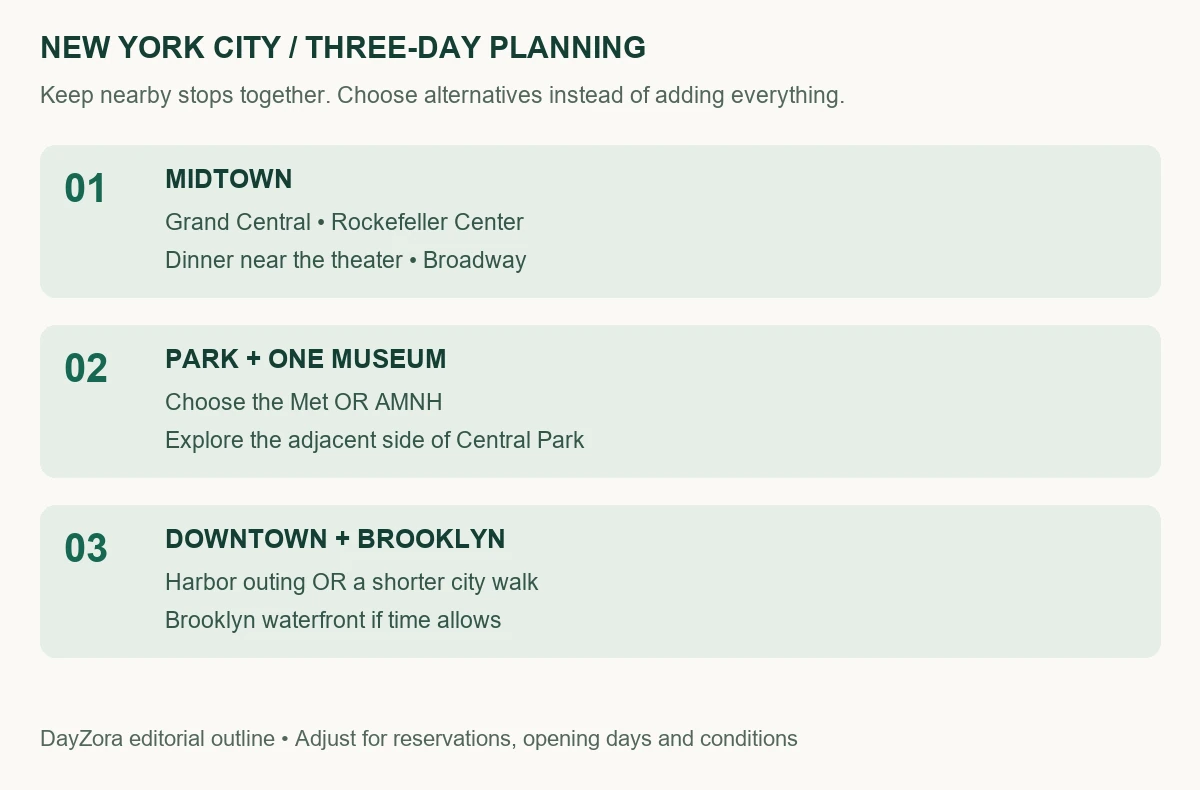
Day 1 — Midtown and a show
Morning: Grand Central and a short Midtown architecture walk. Afternoon: Rockefeller Center and your chosen observation booking, with a real lunch break. Evening: Early dinner and Broadway. Keep Times Square as a short nearby stop rather than another timed attraction.
Day 2 — One museum and Central Park
Morning: Choose the Met on the east side or AMNH on the west. Afternoon: Explore the neighboring part of Central Park rather than crossing the entire park to a second museum. Evening: Eat nearby or continue to a preselected neighborhood. Shift this day if the museum's calendar conflicts.
Day 3 — Lower Manhattan and Brooklyn
Morning: Choose the Statue/Ellis excursion or a shorter Lower Manhattan walk; do not pretend both have the same duration. Afternoon: Cross to Brooklyn if time and energy allow, or use the subway and explore the waterfront. Evening: Dinner in Brooklyn and a planned return. Travelers choosing both islands should shorten the bridge portion.
For additional borough time and a fuller sequence, use the 7-day New York City itinerary.
Trip Budget: Build a Realistic Daily Plan
On mobile, swipe the table sideways to see every column.
| Expense | Budget-oriented | Mid-range | Higher-end |
|---|---|---|---|
| Accommodation | Smaller room near useful transit | More central base and flexible booking | Larger room, view or premium service |
| Food | Bagel/counter meals plus groceries | Casual meals and one reserved dinner | Destination dining and cocktails |
| Transport | Subway/bus and grouped walking | Transit with occasional taxi | Frequent private transport, still subject to traffic |
| Attractions | Free parks/waterfront plus one priority | Museum, observation deck or theater on selected days | Premium seating or private tours |
These are planning choices, not researched city averages. Add the complete lodging quote for your party, then actual meal and ticket choices. Divide lodging by nights and travelers only after confirming occupancy. Sightseeing passes are worthwhile only if their included attractions match an achievable schedule; compare the individual official prices first.
Best Free Things to Do
- Walk through Central Park; paid activities within the park remain separate.
- Cross the Brooklyn Bridge on foot.
- Explore public areas of Brooklyn Bridge Park.
- Walk the High Line during open hours.
- Look around Grand Central's public concourse.
- Ride the Staten Island Ferry, allowing for terminal waits and return boarding.
Each free activity above is linked to its official visitor information in the attraction profiles. Food, organized tours and transport to the starting point may still add cost.
Visiting New York City With Kids
Choose one museum or major outing per day and put a playground or hotel break beside it. Upper West Side stays can make AMNH and Central Park easier; Brooklyn's waterfront offers space after a bridge crossing. A compact stroller can be useful, but elevator outages and station stairs require a route check. Museum admission ages, Broadway minimum ages and subway child-fare rules are different systems, so verify each separately. Compare the city's fit with other options in our family vacation destinations guide.
New York City for Couples
Pair a single skyline experience with an unhurried dinner, or choose a Brooklyn waterfront walk and a neighborhood meal. Theater can be the evening's main event without adding an expensive rooftop reservation afterward. Leave weather-dependent plans flexible, and use our romantic weekend getaways guide if you are comparing NYC with a quieter trip.
Best Day Trips from New York City
Times below are broad one-way planning allowances from central Manhattan, not live schedules. Station transfers and your final destination can change the total.
On mobile, swipe the table sideways to see every column.
| Destination | Approximate travel allowance | Best for | Car needed? |
|---|---|---|---|
| Beacon, New York | About 1½–2 hours by train plus local access | A Hudson Valley town and an art-focused day | No for a compact plan; check Metro-North and attraction calendars |
| Tarrytown/Sleepy Hollow | Roughly 1–1½ hours plus local travel | River towns and historic-site visits | Optional; sites are spread out; verify Hudson Valley tourism |
| Philadelphia | Around 1½–2 hours by intercity train, plus stations | A long but feasible city-history day | No; compare Amtrak departures and official visitor information |
With only three days in NYC, staying in the city usually provides better value than adding a day trip. An excursion should replace a city day, not be added to an already full schedule.
Practical New York City Travel Tips
- Reserve the scarce item first: crown access, a particular show or a desired observation time.
- Check museum closing days before assigning dates to the itinerary.
- Choose the subway station entrance, not just the station name, when planning with luggage.
- Read weekend service changes on the day of travel.
- Keep the same OMNY card or device for your own eligible rides and transfers.
- Leave a generous interval before theater; cross-city traffic can erase dinner time.
- Treat the bridge and waterfront as a substantial walking block, not a quick transfer.
- Compare a hotel's bed layout and total charges before choosing a small room by location alone.
- Use authorized island-ferry tickets; sidewalk sales pitches are not a reservation requirement.
- Leave an indoor alternative for very hot, wet or cold weather.
Frequently Asked Questions
Is three days enough for New York City?
Three full days can cover a selective first visit. Four or five nights provide more flexibility, and a week makes outer-borough exploration easier. Arrival and departure days are not equivalent to full sightseeing days.
Should I stay in Manhattan or Brooklyn?
Stay near the activities and transit you will use. Manhattan can simplify a landmark-heavy visit; a well-connected Brooklyn base can suit neighborhood dining and waterfront time. Compare the exact address rather than the borough label alone.
Do I need a car?
Usually not for this guide. Collect a rental only when leaving for a trip where it is useful, instead of paying to park it through the city stay.
Which observation deck should I choose?
This guide uses Top of the Rock for a Midtown plan. Choose based on the view, price, timing and included experience that matter to you. Visiting several is optional, not a requirement for a complete first trip.
What should I book before arrival?
Book your hotel, any must-see Broadway performance, island access if wanted, and limited timed attractions. Keep ordinary neighborhood walks and some meals flexible.
More DayZora planning resources
Compare other city guides or use our travel planning tips for the practical steps around a U.S. trip.
How this guide was researched
DayZora reviewed official attraction, transit, airport, tourism and government information and added editorial neighborhood comparisons, suggested visit durations and a selective itinerary. Recommendations are research-based, not claims of firsthand visits. Approximate travel allowances are planning estimates, not live schedules or traffic predictions. Linked operator pages provide current prices and conditions; recheck them before booking and before travel.




Pingback: 30 Best Places to Visit in the USA in 2026 | DayZora