
Planning review: September 26, 2026. Recheck official conditions and ticket details for your travel dates.
A good 7 day New York City itinerary leaves room to enjoy the city between its famous sights. This plan groups nearby neighborhoods, uses one hotel for six nights and keeps arrival and departure days light. You will see Midtown, Central Park, the Statue of Liberty area, the Village, Chelsea and Brooklyn without commuting across Manhattan for every meal.
The main rule is one substantial ticketed attraction per day. The Statue of Liberty and Ellis Island take a large part of a day together; the Met deserves more than a quick lap; and a Broadway performance is easier to enjoy after a calm evening meal. Treat the numbered days as movable blocks, especially around museum closures and weather.
One week in NYC: essential trip facts
| Question | Recommended plan |
|---|---|
| Trip length | 7 calendar days, 6 nights; 5 full middle days |
| Start / finish | New York City; choose JFK, LaGuardia or Newark after comparing the whole transfer |
| Hotel | One base with convenient subway access |
| Transport | Walking, subway and local bus; no rental car |
| Pace | One major attraction plus its surrounding neighborhood most days |
| Best fit | First-time visitors who want landmarks, museums and time outside |
| Book early | Hotel, Statue City Cruises, optional Broadway show and chosen museum slots |
| Season | Spring and fall suit long walks; adapt heat, rain and winter daylight plans |
NYC itinerary map and daily overview
The map shows geographic day groups rather than a subway route. Use a current journey planner between your hotel and each district, because weekend service changes, elevator outages and express trains can change the best connection. Broadway is an optional return to Midtown on day 4; it is not part of the Chelsea walking loop.
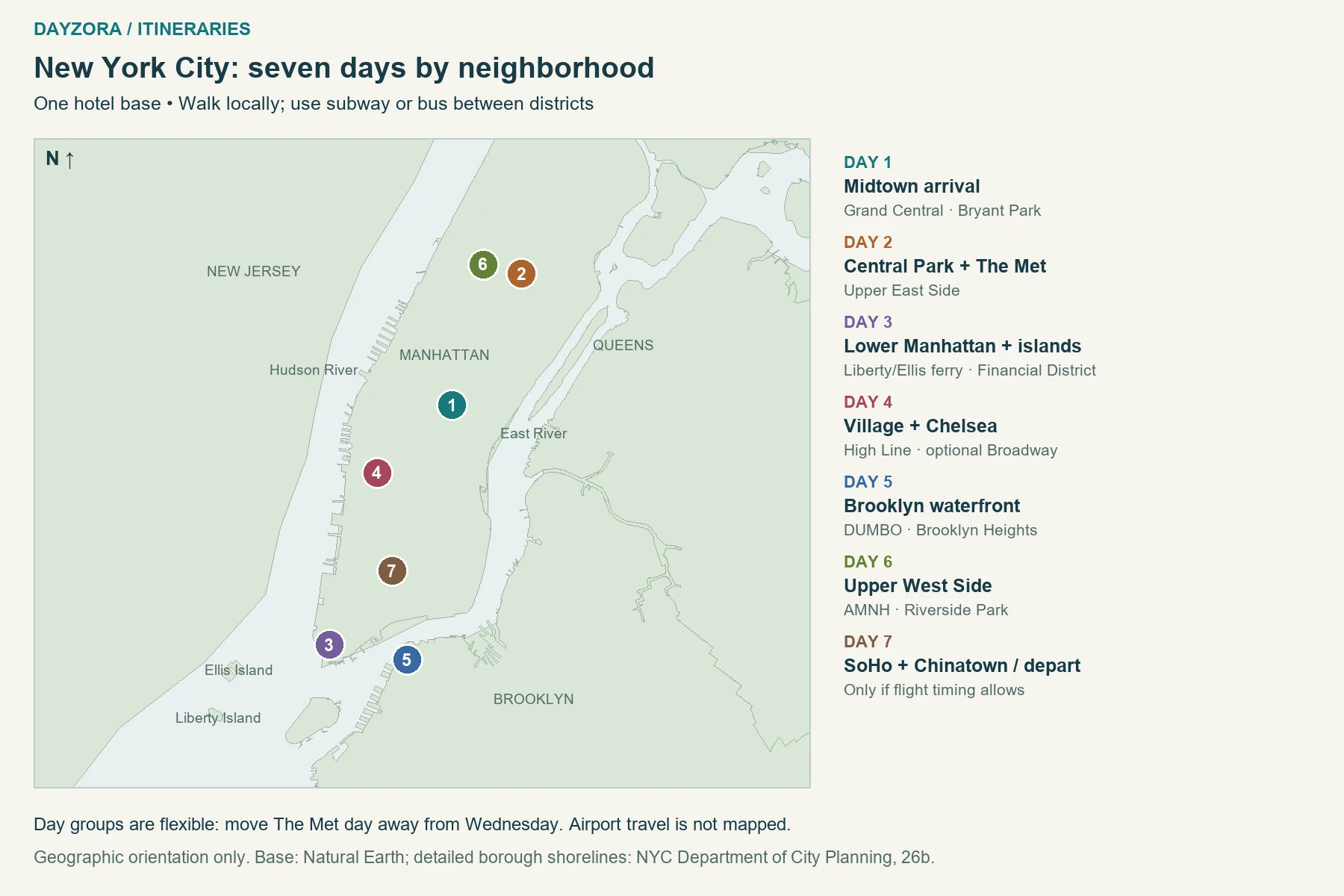
| Day | Neighborhood group | Main decision | Walking approach |
|---|---|---|---|
| 1 | Midtown | Arrival first; landmarks only if time | Short loop near the hotel |
| 2 | Central Park / Upper East Side | The Met is the main indoor visit | Choose one park section |
| 3 | Lower Manhattan / harbor islands | Liberty + Ellis OR 9/11 Museum | Allow security and ferry time |
| 4 | Village / Chelsea | High Line; optional evening show | A northbound neighborhood walk |
| 5 | Brooklyn waterfront | DUMBO, park and Brooklyn Heights | Local waterfront segments |
| 6 | Upper West Side | AMNH or a lighter park day | Museum plus a short outdoor walk |
| 7 | SoHo / Chinatown or departure | Flight timing decides | Optional small loop only |
Plan roughly 30–60 minutes for many hotel-to-district journeys once walking, waiting and station navigation are included; this is a scheduling allowance, not a measured duration for every hotel. Long sightseeing days can easily exceed your usual walking distance. Shorten a park section or take a bus before sore feet dictate the rest of the trip.
Your day-by-day New York City itinerary
Day 1: Arrive and get your bearings in Midtown
There is no essential reservation today. Leave room for a delayed flight, a longer airport transfer or an early night. If you arrive before your room is ready, confirm luggage storage rather than walking around with a suitcase.
- Morning / arrival
- Travel to the hotel, settle your bags and learn the nearest useful subway entrances. Check whether the entrance you need is accessible and whether it serves the direction you want.
- Lunch
- Choose a casual meal near the hotel. A deli, bagel shop or neighborhood café works well when the arrival time is uncertain.
- Afternoon
- If you are staying in Midtown and have energy, visit Grand Central’s public concourse and walk toward Bryant Park. Keep this to a compact orientation walk rather than adding a museum.
- Evening
- Have dinner nearby. A brief look at Times Square is optional; leave when the crowds or jet lag stop being enjoyable. Save an expensive show for a settled evening later in the week.
- Stay
- Your chosen NYC hotel, night 1 of 6. Use the same base throughout the itinerary.
- Transport and booking
- Use the airport options below. Make no nonrefundable attraction booking close to your scheduled landing time. Hotel check-in and bag storage policies matter more today than a sightseeing checklist.
Day 2: Central Park and The Met
Pair one section of Central Park with the Metropolitan Museum of Art’s Fifth Avenue building. The Met Cloisters is a different museum location much farther uptown and is not included in this day.
- Morning
- Spend about two hours in the southern or central part of Central Park, depending on your arrival point. Choose a small loop with places to sit instead of attempting the whole park before lunch.
- Lunch
- Eat near the park’s eastern edge or the Upper East Side before entering the museum. A proper lunch break makes a long indoor visit much more comfortable.
- Afternoon
- Allow 2–3 hours at The Met. Choose a few galleries that interest you, use the museum map and leave something for another visit. Seeing every department is not a useful one-afternoon goal.
- Evening
- Have dinner on the Upper East Side or return toward the hotel. Keep the evening open if this is your first full day after a long-haul flight.
- Stay
- The same hotel, night 2.
- Transport and booking
- Walk locally and use subway or bus for the hotel connections. Check The Met’s official visitor information: Fifth Avenue closes Wednesdays, and regional pay-what-you-wish eligibility does not apply to every visitor. The roof garden is not assumed open in this plan.
Day 3: The harbor islands and Lower Manhattan
Choose between an island-focused day and a museum-focused day before buying tickets. Visiting Liberty Island, Ellis Island and the 9/11 Museum in one tightly scheduled day leaves little room for queues, meals or reflection.
- Morning
- For the island option, take an early authorized Statue City Cruises departure from the Manhattan embarkation point at The Battery. Allow time for security and follow your ticket instructions carefully.
- Lunch
- Use a food break during the island visit or after returning, depending on the ferry schedule. Carry a snack that complies with the attraction’s rules rather than assuming an exact lunchtime on the mainland.
- Afternoon
- Continue to Ellis Island if your ticket and timing allow, then return to Manhattan. After both islands, a brief Financial District walk is enough. Do not attach a second substantial museum reservation.
- Evening
- Have an early dinner downtown or near the hotel. The outdoor 9/11 Memorial may fit after the ferry if you have time and energy; approach it as a memorial rather than another photo stop.
- Stay
- The same hotel, night 3.
- Transport and booking
- Use NPS visitor guidance to reach the authorized ferry seller. The reservation time is for the security queue, not a guaranteed ferry departure. Crown or pedestal access requires the appropriate ticket; general admission is not the same access.
Prefer the 9/11 Museum?
Replace the islands with a prebooked 9/11 Memorial & Museum visit, a lunch break and an unhurried Lower Manhattan afternoon. This is also a useful option for travelers who dislike boats. The museum can be emotionally demanding; leave the evening flexible. If seeing the Statue of Liberty from a boat is enough, research the specific ferry or cruise separately and understand that passing the island is not landing on it.
Day 4: Greenwich Village, Chelsea and an optional show
Today gives the itinerary a neighborhood rhythm after two major attraction days. Walk north through a manageable part of the Village and Chelsea, with pauses for food and sitting down.
- Morning
- Start around Washington Square and explore a few Greenwich Village streets. Choose a café and enjoy the area without trying to follow an exhaustive list of film locations or famous doorways.
- Lunch
- Eat in the Village or Chelsea. A sit-down lunch can be the main meal if you are planning a Broadway performance later.
- Afternoon
- Walk a selected section of the High Line after checking current access. Use an entrance and exit that match your energy and accessibility needs; there is no requirement to walk its full length. Leave time to return to the hotel.
- Evening
- If booked, have an early meal near the theater and arrive according to the venue’s instructions. Otherwise stay in Chelsea or return to a favorite neighborhood for dinner.
- Stay
- The same hotel, night 4.
- Transport and booking
- Walk between nearby sights, then use transit back to Midtown if attending a show. Check the High Line’s official visit page for hours, access and weather notices. Buy theater tickets from the production, venue or an authorized seller linked by them.
Day 5: DUMBO, Brooklyn Bridge Park and Brooklyn Heights
Make Brooklyn a destination in its own right. The waterfront gives you skyline views, places to pause and a different perspective on Manhattan without a day of repeated river crossings.
- Morning
- Take transit to DUMBO and explore the neighborhood before the busiest part of the day. Stay out of vehicle lanes when photographing the bridges and allow normal neighborhood activity to continue around you.
- Lunch
- Eat in DUMBO or near the waterfront. Choosing by location and current menu is more useful than spending an hour in a queue simply because a restaurant is famous online.
- Afternoon
- Walk selected sections of Brooklyn Bridge Park, then explore Brooklyn Heights and its promenade if energy allows. Families can swap additional walking for a playground break.
- Evening
- Have dinner in Brooklyn or return to Manhattan. If you want to walk the Brooklyn Bridge, make it a one-way journey at a comfortable time and use transit for the other direction.
- Stay
- The same hotel, night 5.
- Transport and booking
- Transit out and back keeps the day flexible. The optional bridge walk adds distance and exposure to weather; it should replace another walking segment if needed. Check park notices and allow extra time for busy pedestrian approaches.
Day 6: The Upper West Side at your own pace
Use this day for the American Museum of Natural History, or choose an outdoor alternative if you have reached your museum limit. The week is better when it reflects your interests rather than a required attraction count.
- Morning
- Visit AMNH with a ticket for your chosen date. Pick the halls or exhibitions that matter most and check whether special experiences need separate timed access.
- Lunch
- Eat on the Upper West Side after the museum or take a proper break during the visit according to its re-entry rules. With children, make food and rest part of the plan rather than a reward for finishing every hall.
- Afternoon
- Choose a short Riverside Park walk or time around Lincoln Center. If it is wet or very hot, shorten the outdoor portion and spend the remaining time at a café or resting.
- Evening
- Use the last full evening for a favorite neighborhood meal. A second show or observation deck is optional, but add it only if you still want another timed commitment.
- Stay
- The same hotel, night 6.
- Transport and booking
- Check AMNH’s official visit page and reserve the applicable admission and special-exhibition options. For a lighter alternative, skip the museum and combine a shorter park outing with a relaxed neighborhood lunch.
Day 7: SoHo and Chinatown only if your flight allows
Departure is the priority. An evening flight may leave space for a small final neighborhood loop, but the time needed to recover luggage and cross the city still belongs in the schedule.
- Morning
- If you have a late flight, leave bags at the hotel and explore a small area of SoHo and Chinatown. If departure is early, go directly to the airport instead.
- Lunch
- Choose a neighborhood meal only if it leaves a generous transfer buffer. Do not create a last-day queue or distant reservation that makes collecting bags stressful.
- Afternoon
- Return for luggage and begin the airport journey. Check the actual terminal, current service and your airline’s required arrival margin.
- Evening
- Fly home, or add a seventh hotel night if you want this to be a full sightseeing day.
- Stay
- No overnight included.
- Transport and booking
- Avoid making a final morning boat trip or a distant attraction the condition for enjoying the trip. Airport rail time is only one part of the door-to-terminal journey.
Getting around NYC and choosing an airport transfer
A rental car adds parking costs and does little for this itinerary. Use walking for local clusters and transit for longer moves. Check the train’s direction and whether it is express before boarding; a station entrance on the right street does not always serve the direction you need.
As checked September 26, 2026, the regular subway/local-bus fare is $3, with an OMNY $35 rolling seven-day fare cap for eligible rides. Use the same card or device consistently and a separate payment method for each traveler who needs their own cap. A physical card and that card in a phone wallet are not interchangeable for tracking rides. Airport AirTrain and other regional rail charges are separate. Recheck MTA fares and OMNY fare-cap rules before travel.
| Airport | Practical transit option | What to check |
|---|---|---|
| JFK | AirTrain plus subway; or AirTrain plus LIRR via Jamaica | The subway/AirTrain combination was $11.75 per adult one way at review; LIRR has a different fare. Add station walks and waiting. |
| LaGuardia | Free Q70 connection for terminals B/C to subway/rail transfer points | Terminal A requires an additional airport connection; check your terminal and accessibility needs. |
| Newark | AirTrain to the airport rail station, then an NJ TRANSIT train stopping at New York Penn | Newark Penn and New York Penn are different stations. Check AirTrain works and the complete terminal connection. |
Use the official JFK guide, LaGuardia guide and NJ TRANSIT Newark guide for your travel date. A taxi or car service may be worth comparing for several travelers with luggage, but include tolls, applicable surcharges and traffic in that comparison. Avoid relying on an advertised train ride alone as the entire airport transfer time.
Where to stay for six nights
| Area | Why it works | Tradeoff to check |
|---|---|---|
| Midtown near several subway lines | Convenient first-visit base and easy theater access | Noise, room size and total nightly charges vary greatly by block |
| Chelsea / Flatiron | Useful balance of local dining and Manhattan access | Some hotels are a longer walk from the subway than the neighborhood label implies |
| Upper West Side | Good for the museum and park days; a more residential evening feel | Longer journeys to Lower Manhattan and Brooklyn |
| Lower Manhattan | Useful for the island ferry and downtown visits | More travel to uptown museums and evening theater |
| Long Island City | Worth comparing for a lower total near a suitable subway station | Check the exact station, late-evening service and the walk to the hotel |
For a value-oriented stay, prioritize a reliable room and a short station walk. For a more expensive stay, pay for space, quiet or a location you will use every day. Compare the full six-night total including mandatory charges and taxes; a low first-night rate can be misleading. Families should verify bed configuration, occupancy limits and elevator access.
A transparent one-week NYC budget worksheet
This is an illustrative plan for two adults sharing one room for six nights, not current market pricing. Replace the room, meal and attraction allowances with actual choices. There is no rental car. The example includes seven food days and a separate airport-transfer allowance.
| Category | Example input | Trip total for two |
|---|---|---|
| Hotel | 6 × $300 all-in room allowance | $1,800 |
| Food | 2 × 7 days × $65 | $910 |
| Local transit | 2 × $35 eligible OMNY cap | $70 |
| Airport transfers | Planning allowance; method and airport vary | $70 |
| Attractions / entertainment | Selected admissions and optional show allowance | $350 |
| Subtotal | Before flights and contingency | $3,200 |
| Contingency | 15% | $480 |
| Example total | Flights, shopping and insurance excluded | $3,680 |
A traveler who takes fewer eligible rides may spend less than the fare cap. Taxis, express buses and regional rail can add costs beyond this transit allowance. If the trip extends past the rolling seven-day window, the same single cap does not cover every additional day.
The largest savings usually come from the hotel and the number of paid attractions. Compare individual tickets with a sightseeing pass only after choosing the sights you actually want and checking reservation rules. Free neighborhood walks do not make a packed pass itinerary better value. For a complete planning method, use How to Travel on a Budget.
Before you go: reserve the anchors and leave room between them
- Book the hotel after checking the exact subway access and airport connection. A neighborhood name alone is not enough.
- Reserve the authorized island ferry and any special-access ticket first; place that day where it fits the rest of the calendar.
- Check The Met’s Wednesday closure and the admission options at AMNH. Choose museum dates before filling every evening.
- Book a Broadway performance on a settled day and protect time for dinner, transit and the venue’s arrival instructions.
- Pack broken-in walking shoes, a light rain layer and seasonal clothing. Use the Travel Packing Checklist for the rest.
- For step-free travel, check current MTA elevator status and the attraction’s accessibility page, then choose a backup route. Do not assume every station entrance has an elevator.
Spring and fall suit long outdoor days, but weather can still change quickly. In summer, put longer walks earlier and plan an indoor afternoon break. In winter, shorten waterfront outings and use daylight deliberately. Heavy rain is a reason to swap entire day groups, not to force the same walk under worse conditions.
How to customize one week in New York
Only five days
Keep arrival, a Central Park/Met day, a Lower Manhattan day, a Brooklyn day and departure. Remove the second museum day and the separate Village/Chelsea day. If art museums are not your priority, replace the Met with AMNH rather than squeezing both into one afternoon.
Eight to ten days
Add a full uncommitted neighborhood day and give either museum more time. A separate observation-deck visit or another borough can then have its own space. Choose one area of Queens or the Bronx based on your interests and verify the attraction and transport details before adding it; do not treat an entire borough as a quick stop.
With kids
Limit the museum to a few selected halls, include playground or park time and keep one easy meal option near the hotel. The ferry, bridges and busy stations require attention even when the itinerary contains no difficult activity. A stroller-friendly route should be checked against current elevator access, not just distance.
A slower week
Keep all six hotel nights but remove one museum and the optional bridge walk. Make SoHo/Chinatown part of a free afternoon rather than a departure-day obligation. Sitting in a park or returning to a neighborhood you liked is a reasonable use of the extra time.
Common NYC itinerary mistakes
- Booking Liberty Island, Ellis Island and the 9/11 Museum as a rapid sequence of fixed appointments.
- Crossing the city for breakfast, lunch and dinner instead of eating near the day’s sights.
- Buying a sightseeing pass before checking the attractions you will realistically use.
- Treating The Met Fifth Avenue and The Met Cloisters as the same location.
- Switching payment devices during the week and expecting one OMNY fare cap to follow automatically.
- Using a station-to-station airport estimate without adding bags, hotel access, waiting and terminal time.
New York City itinerary FAQs
Is seven days too long for NYC?
No. With arrival and departure included, this plan has five full sightseeing days. The extra time lets you see several neighborhoods without filling every hour.
Do I need to stay in Times Square?
No. Convenient subway access and a hotel that suits your budget matter more. Midtown is practical, but Chelsea, the Upper West Side, Lower Manhattan and selected Long Island City locations can also work.
Can I walk everywhere?
You can walk within the daily clusters, but the whole itinerary covers too much ground to make walking every transfer pleasant for most visitors. Use transit between districts.
Which day should move if the weather is bad?
Move a museum-centered day into the wettest weather, subject to closures and ticket availability. Keep Brooklyn and the longer park walks for a better forecast when practical.
For a shorter city break, compare our weekend getaways guide. If your next week is about coastlines and driving, the 7-day California itinerary offers a very different pace. Start flight comparisons with our cheap flights guide and include the airport transfer in the total.
City guides for planning your stay
For neighborhood comparisons, places to stay, food and local transport, explore our New York City travel guide. Use this itinerary for the day-by-day route.


Pingback: 30 Best Places to Visit in the USA in 2026 | DayZora