
Last updated: September 26, 2026. Official information checked on this date. DayZora is an independent editorial publisher, not a FIFA or club partner.
The FIFA Women’s World Cup 2027 stadiums are spread across eight Brazilian host cities, from Fortaleza in the northeast to Porto Alegre in the south. The right base depends on your match dates, the kind of city break you want and how much time you are willing to spend changing airports and hotels. This guide combines the confirmed venue programme with practical travel choices: airport gateways, accommodation areas, sightseeing priorities and the difference between a stadium’s normal capacity and its eventual tournament configuration. Rio de Janeiro hosts the opening match and final; São Paulo has the largest number of games. Recife requires particular care because its venue is outside the city in São Lourenço da Mata. The stay lengths and neighborhood recommendations below are DayZora’s editorial planning suggestions, not official packages or firsthand hotel reviews. For qualification, the draw and tournament format, use the main Women’s World Cup 2027 guide.
Confirmed: eight host cities and stadiums, tournament dates of June 24–July 25, 2027, and FIFA’s date/venue framework.
Still to come: most named opponents, kickoff times, final tournament seating inventories and detailed 2027 transport and gate plans. No suggested route below is an announced FIFA shuttle service.
Map of Brazil’s eight confirmed host cities
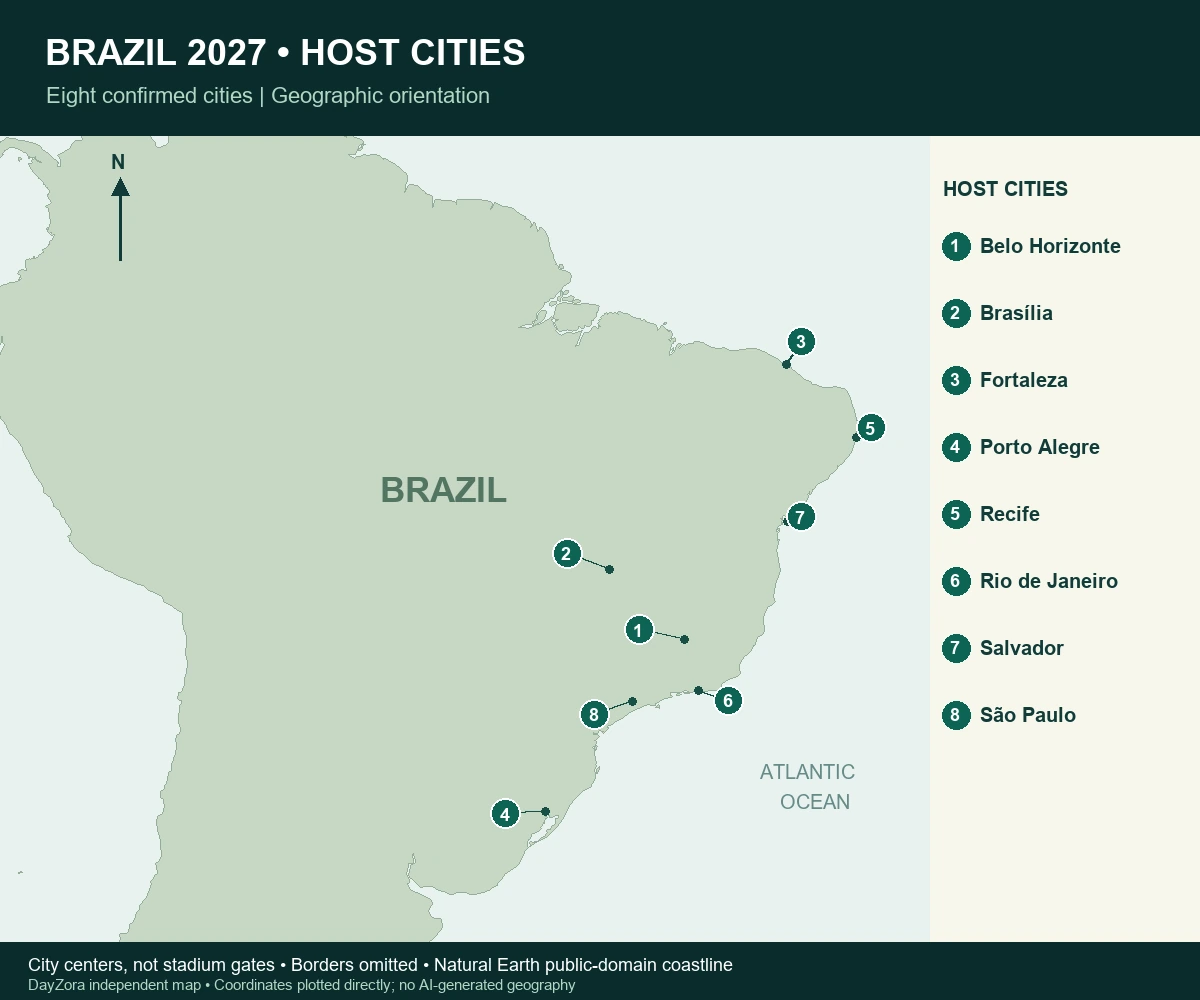
Use the numbered city links in the contents to jump to each travel profile. The map is deliberately static for reliable mobile reading; its purpose is to show the distances and regional pattern without loading an external map service. Recife’s marker identifies the host city, while its stadium is in neighboring São Lourenço da Mata.
Host cities and stadiums compared
| City | FIFA stadium name | Matches | Latest stage | Suggested stay |
|---|---|---|---|---|
| Belo Horizonte | Estádio Mineirão | 8 | Quarter-final | 3–4 nights |
| Brasília | Estádio Nacional | 7 | Round of 16 | 2–3 nights |
| Fortaleza | Arena Castelão | 9 | Quarter-final | 3–4 nights |
| Porto Alegre | Estádio Beira-Rio | 7 | Round of 16 | 2–3 nights |
| Recife | Arena Pernambuco | 7 | Round of 16 | 3–4 nights |
| Rio de Janeiro | Estádio do Maracanã | 9 | Final | 4–5 nights for a city visit; longer for multiple rounds |
| Salvador | Arena Fonte Nova | 7 | Round of 16 | 3–4 nights |
| São Paulo | Arena Itaquera | 10 | Semi-final and third-place match | 3–4 nights |
Suggested stays include a match and city time, but exclude your international journey. The stadium facts below distinguish normal published capacity from the still-unconfirmed 2027 configuration. Where a current, comparable normal figure could not be established, we leave the tournament figure unconfirmed instead of using a historic World Cup total as if it were current.
1. Belo Horizonte — Estádio Mineirão
Official stadium name: Estádio Governador Magalhães Pinto
Opened: 1965 · Home club context: Cruzeiro; also a historic Atlético Mineiro home
Capacity: Up to approximately 62,000 in the operator’s general venue description; 2027 allocation not confirmed
Major airport gateway: Belo Horizonte–Confins (CNF)
Allocated match dates: June 26, 28 and 30; July 2, 5, 7, 11 and 16, 2027.
What soccer fans should know
Mineirão is the natural choice for a trip that gives football and everyday city life equal weight. Its 2014 World Cup semi-final is part of the stadium’s international story, but the local identity also comes from Minas Gerais club football. The arena is in Pampulha, away from the restaurant districts many first-time visitors choose. That makes hotel location a practical decision rather than a simple question of distance from downtown.
Getting to the stadium
Plan a road-based journey to Pampulha and use the tournament’s eventual designated arrival points. Do not assume that a metro station places you at the stadium entrance. Confins is the main air gateway; the airport-to-hotel trip and hotel-to-stadium trip need separate planning. A car close to the ground can still be outside a match-day road closure.
Where to stay and what to do
Areas to compare: Savassi or Lourdes for restaurants and a city-focused stay; Pampulha for proximity to the stadium district.
Put Pampulha’s architecture on a non-match morning, then leave the afternoon flexible. On another day, use the Praça da Liberdade area for cultural stops rather than trying to combine every museum with a stadium visit. Minas food is a good reason to allow an unhurried dinner after a sightseeing day.
Suggested stay: 3–4 nights. Match-day planning: The July 11 round-of-16 game and July 16 quarter-final leave room for a longer city stay. Buying both does not guarantee that the same team appears in both matches.
Official venue / tournament facts
Official visitor or transport information
2. Brasília — Estádio Nacional
Official stadium name: Estádio Nacional Mané Garrincha
Opened: 1974; extensively rebuilt for 2013 · Home club context: Major club and national-team fixtures; no single regular top-flight tenant assumed
Capacity: 2027 tournament seating allocation to be confirmed; no final ticket inventory announced
Major airport gateway: Brasília International Airport (BSB)
Allocated match dates: June 25 and 27; July 1, 4, 6, 8 and 13, 2027.
What soccer fans should know
Brasília offers a different kind of football trip from Brazil’s coastal cities. Modernist architecture, large ceremonial spaces and a deliberately planned urban form define the visit. Estádio Nacional hosted the 2014 men’s World Cup third-place game and is assigned Brazil’s last 2027 group match. Choose it for architecture and a focused match visit rather than expecting a compact old-town district around the arena.
Getting to the stadium
Compare the actual entrance route from your hotel rather than judging by the short line on a map. Broad roads and large public spaces can make a seemingly modest distance an awkward walk. Plan an authorized taxi, app-based ride or the official match transport once announced. BSB is the practical airport gateway; flight availability does not settle the final stadium transfer.
Where to stay and what to do
Areas to compare: North or South Hotel Sector for a central sightseeing base.
Group the monumental sights geographically and allow time between them. A cathedral visit and an architectural walk can fit a non-match day, while a museum-heavy programme deserves more time. In a city built on a large scale, a smaller list of stops is usually more satisfying than repeated cross-city transfers.
Suggested stay: 2–3 nights. Match-day planning: Brazil plays here on July 4. If you are following the host team, leave its next destination flexible until the group result determines the bracket. Brasília’s last allocated game is July 13.
Official venue / tournament facts
Official visitor or transport information
3. Fortaleza — Arena Castelão
Official stadium name: Estádio Governador Plácido Aderaldo Castelo
Opened: 1973 · Home club context: Ceará and Fortaleza
Capacity: 63,904 in the Ceará government’s stadium listing; FIFA 2027 configuration to be confirmed
Major airport gateway: Fortaleza–Pinto Martins (FOR)
Allocated match dates: June 26 and 28; July 2, 4, 6, 8, 10, 13 and 17, 2027.
What soccer fans should know
Fortaleza works well for supporters who want a coastal base with a substantial run of games. Castelão is inland, south of the main waterfront hotel areas; a beach holiday and a stadium visit therefore involve separate parts of the city. Its tournament history includes the 2013 Confederations Cup and 2014 World Cup. The 2027 programme adds two round-of-16 matches and a quarter-final to six group games.
Getting to the stadium
Allow a dedicated road transfer between the waterfront and stadium. A hotel’s sea view is not evidence of convenient stadium access. Check the eventual match-day transport plan and arrange a clear return meeting point outside any restricted perimeter. FOR is the main airport; avoid assuming a late arrival leaves time for a same-day match.
Where to stay and what to do
Areas to compare: Meireles or Mucuripe for a Beira-Mar base.
Use a non-match day for a beach outing and a separate block for the Dragão do Mar district. Do not attach a distant excursion to the morning of an important game. A waterfront base can make relaxed mornings easy, but match days should be planned around traffic and stadium entry rather than a full sightseeing checklist.
Suggested stay: 3–4 nights. Match-day planning: The Ceará government dates Castelão’s opening to November 11, 1973. Some secondary and tournament descriptions give 1972; this guide uses the local authority’s anniversary record. Neither that history nor a normal capacity figure confirms the 2027 seating plan.
Official venue / tournament facts
Official visitor or transport information
4. Porto Alegre — Estádio Beira-Rio
Official stadium name: Estádio José Pinheiro Borda
Opened: 1969; renovated for 2014 · Home club context: Sport Club Internacional
Capacity: Approximately 50,800 in current club/operator descriptions; 2027 seating allocation to be confirmed
Major airport gateway: Porto Alegre–Salgado Filho (POA)
Allocated match dates: June 26, 28 and 30; July 3, 5, 8 and 12, 2027.
What soccer fans should know
Beira-Rio places a club ground beside Porto Alegre’s waterfront rather than inside a detached events precinct. Internacional’s identity gives it a different feel from a national stadium. The city hosted 2014 World Cup games and has seven matches in the 2027 allocation. A southern base also changes the packing calculation: June and July are winter, so this is not a trip to plan as if every Brazilian venue had the same coastal conditions.
Getting to the stadium
Use POA for air access and check the final event-day route to Beira-Rio. Road restrictions can change where a taxi or ride service drops you. The waterfront is a useful landmark but is not a substitute for your ticket’s gate instructions. Keep a return plan that works after dark and in poor weather.
Where to stay and what to do
Areas to compare: Moinhos de Vento for a neighborhood base, or Centro Histórico for central sights.
Reserve one daylight period for the Guaíba waterfront and another for central cultural sights. Moinhos de Vento provides a neighborhood alternative when you want a park and a slower day between games. Weather can change the appeal of a long outdoor walk, so leave a flexible indoor option rather than prebooking every hour.
Suggested stay: 2–3 nights. Match-day planning: The club and venue publish slightly different normal seating totals, both around 50,800. This guide rounds that baseline instead of presenting a false single-seat precision. Tournament inventory remains a separate figure.
Official venue / tournament facts
Official visitor or transport information
5. Recife — Arena Pernambuco
Official stadium name: Arena Pernambuco, São Lourenço da Mata, metropolitan Recife
Opened: 2013 · Home club context: Regional club fixtures; no permanent tenant assumption
Capacity: 2027 tournament capacity to be confirmed; older state material describes approximately 46,000, not a verified final 2027 total
Major airport gateway: Recife–Guararapes / Gilberto Freyre (REC)
Allocated match dates: June 27 and 29; July 1, 3, 5, 7 and 10, 2027.
What soccer fans should know
The key fact for a Recife football trip is geographical: Arena Pernambuco is in São Lourenço da Mata, west of the city’s central and beachfront districts. It is not a stadium you reach by a short stroll from a Boa Viagem hotel. The travel reward is a base that combines a 2014 World Cup venue with Recife’s historic core and a separate visit to Olinda.
Getting to the stadium
Plan the stadium journey as its own substantial outing. Any tournament rail-and-shuttle arrangement needs an official 2027 announcement; do not assume that a service used for an earlier event will operate again. REC is the airport gateway. Keep the stadium transfer separate from your airport arrival, especially if baggage, hotel check-in or a connection is involved.
Where to stay and what to do
Areas to compare: Boa Viagem or Pina for accommodation choice; compare a central base if historic sightseeing is your priority.
Give Recife Antigo a dedicated half-day rather than using it as a rushed stop on the way to the arena. Olinda is a separate outing with its own travel time and walking demands. A three- or four-night stay can accommodate a match, the historic district and Olinda without making every day a transfer exercise.
Suggested stay: 3–4 nights. Match-day planning: For an early knockout trip, Recife’s July 10 round-of-16 game is useful. It is also the city’s final scheduled tournament match. Check your next city before extending accommodation in the hope of a later round.
Official venue / tournament facts
Official visitor or transport information
6. Rio de Janeiro — Estádio do Maracanã
Official stadium name: Estádio Jornalista Mário Filho
Opened: 1950; rebuilt for the 2013 reopening · Home club context: Flamengo and Fluminense
Capacity: 78,838 in the official stadium-tour operator’s description; 2027 tournament allocation to be confirmed
Major airport gateway: Rio de Janeiro–Galeão (GIG) for international access; Santos Dumont (SDU) for many domestic services
Allocated match dates: June 24, 26 and 30; July 3, 5, 7, 16, 21 and 25, 2027.
What soccer fans should know
Rio is the strongest choice for fans who want the tournament’s ceremonial beginning or final. Maracanã hosted the decisive match of the 1950 men’s World Cup and the 2014 men’s final; in 2027 it hosts the opening game, a semi-final and the final. The 1950 match was part of a final group, so describing it as an ordinary knockout final would be inaccurate.
Getting to the stadium
MetrôRio serves Maracanã, but follow event guidance for the correct station exit and ticket gate. The best hotel is not necessarily the closest one: a manageable metro walk and a sensible evening return can matter more than stadium proximity. GIG and SDU are different airports. Check which one your domestic flight uses before calculating a connection or hotel transfer.
Where to stay and what to do
Areas to compare: Botafogo, Copacabana or Ipanema, comparing the actual metro walk and evening return.
Separate your major sightseeing from match entry. Rio’s viewpoints and waterfront districts can each absorb substantial time, particularly when weather or queues intervene. Do not promise yourself a full-day excursion and an effortless stadium arrival. A four- or five-night stay gives space for the match, city exploration and a weather-dependent activity.
Suggested stay: 4–5 nights for a city visit; longer for multiple rounds. Match-day planning: There is a long gap between the July 7 group game and July 16 quarter-final. A tournament-long Rio booking suits a city holiday, but it does not provide uninterrupted football. The final date is confirmed; a particular team’s participation is not.
Official venue / tournament facts
Official visitor or transport information
7. Salvador — Arena Fonte Nova
Official stadium name: Arena Fonte Nova
Opened: 2013 for the present arena · Home club context: Esporte Clube Bahia
Capacity: 48,661 in the operator’s venue description; FIFA 2027 configuration to be confirmed
Major airport gateway: Salvador–Deputado Luís Eduardo Magalhães (SSA)
Allocated match dates: June 25, 27 and 29; July 2, 4, 7 and 12, 2027.
What soccer fans should know
Salvador gives a football itinerary a strong cultural focus. The current Fonte Nova opened in 2013 and hosted matches at the 2014 World Cup and 2016 Olympics. Its setting is closer to the historic city than a distant suburban arena, but the surrounding streets and changes in level still matter when choosing an approach. A cultural visit and a match fit well together when they are given separate time.
Getting to the stadium
Use SSA as the airport gateway and check the official tournament plan for the final stadium approach. Do not assume that the nearest-looking hotel gives the easiest walking route, particularly if stairs or gradients are difficult for you. Ask accommodation staff about a practical daytime route and use the tournament’s gate information for match day.
Where to stay and what to do
Areas to compare: Barra for a coastal base, Rio Vermelho for dining, or the historic center for a culture-focused stay.
Give Pelourinho time for an unrushed visit. Barra offers a different coastal setting, while Rio Vermelho suits travelers who want dining to structure their evenings. These are different bases rather than interchangeable hotel labels. Choose according to the days around your match, then budget the stadium journey explicitly.
Suggested stay: 3–4 nights. Match-day planning: The published programme ends on July 12 with a round-of-16 match. A three- or four-night stay can pair one match with cultural time; a multi-match stay needs to be built around the actual date gaps.
Official venue / tournament facts
Official visitor or transport information
8. São Paulo — Arena Itaquera
Official stadium name: Arena Itaquera, commonly Neo Química Arena
Opened: 2014 · Home club context: Corinthians
Capacity: 2027 tournament seating allocation to be confirmed; do not reuse the temporary 2014 World Cup capacity
Major airport gateway: São Paulo–Guarulhos (GRU) for international access; Congonhas (CGH) for many domestic services
Allocated match dates: June 25, 27 and 29; July 1, 4, 8, 11, 17, 20 and 24, 2027.
What soccer fans should know
São Paulo has the tournament’s largest allocation, with ten games including a semi-final and the third-place match. The stadium opened for the 2014 World Cup and is Corinthians’ home. Its location in Itaquera, in the east of the city, is crucial: a central hotel can be a good sightseeing base while still requiring a long match-day journey. The commercial stadium name and FIFA’s Arena Itaquera refer to the same ground.
Getting to the stadium
Build your plan around the full journey to Itaquera, then the correct entrance. Verify rail or metro service and any event changes through official transport guidance when published. GRU and CGH are different airports; a cheap domestic fare is less attractive if it creates a difficult cross-city airport transfer. Do not use straight-line distance to estimate arrival time.
Where to stay and what to do
Areas to compare: Paulista or another well-connected central district; Pinheiros for a neighborhood stay after checking the full route.
A park or museum day and a food-focused neighborhood day provide a useful counterweight to football. Keep the match day lighter. São Paulo rewards a selective itinerary: changing neighborhoods repeatedly can consume time that would be better spent exploring one area properly.
Suggested stay: 3–4 nights. Match-day planning: Brazil’s second group match is June 29. The July 20 semi-final and July 24 third-place match create a separate late-tournament option. The bronze match involves the losing semi-finalists, so it is not a second chance to watch a finalist.
Official venue / tournament facts
Official visitor or transport information
Choose a practical Brazil football route
Start with the number of matches you want to attend, then decide how many hotel changes that justifies. One city with two well-spaced games can be a better football holiday than three cities with little time outside terminals. Domestic flights are an option to compare, not a guarantee of a direct service on your chosen dates. Leave a buffer before the match you care about most.
One city: simplest for a short trip
Choose Rio for the opening or final, São Paulo for the broadest allocation, or another host city for a specific cluster of dates and a different travel focus. A single base gives you time to learn the transport route before match day. It also avoids a common cost trap: a cheap hotel in each city can still produce an expensive holiday once transfers and flights are added.
Two cities: choose a deliberate contrast
Rio and São Paulo can combine two very different urban stays, but still require a real travel day and careful airport selection. A northeast pairing such as Recife and Salvador can offer cultural variety, but the cities are not neighboring suburbs. Compare actual flight schedules and hotel nights before deciding that a regional pairing is automatically easy.
Follow Brazil’s group-stage route
Brazil’s confirmed dates are June 24 in Rio, June 29 in São Paulo and July 4 in Brasília. Those gaps make an organized three-city route possible in principle. The more demanding question is whether you want that many transfers and can secure the relevant tickets. Keep post-group travel flexible because Brazil’s finishing position determines its knockout route; reaching the next round is not guaranteed.
Booking and match-day checklist
Book in this order: establish the match you want, check the official ticket channel, choose a realistic city route, then compare accommodation and transport conditions. Do not reverse the process by buying a complicated flight itinerary around an imagined draw. The final draw is scheduled for December 11, 2026.
- Tickets: start with FIFA ticket information. Confirm the actual match, seat type and purchase conditions.
- Hotels: compare the street and transport connection, cancellation deadline and late-arrival policy. Neighborhood suggestions are starting points, not guarantees about every property.
- Airports: check the airport code on every booking. Rio and São Paulo each have more than one important passenger airport.
- Arrival: reach the host city with a buffer before your key match. Weather, baggage or a missed connection can consume the time a tight plan leaves free.
- Gate and bags: use the final tournament rules. A stadium’s ordinary club rules may change for FIFA matches.
- Access needs: verify the whole route, including the last approach, entrance, seat and return transport.
- After the match: choose a meeting point and a return option before entering. Expect crowds to slow the exit.
Pack for the cities you will actually visit. Southern winter conditions, a long stadium approach and changeable outdoor plans call for more than a beach bag. Use DayZora’s packing checklist and international travel preparation guide as planning aids. For costs, separate tickets, domestic flights, transfers, accommodation and daily spending using our travel budget guide.
Frequently asked questions
Which city hosts the final?
Rio de Janeiro, at Maracanã on July 25, 2027. São Paulo hosts a semi-final and the third-place match, not the final.
Are all the stadiums inside their named host cities?
No. Arena Pernambuco is in São Lourenço da Mata in metropolitan Recife. Treat the host-city label as a regional destination, not a precise stadium address.
Can I use 2014 stadium capacities to estimate tickets?
No. Temporary seating and different event configurations make historic totals unsuitable as current 2027 ticket inventory.
Are the suggested hotel areas official fan zones?
No. They are editorial areas to compare for accommodation and sightseeing. Official fan zones, transport hubs and event arrangements require separate announcements.
Can I visit all eight cities during the tournament?
It may be possible to construct such a route, but it creates substantial travel and leaves little flexibility. Most readers will get more from one or two bases chosen around actual tickets.
Where are teams, groups and qualification covered?
The main World Cup guide holds the confirmed team list, draw information and schedule status. This page focuses on the physical trip.
Continue with the confirmed tournament guide or explore our worldwide stadium travel selection.
Explore more in DayZora Soccer.

Pingback: FIFA Women’s World Cup 2027: Teams, Dates & Venues