
There’s a special kind of restlessness that sets in around hour three of a long drive. The snacks are half-gone, the playlist is looping, someone’s asking “are we there yet,” and the highway looks exactly like it did fifty miles ago. Every road trip hits this wall — the difference between a miserable drive and a memorable one is having a plan for it.
This guide has you covered with 40 road trip games and activities organized by type: no-supply classics you can start instantly, active car games that burn off energy, audio entertainment for the whole crew, and quiet solo activities for kids (and adults) who need to zone out. You’ll also find age recommendations for every game and a packing checklist so the car is stocked before you leave the driveway.
The golden rule of road trip entertainment: variety beats volume. Ten games rotated at the right moments will carry you further than forty games dumped on everyone at once. Start with the easy classics, save the big-energy games for the restless stretches, and keep the quiet activities in reserve for when someone needs to recharge. Think of the drive itself as part of the vacation — a road trip is the perfect staycation extension.
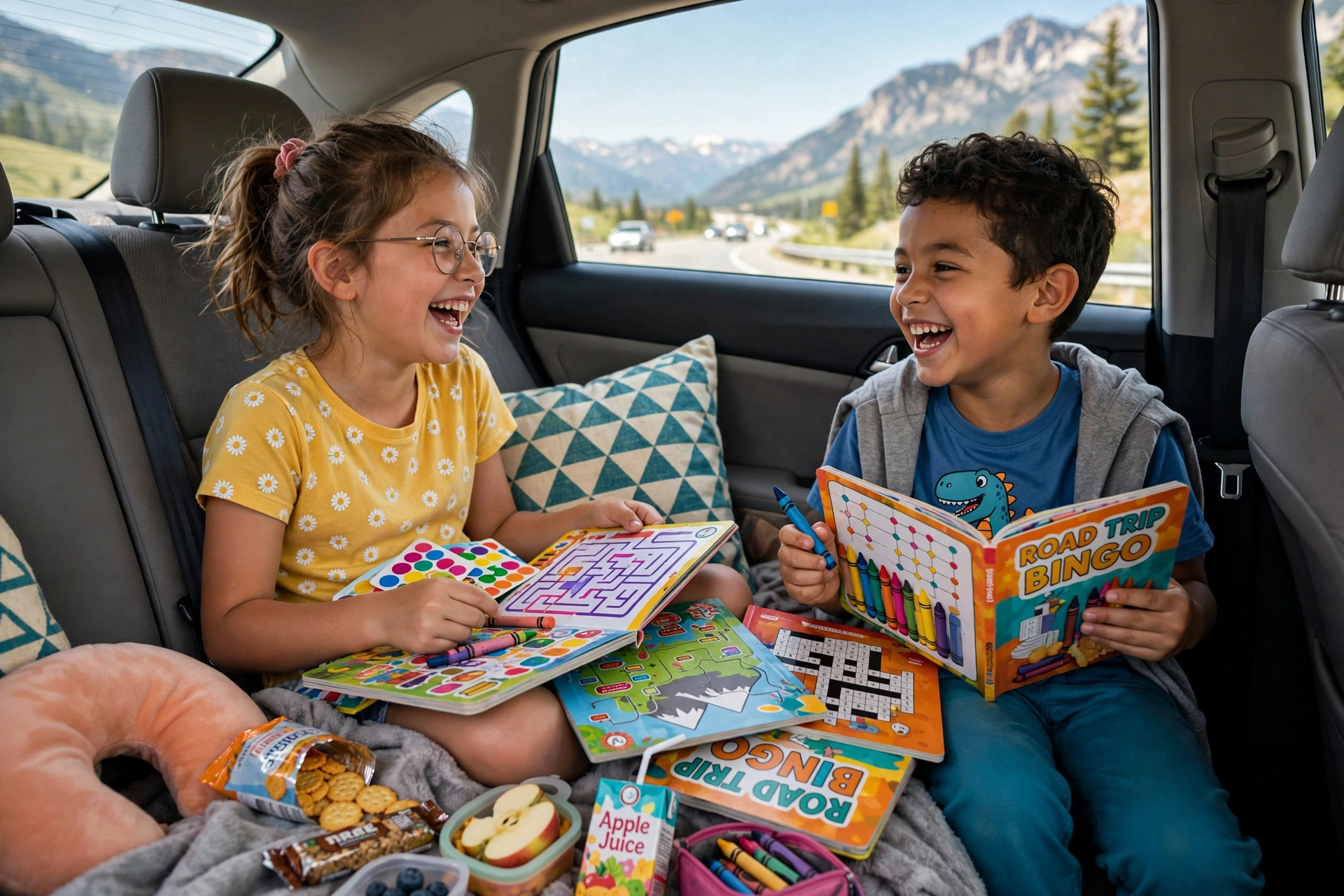
No-Supply Classics: Zero Prep, Instant Fun
These are the games that need nothing but the people in the car and the world outside the windows. They’re the backbone of every great road trip because you can start them the second boredom strikes.
1. Twenty Questions (Ages 5+)
One person thinks of something — a person, place, or thing — and everyone else gets 20 yes-or-no questions to figure it out. Start broad (“Is it alive?”) and narrow down. For younger kids, stick to animals or objects in the car; for teens and adults, allow anything from historical figures to kitchen appliances. The sweet spot is when the answer is guessable but not obvious.
Pro tip: With little kids, drop it to 10 questions and let the thinker give hints after five wrong guesses. It keeps the game moving instead of stalling out.
2. The License Plate Game (Ages 6+)
Spot license plates from as many different states as you can. Keep a running list on a phone or a piece of paper. On interstate highways you’ll rack up a dozen states in a few hours; the rare ones (Hawaii, Alaska, Maine on a southern highway) become legendary.
Level up: Turn it into a competition — first person to spot a new state gets a point, and spotting the same state twice doesn’t count. For a longer challenge, try to spell a word using the letters on plates you pass.
3. I Spy (Ages 4+)
The eternal classic. “I spy with my little eye, something… red.” It works because the world outside the window is constantly refreshing the game board. For older kids and adults, make it harder: spy things that are only visible for a few seconds, or use cryptic clues (“I spy something that wasn’t here a hundred years ago” — a billboard, a power line).
4. The Alphabet Game (Ages 6+)
Find the letters A through Z in order on road signs, billboards, and license plates. One player calls out letters as they spot them; the catch is you can’t use the same sign for two letters, and license plates don’t count for the hard letters (or do — house rules). Q, X, and Z are where road trips are won and lost. This one quietly eats 30–45 minutes.
5. Fortunately / Unfortunately (Ages 8+)
A storytelling game: one person starts with a sentence (“We were driving through the desert…”), and the next person continues with a sentence starting with “Unfortunately,” then the next with “Fortunately,” alternating. It gets gloriously absurd fast — “Fortunately, the alien was friendly. Unfortunately, he wanted a ride.” Great for creative kids and funny adults.
6. Would You Rather: Road Trip Edition (Ages 8+)
Classic would-you-rather, themed for the road: “Would you rather drive through a thunderstorm or a blizzard?” “Would you rather have unlimited snacks but no music, or unlimited music but no snacks?” The best rounds come from everyone defending their answer. Keep a few genuinely hard ones in your back pocket.
7. The Name Game / Categories (Ages 7+)
Pick a category — countries, movies, dog breeds, breakfast cereals — and go around the car naming one item each. If you hesitate too long or repeat, you’re out; last person standing picks the next category. For adults, try harder categories (Oscar winners, state capitals, 90s one-hit wonders). For kids, keep it to animals, colors, and foods.
8. Story Chain (Ages 6+)
One person says a sentence, the next adds a sentence, and the story builds. Unlike Fortunately/Unfortunately, there are no constraints — which means the story can go anywhere. Record the best ones on a phone; some families have story-chain sagas that span multiple road trips.
9. The Quiet Game (Ages 4–10, and exhausted parents)
Whoever stays quiet the longest wins. It sounds like a joke, but deployed strategically — say, 20 minutes before a planned stop — it’s a legitimate parenting tool. Set a timer so there’s a clear end. The prize can be picking the next snack or choosing the next game.
10. Two Truths and a Lie (Ages 8+)
Each person shares three “facts” about themselves — two true, one false — and everyone guesses the lie. On a family road trip, this gets hilarious because you think you know everything about each other and you absolutely do not. (“I once got stuck in an elevator with a celebrity” is always worth investigating.)
11. The Rhyming Game (Ages 5+)
One person says a word; the next has to say a word that rhymes with it. Keep going until someone can’t think of one. Start easy (cat, hat, bat) and watch it get competitive. For older players, ban the obvious rhymes after the first round.
12. Guess the Song (Ages 6+)
One person hums, whistles, or taps the rhythm of a song; everyone else guesses. No lyrics allowed. It’s much harder than it sounds, which is exactly why it’s fun. Playlist-era kids who’ve never heard the radio will surprise you with what they know.
Active Car Games: Burn Off That Restless Energy
When everyone’s been sitting too long and the wiggles set in, you need games with a little more juice — things that involve movement (as much as seatbelts allow), competition, and silliness.
13. Car Bingo (Ages 5+)
Before the trip, print or draw bingo cards with things you’ll see on the road: a red truck, a cow, a bridge, a fast-food sign, a motorcycle, a tunnel. First to get five in a row wins. You can find free printable road trip bingo cards online, or make custom ones together the night before — making the cards is half the fun for kids.
14. Punch Buggy / Slug Bug (Ages 6+)
Spot a Volkswagen Beetle, call “punch buggy!” and gently punch a sibling’s arm (house rules on force — keep it light). Different colors can be worth different points. It’s old, it’s silly, and kids still love it. Important: establish the no-hitting-hard rule before the first Beetle appears, not after.
15. The Cow Game (Ages 5+)
Count cows on your side of the car; each cow is a point. Pass a cemetery on your side and you lose all your points (“your cows died”). First to 50 wins. It’s ridiculous, it’s morbid in a way kids find hilarious, and it keeps eyes on the windows for miles.
16. Thumb War Tournament (Ages 6+)
Bracket-style thumb wars between passengers. Best of three per match, winners advance. It requires leaning across seats, so save it for when the car is stopped or moving slowly — or designate the front passenger as referee and run matches between back-seat players only. Silly? Absolutely. Effective against boredom? Completely.
17. The Waving Game (Ages 4+)
Wave at truck drivers and see who waves back. Truckers are famously good sports about this. Keep score: one point per wave returned, bonus point if they honk. It’s pure, wholesome road trip joy — and it works just as well for waving at people in other cars (most will wave back, delighted).
18. Scavenger Hunt (Ages 6+)
Make a list of 15–20 things to spot before the next stop: a yellow car, a water tower, someone wearing a hat in another car, a funny bumper sticker, a windmill. First to find everything wins. Unlike bingo, it’s a race rather than a grid — better for competitive kids.
19. Mad Libs (Ages 7+)
The classic fill-in-the-blank stories, road-trip style. One person asks for nouns, verbs, and adjectives without revealing the story; the results are always funnier read aloud in a car. Bring a Mad Libs pad or use a free app. Fair warning: this one causes the kind of laughter that makes the driver ask what’s going on.
20. The Singing Game / Song Association (Ages 8+)
One person sings a line from a song containing a word (say, “road”); the next person has to sing a line from a different song containing the last word of the previous line. It chains together and collapses hilariously. For families, allow humming if someone can’t remember lyrics.
Audio Entertainment: Podcasts, Audiobooks & Playlists
Sometimes the best road trip activity isn’t a game at all — it’s something everyone experiences together through the speakers. Audio entertainment is the secret weapon for the long, flat stretches where games feel like too much effort.
21. Family Podcasts (Ages vary)
Podcasts built for the car, where adults won’t suffer and kids stay hooked:
- Story Pirates (ages 5+) — kids’ story ideas turned into sketch comedy and songs. Genuinely funny for grown-ups too.
- Brains On! (ages 6+) — science answers to kids’ questions, high energy, great for curious minds.
- Smash Boom Best (ages 7+) — a debate show where two things face off (pizza vs. tacos, dragons vs. unicorns). Sparks the best car arguments.
- The Past and the Curious (ages 7+) — weird history stories, well told.
- For adults/teens: This American Life, Radiolab, The Moth, or a true-crime series everyone agrees on — a gripping multi-episode series can carry an entire day’s drive.
22. Audiobooks for the Whole Car (Ages 8+)
One audiobook, everyone listening, no screens. It turns the car into a rolling book club. Reliable crowd-pleasers:
- For families: the Harry Potter series, Wonder by R.J. Palacio, The Wild Robot by Peter Brown.
- For teens and adults: Project Hail Mary by Andy Weir (the audiobook is phenomenal), Born a Crime by Trevor Noah (read by the author), The Martian.
- Tip: download before you leave. Highway dead zones and streaming do not mix.
23. The DJ Rotation Playlist Game (Ages 10+)
Each person gets 30 minutes as DJ — full control, no skips from anyone else (house rule: no skipping is what makes it work). You’ll hear music you’d never choose and discover you like it. For families with teens, this is diplomacy disguised as a game: everyone feels heard, literally.
24. Road Trip Trivia (Ages 10+)
One person is the quizmaster with a trivia app or book; everyone else competes. Theme the rounds to your trip: state capitals you’re driving through, music from the decade everyone was born, movie quotes. Loser buys the next round of snacks — stakes make it real.
25. Learn Something Together (Ages 12+)
Pick a language-lesson podcast, a history series about the region you’re driving through, or a “how things work” show, and learn together. Driving through the Southwest? A podcast about the Grand Canyon or Route 66 history makes the landscape outside the window ten times more interesting. This is the most underrated road trip activity there is — arriving somewhere already knowing its stories changes the whole trip.
Quiet & Solo Activities: For When Everyone Needs a Break
Not every mile needs to be social. Introverts, overstimulated kids, and anyone who just needs to stare out the window for a while deserve activities that don’t require participation. Pack these so they’re within arm’s reach. And for more low-key options once you reach your destination, browse our indoor activities for adults too.
26. Coloring Books and Colored Pencils (Ages 4+, honestly all ages)
Not just for little kids — intricate adult coloring books exist for a reason. Colored pencils (not markers; markers + car = regret) and a hard surface like a lap desk or a book. Mandalas, landscapes, road-trip-themed pages. Quiet, absorbing, zero batteries required.
27. Sticker Books and Activity Pads (Ages 3–8)
Reusable sticker scenes, dot-to-dot, mazes, and seek-and-find pads are purpose-built for cars. Buy a couple before the trip and reveal them one at a time — a new activity pad at hour four feels like a gift.
28. Magnetic Board Games (Ages 6+)
Travel versions of checkers, chess, Battleship, and tic-tac-toe with magnetic pieces that survive bumps and turns. Two players, no setup drama, endlessly replayable. The back seat becomes a game room.
29. Audiobooks with Headphones (Ages 8+)
The solo version of #22: one kid with headphones and a downloaded audiobook is a kid who will not ask “are we there yet” for two solid hours. Load a few options before the trip so they can choose. Library apps like Libby offer free audiobook downloads — grab them a week before you leave since popular titles have waitlists.
30. Journaling and Travel Sketching (Ages 8+)
Give each kid (or adult) a small notebook as a trip journal. They can draw what they see, write about the weird roadside attractions, rate the rest stops, press a leaf from each state. It becomes a souvenir they’ll actually keep — and it quietly builds observation skills.
31. Window-Gazing with a Mission (All ages)
Sometimes the activity is just… looking. Give it a tiny bit of structure: “count how many different birds you see in the next 20 minutes,” or “find the weirdest thing visible from the highway.” It’s meditation disguised as a game, and honestly, adults need this one as much as kids do.
32. Tablet / Downloaded Shows (All ages, in moderation)
No judgment — screens are a legitimate tool. The key is downloaded content (no signal needed) and time-boxing it so it doesn’t eat the whole drive. Save screens for the hardest stretch (usually the last 90 minutes) when everything else is exhausted. A movie everyone watches together on a mounted tablet can actually be a shared experience, not just zoning out.
Classic Car Games for Adults & Teens
Road trips aren’t just for families — groups of friends and couples need entertainment too. These skew older and a little sharper.
33. The Movie Game (Ages 12+)
Name an actor; the next person names a movie they were in; the next names another actor from that movie; chain continues. (“Tom Hanks → Forrest Gump → Robin Wright → House of Cards → Kevin Spacey → …”) It gets brutally competitive among film nerds. Ban the Marvel Cinematic Universe if someone keeps looping through it.
34. The Playlist Story (Ages 14+)
Put the music on shuffle. Each person has to connect the current song to a personal story or memory — where you were when you first heard it, who it reminds you of, what it means. It’s part game, part late-night conversation, and it works best after dark on an open highway.
35. Hot Takes: Travel Edition (Ages 14+)
Everyone offers a travel hot take — “window seat is overrated,” “rest stop snacks beat restaurant meals,” “the best part of any trip is the drive” — and the car votes: agree or disagree, with defenses required. It reveals things about your friends you never knew and starts the best arguments.
36. The Alphabet Story (Ages 12+)
Tell a story together where each sentence must start with the next letter of the alphabet. (“Aliens landed at the rest stop. But nobody believed Dave. Cameras were rolling, though…”) X and Z will break you. That’s the point.
37. Contact (Ages 12+)
One person (the “wordmaster”) thinks of a word and gives the first letter. Others try to guess the word by giving clues to other words starting with that letter — if a guesser and a clue-giver both say the same word (“contact!”), the wordmaster must reveal the next letter. It’s the thinking person’s car game, and word nerds will play it for hours.
38. Degrees of Separation (Ages 14+)
Pick two celebrities; connect them through movies, relationships, or collaborations in as few steps as possible. (“Beyoncé → worked with Lady Gaga on ‘Telephone’ → Gaga was in A Star Is Born with Bradley Cooper.”) It’s Six Degrees of Kevin Bacon, generalized. Shockingly addictive.
39. The Compliment Game (All ages, surprisingly great with teens)
Go around the car; each person gives a genuine compliment to the person on their left. Specific beats generic (“you always know when I need to laugh” beats “you’re nice”). It sounds corny. It takes five minutes. And it reliably becomes one of the most-remembered moments of the trip.
40. Rest Stop Challenges (Ages 6+)
Turn every rest stop into a mini-event: a 5-minute stretch-and-race (around the parking lot island, safely), a photo challenge (funniest pose with the state sign), or a snack draft (each person picks one surprise snack for someone else). It breaks the drive into chapters and gives everyone something to look forward to.
The Ultimate Road Trip Packing Checklist for the Car
Games only work if the supplies are within reach. Pack a dedicated “car bag” — a tote or backpack that lives between the front seats or at someone’s feet — with:
Entertainment:
- Printed car bingo cards + markers or crayons
- Mad Libs pad and pens
- Coloring books + colored pencils (not markers)
- Sticker/activity pads for little kids
- Magnetic travel games (checkers, Battleship)
- Trip journals + pencils for each kid
- Tablets/phones loaded with downloaded shows, audiobooks, and podcasts
- Headphones for each kid (plus one spare — they break)
- A phone mount for shared video watching
- Trivia book or app, quizmaster-ready
Comfort & survival:
- Snacks in individual portions (less fighting) + a trash bag
- Refillable water bottles for everyone
- Pillows and light blankets
- Sunglasses and sunscreen (yes, in the car)
- Wet wipes and hand sanitizer
- Plastic bags for trash and motion-sickness emergencies
- Basic first-aid kit
- Phone chargers + a car charger with multiple ports
- Paper towels (spills will happen)
- A physical road atlas or printed route (dead zones are real)
The secret weapons:
- One wrapped “surprise” per kid, revealed at the trip’s hardest hour
- Coins for tolls and vending machines
- A small cooler with cold drinks
- This list — seriously, check things off the night before
Tips for Different Ages
Toddlers (1–3): Keep expectations realistic — this age group does best with frequent stops (every 90 minutes), sticker books, snack traps, and familiar music. The quiet game won’t work; the waving game will. Plan drives around nap time whenever possible.
Preschoolers (4–5): I Spy, coloring, sticker scenes, the alphabet game with help, and audiobooks with sound effects. They’re at peak “are we there yet” age — answer with the next fun milestone (“after we find 5 red cars, we stop for lunch”) instead of a time.
School-age kids (6–12): This is the golden age of road trip games. License plates, bingo, scavenger hunts, Mad Libs, 20 Questions, cow game — all of it lands. Give them a trip journal and some autonomy over the DJ rotation and they’ll feel like co-pilots, not cargo.
Teens (13+): Don’t force the little-kid games; offer the sharper ones (Contact, Movie Game, Hot Takes, Playlist Story) and respect headphone time. Teens engage when they have agency — let them navigate, DJ, or document the trip on video. The compliment game works on teens precisely because they pretend it won’t.
Adults-only trips: Lean into podcasts, audiobooks, trivia, and the conversation games (Playlist Story, Hot Takes, Two Truths and a Lie). And honestly? Some of the best adult road trip miles are the quiet ones — good music, good company, no agenda.
Frequently Asked Questions
What are the best road trip games with no supplies?
The best no-supply road trip games are Twenty Questions, the License Plate Game, I Spy, the Alphabet Game, and Would You Rather. They need nothing but the people in the car, work for a wide range of ages, and can be started the instant boredom hits. Fortunately/Unfortunately and the Categories game are great backups once the classics run their course.
How do I keep kids entertained on a long car ride?
Rotate through three types of entertainment: active games (bingo, scavenger hunts, I Spy), audio (audiobooks, story podcasts), and quiet solo activities (coloring, sticker books, journals). Introduce them in waves rather than all at once — a new activity every 45–60 minutes keeps things fresh. Plan a stop every 2–3 hours so kids can move, and save screens for the hardest stretch of the drive.
What are good road trip games for adults?
Adults tend to love Contact (the word-guessing game), the Movie Game (actor-to-movie chains), Hot Takes debates, the Playlist Story game, and road trip trivia. Long-form audio — a gripping true-crime podcast series or an audiobook like Project Hail Mary — can carry entire days. And Two Truths and a Lie gets surprisingly revealing among old friends.
What should I pack in the car for a road trip with kids?
Pack a dedicated car bag with: printed bingo cards, Mad Libs, coloring books and colored pencils, sticker activity pads, magnetic travel games, trip journals, headphones (plus a spare), tablets with downloaded shows and audiobooks, individual-portion snacks, water bottles, wet wipes, a trash bag, pillows, chargers, and one wrapped surprise per kid for the hardest hour of the drive. Download everything before you leave — highway dead zones are real.
How often should we stop on a road trip with kids?
Every 2–3 hours for school-age kids, and every 90 minutes for toddlers. Stops don’t need to be long — 15–20 minutes to run around, use the restroom, and reset is enough. Turn rest stops into mini-events with photo challenges or snack drafts so they feel like part of the adventure instead of interruptions.
What are the best podcasts for a family road trip?
For kids: Story Pirates (comedy from kids’ story ideas), Brains On! (science), Smash Boom Best (debate show), and The Past and the Curious (weird history). For mixed ages: The Moth (true stories) or a full-cast audiobook like Harry Potter. For adults and teens: This American Life, Radiolab, or a multi-episode true-crime series everyone agrees on.
How do I handle “are we there yet?” on repeat?
Give kids the next event, not a time: “after we play two more rounds of bingo, we stop for lunch” is more satisfying than “two hours.” A visible trip tracker helps — a simple map on paper where they mark off each state or stop. And build anticipation into the drive itself with rest-stop challenges and surprise reveals, so the journey has its own milestones.
Are screens okay on road trips?
Absolutely — screens are a tool, not a failure. The smart approach: download content in advance (no signal needed), time-box it rather than letting it run all day, and save it for the hardest stretch (usually the last 60–90 minutes). A movie watched together on a mounted tablet can be a shared experience. The goal isn’t zero screens; it’s screens as one chapter of the drive, not the whole book.