What Japan eats for Christmas surprises almost every visitor: Kentucky Fried Chicken and strawberry shortcake. In a country where barely 1% of the population is Christian, Christmas has become a secular, commercial, romantic holiday — and its food traditions are among the most fascinating on Earth: a 1970s marketing campaign so successful it rewrote a nation’s holiday table, and a sponge cake so iconic it defines Christmas Eve itself.
This guide explains exactly what Japan eats for Christmas — the KFC phenomenon, the Christmas cake tradition, the romantic Christmas Eve dinner culture, seasonal treats from convenience stores to department stores, and how to recreate a Japanese Christmas at home. See our Christmas traditions in Japan for the full cultural picture and Christmas dinner ideas for more menus.
Christmas in Japan: A Holiday Without the Religion
To understand what Japan eats for Christmas, you must first understand what Christmas is in Japan: not a religious holiday, not a family gathering, and not a public holiday (December 25 is a regular workday). Instead, Christmas is a seasonal event — a month of illuminations (irumineeshon), department-store decorations, and romantic atmosphere — whose two poles are Christmas Eve as date night (Japan’s version of Valentine’s Day) and Christmas as children’s gift day (Santa brings presents on the 24th).
Because Christmas carries no religious or family-meal obligations, its food traditions were free to be invented — and invented they were, by marketers, department stores, and a post-war generation hungry for Western glamour. The result is a Christmas food culture that’s commercial, cute, and completely sincere: nobody in Japan eats KFC on Christmas Eve ironically.
A Brief History of Christmas in Japan
Christmas first reached Japan with Portuguese missionaries in the 1500s — and was promptly banned along with Christianity in the 1600s. It returned with the Meiji Restoration (1868), when Japan opened to the West: foreign merchants in Yokohama and Kobe celebrated Christmas, and curious Japanese observed. The first Japanese Christmas cake is often credited to Fujiya’s founder in the early 1900s, who sold Christmas cakes to foreigners and Westernized Japanese.
The post-war American occupation (1945–52) was the real catalyst: American soldiers celebrated Christmas lavishly, Japanese children glimpsed the plenty, and the economic miracle of the 1960s–70s gave ordinary families the means to imitate it. Department stores built Christmas into a shopping season; KFC’s 1974 campaign built it into a food season; and the bubble economy of the 1980s made Christmas Eve the ultimate date night (the “Christmas Eve hotel” phenomenon). Every decade added a layer — and the result is the uniquely Japanese Christmas we know: part American, part European, entirely its own.
KFC on Christmas: Japan’s Strangest and Most Successful Tradition
The “Kentucky for Christmas” Campaign
The story is marketing legend. In 1974, KFC Japan launched the “Kentucky for Christmas” (Kurisumasu ni wa Kentakkii) campaign, reportedly inspired by a foreign customer who said he came to KFC because he couldn’t find turkey in Japan. The campaign positioned fried chicken as the Japanese Christmas turkey — and it worked beyond anyone’s dreams. Today, an estimated 3.6 million Japanese families eat KFC on Christmas Eve, and KFC Japan does a huge share of its annual business in the last week of December.
The Christmas Party Barrel
The centerpiece is the Christmas Party Barrel — a bucket of fried chicken (eight pieces in the classic), plus sides, and often a Christmas cake or commemorative plate. KFC takes reservations weeks in advance; without one, expect lines around the block on December 24. The Colonel Sanders statues outside Japanese KFCs wear Santa suits in December — a sight that has become a Christmas attraction in itself. Ordering tips if you’re in Japan: reserve via the KFC Japan app or website starting in late November (English available), choose your pickup time slot, and expect the store to be takeout-only chaos on the 24th. The premium roast chicken (a whole roasted bird, KFC’s upscale Christmas offering) sells out fastest — it’s the closest thing to a Japanese Christmas turkey, and it’s delicious.
Why It Worked: Turkey, Chickens, and Post-War Cravings
The campaign succeeded for real reasons. Turkey is nearly impossible to find in Japan — the bird isn’t farmed domestically at scale, ovens in Japanese homes are small (many households have only a fish grill or toaster oven, not a full Western oven), and a whole roast turkey is impractical. Fried chicken filled the poultry-shaped hole: festive, shareable, and requiring no oven. Add post-war aspiration for American culture, the convenience of no cooking on a workday Christmas, and fifty years of nostalgia (parents who ate KFC as children now buy it for their own kids), and you have a tradition as real as any other — just younger.
How to Do KFC Christmas at Home (Anywhere)
Outside Japan, recreate it: order a fried chicken bucket on December 24, serve it with coleslaw, biscuits, and corn, and — crucially — pair it with a strawberry shortcake for dessert. Tell your guests the story. The charm of Japanese Christmas is its unpretentious joy: the meal is about the occasion, not the cuisine.
The Japanese Christmas Cake: Strawberry Shortcake Season
If KFC is Christmas Eve dinner, Christmas cake is Christmas Eve dessert — and it means one specific thing: strawberry shortcake. A light sponge cake layered with whipped cream and strawberries, decorated with more cream, berries, and often a Santa or chocolate plaque reading Merry Christmas. It’s red and white — the colors of the Japanese flag, and of celebration — and it’s eaten on Christmas Eve, not Christmas Day.
Why Shortcake? The Fujiya Story
The Japanese Christmas cake descends from the post-war era, when the confectionery company Fujiya popularized the strawberry shortcake as a Christmas item in the 1950s–60s. Strawberries in December were luxury greenhouse fruit — expensive, precious, festive. The cake’s lightness suited Japanese palates; its red-white beauty suited the holiday. Department stores (Takashimaya, Mitsukoshi) turned Christmas cake into a status purchase: the elaborate, limited-edition cakes of famous pâtissiers now sell for premium prices, ordered weeks ahead.
The “Christmas Cake” Slang (and Its Decline)
A linguistic footnote: in 1980s–90s Japan, “Christmas cake” was cruel slang for an unmarried woman over 25 — unsold after the 25th, like the cakes discounted on December 26. The phrase has thankfully faded as marriage ages rose, but it testifies to how deeply the Christmas cake is embedded in Japanese culture. (And yes, department stores really do discount cakes on December 26 — the savvy move is the half-price cake run.)
Convenience Store Christmas Cakes
Modern Japanese Christmas runs on convenience stores: 7-Eleven, Lawson, and FamilyMart all sell Christmas cakes (whole and by the slice), fried chicken, and Christmas Eve dinner sets — ordered via catalog and app, picked up on the 24th. For Japan’s millions of single-person households, the konbini Christmas — a small cake, fried chicken, and a canned chu-hi — is the real tradition. There’s even a term for it: kuribotchi (Christmas + hitoribotchi, alone), the solo Christmas embraced without shame — the konbini cake for one is its delicious emblem — proof that Japanese Christmas food welcomes everyone, coupled or not.
Christmas Eve Date Night: The Romantic Dinner
For Japanese couples, Christmas Eve is date night — the most romantic evening of the year, bigger than Valentine’s Day. The classic Christmas date: dinner at a fancy restaurant (French and Italian restaurants do their biggest business of the year on December 24; reservations are essential), a walk through the illuminations, and the exchange of presents — followed, for many couples, by a night at a hotel.
Restaurants respond with Christmas courses: multi-course French or Italian tasting menus, often with a Christmas cake or bûche de Noël for dessert. Hotels sell Christmas Eve dinner-and-stay packages months in advance. The food is Western fine dining — the glamour is the point. Proposals are a Christmas Eve tradition too: the romantic dinner, the illuminations, the ring presented with the Christmas cake. Jewelry brands run Christmas campaigns; hotels offer proposal packages with Champagne and cake. For many Japanese couples, Christmas Eve is the night — and dinner is its stage. If you’re in Tokyo on December 24 without a reservation, the romantic dinner ship has sailed; the KFC line awaits instead.
What Japanese Families Actually Eat: The Home Christmas
Beyond the KFC-and-cake stereotype, Japanese family Christmas (for households with children, where Santa visits) looks like this: fried chicken (KFC or homemade karaage), Christmas cake, pizza (delivery pizza spikes on Christmas Eve), sushi platters (party sushi — chirashi or delivery sets), and potato salad or macaroni salad from the deli. It’s party food, not a traditional dinner — closer to a birthday party spread than a roast. Regional touches appear: Hokkaido families might add crab or jingisukan (lamb grill); Osaka homes lean on takoyaki party sets; Okinawa tables feature champuru and taco rice. And in every region, the children’s excitement is the main course — Santa’s visit on Christmas Eve night is the emotional center, with the food as its delicious supporting cast.
Drinks: Christmas is for children, so the table has juice and soda; adults might open wine, beer, or Champagne. Hot wine (mulled wine) appears at illuminations and Christmas markets — Japan’s German-style Christmas markets (notably in Hibiya, Osaka, and Fukuoka) serve glühwein, sausages, and stollen to homesick Europeans and curious locals.
Seasonal Treats: Department Stores and Konbini
Depachika Christmas
Japan’s department-store basements (depachika) are Christmas wonderlands in December: limited-edition Christmas cakes from famous pâtissiers, roast chicken (whole birds, for the oven-equipped), stollen, panettone, and Christmas bentos. The depachika Christmas is the gourmet version of the holiday — expensive, beautiful, and worth the pilgrimage.
Konbini Christmas
The convenience store is the democratic Christmas: fried chicken (Famichiki!), Christmas cake slices, strawberry sandwiches, limited-edition sweets (every major brand does a Christmas line), and Christmas Eve dinner sets. Japan’s konbini culture means nobody is without Christmas food — even the solo worker pulling a late shift on the 24th.
New Year vs. Christmas: Japan’s Real Holiday Feast
Essential context: Christmas is the appetizer; New Year (Oshogatsu) is the feast. Japan’s real traditional holiday meal is osechi ryori — the elaborate boxed New Year’s foods (black beans, herring roe, sweet rolled omelet, prawns) eaten January 1–3 — plus toshikoshi soba (year-crossing noodles) on December 31. Christmas food is fun; New Year food is sacred. Understanding this hierarchy is key to understanding what Japan eats for Christmas: it’s the playful, commercial, Western-facing holiday, while the serious food traditions wait for January.
Illuminations and Street Food: Eating in the Light
Japan’s winter illuminations (irumineeshon) are among the world’s most spectacular — millions of LEDs draped over Roppongi, Shinjuku, Kobe, and Nabana no Sato — and they have their own food culture. The illumination districts fill with yatai (food stalls) and pop-up stands selling hot wine, crepes, taiyaki (fish-shaped cakes, with winter-exclusive fillings), roasted sweet potatoes (yakiimo), and hot corn tea. Couples stroll the light tunnels with crepes in hand; families warm up with amazake (sweet sake).
The illumination date is the Christmas Eve ritual for couples who can’t get restaurant reservations: walk the lights, eat street food, buy a konbini cake, and call it romance. Tokyo’s Caretta Shiodome and Tokyo Dome City illuminations draw millions; the food stalls are half the attraction. If you’re visiting Japan in December, the illuminations’ street food is as essential as any restaurant.
Japanese Christmas Sweets Beyond the Cake
The strawberry shortcake is king, but Japan’s Christmas sweet culture runs deeper. Department stores sell stollen (German-style, increasingly popular), panettone, and bûche de Noël (the French log, adopted via pâtisserie culture). Wagashi (traditional Japanese sweets) get Christmas editions: Santa-shaped manju, Christmas-tree yokan, and snowman daifuku — the traditional sweet shops’ playful answer to the Western holiday.
Chocolate is huge: Meiji, Lotte, and Morinaga all release Christmas-exclusive lines — advent calendars (a recent import, growing fast), Christmas Kit Kats (Japan’s Kit Kat culture demands a holiday edition), and strawberry-chocolate everything. Conbini shelves in December are a limited-edition battlefield: Christmas Pocky, Christmas Melty Kiss, Christmas umaibo. The Japanese Christmas sweet is cute, limited, and gone by January — which is exactly why people buy it.
Christmas Markets: Germany in Japan
Japan has embraced the German Christmas market with characteristic enthusiasm. The Tokyo Christmas Market (in Hibiya Park or Meiji Jingu Gaien, typically late November through Christmas Day — check official dates for 2026), the Osaka Christmas Market, and markets in Yokohama, Kobe, Fukuoka, and Sapporo recreate the European formula: wooden huts, glühwein, bratwurst, stollen, and handicrafts.
The Japanese Christmas market is part authentic, part cosplay — and entirely beloved. The glühwein is real, the sausages are good, and the crowds are enormous. For Japanese visitors, it’s European Christmas as theme park; for European expats, it’s a taste of home. Either way, the markets’ food — hot wine, roasted nuts, chimney cakes — has become part of what Japan eats (and drinks) for Christmas.
The Economics of Japanese Christmas Food
Japanese Christmas is big business, and the numbers are staggering. KFC Japan earns a significant share of its annual revenue in December, with the Christmas period as its single biggest sales event. The Christmas cake market — department stores, konbini, and pâtisseries combined — is worth billions of yen annually. Delivery pizza chains (Domino’s, Pizza-La) run Christmas campaigns; hotels sell out Christmas Eve dinner packages months ahead.
What’s remarkable is how willingly Japan participates: there’s no irony in the KFC line, no eye-rolling at the shortcake. Japanese Christmas food works because it’s honest commercialism — the holiday was never religious, so nobody feels it’s been corrupted. It’s tradition by consensus: millions of people agreeing, every December, that fried chicken and strawberry cake is Christmas. That consensus is as real as any other tradition — and, fifty years in, with each December’s buckets and shortcakes, it’s only getting stronger.
Recreate a Japanese Christmas at Home: The Full Menu
December 24: Fried chicken bucket (KFC or homemade — the point is the bucket), potato salad, delivery pizza or sushi platter, and a strawberry shortcake (sponge, whipped cream, strawberries — bake or buy). Serve with soda and juice for kids, wine, beer, or chu-hi for adults — and light every string light you own, because the illumination is half the Japanese Christmas aesthetic. Decorate with illuminations (string lights everywhere — the more, the better) and play Japanese Christmas songs (Yamashita Tatsuro’s “Christmas Eve” is the canonical track).
For couples: book the fanciest French or Italian restaurant you can, order the Christmas course, walk through the lights afterward, and exchange presents at midnight. For families: Santa visits on the night of the 24th (presents appear by morning), the fried chicken is non-negotiable, and the cake is eaten on Christmas Eve — never the 25th.
In Pictures: What Japan Eats for Christmas
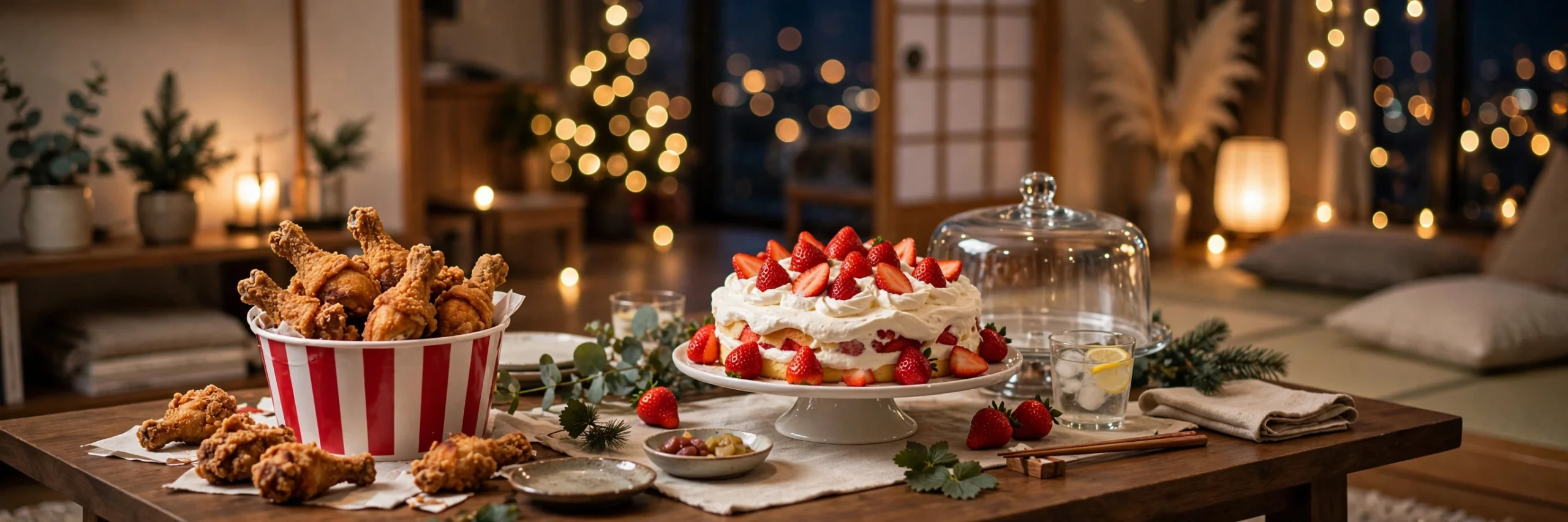
Japan’s Christmas is fried chicken, strawberry cake and romance — a secular feast built on marketing genius and sweet tradition.

A Japanese Christmas spread: a KFC party barrel of fried chicken and a strawberry Christmas cake in a cozy apartment at night.
Watch: What Japan Eats for Christmas
The story of Japan’s KFC Christmas — the 1974 “Kentucky for Christmas” campaign and the party barrels families preorder weeks ahead.
At a Glance: What Japan Eats for Christmas
Japan’s Christmas table, course by course.
| Dish | When | Key detail |
|---|---|---|
| KFC Christmas | 24 December | The party barrel — the 1974 “Kentucky for Christmas” campaign by Takeshi Okawara; ordered weeks ahead |
| Strawberry Christmas cake | 24 December | Sponge, cream and strawberries — popularized by Fujiya in the early 20th century |
| Christmas Eve date night | 24 December | The romantic evening — couples’ dinners, not a family gathering |
| Home Christmas | 25 December | Roast chicken, pizza and cake — the modern family spread |
| Department store treats | December | Elaborate seasonal cakes and chicken sets from the depachika food halls |
| Ōmisoka | 31 December | New Year’s Eve — toshikoshi soba and the real family feast |
| New Year vs Christmas | Dec – Jan | Christmas is for couples; New Year (oshōgatsu) is Japan’s main holiday |
Frequently Asked Questions
Why do Japanese people eat KFC on Christmas?
A 1974 marketing campaign (“Kentucky for Christmas”) positioned fried chicken as Japan’s Christmas turkey — brilliantly solving the problem that turkey is nearly unavailable in Japan and most homes lack full-size ovens. Fifty years of nostalgia later, an estimated 3.6 million families eat KFC on Christmas Eve, with reservations required weeks ahead.
What is Japanese Christmas cake?
Strawberry shortcake — sponge cake layered with whipped cream and strawberries, decorated for Christmas. It’s eaten on Christmas Eve (not Christmas Day), it’s red and white, and it was popularized by Fujiya in the post-war era when December strawberries were luxury fruit. Department stores and convenience stores all sell versions.
Is Christmas a public holiday in Japan?
No — December 25 is a regular workday in Japan. Christmas is a commercial and romantic event, not a national holiday: Christmas Eve is date night for couples and present night for children, while the real traditional feast is New Year’s osechi ryori (January 1–3).
Do Japanese people eat turkey at Christmas?
Almost never — turkey is barely farmed or sold in Japan, and most Japanese homes lack ovens large enough to roast one. Fried chicken (KFC’s Christmas buckets or homemade karaage) is the poultry of Japanese Christmas, with roast chicken (whole, from department stores) as the upscale alternative.
What do Japanese couples do on Christmas Eve?
Date night — dinner at a fancy (usually French or Italian) restaurant, a walk through the illuminations, present exchange, and often a hotel stay. Christmas Eve is Japan’s most romantic night, bigger than Valentine’s Day — restaurant reservations are essential.
Can I order KFC Christmas outside Japan?
The Christmas Party Barrel is Japan-only, but you can recreate it: a fried chicken bucket, sides, and a strawberry shortcake on December 24. The spirit — unpretentious, joyful, commercial-and-proud — travels anywhere.
Merii Kurisumasu — Japan’s Deliciously Unusual Christmas
What Japan eats for Christmas — KFC and strawberry shortcake — shouldn’t work, and yet it’s one of the world’s most successful holiday food traditions: fifty years old, millions strong, and completely sincere. It’s a reminder that traditions are invented, that marketing can become culture, and that the best Christmas food is whatever your family actually looks forward to. This December 24th, consider the Japanese way: order the fried chicken, buy the shortcake, hang the lights, and enjoy the playful side of Christmas — the serious feast can wait for New Year, when the osechi boxes come out and Japan’s real traditional eating begins. For more holiday tables, see our best Christmas movies (a Japanese Christmas Eve essential), our Christmas traditions in Japan, and Australia’s Christmas lunch for another non-traditional feast. Merii Kurisumasu — and don’t forget to reserve the chicken weeks ahead!