Writing vows the first time is an act of hope. Writing them again — five, ten, twenty-five years later — is an act of knowledge. You are no longer promising based on who you think you will become; you are promising based on who you have actually been, through the moves and the losses, the 3 a.m. feedings and the quiet Sunday mornings, the versions of each other you never could have predicted. That is what makes vow renewal vows so powerful, and it is also what makes them so hard to write. How do you compress a decade of real life into two minutes of words?
This guide gives you everything you need: the anatomy of a vow that lands, dozens of original example vows organized by tone and length, frameworks for writing your own from scratch, and practical advice on delivery, timing, and avoiding the traps that make renewal vows fall flat. Every example here is written fresh for this guide — use them word for word, or treat them as starting points and make them yours. The best renewal vow is not the most poetic one. It is the one that could only have been written by you, to the person standing in front of you, about the life you actually share.
The Anatomy of a Vow That Lands
Before the examples, it helps to understand why some vows make a whole room cry and others make guests check their watches. Great renewal vows share a simple architecture: they look backward with specificity, they stand in the present with gratitude, and they look forward with intention. Past, present, future — in that order, in roughly equal measure.
The backward look is where most renewal vows find their power, and where most first-wedding vows cannot go. You have actual history now. Name it. Not “we’ve been through a lot” — everyone has been through a lot — but the specific things: the apartment with the broken heater, the year everything went wrong at once, the Tuesday he drove three hours because you needed him. Specificity is the difference between a vow that sounds nice and a vow that sounds true. Your guests may not know the details, but they will feel the weight of them.
The present-tense gratitude is the emotional core. Tell your partner what they are to you now, not in abstract terms but in observed ones. Not “you’re amazing” but “you still make me laugh when I’m trying to stay mad, and I have never once doubted that you are on my team.” Observation proves attention, and attention is the rarest compliment in a long relationship.
The forward look is the actual vow — the promise part. Here is where renewal vows differ most from wedding vows. First-time vows promise everything because the future is blank. Renewal vows should promise specifically because the future is not. Promise the things you have learned matter: patience on the hard days, presence over perfection, choosing each other in the small daily ways. A promise rooted in lived experience carries more weight than any grand declaration.
Romantic Renewal Vows: The Classics, Rewritten
Romantic vows are the heart of most renewal ceremonies. They are earnest, emotional, and unembarrassed about it. Here are original examples in the romantic register — adapt the details to your own story.
“When I stood here years ago, I promised to love you without knowing what that would cost or what it would give back. Now I know. It cost us our certainty, our sleep, and at least one car. It gave us everything that matters. I choose you again — not the idea of you, not the memory of who we were, but you, exactly as you are today, coffee breath and all. I will spend the next chapter the way I spent the last one: trying, every day, to be worthy of the person who chose me back.”
“They say you can’t step in the same river twice, and they’re right — we are not the people who made those first promises. We are better. We are the people who kept them. I have watched you become someone I admire more every year, and I have felt you do the same impossible, generous thing for me. So here is my vow, simpler than the first one and truer: I am yours. I have been yours through every version of us, and I will be yours through every version still to come.”
“I want to thank you for the ten thousand invisible things. The coffee made before I asked. The worry you carried so I didn’t have to. The way you learned my bad days before I could name them. A marriage is built in moments nobody applauds, and you have built ours with more grace than I deserved. Today I promise to notice more, to thank you more, and to love you not just in the grand gestures but in the ten thousand invisible things I do for you.”
“If I could go back to the day we met, I wouldn’t change a single thing — not the awkward first date, not the hard years, not even the fights, because every one of them taught me something about loving you. But I would tell that younger version of me one thing: pay attention. It goes fast, and it gets better than you can imagine. Standing here now, I make the same promise with open eyes: whatever comes next, I want to face it holding your hand.”
Heartfelt Vows for Hard-Won Love
Some couples have been through the fire — illness, loss, financial ruin, the kind of years that end marriages. If that is your story, your vows can honor it directly. These examples speak to love that survived.
“We did not get the easy version. We got the version with hospital waiting rooms and empty bank accounts and grief we didn’t see coming. And here is what I learned: I would rather have the hard version with you than the easy version with anyone else. You were steady when I was falling apart. You were funny when nothing was funny. You stayed. So this is my vow: I will stay too, through whatever the next chapter brings, the way you stayed through this one.”
“There was a year I wasn’t sure we’d make it. I think we both know which one. What saved us wasn’t romance — it was decision. We decided, on the worst days, to keep choosing each other. Today I want to say out loud what I should have said then: thank you for deciding too. My vow is to keep deciding, every morning, for the rest of our lives. Love got us here. Choice will carry us home.”
“You have seen me at my absolute worst — not the cute worst, the real worst — and you loved me anyway. That is the bravest thing anyone has ever done for me, and I have never properly thanked you for it. So thank you. And here is my promise in return: I will spend the rest of my life trying to be someone who deserves the grace you gave me freely. I will love you carefully, deliberately, and out loud, for as long as I get.”
Short and Sweet: Vows Under a Minute
Not everyone wants to deliver a monologue. Short vows can be devastatingly effective — sometimes one perfect paragraph says more than five minutes of prose. These examples each run under a minute when spoken.
“I knew then. I know now. I will know always. You are my person, my home, my favorite everything. I choose you — again, completely, forever.”
“Years ago I promised you my future. Today I give you my past too — every memory, every lesson, all of it, gladly. You’re the best thing I ever chose, and I’d choose you a hundred times over.”
“We’ve built a life I couldn’t have dreamed of with anyone else. Thank you for every ordinary day that turned out to be extraordinary because you were in it. Here’s to all the ordinary days still to come.”
“I loved you then for who you might become. I love you now for who you are. Same promise, deeper roots: I’m yours, completely, for whatever comes next.”
Playful Vows: Love With a Laugh
Renewal vows do not have to be solemn to be serious. For couples whose love language is laughter, playful vows feel more honest than poetry. The trick is balancing the humor with genuine sentiment — every joke should land on a foundation of real feeling.
“I vow to continue pretending your snoring is ‘white noise,’ to keep eating the burnt toast so you get the good slice, and to love you even when you leave exactly one sip of milk in the carton. We’ve survived your driving, my cooking, and seventeen IKEA assemblies. There is nothing we can’t handle — especially since I’ve learned that ‘we need to talk’ from you just means the Wi-Fi is down.”
“Years ago, I promised to love you in sickness and in health. Since then, you’ve given me your colds, your questionable fashion phases, and your unwavering belief that the thermostat is a suggestion. And I’d do it all again. I vow to keep laughing at your jokes — even the ones I’ve heard forty times — to keep stealing the blankets, and to keep choosing you, the weirdo who still makes my day better just by walking into the room.”
“I take you, again, to be my lawfully wedded spouse — my co-pilot, my emergency contact, and the only person allowed to eat off my plate without asking. I promise to support you in good times and bad, in sickness and in health, and during every single home renovation project, which as we both know is the true test of marriage. You’re stuck with me, and honestly, you’ve never looked happier about it.”
Frameworks: Build Your Own Vows From Scratch
If the examples inspire you but you want vows that are unmistakably yours, use one of these frameworks. Fill in the brackets with your own details, then read the result aloud and smooth the edges.
The Then-and-Now Framework
“When we married, I thought love was [what you believed then]. Now I know love is [what you’ve learned]. Thank you for [specific thing]. I promise [specific promise].” This structure works because it honors growth — it shows the vow is informed by real experience, not just recycled sentiment.
The Gratitude List Framework
“I am grateful for [three specific things, small and large]. Because of you, I [something you’ve become]. Today I vow [two promises].” Gratitude-based vows are disarming; they lower the emotional defenses of everyone listening and create the warmest possible atmosphere.
The Story Vow Framework
“I’ll never forget [one specific memory]. That was the day I learned [what it taught you]. Every day since, you’ve [ongoing pattern]. So here’s my promise: [vow].” Anchoring a vow in a single story gives it narrative power — guests lean in, and the promise at the end lands like a punchline in the best way.
The Simple Declarative Framework
“You are [three true things about them]. I choose [what you choose]. I will [two promises]. Always.” Short, rhythmic, and powerful. This framework suits confident speakers and intimate ceremonies where less is more.
How Long Should Renewal Vows Be?
Length is one of the most common anxieties, and the answer depends on your ceremony’s tone. The table below gives practical guidance — but the golden rule is that your vows should feel complete, not long. If you are unsure, shorter is almost always better.
| Vow Length | Word Count | Speaking Time | Best For |
|---|---|---|---|
| Micro vow | 30–60 words | Under 30 seconds | Large ceremonies; couples who dislike public speaking |
| Short vow | 100–150 words | 45–60 seconds | Intimate ceremonies; paired with an officiant-led script |
| Standard vow | 200–300 words | 1.5–2.5 minutes | Most renewal ceremonies; the sweet spot |
| Extended vow | 350–500 words | 3–4 minutes | Private ceremonies; confident speakers with a real story to tell |
Whatever length you choose, match your partner. Nothing deflates a ceremony faster than one person delivering a four-minute epic while the other reads three sentences off a shaking card. Agree on a target length in advance — it is not unromantic to coordinate; it is considerate. And time yourselves reading aloud, not silently. Spoken words run about 130 per minute, and nerves speed most people up.
Delivery Tips: Saying It Like You Mean It
Great vows poorly delivered lose half their power. These practical tips make the difference between reading words and delivering them.
Write them by hand first, then type a clean copy. Handwriting forces slower thinking and produces better first drafts; the typed copy is your ceremony-day backup. Print in large type — at least 16 point — because happy tears and shaky hands make small print unreadable. Bring the printed copy even if you have memorized your vows; nerves erase memorization with ruthless efficiency.
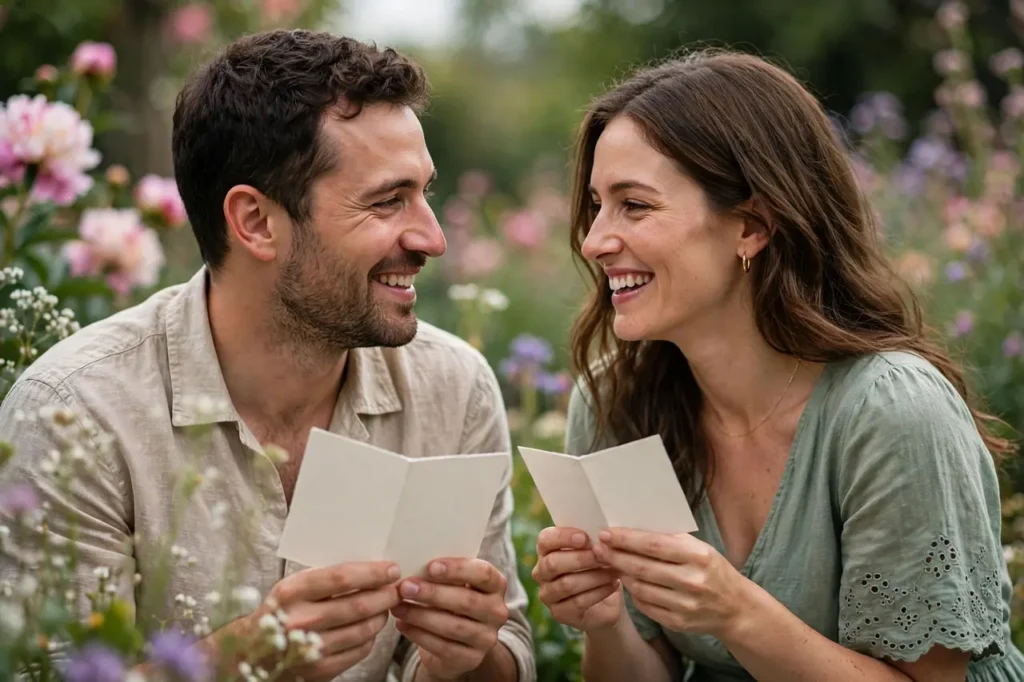
Practice aloud at least three times, ideally to another human. Your best friend, your sibling, your mirror — anyone who will listen. You are not rehearsing to sound polished; you are rehearsing so the words feel familiar in your mouth and the emotional peaks do not ambush you. Decide in advance what you will do if you cry: pause, breathe, smile, continue. Crying during vows is not a failure — it is evidence — but having a plan keeps it from derailing you.
On the day, slow down. Make eye contact with your partner, not the paper. Pause between sections and let the words land. And remember who the vows are for: not the guests, not the photographer, not posterity. They are for the person standing two feet away. Speak to them, and everyone else gets to witness something real.
Vows by Milestone: What to Emphasize at 5, 10, 25, and 50 Years
The right emphasis for renewal vows shifts with the milestone. A five-year renewal and a fifty-year renewal are different emotional events, and your vows should reflect what the years have actually taught you. Use this milestone guide to calibrate your tone and content.
At five years, the theme is foundation. You have survived the newlywed adjustment period, maybe bought a home or started a family, and you are beginning to understand what marriage actually requires. Vows at this stage should acknowledge the learning curve with warmth: the habits you have discovered, the teamwork you have built, the way “us” has started to feel like a real thing rather than an aspiration. Keep the tone optimistic and forward-looking — you are still early in the story, and the vows should feel like the end of the prologue.
At ten years, the theme is depth. A decade gives you real material: career changes, children, losses, moves, the full spectrum. Ten-year vows can be more honest about difficulty because there is enough good history to hold the weight. This is the milestone where the “we survived” vows resonate most — not as complaint, but as pride. Name what the decade taught you, thank your partner for specific acts of partnership, and make promises that reflect who you have become rather than who you hoped to be. Our dedicated guide to silver anniversary celebration ideas pairs well with ten-year renewal planning, since many couples combine the two milestones.
At twenty-five years, the theme is legacy. You are likely renewing vows in front of adult children, maybe grandchildren, and friends who have watched the whole story. Silver-anniversary vows should speak to what the marriage built — the family, the values, the example. Address the next generation directly if they are present; the most memorable twenty-five-year vows include a line for the kids about what lasting love actually looks like from the inside. The tone here is gratitude mixed with quiet pride: look what we made.
At fifty years, the theme is wonder. Golden-anniversary vows do not need to be long — after half a century, the fact of the marriage is the statement. The most moving fifty-year vows are often the simplest: a few sentences of astonishment and thanks. “I can’t believe I got you.” “Thank you for my whole life.” Brevity at this milestone is not a lack of words; it is the confidence that the life itself said everything. Let the tears do the talking.
Watch: A Real Renewal of Vows
Reading examples is one thing; watching a real couple live the moment is another. This renewal of vows film captures a couple celebrating ten years of marriage, choosing each other again in front of the people they love. Pay attention to the pacing of the ceremony, the emotion in the room, and the personal touches that make it theirs. Let it remind you that your vows do not need to be perfect — they need to be true.
Frequently Asked Questions
Should vow renewal vows be different from our original wedding vows?
Yes — that is the entire point. Your original vows were promises about a future you could only imagine. Renewal vows should reflect the life you have actually lived: reference real memories, acknowledge growth and hard times, and make promises informed by experience. Repeating your original vows word for word misses the opportunity; at minimum, add a new section that speaks to the years since.
How do I start writing if I am staring at a blank page?
Start with a list, not a vow. Write down ten specific memories, five things you are grateful for, and three promises you want to make. Then use one of the frameworks in this guide to shape the raw material into vows. The blank page is intimidating; a messy list is just honest. Most people find the vow practically writes itself once the specifics are on paper.
Is it okay to use funny vows for a vow renewal?
Absolutely, as long as the humor is affectionate and both partners are on board. The best funny vows pair every joke with genuine sentiment — laugh, then land the heartfelt line. Avoid humor that punches down at your partner, inside jokes no one else understands without context, or anything you would not want your grandmother to hear. When in doubt, run the vows past a trusted friend first.
Should we write our vows together or keep them secret?
Either works, but coordinate on tone and length even if you keep the content secret. Surprise vows are more emotional in the moment; collaborative vows avoid the awkward mismatch of one funny and one tearful set. Many couples choose a hybrid: agree on the framework and length together, then write the actual words separately.
Can we include our children in the vow renewal vows?
Yes, and it is often the most moving part of the ceremony. Address a few lines directly to your kids — thanking them, including them in the family’s next chapter, or making a simple promise to them. Keep it brief and age-appropriate. Some families do a separate family vow exchange after the couple’s vows, which gives the moment its own space.
What if I cry too hard to finish?
Have a backup plan, not a fear. Ask your officiant or best man to hold a copy of your vows and step in if needed — just knowing the safety net exists usually prevents the meltdown. Pause, breathe through your nose, smile at your partner, and continue when you can. Guests find genuine emotion deeply moving; nobody will remember the pause, but everyone will remember the feeling.
Are religious vows appropriate for a renewal if our wedding was secular?
Your renewal is yours to define. Many couples find their spiritual lives have deepened over the years and choose to include faith elements that were absent the first time. Others keep it secular. There is no rule — only what feels true to who you are now. If you are blending traditions, our overview of marriage anniversary traditions around the world may spark ideas.
How do we handle vows if we are renewing after a difficult period?
Honesty, handled with care, is more powerful than pretending the hard times did not happen. Acknowledge the difficulty briefly and specifically, then pivot to what it taught you and the choice you are making today. Avoid turning vows into a therapy session or airing grievances — one honest sentence about the struggle, followed by gratitude and commitment, is the right ratio. For wording inspiration for the written side, see what to write in an anniversary card for your husband and for your wife.
Your Vows, Your Story
The examples in this guide are starting points, not scripts. The vow that will matter most on the day is the one with your fingerprints on it — your memories, your humor, your particular way of loving this particular person. Take the framework that resonated, fill it with the specifics only you know, read it aloud until it sounds like you, and then stand up and say it like you mean it.
Years from now, you will not remember whether the vows were poetic. You will remember the look on your partner’s face when you said the true thing. Write toward that moment. Everything else is decoration.