A vow renewal is one of life’s happiest paradoxes: it should feel effortless and deeply personal, yet it runs on structure just like any ceremony. Knowing the vow renewal ceremony order of events in advance is what separates a smooth, emotional celebration from an awkward one where guests are not sure when to stand, sit, or wipe away a tear. Whether you are planning a two-minute exchange on a beach or a full hour-long celebration in a ballroom, the sequence of moments matters.
The good news is that a vow renewal follows a familiar, forgiving shape. There are no legal requirements to satisfy — you are already married — so every element is optional and every tradition is yours to keep, adapt, or skip. This guide gives you the classic order of events step by step, three ready-made timelines for 15-minute, 30-minute, and 60-minute ceremonies, an element-by-element breakdown with timing notes, sample script language, and the mistakes that trip up even experienced planners. By the end, you will have a ceremony flow you can hand to your officiant with total confidence.
The Classic Vow Renewal Order of Events
Most vow renewal ceremonies follow this sequence. Think of it as a template, not a rulebook — you can merge steps, reorder them, or cut anything that does not fit your story.
1. Prelude and guest seating (10–15 minutes before). Music plays as guests arrive and find their seats. This is the emotional on-ramp: choose songs that mean something to the two of you rather than generic ceremony music. A friend with a guitar, a string duo, or a well-built playlist all work. Display a small sign or have your coordinator invite guests to be seated about five minutes before you begin.
2. Processional. Unlike a wedding, there are no rules about who walks in with whom. Many couples walk in together — it is a renewal, after all, and arriving as a united pair sets exactly the right tone. Others have children escort them, or one partner waits at the front while the other walks down the aisle for a touch of the original magic. Keep it simple: one song, one walk, no bridal party logistics unless you want them.
3. Welcome and opening remarks. Your officiant greets everyone, names the occasion honestly (“we are gathered to celebrate twenty-five years of marriage”), and sets the emotional temperature. This is the moment to acknowledge the journey — the years, the children, the challenges weathered — in two or three warm sentences. A good opening takes about two minutes and makes the whole ceremony feel intentional rather than improvised.
4. Reading or reflection. A short poem, a meaningful passage, or a few words from a child or close friend. Renewals are the perfect place for readings because the words can speak directly to enduring love rather than new beginnings. Keep it under three minutes; one strong reading beats three forgettable ones.
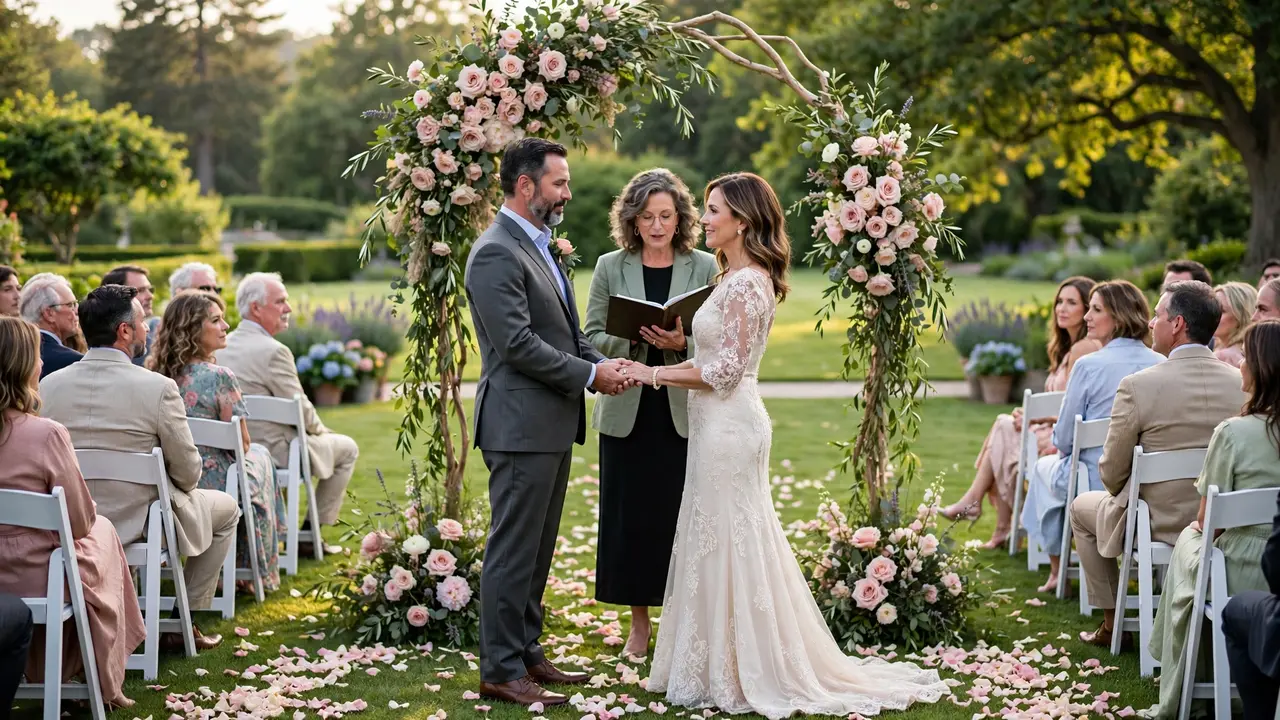
5. The vow exchange. The heart of the ceremony. You may repeat your original vows, write new ones, or do both — many couples read their original vows first (“and we meant every word”) and then add new promises that reflect who they are now. Each partner typically speaks for one to two minutes. This is the moment guests will remember, so give it room to breathe: pause, make eye contact, and do not rush.
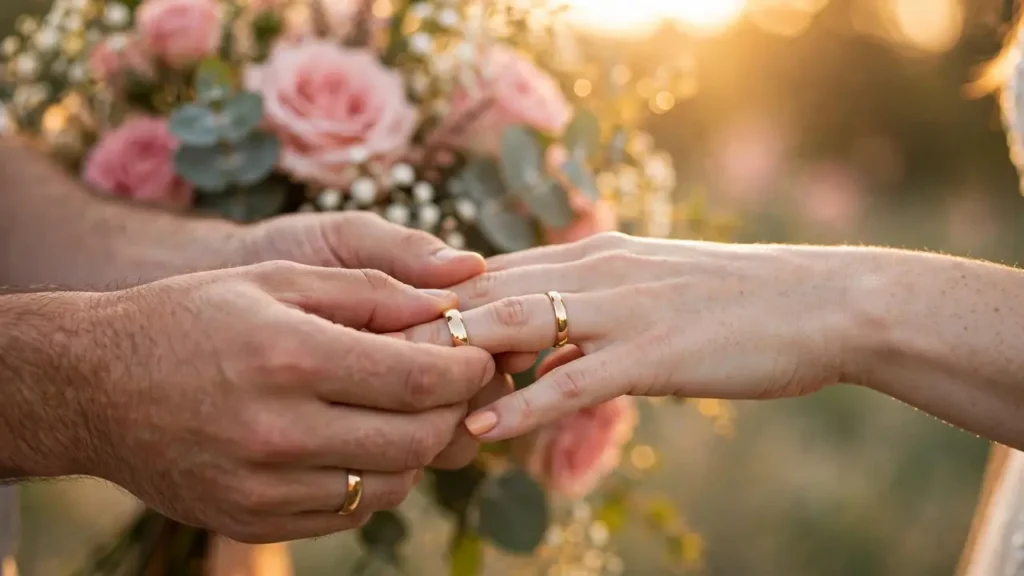
6. Ring exchange or ring blessing. Some couples exchange new rings or wedding bands engraved with the renewal date; others have their officiant bless the rings they already wear. Either way, the language is simple: a sentence or two about what the ring has come to mean over the years. If you are planning new bands, our roundup of best anniversary gifts for couples includes ring and jewelry ideas that pair beautifully with a renewal.
7. Unity ritual (optional). A symbolic act that represents your joined lives: lighting a unity candle, blending sands from meaningful places, planting a tree, pouring two wines into one glass, or tying a fisherman’s knot. Unity rituals photograph beautifully and give fidgety hands something meaningful to do. Keep it to one ritual and rehearse the mechanics — fumbling with sand vials while guests watch is the fastest way to deflate a tender moment.
8. Pronouncement and kiss. Your officiant declares what everyone already knows — that you have renewed your marriage — and invites the kiss. Some officiants use joyful language here (“I now re-pronounce you husband and wife — still, again, and always”), which gets a laugh and a cheer.
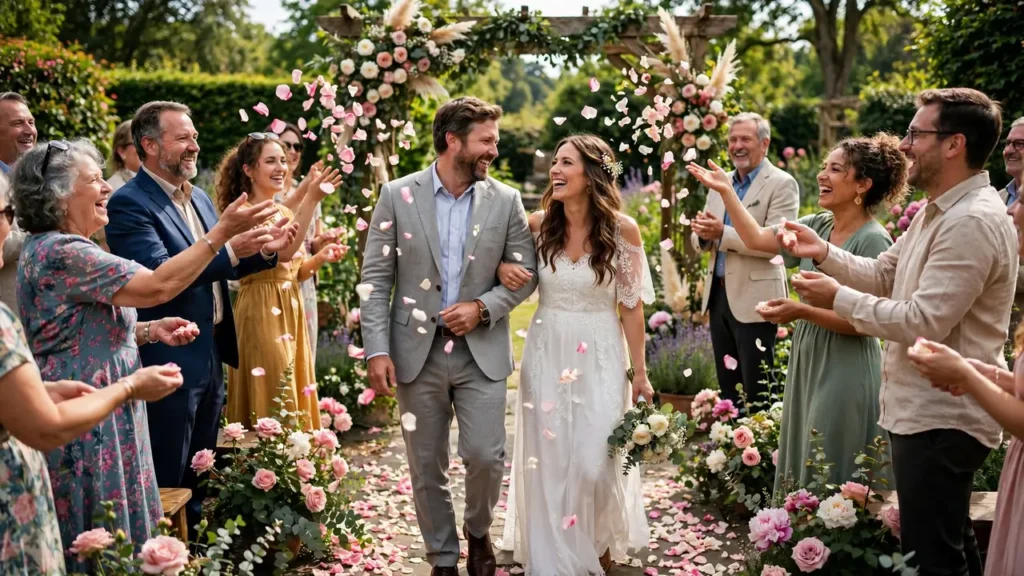
9. Recessional. You walk back out together, usually to something upbeat. Guests often shower you with petals, blow bubbles, or ring bells. This is the emotional exhale of the ceremony — let it be joyful and a little messy.
10. Receiving line or mingling. Formal receiving lines have largely given way to relaxed mingling, but do plan some structured moment to greet everyone. A champagne toast immediately after the recessional gathers the group naturally and transitions the celebration into party mode.
Three Ready-Made Timelines: 15, 30, and 60 Minutes
Choose the timeline that matches your guest count, venue, and appetite for ceremony. All three use the classic order above, scaled up or down.
| Element | 15-Minute Intimate | 30-Minute Classic | 60-Minute Grand |
|---|---|---|---|
| Prelude & seating | 10 min (before start) | 15 min (before start) | 20 min (before start) |
| Processional | 2 min | 3 min | 5 min |
| Welcome & opening | 2 min | 3 min | 5 min |
| Reading / reflection | — (skip or 1 min) | 3 min (one reading) | 8 min (two readings + music) |
| Vow exchange | 4 min | 8 min | 12 min |
| Ring exchange | 2 min | 3 min | 5 min |
| Unity ritual | — (skip) | 3 min (one ritual) | 8 min (ritual + family vows) |
| Pronouncement & kiss | 1 min | 2 min | 3 min |
| Recessional | 2 min | 3 min | 5 min |
| Champagne toast | 2 min | 5 min | 10 min |
The 15-minute version suits elopement-style renewals with a handful of witnesses — a beach, a mountaintop, a backyard. The 30-minute classic is the sweet spot for most couples: substantial enough to feel like a real ceremony, tight enough that no one’s attention wanders. The 60-minute grand timeline fits milestone anniversaries with large guest lists, multiple generations participating, and a formal venue. When in doubt, choose shorter: guests remember emotion, not duration, and a tight ceremony always feels more powerful than a padded one. For help finding the right words for each section, browse our marriage anniversary wishes and happy wedding anniversary quotes for language you can weave into readings and remarks.
Element-by-Element Breakdown: Timing Notes and Tips
Processional. Keep it to one song and under three minutes. Couples walking in together should practice the pace — excitement makes everyone walk too fast. If children escort you, brief them (and bribe them) in advance.
Welcome. Two to three minutes is the sweet spot. The officiant should name the milestone (“twenty-five years”), thank guests for traveling or gathering, and frame what is about to happen. Avoid inside jokes in the welcome — half the guests will not get them, and the ceremony’s opening should unite the room, not divide it.
Readings. One strong reading beats a medley. Choose pieces about enduring love rather than new beginnings — renewals are about depth, not discovery. Brief your reader on pace and microphone technique; even confident speakers rush when nervous.
Vow exchange. The emotional peak — protect it. Ask guests to silence phones, position the photographer discreetly, and build in pauses. If you are writing your own vows, aim for 150 to 250 words each (about one to two minutes spoken). Longer vows lose the room; shorter ones can feel abrupt.
Ring exchange. Simple and swift. If you are blessing existing rings, the officiant holds them briefly; if exchanging new ones, have them ready — not buried in a pocket or a purse across the room.
Unity ritual. Rehearse the physical mechanics, not just the words. Sand ceremonies need steady hands, candles need shelter from wind, and anything involving fire needs a backup plan. One ritual, done well, is plenty.
Sample Officiant Script Language
You do not need to write your ceremony from scratch — adapt these proven passages and make them yours.
Opening: “We are gathered here today not to begin a marriage, but to celebrate one — twenty-five years of promises kept, storms weathered, and joy multiplied. Sarah and James stood before their loved ones a quarter century ago and pledged their lives to each other. Today, with fuller hearts and deeper understanding, they renew those vows.”
Before the vows: “Marriage is not a single promise but a thousand small ones, renewed each morning. The vows you speak today are not new — they are the same promises, made again with the wisdom of every year behind you.”
Ring blessing: “These rings have circled your fingers through twenty-five years of ordinary Tuesdays and extraordinary moments. May they continue to remind you, and everyone who sees them, of the love they represent.”
Pronouncement: “By the love you have shown, the life you have built, and the vows you have renewed today, I joyfully reaffirm you as husband and wife — still, again, and always. You may kiss… again!”
Give your officiant the full script at least two weeks before the ceremony, and do a walkthrough — even a fifteen-minute rehearsal the day before eliminates nearly all day-of surprises.
Adding Personal Rituals That Tell Your Story
The classic order gives you structure; personal rituals give you soul. Choose one — at most two — rituals that reflect your specific journey. The wine box: seal a bottle of wine with love letters to each other, to be opened on a future anniversary. Handfasting: an ancient Celtic tradition where your hands are bound with cords or ribbons as vows are spoken — visually striking and deeply symbolic. Tree planting: pot a sapling together during the ceremony and plant it at home after; it grows as your marriage does. The anniversary capsule: guests write predictions or advice on cards, sealed until your next milestone. Ring warming: pass your rings through the guests before the ceremony so everyone holds them briefly and “warms” them with good wishes — profoundly moving in small gatherings.
Family vows deserve special mention: many renewing couples speak vows not only to each other but to their children — promising to love, guide, and cherish them. In blended families, this moment often moves guests more than the couple’s own vows. Keep family vows short (two or three sentences each) and let kids speak in their own words rather than reciting something written for them.
Rehearsal and Day-Of Coordination Tips
Even a fifteen-minute ceremony benefits from a walkthrough. The day before, gather your officiant, readers, musicians, and anyone with a role, and physically walk the order of events: where everyone stands, when the music starts, where the rings are, how the unity ritual works mechanically. Time each segment with a phone stopwatch — you will be surprised how long two minutes of speaking actually feels. Assign a point person who is not in the couple: someone to cue the music, gather guests for seating, and handle the inevitable small crisis (a missing boutonniere, a confused reader). On the day, build in thirty unscheduled minutes before the ceremony for calm — rushed couples cannot be present, and presence is the whole point.
Brief your photographer on the order of events in advance, marking the three must-capture moments: the vow exchange, the ring exchange, and the kiss. Everything else is gravy. And have a printed order of events for the wedding party, the coordinator, and the DJ or musicians — when everyone holds the same one-page timeline, the ceremony runs itself.
Common Order-of-Events Mistakes to Avoid
Front-loading all the emotion. If the vows, the readings, and the family moment all happen in the first ten minutes, the ceremony peaks too early and the ending feels flat. Space emotional beats: welcome, reading, vows, ritual, pronouncement — a rhythm of rising and breathing.
Skipping the rehearsal for “simple” ceremonies. Simple ceremonies have the least margin for error because there is nothing to hide behind. A five-minute walkthrough prevents the fumbled rings, the dead microphone, and the reader who did not know they were reading.
Forgetting the guests’ physical comfort. Ceremonies run long in memory and short in planning — guests standing in sun, wind, or heat for forty minutes stop feeling romantic and start feeling restless. Provide shade, water, and seating; keep outdoor ceremonies under thirty minutes.
No transition into the party. The ceremony ends, guests stand around uncertainly, energy dissipates. Always plan the bridge: a champagne toast, a receiving moment, or music that clearly signals “celebration mode.”
Overstuffing the program. Three readings, two rituals, a slideshow, and a surprise dance belong at an anniversary party, not inside the ceremony. The ceremony is the jewel; the party is the setting. Keep the jewel small and let it shine.
A Complete 30-Minute Ceremony Script, Annotated
Sometimes the easiest way to understand an order of events is to see one fully written. Below is a complete 30-minute ceremony for a 25th-anniversary renewal — adapt the names, the milestone, and the personal details to make it yours.
Processional (3 min): Guests are seated. A guitar plays the couple’s song as Sarah and James walk in together, hand in hand, smiling at familiar faces.
Welcome (3 min): “Friends and family — welcome. Twenty-five years ago, Sarah and James stood before a small gathering and promised each other forever. They could not have known what forever would hold: two children, three homes, one very patient dog, and a thousand ordinary Tuesdays that turned out to be the good stuff. Today, knowing exactly what the promise costs and exactly what it is worth, they make it again.”
Reading (3 min): Their daughter Emma reads a short poem about enduring love — chosen by the couple, rehearsed twice, kept under two minutes.
Vow exchange (8 min): The officiant introduces the moment: “The vows you speak today are not new. They are the same promises, made again — with the wisdom of every year behind you.” Sarah speaks first (her original vows, then one new promise); James follows the same shape. They pause, they look at each other, nobody rushes.
Ring blessing (3 min): The officiant holds their original bands: “These rings have circled your fingers for twenty-five years. May they circle for twenty-five more.” The couple slips them back on.
Unity ritual (4 min): Together they pour sand from two meaningful places — the beach where they honeymooned, the lake near their home — into one vessel. The officiant says nothing; the symbolism needs no narration.
Pronouncement and kiss (2 min): “By the love you have shown and the vows you have renewed, I joyfully reaffirm you as husband and wife — still, again, and always!” Cheers, kiss, applause.
Recessional and toast (4 min): They walk out to something joyful as guests shower petals. Champagne is poured; the officiant raises the first toast. Ceremony complete — thirty minutes, not a wasted one.
Placing Music and Readings in the Order
Music and readings are the ceremony’s emotional punctuation — placement determines whether they lift the moment or interrupt it. Prelude music (15 minutes before) should be warm and recognizable; it tells arriving guests “something beautiful is about to happen.” Processional music needs a clear beginning and a natural length of two to three minutes — a full song is too long; a 90-second arrangement is perfect. Readings belong in the ceremony’s first half, before the vows: they build emotion toward the peak rather than competing with it. Never place a reading after the vow exchange — nothing should follow the emotional climax except the joyful release of the pronouncement. A musical interlude works beautifully during a unity ritual, filling the silence with meaning while hands are busy. Recessional music should be unambiguously celebratory — this is the moment the room exhales into joy. Brief every musician and reader on their exact cue: “You begin when the couple reaches the arch,” not “sometime during the ceremony.” Precision here is invisible when it works and glaring when it does not.
The Officiant Briefing: Your One-Page Handoff
Your officiant can only deliver what you’ve communicated. Two weeks before the ceremony, hand them a single page containing: the facts — couple’s full names and pronunciations, anniversary milestone, date, time, venue, and expected guest count; the order — your chosen sequence with timing for each element and the full names of readers, musicians, and anyone with a role; the words — the complete script or detailed bullet points for every segment the officiant speaks, including the exact pronouncement language you want; the cues — what signals each transition (music change, a nod, the coordinator’s hand signal); the people — who stands where, who processes with whom, and any family dynamics worth knowing (divorced parents seated apart, a reader who is nervous); the contingencies — rain plan, microphone backup, and what to cut if you’re running long. Walk through it together once — even by video call — and invite questions. A well-briefed officiant sounds effortless; an under-briefed one sounds uncertain, and guests can tell the difference instantly. This single page is the highest-leverage document in your entire ceremony plan.
Ceremony Roles: Who Does What
A smooth ceremony is a team effort with clearly assigned roles. The officiant guides the order, speaks the scripted segments, and sets the emotional tone — brief them thoroughly and give them authority to adapt if something runs long. The coordinator or point person (not the couple) cues music, gathers guests, handles crises, and keeps time — this is the most underrated role in the entire event. Readers deliver readings; give them the text two weeks out, confirm pronunciation of every name, and have them practice with a microphone. Musicians need exact cues, not vibes: “begin when the couple reaches the arch; play for approximately two minutes; end on my nod.” The ring keeper holds the rings (or new bands) and delivers them at the exact moment — pockets fail; a small dish or pillow succeeds. The photographer/videographer needs the order of events marked with must-capture moments and positioning notes (where to stand during the vows without blocking guests’ view). Children with roles need rehearsal, encouragement, and an exit strategy if nerves win — a child who waves from a parent’s lap beats a crying child at the microphone. Assign every role by name, in writing, two weeks before. Unassigned tasks don’t get done; they get discovered missing at the worst moment.
The Day-Of Ceremony Emergency Kit
Pack a small kit and hand it to your coordinator — it will save the day at least once. For the couple: printed vows (two copies), tissues, water, breath mints, a sewing kit, stain remover, and comfortable backup shoes. For the ceremony: extra programs, a lighter and backup candles, tape and wire for last-minute decor fixes, and a printed order of events for every vendor. For guests: sunscreen and bug spray (outdoor), wraps or blankets (evening chill), and a phone-charging station at the reception. For Murphy’s Law: the officiant’s phone number, the venue manager’s number, and cash for the unexpected tip. The kit lives with your point person, not with you — your only job on ceremony day is to be present, calm, and happy.
Watch: Unique Vow Renewal Ideas in Action
Professional planners share their favorite creative ideas for making a vow renewal ceremony truly unforgettable:
Frequently Asked Questions
How long should a vow renewal ceremony last?
Twenty to thirty minutes is the sweet spot for most renewals. Fifteen minutes suits intimate gatherings; forty-five to sixty works for grand milestone celebrations with multiple elements. Shorter is almost always better — guests remember emotion, not duration.
Do we need an officiant for a vow renewal?
Not legally — but practically, yes, you want someone to guide the ceremony. A friend, family member, or professional officiant gives the event structure and gravitas. Many couples ask someone meaningful to them rather than hiring a stranger.
Should the wedding party be part of a vow renewal?
Only if you want them to be. Most renewals skip formal wedding parties entirely, though some couples invite their original bridal party to stand with them again — a deeply nostalgic touch for milestone anniversaries. There are no rules here.
Do we walk down the aisle at a vow renewal?
Many couples walk in together, which beautifully symbolizes the journey so far. Others recreate the original processional for nostalgia, or have children escort them. Choose the entrance that tells your story — all options are correct.
Can we include our children in the ceremony?
Absolutely — and you should if they are willing. Children can read, carry rings, perform music, or join family vows. Keep their parts short and low-pressure; a willing two-sentence reading beats a reluctant memorized poem.
What is the difference between a vow renewal and a second wedding?
A vow renewal celebrates an existing marriage; a second wedding (usually after divorce or widowhood) creates a new one. Renewals have no legal component, no “giving away,” and the couple hosts — the tone is gratitude and continuity rather than beginning.
Do guests bring gifts to a vow renewal?
It varies. Many couples request no gifts (“your presence is the present”); others welcome them. State your preference clearly on the invitation — silence reads as expectation. Cards with heartfelt messages are always appropriate.
Should we rehearse a vow renewal ceremony?
Yes — even a brief fifteen-minute walkthrough the day before prevents nearly all day-of surprises. Walk the space, practice cues, time the segments, and confirm everyone knows their role. Calm couples are present couples.
Your ceremony’s order of events is the invisible architecture of the day — guests will never compliment it directly, but they will feel it in every smooth transition and every perfectly timed pause. Build it thoughtfully, rehearse it once, and then let it go: on the day itself, the only order that matters is the two of you, facing each other, saying it all again.