On February 14, the streets of Mexico City fill with something more than romance. Yes, couples stroll hand in hand through Chapultepec Park and flower vendors do their best business of the year, but look a little closer and you will see groups of friends trading small gifts, coworkers handing out cards at the office, and schoolchildren swapping handmade notes in the classroom. In Mexico, Valentine’s Day is not just a couples’ holiday — it is El Día del Amor y la Amistad, the Day of Love and Friendship, and that single extra word changes everything about how the day feels.
Mexico’s version of February 14 is warmer, louder, and far more communal than the American original. While the holiday arrived through the same channels of advertising, media, and retail as it did north of the border, Mexicans adapted it to reflect one of their deepest cultural values: that relationships of all kinds deserve to be celebrated. The result is a festival where a boyfriend might receive a serenade, but so might a best friend, a beloved teacher, or an entire office staff. For travelers, romantics, and anyone who has ever felt left out on February 14, Mexico’s approach offers a refreshing alternative — and a set of traditions worth borrowing.
This guide explores everything about Valentine’s Day in Mexico: why it carries a double name, how it evolved from a mid-20th-century marketing campaign into a genuinely beloved national celebration, what Mexicans actually give and do on the day, and how you can celebrate the Mexican way wherever you are. Along the way, we will look at the mariachi serenades, the elaborate balloon arrangements that are a uniquely Mexican signature, the amigo secreto gift exchanges, and the regional celebrations that turn February 14 into a week of festivities.
| Fact | Detail |
|---|---|
| Local name | El Día del Amor y la Amistad — the Day of Love and Friendship |
| Date | February 14 (not a public holiday; schools and businesses stay open) |
| How it arrived | Via U.S. media and retail in the mid-20th century, then adapted to Mexico’s friendship-centered culture |
| Signature gift | Towering heart-shaped balloon arrangements, red roses, chocolates, stuffed animals |
| Key custom | Amigo secreto — secret-friend gift exchanges in schools and offices |
| Grandest gesture | A mariachi serenata performed beneath a loved one’s window |
| Most festive cities | Mexico City, Guadalajara, Mérida, Puerto Vallarta |
What’s in a Name: El Día del Amor y la Amistad
The name itself is the key to understanding everything. In English, “Valentine’s Day” points backward to Saint Valentine, a figure from early Christian tradition whose exact identity remains a matter of debate among historians. In Spanish, the day has two common names: Día de San Valentín (Saint Valentine’s Day), used widely in Spain and parts of South America, and Día del Amor y la Amistad — literally, “Day of Love and Friendship” — the form that took hold in Mexico.
That difference is not accidental. By naming the holiday for love and friendship, Mexico’s version deliberately broadened the celebration beyond couples. Romantic love (amor) is only half of the equation; amistad — the platonic affection between friends, family members, classmates, and colleagues — gets equal billing. The practical effect is that nobody is excluded. Single people, who in many countries dread February 14 as a reminder of coupledom, are simply folded into the festivities. A person without a partner still has friends, and friends exchange gifts.
This inclusivity reflects something real about Mexican social life. Mexico is often described by sociologists as a collectivist culture, where extended family ties, deep friendships, and social networks carry enormous weight in daily life. The godparent (compadre/comadre) system, the tradition of large family gatherings, and the central role of the neighborhood and workplace all point to a society that treats relationships as the core of a good life. A Valentine’s Day that celebrated only romantic couples would have felt strangely narrow in this context. The Mexican adaptation made the holiday fit the culture rather than forcing the culture to fit the holiday.
It is worth noting that Mexico is not the only country to use this name — Colombia, for example, celebrates a Día del Amor y la Amistad on the third Saturday of September — but Mexico’s February 14 version is by far the most famous. For visitors from the United States, where February 14 is overwhelmingly a couples-and-commerce affair, the Mexican version can feel like a small revelation: Valentine’s Day without the performance anxiety.
How Valentine’s Day Arrived in Mexico
The story of Valentine’s Day in Mexico begins, as it does in so many countries, with 20th-century commercialization. The figure of Saint Valentine has Christian roots stretching back to Roman times — tradition holds that a priest named Valentine defied an emperor’s ban on marriages and was martyred for it — but the holiday as Mexico knows it arrived much later, carried by American cultural exports.
Through the mid-1900s, as radio, cinema, and advertising crossed the border from the United States, so did February 14. Mexican florists, chocolatiers, and greeting card companies recognized the same commercial opportunity their American counterparts had seized: a mid-winter occasion dedicated to gift-giving. Department stores in Mexico City began promoting Valentine’s merchandise, and the date entered the national calendar of consumer rituals alongside Mother’s Day and Christmas.
But something interesting happened in the adaptation. Rather than importing the American version wholesale — with its exclusive focus on romantic partners — Mexican society bent the holiday toward its own values. Schools became one of the great engines of this transformation. Teachers encouraged children to exchange small gifts and handmade cards with everyone in the class, not just a sweetheart. The lesson embedded in the classroom ritual was explicit: February 14 is about affection in all its forms. A generation of Mexican children grew up understanding the holiday as a celebration of friendship first and romance second.
The workplace followed. Offices developed their own rituals — the amigo secreto (secret friend) exchanges that mirror the American office Secret Santa but with a Valentine’s twist. And restaurants, noticing that groups of friends and families were booking tables alongside couples, began catering to both. By the late 20th century, the Mexican version of Valentine’s Day had become something distinct: a national celebration that was recognizably related to the American original but warmer, more communal, and harder to opt out of without missing the fun.
Gifts of the Day: Roses, Balloons, and Grand Gestures
Gift-giving is central to El Día del Amor y la Amistad, and Mexican gift culture on February 14 has its own signature style. The international staples are all present — red roses, boxes of chocolates, stuffed animals, jewelry, handwritten love letters — but they are joined by traditions that are distinctly Mexican and by a scale of giving that extends far beyond the couple.
Red roses are, as elsewhere, the quintessential romantic gesture, and Mexican florists report that February 14 is their busiest day of the year. But the real signature gift of a Mexican Valentine’s Day is the balloon arrangement. Towering bouquets of heart-shaped foil balloons, often combined with stuffed animals, candy, and personalized messages, are a fixture of the holiday. Vendors set up on street corners and in plazas, and the arrangements grow more elaborate every year — some are nearly as tall as the person carrying them. Receiving a giant balloon arrangement at the office or at school is a public declaration, and part of the fun is the spectacle itself.
Chocolates and sweets follow the international pattern: heart-shaped boxes, artisanal truffles, and pastries from neighborhood bakeries. Stuffed animals — especially oversized teddy bears — remain enormously popular, particularly among younger couples and school-age admirers. Jewelry has its place among more established couples, and in recent years, experience gifts have gained ground: romantic dinners, spa treatments, and weekend getaways are increasingly popular ways to mark the day.
What sets Mexican gifting apart is not any single item but the breadth of the exchange. A Mexican office worker might give small gifts to five or six colleagues. A student might bring cards for the whole class. A person might buy flowers for their partner and for their mother and for their best friend. The spending is distributed across relationships rather than concentrated on one romantic target — which, as it happens, makes February 14 a much bigger retail event in Mexico than a purely couples’ holiday would be.
Amigo Secreto: The Secret Friend Exchange
If there is one custom that captures the friendship half of El Día del Amor y la Amistad, it is the amigo secreto — the secret friend exchange. Familiar to Americans as Secret Santa, the Mexican version is adapted for Valentine’s Day and appears in schools, offices, and social circles across the country.
The mechanics are simple. A group agrees to participate; names are drawn; each person secretly buys or makes a small gift for their assigned “secret friend.” On February 14, the gifts are exchanged, often accompanied by clues, anonymous notes in the days leading up to the reveal, and a ceremonial unmasking. The gifts themselves are usually modest — candy, a small stuffed animal, a funny card, a personalized trinket — because the point is participation, not price.
In schools, amigo secreto is often organized by teachers as a classroom activity, and it serves a genuinely pedagogical purpose: every child gives and receives, so nobody is left out, and the exercise of choosing a thoughtful gift for a classmate teaches empathy and attention. In offices, the exchange breaks down hierarchies for a day — the intern’s gift to the manager matters as much as the reverse. Among friend groups, it adds a layer of playful suspense to the week’s festivities.
The tradition also solves one of the quieter problems of Valentine’s Day: the awkwardness of singleness. In a culture where the holiday officially includes friendship, a single person participating in amigo secreto is not a consolation-prize participant — they are doing exactly what the holiday is for. It is a small structural detail, but it explains a great deal about why February 14 in Mexico feels celebratory rather than exclusionary.
The Mariachi Serenade: Mexico’s Grandest Romantic Gesture
No discussion of Valentine’s Day in Mexico is complete without the serenade. The tradition of the serenata — hiring musicians to perform beneath a loved one’s window — is one of the oldest and most romantic customs in Mexican culture, and February 14 is its biggest night of the year.
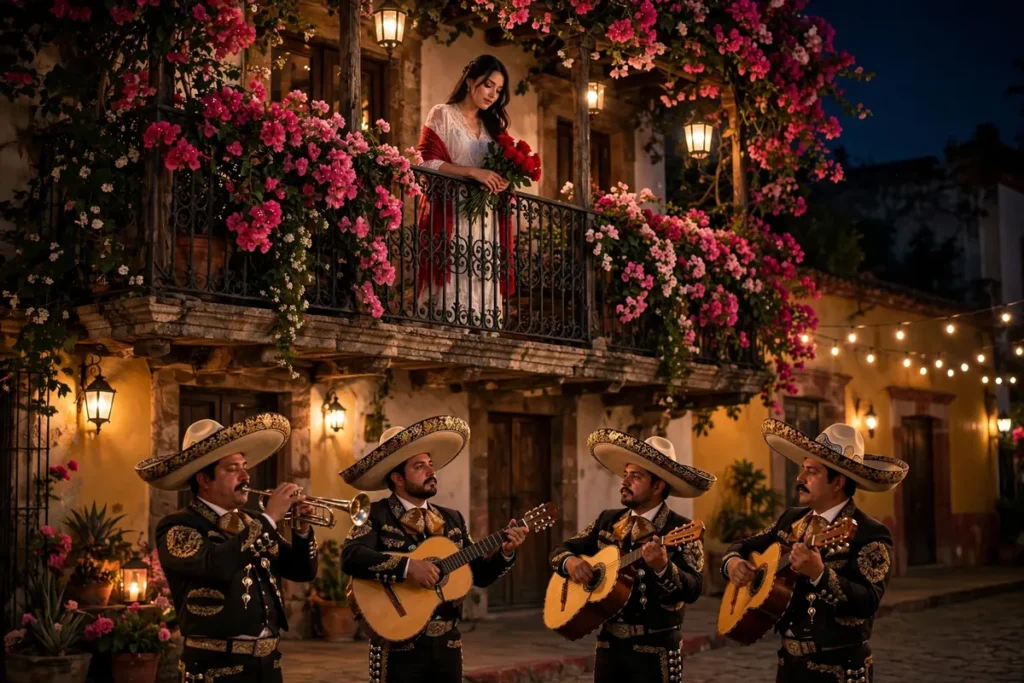
The classic serenade works like this: a person hires a mariachi band (or, in some regions, a rondalla or trio) to arrive at the beloved’s home, often late in the evening or even after midnight. The musicians strike up — traditionally beginning with “Las Mañanitas” or a beloved romantic standard — and the intended recipient comes to the window or door to listen. The performance might last for a few songs or a full set, depending on the budget, and it is as much a public declaration as a private one: the whole neighborhood knows what is happening, and that is part of the point.
On Valentine’s Day, serenades take on an added layer of meaning because of the friendship dimension. While the window serenade remains a romantic gesture, groups of friends sometimes hire musicians for a shared celebration — a mariachi band at a house party, a trio performing at a restaurant table for a group of amigas. The serenade scales from intimate to communal, and both versions are recognizably Mexican.
The repertoire matters. Songs like “Cielito Lindo,” “Bésame Mucho,” “Sabor a Mí,” and “El Reloj” are Valentine’s standards, and experienced mariachis know exactly which songs suit a new romance versus a decades-long marriage. For visitors, hiring a mariachi serenade is one of the most memorable Valentine’s experiences Mexico offers — many hotels and restaurants in tourist areas can arrange one, and in cities like Guadalajara, the birthplace of mariachi, the tradition is woven into the fabric of daily life.
It is worth noting that the serenade tradition, while beloved, belongs to a particular vision of romance — one that is public, musical, and unabashedly sentimental. In an era of dating apps and texted Valentine’s wishes, the serenade’s persistence in Mexico says something about a culture that has not outgrown grand gestures. When a mariachi band plays under a window in Mexico City on February 14, it is not nostalgia; it is the present tense of romance.
Dining Out: Restaurants, Plazas, and Street Food
Food is inseparable from any Mexican celebration, and El Día del Amor y la Amistad is no exception. Restaurants across the country prepare for February 14 as one of the busiest nights of the year, and the dining scene reflects the holiday’s dual nature: romantic dinners for two sit alongside boisterous group celebrations.
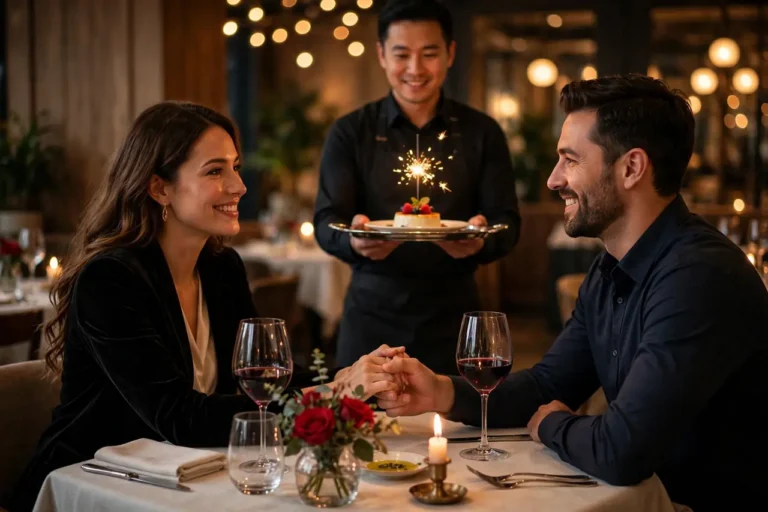
In major cities, restaurants roll out special Valentine’s menus — multi-course dinners with wine pairings, candlelit tables, and live music. Reservations fill weeks in advance at the most popular spots, and many establishments decorate elaborately with hearts, flowers, and the red-and-pink palette of the season. But the Mexican twist is that many of these restaurants also cater enthusiastically to groups. A table of eight friends celebrating together is as normal a sight on February 14 in Mexico as a table for two, and servers are accustomed to both.
Beyond the formal dining room, the holiday spills into public space. Parks and plazas host concerts, dances, and cultural events. Street vendors do a roaring trade in balloons, flowers, stuffed animals, and sweets. In cities like Mérida, Guadalajara, and Mexico City, the combination of a festive plaza, live music, and street food creates an atmosphere that is part date night and part block party — a distinctly Mexican way to spend the evening.
For couples who prefer to stay in, the home celebration is equally rich. A home-cooked Valentine’s dinner in Mexico might feature mole, chiles en nogada (out of season in February, but beloved), fresh seafood, or a spread of antojitos — and the guest list might include friends and family alongside the romantic partner. The idea that Valentine’s dinner must be a private affair for two is, in Mexico, simply not a rule.
Travelers should note one practical detail: because the holiday is so widely celebrated, restaurants in tourist areas are genuinely crowded on February 14. Booking ahead is not just advisable — it is essential. The same goes for mariachi bookings and flower orders. Mexico takes this holiday seriously, and the infrastructure of celebration fills up fast.
A Regional Tour: How February 14 Looks Across Mexico
Mexico is a large and diverse country, and while the broad strokes of El Día del Amor y la Amistad are national, the details vary by region. A tour of the country’s Valentine’s celebrations reveals how a single holiday adapts to local culture.
Mexico City
In the capital, Valentine’s Day is a full-scale urban festival. The historic center and neighborhoods like Roma, Condesa, and Coyoacán fill with flower vendors, balloon sellers, and pop-up gift stalls. Chapultepec Park becomes a promenade for couples and families alike. The city’s restaurants — from high-end dining rooms in Polanco to beloved neighborhood fondas — run special menus, and the nightlife districts see some of their biggest crowds of the year. The scale of the celebration in Mexico City is a reminder that this is not a niche holiday: it is a mainstream cultural event.
Guadalajara
As the birthplace of mariachi, Guadalajara has a special claim on the serenade tradition. On February 14, the Plaza de los Mariachis comes alive, and bands are booked solid for window serenades across the city. The city’s romantic plazas and colonial architecture provide a naturally cinematic backdrop, and local couples often combine dinner with a stroll through the historic center. Guadalajara’s celebration feels deeply rooted — this is a city where the Valentine’s traditions are not imported novelties but extensions of a living musical culture.
Mérida and the Yucatán
In Mérida, the Valentine’s celebration takes on a Yucatecan flavor. The city’s beautiful Paseo de Montejo becomes a promenade for the evening, and restaurants in the historic center offer special menus featuring regional cuisine. The warm February weather — the Yucatán is one of Mexico’s most pleasant regions in mid-February — means the celebration happens largely outdoors, in plazas and on restaurant terraces. The emphasis on friendship is particularly visible here, with large groups of friends dining together late into the night.
Beach Destinations: Cancún, Puerto Vallarta, Los Cabos
Mexico’s resort towns market Valentine’s Day aggressively to international visitors, and the result is a hybrid celebration: the Mexican emphasis on friendship and festivity blended with the expectations of tourists from the United States and Canada. Beachfront dinners, sunset sails, couples’ spa treatments, and proposal packages are the stock in trade. But even in the most tourist-oriented settings, the local staff and Mexican guests bring the amistad spirit — it is common to see Mexican families and friend groups celebrating alongside honeymooning couples.
Smaller Towns and Rural Areas
In smaller communities, the celebration is often organized around the town plaza and the local church. School events, community dances (bailes), and plaza concerts form the backbone of the festivities. The commercial apparatus is thinner — fewer balloon vendors, fewer restaurant prix-fixe menus — but the social core of the holiday is, if anything, stronger. In a small town, El Día del Amor y la Amistad is genuinely a community event, and the line between a romantic celebration and a neighborhood party barely exists.
Valentine’s Day in Mexican Schools: Where the Tradition Is Taught
To understand why Mexico’s Valentine’s Day feels so different, look at the schools. In Mexican classrooms, February 14 is a pedagogical event as much as a celebration, and the lessons taught there shape how an entire generation understands the holiday.
In the weeks leading up to the day, teachers organize amigo secreto exchanges, help students make handmade cards, and decorate classrooms with hearts and paper flowers. On the day itself, many schools hold small parties — with music, snacks, and the ceremonial exchange of gifts and cards. The critical detail is that participation is universal. Unlike the American classroom valentine exchange, which can become a popularity contest, the Mexican school celebration is explicitly structured around inclusion: everyone gives, everyone receives, and the emphasis is on kindness and friendship.
This matters because it means Mexican adults did not learn Valentine’s Day as a couples-only holiday and then broaden it — they learned it as a friendship holiday from the start. The romantic dimension arrives later, layered on top of a foundation of amistad. When Mexican adults exchange gifts with friends on February 14, they are not performing a quirky alternative to the “real” holiday; they are celebrating the holiday exactly as they were taught.
The school tradition also explains the holiday’s remarkable resilience. Commercial holidays can fade when the marketing stops, but a holiday embedded in childhood ritual — in the muscle memory of classroom parties and handmade cards — persists across generations. Mexico’s Valentine’s Day is not just a date on the retail calendar; it is a shared childhood memory, and shared memories are much harder to dislodge.
Celebrate El Día del Amor y la Amistad Wherever You Are
You do not need to be in Mexico to borrow the best parts of its Valentine’s Day. The genius of El Día del Amor y la Amistad is that it is a philosophy as much as a set of customs: celebrate every kind of love, include everyone, and do it with warmth and color. Here is how to bring that spirit into your own February 14.
Start by widening the guest list. The single most Mexican thing you can do on Valentine’s Day is to give a gift to someone who is not your romantic partner — a friend, a sibling, a parent, a coworker, a neighbor. The friendship-first celebrations like Galentine’s Day that have become popular in the United States are, in spirit, Mexico’s idea arriving by another route: love is bigger than couples. Send the text, buy the extra bouquet, invite the single friend to dinner. In Mexico, this is not a consolation gesture; it is the main event.
Second, go public with your affection in a joyful way. The balloon arrangement may be hard to replicate outside Mexico, but the impulse behind it — making love visible and celebratory rather than private and anxious — travels well. Decorate the office. Put hearts on the classroom door. Cook a big meal and invite the people you love, all of them, instead of reserving the evening for two. Many of the classic Valentine’s Day date ideas work beautifully as group plans: a cooking night, a movie marathon, a walk through the city’s prettiest neighborhood.
Third, consider the serenade principle. You probably cannot hire a mariachi band on short notice — though in cities with large Mexican communities, you genuinely might — but you can borrow the serenade’s emotional logic: a grand, slightly theatrical, unembarrassed declaration of affection. Write the long letter. Make the playlist. Show up with the flowers at the office. Mexico’s Valentine’s culture has never been embarrassed about big romantic gestures, and there is something liberating about a holiday that rewards sincerity over coolness.
Fourth, run your own amigo secreto. It takes ten minutes to organize: collect names, draw them from a hat (or use a free online generator), set a modest spending limit, and exchange gifts on February 14. It works for offices, classrooms, friend groups, and extended families. The reveal — everyone guessing who had whom — is reliably the most fun part of the day. If you want to see how Valentine’s Day traditions around the world compare, from South Africa’s sleeve-pinning custom to Ghana’s National Chocolate Day, you will find that Mexico’s inclusive model is one of the most joyful variations on the planet.
Finally, eat well. A Mexican Valentine’s table is abundant, colorful, and shared. Whether you cook mole, order from your favorite Mexican restaurant, or simply bake heart-shaped conchas (Mexican sweet bread, available at most panaderías in February), the food should feel like a fiesta. And if you are planning a trip, consider timing it for the holiday itself: experiencing El Día del Amor y la Amistad in a Mexican plaza, with mariachis playing and balloon vendors on every corner, is one of the great Valentine’s experiences in the world.
Watch: What Valentine’s Day in Mexico Looks Like
To see the celebration in action — the gift exchanges, the restaurant scenes, the mariachi serenades, and the way friendship takes center stage — watch this video tour of Valentine’s Day in Mexico:
Frequently Asked Questions
What is Valentine’s Day called in Mexico?
Valentine’s Day in Mexico is called El Día del Amor y la Amistad, which translates to “the Day of Love and Friendship.” The name reflects the Mexican tradition of celebrating both romantic love and platonic friendship on February 14, making the holiday more inclusive than in countries where it focuses only on couples. The shorter form Día de San Valentín (Saint Valentine’s Day) is also used.
Is Valentine’s Day a public holiday in Mexico?
No. Valentine’s Day is not an official public holiday in Mexico — businesses, schools, and government offices remain open. However, it is one of the most widely celebrated informal holidays in the country. Restaurants are packed, florists do their biggest business of the year, and schools and workplaces organize gift exchanges and parties during the day.
What do Mexicans give for Valentine’s Day?
The most iconic Mexican Valentine’s gifts are elaborate heart-shaped balloon arrangements, red roses, chocolates, stuffed animals (especially oversized teddy bears), jewelry, and handwritten letters. Gifts are exchanged not only between romantic partners but also among friends, family members, classmates, and coworkers — the friendship dimension means the average Mexican gives (and receives) far more Valentine’s gifts than the average American.
What is amigo secreto?
Amigo secreto (“secret friend”) is the Mexican Valentine’s version of Secret Santa. Participants draw names and secretly buy or make a small gift for their assigned person, often leaving anonymous clue notes in the days before February 14, when identities are revealed. It is organized in schools, offices, and friend groups across Mexico and is one of the customs that makes the holiday genuinely inclusive of single people.
What is a Mexican Valentine’s serenade?
A serenata is the tradition of hiring musicians — usually a mariachi band — to perform beneath a loved one’s window, often late at night. The band plays romantic standards, the recipient comes to the window to listen, and the whole neighborhood witnesses the declaration. February 14 is the busiest night of the year for serenades in Mexico, and in mariachi’s birthplace of Guadalajara the tradition is especially strong.
How is Valentine’s Day in Mexico different from the United States?
The core difference is the friendship dimension. In the U.S., February 14 is overwhelmingly a couples’ holiday centered on romantic partners; in Mexico, friends, family, classmates, and coworkers are full participants through gift exchanges, group dinners, and school and office rituals. The Mexican celebration is also more public and communal — plazas, concerts, street vendors, and serenades make it a visible street-level festival rather than a private dinner-for-two affair. For a broader comparison, see our guide to Valentine’s Day traditions around the world.