In most countries, February 14 belongs to roses and candlelit dinners. In Ghana, it belongs to chocolate — officially. Since 2005, Valentine’s Day in Ghana has doubled as National Chocolate Day, a government-backed celebration that turned the world’s most romantic date into a festival of cocoa. The idea was as clever as it was delicious: Ghana is one of the world’s great cocoa producers, yet Ghanaians themselves ate very little of the chocolate made from their own beans. So the Ghana Tourism Authority decided to rebrand February 14 — to give the day, in the words of officials at the time, “a healthy orientation” — and encourage the whole country to show love the Ghanaian way: with chocolate.
Two decades later, National Chocolate Day has grown from a tourism-ministry initiative into a genuine national tradition. The single day has expanded into National Chocolate Week, complete with “chocolate cities,” street floats through Accra, school visits, hospital donations, and a full calendar of cocoa-themed events. Ghana’s Vice President marked the 2026 edition with a public address urging citizens to swap foreign confectionery for made-in-Ghana chocolate. Parliament itself has celebrated the day, with members trading debate for chocolate bars on the floor of the House.
This guide tells the full story: how and why Ghana invented National Chocolate Day, the cocoa heritage that makes it possible, how the celebration works today — from Chocolate Week events to the chocolate hampers couples exchange — and what the day reveals about the delicious intersection of love, agriculture, and national pride.
| Fact | Detail |
|---|---|
| Official name | National Chocolate Day |
| Date | February 14, every year (coincides with Valentine’s Day) |
| First observed | 2005, instituted by the Ghana Tourism Authority |
| Founding partners | Ghana Tourism Authority, Cocoa Processing Company of Ghana, Ministry of Tourism |
| Expanded to | National Chocolate Week (since 2021), organized with COCOBOD |
| Recurring theme | “Eat Chocolate, Stay Healthy, Grow Ghana” |
| Signature gifts | Made-in-Ghana chocolate hampers, Golden Tree bars, cocoa gift boxes |
| Local nickname for Feb 14 | “Vals Day” / “Chocs Day” |
The Origin Story: How 2005 Changed February 14
The story begins with a paradox that troubled Ghana’s tourism minister in the mid-2000s. Ghana was the world’s second-largest producer of cocoa — the raw material of chocolate — yet domestic consumption of chocolate was strikingly low. The country’s finest beans were shipped abroad, transformed into premium chocolate in Europe and North America, and sold back to the world at a markup. Ghanaians grew the chocolate; other countries ate it.
Jake Obetsebi Lamptey, Ghana’s Minister of Tourism at the time, saw an opportunity in the calendar. Valentine’s Day was already gaining traction among young Ghanaians — a radio station in Accra had pioneered Valentine’s promotions back in 1996 — but it also carried a whiff of controversy. Some commentators worried the imported holiday encouraged promiscuity among the youth. The ministry’s answer was characteristically Ghanaian: keep the date, change the meaning. Institute a National Chocolate Day on February 14, and redirect the energy of the holiday toward something wholesome, patriotic, and delicious.
The initiative was launched in 2005 as part of the Ghana@50 celebrations (marking fifty years of independence), in partnership with the Cocoa Processing Company of Ghana. At the launch, the minister made the economic case plainly: a country that was the world’s second-largest cocoa producer should not be a negligible consumer of chocolate. The new day would promote the health and nutritional benefits of cocoa, boost domestic tourism, and — in the ministry’s memorable phrasing — give Valentine’s Day “a healthy orientation.” The subtext was equally clear: express your love with a gift of chocolate, not with anything the aunties would disapprove of.
The ministry even floated the idea of a cocoa museum to anchor the celebration in Ghana’s agricultural heritage. And while the museum took longer to materialize than the holiday, the day itself caught on immediately. Schools, churches, media houses, and market associations embraced it. Within a few years, “Chocolate Day” was as familiar a phrase in Accra as Valentine’s Day itself — and for many Ghanaians, the two names became interchangeable.
Why Chocolate? Ghana’s Cocoa Heritage
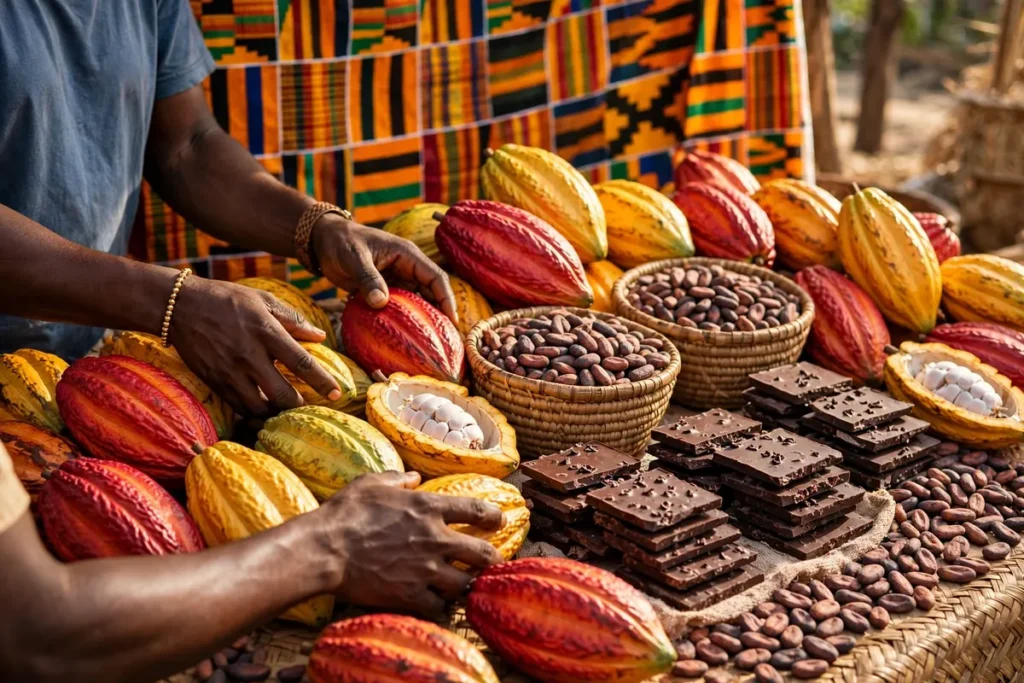
To understand why chocolate — rather than flowers or cards — became Ghana’s love language, you have to understand cocoa’s place in the national story. Cocoa is not just a crop in Ghana; it is the crop. Introduced in the late 19th century — tradition credits the farmer Tetteh Quarshie with bringing Amelonado cocoa pods from the island of Fernando Po in 1879 — cocoa transformed Ghana’s economy within a generation. By the early 20th century, the Gold Coast was the world’s largest cocoa exporter, and cocoa revenue funded roads, schools, and the independence movement itself.
That heritage is why National Chocolate Day resonates so deeply. When a Ghanaian gives chocolate on February 14, the gift carries layers of meaning that an imported rose cannot: it is a product of Ghanaian soil, processed — increasingly — by Ghanaian companies, and given on a day the government set aside to celebrate exactly that chain. The chocolate becomes a small act of economic patriotism, a theme Ghana’s leaders have leaned into explicitly. In her February 2026 address, Vice President Naana Jane Opoku-Agyemang urged Ghanaians to “redefine Valentine’s Day as a moment of economic patriotism,” swapping foreign confectionery for local chocolate and honoring what she called one of Ghana’s finest gifts to the world.
The brands tell the story too. The Cocoa Processing Company’s Golden Tree line — long the flagship of Ghanaian chocolate — shares shelf space with a new generation of bean-to-bar makers. ’57 Chocolate, founded in Accra by two sisters and named for the year of Ghana’s independence, has become an emblem of the artisanal wave, winning fans at home and abroad. On National Chocolate Day, these made-in-Ghana brands are the heroes of the hour: gift shops assemble hampers around them, and the “buy local” message lands with unusual force because the product is genuinely world-class.
There is also the health angle, which the Tourism Authority emphasized from the start. Cocoa is rich in flavanols and antioxidants, and the “Eat Chocolate, Stay Healthy” messaging gave the day a wellness gloss that distinguished it from the pure indulgence of a Western Valentine’s. Whether or not a chocolate bar is health food, the framing worked: National Chocolate Day positioned chocolate as a wholesome gift — good for the heart in every sense.
From a Day to a Week: The Birth of National Chocolate Week
For its first decade and a half, the celebration was a single day. Then, in 2021, the Ghana Tourism Authority and COCOBOD (the Ghana Cocoa Board) decided that one day was not enough. National Chocolate Day was extended into National Chocolate Week — typically running from around February 10 to February 14 — and the expanded format unlocked a far richer program of events.
The centerpiece of Chocolate Week is the “Chocolate City” concept: designated venues where chocolatiers, cocoa processors, and vendors showcase their products — tastings, exhibitions, and sales all in one place. The 2021 launch edition set the template, and subsequent years have added street floats through Accra (with the Tourism Authority’s deputy CEO riding along to preach the gospel of cocoa consumption), school outreach programs, and media campaigns built around the enduring theme: “Eat Chocolate, Stay Healthy, Grow Ghana,” with the sub-theme “Our Chocolate, Our Health, Our Wealth.”
The week’s events deliberately mix commerce, education, and charity. The Tourism Authority’s regional offices organize their own programs — in 2025, the Upper West regional office marked the day by donating chocolate, bottled water, diapers, and toiletries to children in the paediatric unit of the regional hospital, explicitly framing the gesture as showing love on Chocolate Day. It is a striking image of how the holiday has evolved: Valentine’s romance expressed as community care, with chocolate as the medium.
Parliament has gotten in on the act as well, with members photographed celebrating National Chocolate Day in the chamber — trading debate for chocolate in a display of bipartisan sweetness. The political embrace matters because it signals that Chocolate Day is not a marketing gimmick but a fixture of the national calendar, observed from the hospital ward to the House floor.
How Ghanaians Celebrate: Hampers, “Vals Day,” and Chocolate Everything
Ask a young Ghanaian about February 14 and you may hear it called “Vals Day” — the local shorthand for Valentine’s Day, used with the easy familiarity of a nickname. But the celebration itself has a distinctly Ghanaian texture, shaped by the chocolate mandate and by West African social life.
The signature gift is the chocolate hamper. Where Americans default to roses and Europeans to candlelit dinners, Ghanaians assemble elaborate gift baskets and boxes built around chocolate: Golden Tree bars, cocoa powder, chocolate-coated nuts, artisanal truffles from local makers, sometimes paired with wine or a plush toy. “Tailor-made hampers to boxes of handmade chocolate creations” is how one travel writer described the range, and the hamper has become the visual emblem of the holiday — stacked in shop windows across Accra and Kumasi in the week before the 14th, photographed for social media, and delivered with ceremony.
Chocolate is the must, but it is not the only gift. Flowers — especially red roses — remain popular, and the full international repertoire of Valentine’s gifts (jewelry, perfume, teddy bears, dinner dates) is well represented among Ghana’s urban couples. What distinguishes the Ghanaian version is the layering: the roses and the chocolate, the dinner and the hamper. The chocolate is non-negotiable; everything else is the romance on top.
The day’s social geography will be familiar to anyone who has spent a Valentine’s in a major city: restaurants fill up, hotels report a bump, gift shops do their best week of the year, and the streets turn red with decorations. But there are Ghanaian particularities. The Tourism Authority’s floats and public events give the day a civic dimension — it is not just a private romantic occasion but a public festival with floats, music, and free chocolate tastings. Media houses run Chocolate Day promotions. Churches and schools organize events. The whole country seems to be in on it, which is precisely what the founders intended: a Valentine’s Day that belongs to everyone, not just couples.
And then there is the charity tradition, which may be the most genuinely moving part of the modern celebration. The hospital donations, the school visits, the community outreach — these reframe February 14 as a day of love expressed outward, toward strangers and neighbors. In a sense, Ghana stumbled onto something profound: by making the holiday about a product rather than a partner, it accidentally made it about generosity. You can give chocolate to anyone — your mother, your teacher, a sick child in a hospital ward — and the gesture reads as love.
The Economics of Love: What Chocolate Day Means for Ghana
Beneath the romance, National Chocolate Day is an economic instrument — and a revealing one. Ghana’s cocoa sector has long been caught in a familiar developing-world bind: the country grows the raw material, but the value-added processing (and the profits) happen abroad. Domestic consumption was, at the day’s founding, a fraction of a percent of production. The Tourism Authority’s deputy CEO noted in a recent Chocolate Day address that the goal was to push consumption upward as part of a broader industrialization drive — more local processing, more local consumption, more of the chocolate value chain captured at home.
The numbers tell the story of both the challenge and the ambition. Ghana consistently ranks among the world’s top cocoa producers, yet for decades the average Ghanaian ate very little chocolate. National Chocolate Day — and now Chocolate Week — is the demand-side complement to COCOBOD’s supply-side strategy of increasing domestic processing. Every hamper bought, every Golden Tree bar gifted, every tourist who tastes Ghanaian chocolate and becomes a convert is a small vote for the local value chain.
The tourism dimension matters too. The day was, after all, created by the Tourism Authority, and “promote domestic tourism” was in the founding brief. Chocolate Week events — the Chocolate Cities, the tastings, the floats — are designed as attractions, drawing Ghanaians out of their homes and into public celebration. The 2026 Vice President’s address made the pitch explicit: position “cocoa and the chocolate experience as a strong element of the Ghana tourism experience.” In a country that has successfully marketed itself to the diaspora (the Year of Return drew an estimated one million visitors in 2019), chocolate tourism is a natural next chapter.
There is a lesson here for other commodity-producing countries: Ghana took a global romantic holiday and bent it into a development policy. The genius of National Chocolate Day is that nobody experiences it as policy. It feels like a festival — because it is one — and the economics ride along inside the celebration, like cocoa butter in a truffle.
Cocoa, Health, and the “Healthy Orientation”
One of the founding goals of National Chocolate Day deserves a closer look, because it reveals the moral logic of the holiday: the Ghana Tourism Authority wanted to give Valentine’s Day “a healthy orientation.” The phrase sounds bureaucratic, but the idea behind it was sincere and culturally specific.
The concern, as expressed by officials and commentators in 2005, was that Valentine’s Day — still a relatively new import — was becoming associated among Ghanaian youth with sexual activity and, in the moral panic of the moment, promiscuity. The ministry’s response was not to ban the holiday or preach against it, but to redirect it: make February 14 about chocolate, a gift you can give your mother, your teacher, or your pastor without raising an eyebrow. Chocolate became the wholesome alternative — love you can express in public.
The health messaging reinforced the point. Cocoa’s nutritional profile — flavanols, theobromine, mood-lifting compounds — gave the Tourism Authority a science-backed story: chocolate is not just a treat, it is good for you. “Eat Chocolate, Stay Healthy” became the slogan, and the day’s events routinely include nutrition education alongside the tastings. Whether chocolate is truly health food is a debate for nutritionists; as a cultural framing, it worked brilliantly, giving the holiday a virtuous glow that a purely romantic Valentine’s could never claim.
Two decades on, the “healthy orientation” reads as a period piece — the moral panic has faded, and young Ghanaians celebrate Vals Day with the same romantic enthusiasm as their peers anywhere. But the chocolate stuck. The redirection succeeded so completely that it is now hard to imagine February 14 in Ghana without it. The ministry set out to tame Valentine’s Day and ended up creating something better: a holiday that is simultaneously romantic, patriotic, charitable, and delicious.
Watch: Why Ghana Created Chocolate City for Valentine’s Day
See how Ghana marks the day — from the Chocolate City showcases to street celebrations — in this video look at National Chocolate Day:
Celebrating the Ghanaian Way: Ideas to Borrow
You do not need to be in Accra to take inspiration from National Chocolate Day. The Ghanaian model offers a few ideas worth stealing for your own February 14. First, make chocolate the centerpiece rather than an afterthought: build a hamper around excellent chocolate — ideally from a maker with a story, the way Ghanaians champion Golden Tree and ’57 Chocolate. A curated chocolate gift, with tasting notes and a little ceremony, feels more personal than a generic box. Our guide to last-minute Valentine’s Day gifts has plenty of chocolate-forward ideas if you are short on time.
Second, borrow the “buy local” patriotism. Ghana’s Valentine’s is an economic act as well as a romantic one — and the principle travels. Seek out a chocolatier in your own city, region, or country, and make their product the star of your Valentine’s. It is a more interesting gift than anything mass-produced, and it supports the same kind of local value chain that Chocolate Day was built to promote. For her, specifically, a thoughtful chocolate hamper belongs on any list of Valentine’s Day gifts for her — and the Ghanaian version shows how to do it with style.
Third, take the generosity outward. The hospital donations and community outreach of Ghana’s Chocolate Week are a reminder that February 14 does not have to be a closed circuit between two people. Bring chocolate to the office, to your neighbors, to a local shelter. It is the rare Valentine’s tradition that gets better the more people you include — a spirit it shares with Mexico’s Day of Love and Friendship, where amistad gets equal billing with amor. And if you are curious how another country stretches the holiday across multiple days, see how India’s Valentine’s Week dedicates a whole day to chocolate too. For the full global picture, browse our roundup of Valentine’s Day traditions around the world.
Frequently Asked Questions
What is National Chocolate Day in Ghana?
National Chocolate Day is Ghana’s official name for the February 14 celebration, instituted in 2005 by the Ghana Tourism Authority. It coincides with Valentine’s Day but reframes it around chocolate: the goals are to boost domestic consumption of Ghanaian chocolate and cocoa products, promote domestic tourism, and give the holiday what officials called “a healthy orientation.” It is observed nationwide every February 14.
Why does Ghana celebrate Valentine’s Day with chocolate?
Ghana is one of the world’s leading cocoa producers, yet historically Ghanaians consumed very little chocolate domestically. The Tourism Authority created National Chocolate Day to close that gap — encouraging Ghanaians to eat the chocolate made from their own cocoa beans, supporting local processors like the Cocoa Processing Company and artisanal makers like ’57 Chocolate, and turning Valentine’s gift-giving into an act of economic patriotism.
What is National Chocolate Week?
National Chocolate Week is the expanded, week-long version of the celebration, introduced in 2021 by the Ghana Tourism Authority in partnership with COCOBOD (the Ghana Cocoa Board). It typically runs from around February 10 to February 14 and features “Chocolate Cities” (showcase venues for chocolatiers), street floats, tastings, school programs, charity donations, and media campaigns under the theme “Eat Chocolate, Stay Healthy, Grow Ghana.”
When was National Chocolate Day established?
National Chocolate Day was established in 2005 by the Ghana Tourism Authority, in partnership with the Cocoa Processing Company of Ghana, as part of the Ghana@50 independence celebrations. The initiative was launched under Tourism Minister Jake Obetsebi Lamptey, who argued that the world’s second-largest cocoa producer should consume more of its own chocolate.
What do Ghanaians give on Valentine’s Day?
Chocolate is the essential gift — especially in the form of elaborate chocolate hampers built around made-in-Ghana brands. Flowers (particularly red roses), jewelry, teddy bears, and dinner dates are also popular, but the chocolate hamper is the signature. The day is known locally as “Vals Day,” and the celebration extends beyond couples to friends, family, schools, churches, and community charity events.
Is National Chocolate Day only celebrated in Ghana?
Yes — the official National Chocolate Day is unique to Ghana. While chocolate is a near-universal Valentine’s gift worldwide, no other country has a government-instituted chocolate holiday on February 14. Ghana’s combination of top-tier cocoa production, a tourism ministry willing to rebrand a romantic holiday, and two decades of tradition makes it a one-of-a-kind celebration.