Germany’s relationship with Valentine’s Day is complicated — and that’s what makes it interesting. In a country famous for Ordnung and understatement, February 14th arrived as an American import, was eyed with suspicion by older generations, and has slowly, unevenly, been adopted by the young. Along the way, Germany added its own unmistakable twist: the lucky pig. On Valentinstag, German sweethearts exchange not just roses and chocolates but marzipan pigs, porcine chocolates, and pig figurines — because in Germany, the pig is a symbol of luck, prosperity, and (whisper it) lust.
This guide separates myth from fact about Valentine’s Day in Germany: where the day really came from, what Germans actually give each other, why the pig matters, and how to celebrate Valentinstag the German way — with sincerity, a little irony, and excellent chocolate.
Valentine’s Day in Germany: Key Facts at a Glance
| Fact | Detail |
|---|---|
| Local name | Valentinstag (Valentine’s Day) |
| How it arrived | After WWII — American soldiers stationed in Germany held a Valentine’s Ball in Nuremberg in 1950 |
| Status today | Widely observed by under-50s, especially in cities; older generations often skeptical (“not really our thing”) |
| Top gift | Flowers — more flowers are given on Feb 14th than any other day of the year; red roses lead |
| Unique German custom | Pig-themed gifts — marzipan pigs (Glücksschwein), pig chocolates, figurines; the pig symbolizes luck and lust |
| Other popular gifts | Chocolates (often heart-shaped packaging), homemade heart-shaped cookies with romantic messages, greeting cards (Valentinsgrüße) |
| Tone | Romantic love focused (less about friends/family than in some countries); sincere but understated |
| Commercial footprint | Modest — fewer decorations and cards in shops than in the US/UK; florists and chocolatiers drive the day |
Myth vs. Fact: The Real Story of Valentinstag
Myth: Valentine’s Day is an ancient German tradition
Fact: It’s one of Germany’s youngest holidays. Unlike in England or France, where February 14th has centuries of romantic history, Germany had no native Valentine’s tradition. The medieval German calendar had its own days for love and courtship — May Day (Walpurgisnacht) festivities and name days (Namenstage) were the traditional occasions for expressing affection. February 14th meant nothing romantically to most Germans before the 20th century.
Myth: It was invented by the German flower industry
Fact: Many Germans believe this — and it’s half true. The day’s origins are genuinely old (Roman and early Christian), but its German career began with American soldiers. In 1950, American GIs stationed in Germany threw a Valentine’s Ball in Nuremberg, and the custom caught on from there. Florists, retailers, and chocolatiers certainly promoted it enthusiastically from the 1990s onward — but they were amplifying an imported American custom, not inventing one. The U.S. Army’s own reporting on the holiday in Germany traces the same story: European immigrants brought Valentine’s Day to America, and after WWII, American soldiers brought it back to Germany.
Myth: Germans don’t really celebrate it
Fact: It’s complicated — and generational. Valentine’s Day has been described as “not really our thing” in Germany, and you’ll find fewer decorations in shop windows and fewer cards on sale than in Britain or America. Older Germans often view it with amused skepticism. But among younger couples and urban populations, it’s now a well-established occasion: flowers, chocolates, cards with hearts, romantic dinners. The day is real; it’s just quieter, less commercial, and more private than its Anglo-American cousin.

Myth: The gifts are the same as everywhere else
Fact: Mostly — but with a porcine twist. Red roses are the classic gift (men buy flowers more often than women, according to surveys), and heart-shaped chocolate packaging sells briskly. But Germany’s unique contribution is the pig. The Glücksschwein (lucky pig) is an ancient German symbol of good fortune and prosperity — pigs were historically associated with fertility and abundance — and it has become a Valentine’s mascot. Couples exchange marzipan pigs, pig-shaped chocolates, pig pictures, and tiny pig figurines. The pig represents luck and lust, making it, in its way, the perfect Valentine’s symbol: sincere, slightly cheeky, and unmistakably German.
Myth: It’s a day for everyone you love
Fact: In Germany, Valentine’s Day is more narrowly focused on romantic love than in many countries. While Americans exchange valentines with friends, classmates, and family members, and Finns celebrate friendship outright (see our guide to Ystävänpäivä), the German Valentinstag is primarily a couples’ day. Cards and gifts go to sweethearts — not to colleagues or pals.
The Lucky Pig: Germany’s Most Charming Valentine’s Symbol
The Glücksschwein deserves its own chapter, because it’s the single most distinctive thing about the German Valentine’s Day. The lucky pig appears across German life — as a New Year’s good-luck charm, a mascot, a marzipan treat — but on February 14th, it goes romantic.
Why a Pig?
The pig’s lucky reputation in German culture is old. Pigs were valuable livestock — a sign of wealth, fertility, and plenty — and the phrase Schwein haben (“to have a pig”) still means “to be lucky” in German. The piglet, plump and cheerful, became a good-luck token. On Valentine’s Day, the symbolism gets a romantic spin: the pig stands for luck in love, and — with a wink — for desire. A marzipan pig from your sweetheart says: I wish you luck, I find you desirable, and I don’t take any of this too seriously. It’s affection with a sense of humor, which is a very German kind of romance.
What Pig Gifts Look Like
German confectioners produce an entire Valentine’s bestiary: pink marzipan pigs (often with a lucky coin or clover), chocolate pigs in foil, pig-shaped gingerbread, and plush pigs holding hearts. Card shops sell pig-themed Valentinsgrüße. It’s kitsch, it’s sweet, and it’s beloved — the rare Valentine’s tradition that couldn’t exist anywhere else.
What Germans Actually Do on February 14th
Flowers First
The gift of choice on the German Valentine’s Day is flowers — and more flowers are given on this day than on any other day of the year. Red roses dominate, but tulips, gerberas, and mixed bouquets are common. German florists prepare for weeks; prices spike; and the morning of February 14th sees queues at flower shops across the country. If you’re celebrating in Germany, the florist is your first stop — not the card shop.
Chocolate and Homemade Sweets
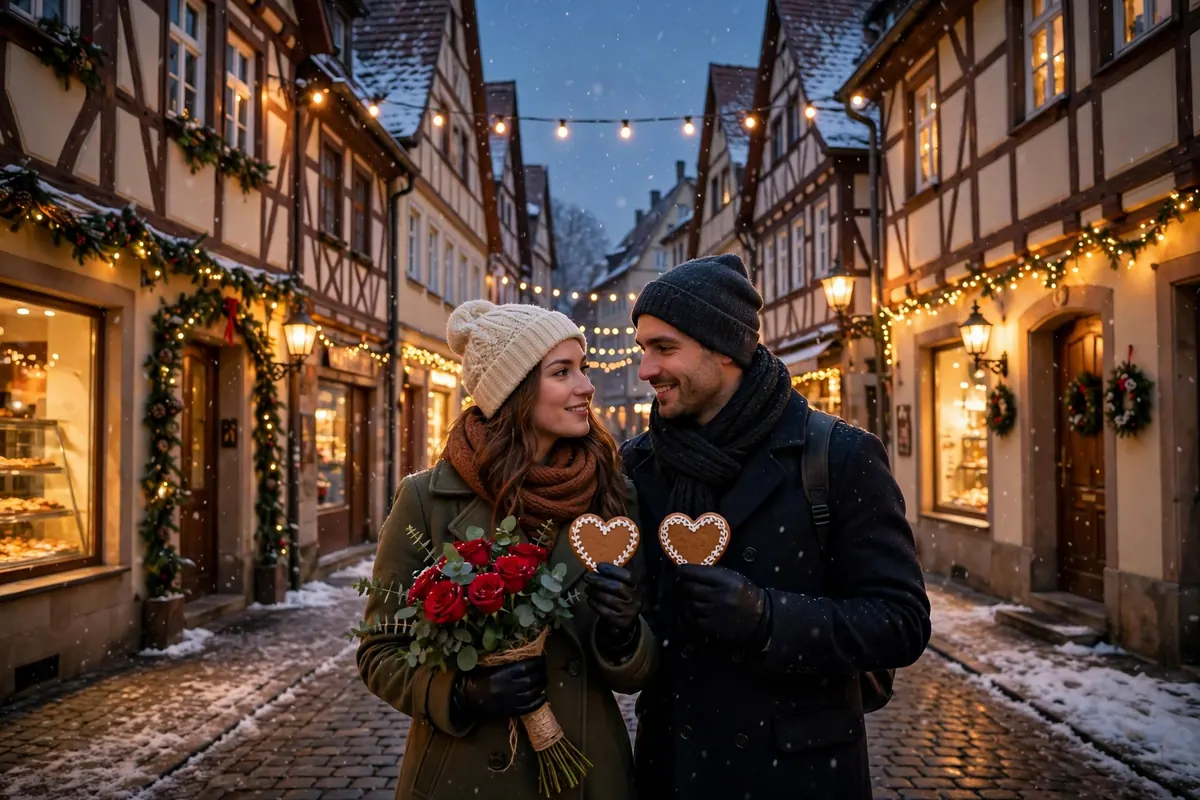
Chocolates and sweets run a close second, with manufacturers releasing special Valentine’s editions — often in heart-shaped packaging, and increasingly personalized with messages. A particularly German tradition is the homemade heart-shaped cookie (Herzplätzchen), inscribed with romantic messages in icing. These are the edible equivalent of a love letter: personal, effortful, and delicious.
Cards — But Quieter
Germans do exchange greeting cards (Valentinsgrüße), both handwritten notes and commercial cards — but the card culture is nowhere near as intense as Britain’s. The great British tradition of the anonymous valentine never took hold here; German cards tend to be signed, sincere, and straightforward. For card inspiration with international flair, see our Valentine’s Day traditions guide.
Dinner — Booked in Advance
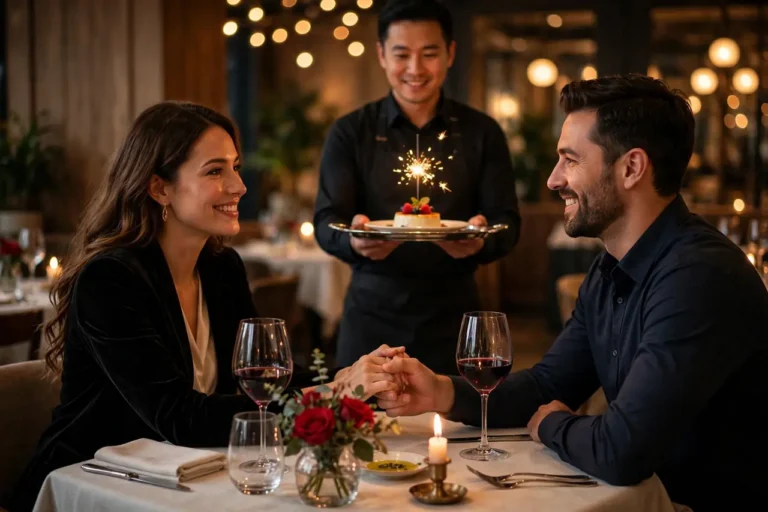
Romantic dinners are central, and the practical rule is the same as everywhere: reserve early. German couples favor cozy, quality restaurants over flashy Valentine’s productions — the emphasis is on good food, good wine, and unhurried conversation. Many prefer to cook at home: a well-executed dinner for two, with candles and the phones away, is considered deeply romantic. Our Valentine’s Day dinner ideas collection translates perfectly to a German kitchen.
Watch: Do Germans Celebrate Valentine’s Day?
For a firsthand, funny, and honest take on Valentinstag — how it compares between Germany and the US, what Germans actually think of the day, and where the traditions came from — watch Feli from Germany’s explainer. Born and raised in Munich, Feli breaks down the history and the modern reality with the clarity of someone who’s lived both sides.
Celebrating Valentinstag the German Way: A Practical Guide
Step 1: Keep It Sincere, Keep It Simple
The German Valentine’s rewards sincerity over spectacle. A thoughtful bouquet, a heartfelt card, a home-cooked meal — these land better than grand, expensive gestures. The day is not a competition; it’s a quiet acknowledgment. If you’re shopping for gifts, our guides to gifts for her and gifts for him can help — just dial the extravagance down a notch for a German audience.
Step 2: Add the Pig
Whatever else you give, add a Glücksschwein. A marzipan pig tucked into the bouquet, a pig chocolate with the card — it’s the gesture that says you understand the local culture. It’s also a great conversation starter and a guaranteed smile.
Step 3: Bake Something
Homemade heart-shaped cookies with iced messages are a beloved German Valentine’s tradition. They don’t need to be perfect — the effort is the message. Pair them with good coffee or glühwein (if February is still cold, which it will be) for a cozy evening in.
Step 4: Plan the Evening, Not the Month
Germans tend not to build Valentine’s Day into a weeks-long production. A well-planned evening — dinner reservation, a walk through the old town, maybe a concert or film — is the right scale. Cities like Munich, Berlin, Hamburg, and Heidelberg are at their most atmospheric on a cold February night, all lit windows and quiet streets.
Where to Celebrate: A Map of Germany
From Nuremberg — where the Valentine’s Ball of 1950 started it all — to romantic Heidelberg, Germany offers countless backdrops for February 14th. Use the map below to explore.
Valentinstag Through the Decades: A Timeline
Germany’s Valentine’s Day didn’t arrive all at once — it seeped in over seventy years. Here’s how Valentinstag evolved from an American military curiosity into a German fixture.
1950s: The Nuremberg Ball
American soldiers stationed in post-war Germany throw a Valentine’s Ball in Nuremberg in 1950, introducing the holiday to the local population. For most Germans, it’s an exotic American custom — interesting, but foreign. The day barely registers outside the orbit of the US military bases.
1960s–70s: Slow Seep
American films, music, and television carry Valentine’s imagery into German living rooms. Young Germans begin to notice the day, but there’s no commercial infrastructure behind it — few cards, little advertising, minimal retail participation. It remains a niche, youth-driven curiosity.
1980s: The Florists Notice
German florists, watching the Valentine’s boom in neighboring countries, begin promoting February 14th. Flower shops stock Valentine’s arrangements; the first tentative advertising appears. The day is still far from mainstream, but the commercial seed is planted.
1990s: The Takeoff
Reunification-era Germany embraces Western consumer culture wholesale, and Valentine’s Day rides the wave. Retailers, chocolatiers, and restaurants promote the day aggressively. The Glücksschwein pig tradition merges with the holiday. By the end of the decade, Valentinstag is a recognized — if still low-key — occasion, especially among the under-40s.
2000s–Today: Established but Understated
Valentine’s Day settles into its modern German form: widely observed by younger couples, met with affectionate skepticism by their parents, and largely ignored as a commercial frenzy. Social media adds new rituals (the Valentine’s post, the story shout-out), but the core remains flowers, chocolate, a card, and dinner. The pig endures.
The Language of Love: German for Valentine’s Day
A few words of German go a long way on Valentinstag — and they reveal how the culture thinks about love.
- Valentinstag — Valentine’s Day (literally “Valentine’s day”).
- Alles Liebe zum Valentinstag! — All my love for Valentine’s Day! (the standard greeting).
- Ich liebe dich — I love you (deep, serious — not used lightly).
- Ich hab dich lieb — I love you / I’m fond of you (warmer, more casual — the everyday version).
- Schatz — treasure/darling (the most common German term of endearment).
- Mein Schatz, mein Herz, mein Liebling — my treasure, my heart, my darling.
- Glücksschwein — lucky pig (the Valentine’s mascot).
- Valentinsgrüße — Valentine’s greetings (the cards).
Note the distinction between ich liebe dich and ich hab dich lieb — it’s a very German precision. The first is a declaration; the second is affection. Using the right one at the right moment is, in its way, the most romantic thing a non-native speaker can do. A handwritten card in German, even a simple one, will be treasured far beyond its words.
Regional Notes: Valentinstag Across Germany
Bavaria: Tradition Meets Romance
In Munich and across Bavaria, Valentine’s Day blends with the region’s love of Gemütlichkeit — coziness. Couples favor traditional restaurants, beer gardens (in milder years), and the city’s beautiful winter streets. The Bavarian touch: a heart-shaped Lebkuchen (gingerbread) cookie, iced with a message, echoing the Oktoberfest Lebkuchenherzen tradition.
Berlin: Irony and Edge
Berlin does Valentine’s Day with the city’s characteristic irony. Anti-Valentine’s parties are as popular as romantic dinners; the city’s clubs and bars host February 14th events that range from sincere to satirical. For couples, Berlin offers gallery nights, concerts, and the unmistakable romance of the city’s lit-up winter streets.
The Rhineland: Carnival Season Overlap
In Cologne, Düsseldorf, and Mainz, Valentine’s Day sometimes collides with carnival season (Karneval) — and carnival usually wins. A February 14th that falls during carnival week will find the Rhineland in costume, not candlelight. Locals take it in stride: love and carnival are both celebrations, after all.
Heidelberg: Germany’s Romantic Capital
If Germany has a Valentine’s capital, it’s Heidelberg — the castle ruins, the old bridge, the Philosopher’s Walk above the Neckar. February visitors get the romance without the summer crowds. A Heidelberg Valentine’s is the closest Germany comes to a grand romantic gesture, and it’s magnificent.
The Anti-Valentine’s Movement: Germany’s Skeptical Heart
No account of Valentinstag is complete without its shadow: the robust German tradition of not celebrating it — or celebrating against it. Anti-Valentine’s sentiment runs deeper in Germany than in most Western countries, and it takes several forms.
The Generational Divide
For many older Germans, Valentine’s Day remains an artificial import — a holiday they didn’t grow up with and see no reason to adopt. This isn’t hostility so much as indifference: the day simply isn’t part of their emotional calendar. Younger Germans sometimes navigate this directly, celebrating with their partners while their parents shrug. The divide is narrowing as the generations turn over, but it remains one of the day’s defining features.
Anti-Valentine’s Parties
In Berlin, Hamburg, and other cities, February 14th brings a parallel nightlife: anti-Valentine’s parties for singles, skeptics, and the happily unattached. These range from ironic (black dress codes, break-up song playlists) to genuinely celebratory — a night out with friends, no romance required. It’s the German answer to America’s Singles Awareness Day, with better techno.
The Thoughtful Critique
German media loves a Valentine’s Day think piece, and the critique is usually thoughtful rather than snarky: why does love need a marketing calendar? Isn’t a spontaneous gesture worth more than a scheduled one? These questions reflect real cultural values — authenticity, understatement, resistance to commercial pressure — and they shape how even celebrating Germans approach the day: sincerely, privately, and without much fuss.
The German Valentine’s Shopping Guide
If you’re buying for a Valentine’s in Germany, here’s what works — ranked by local approval.
Tier 1: Always Right
- Red roses from a real florist — not a petrol station. The florist matters.
- A Glücksschwein — the marzipan pig. Non-negotiable for cultural fluency.
- Homemade heart cookies — iced with a personal message.
- A handwritten card — in German if you can manage it.
Tier 2: Very Welcome
- Good chocolate — German chocolate standards are high; choose quality over novelty. Heart-shaped packaging is a plus.
- A dinner reservation — at a restaurant they’d actually choose, not a Valentine’s tourist trap.
- Concert or theater tickets — experiences are respected.
Tier 3: Proceed with Caution
- Expensive jewelry — can feel like pressure rather than romance, especially early in a relationship.
- Grand public gestures — flash mobs, billboards, and the like tend to embarrass rather than delight. German romance is private.
- Anything obviously last-minute — the petrol-station bouquet is a recognized symbol of failure. Plan ahead.
For more gift ideas calibrated to your relationship stage, see our gifts for her and gifts for him guides — and if money is tight, our budget Valentine’s planner proves that the pig and the cookies beat the price tag every time.
Frequently Asked Questions
How did Valentine’s Day come to Germany?
Valentine’s Day arrived in Germany after World War II via American soldiers stationed in the country. In 1950, American GIs held a Valentine’s Ball in Nuremberg, and the custom spread from there. It gained real commercial traction from the 1990s onward, driven by florists, retailers, and chocolatiers — but it remains a younger, quieter holiday than in Britain or the US.
Why do Germans give pig gifts on Valentine’s Day?
The pig (Glücksschwein, or lucky pig) is a traditional German symbol of good luck, prosperity, and fertility. On Valentine’s Day, pig-themed gifts — marzipan pigs, pig chocolates, figurines — carry a romantic spin: the pig represents luck in love and, with a wink, desire. It’s Germany’s most distinctive Valentine’s custom.
Is Valentine’s Day a big deal in Germany?
It’s a matter of perspective — and generation. Older Germans often view it skeptically (“not really our thing”), and the commercial footprint is modest compared to the US or UK. But among younger couples and in cities, it’s a well-established romantic occasion centered on flowers, chocolates, cards, and dinners. It’s real; it’s just understated.
What are the most popular Valentine’s gifts in Germany?
Flowers — especially red roses — are the number one gift; more flowers are given on February 14th than any other day of the year. Chocolates (often in heart-shaped packaging), homemade heart-shaped cookies with romantic messages, pig-themed sweets and figurines, and greeting cards round out the classic list.
Do Germans send anonymous Valentine’s cards?
Generally no. The British tradition of the unsigned valentine never took hold in Germany. German Valentine’s cards (Valentinsgrüße) tend to be signed, sincere, and straightforward — reflecting a culture that values directness over mystery in matters of the heart.
Is Valentine’s Day a public holiday in Germany?
No. February 14th is a normal working day in Germany. Couples typically celebrate in the evening, and restaurants — while busy — don’t see the weeks-ahead booking frenzy of London or New York. (Though booking ahead is still wise in major cities.)
Germany’s Valentinstag is a reminder that traditions don’t have to be ancient to be meaningful — they just have to be embraced. In seventy-odd years, Germany took an imported American custom, added a lucky pig, and made it quietly its own: sincere, a little ironic, and deeply felt. Whether you’re exchanging marzipan pigs in Munich or roses in Berlin, you’re part of one of Europe’s youngest — and most charming — Valentine’s traditions. For contrast with Germany’s neighbors, see our guides to Valentine’s Day in the Netherlands and Alla hjärtans dag in Sweden.