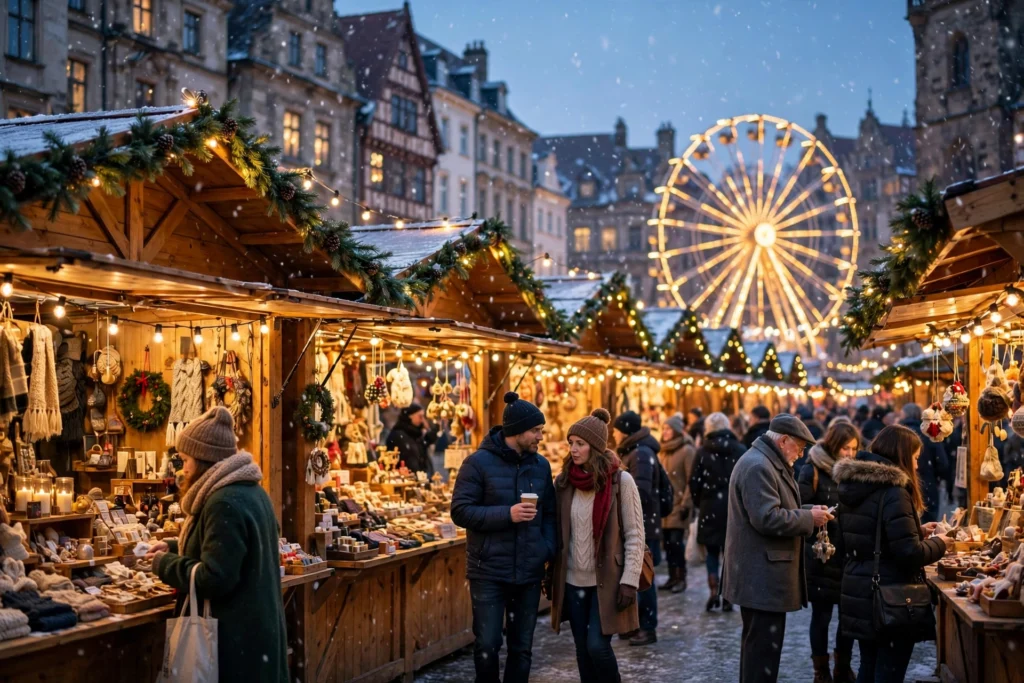
Tokyo does not do Christmas the way anyone else does it. In a country where barely one percent of the population is Christian, December has been enthusiastically adopted as a season of illuminations, German-style markets, fried chicken, and strawberry cake — a fascinating cultural remix where European Christmas traditions are performed with Japanese precision and entirely local meaning. The Tokyo Christmas markets, from Roppongi to Yokohama, are the most interesting Christmas markets in Asia: expat-meets-local curiosities where you can drink authentic glühwein under Tokyo Tower, buy a Käthe Wohlfahrt ornament, and then watch a couple on a Christmas Eve date night stroll past in the illuminations.
This guide is a market-hopper’s manual: every major Tokyo-area Christmas market detailed and compared, the perfect market-hopping itinerary, the illuminations that matter as much as the markets, Japanese Christmas culture explained, and practical logistics. If you are weighing an Asian winter trip, our best places to spend Christmas guide sets Tokyo against the traditional heavyweights.
Roppongi Hills Christmas Market: The Original (20th Year in 2026)
The Roppongi Hills Christmas Market is the granddaddy of them all — one of Japan’s longest-running Christmas markets, celebrating its 20th edition in 2026. Held at Oyane Plaza (the big-roof plaza) in the Roppongi Hills complex, it was designed to recreate the famous Stuttgart Christmas market — often called the world’s largest — in the heart of Tokyo.
2026 dates: November 21 to December 25, open daily 11:00 AM to 9:00 PM. Admission is free. The market is intimate — around 10 stalls — but the curation is excellent: authentic German decorations, gifts, and crafts, including a stall from Käthe Wohlfahrt, the legendary German Christmas decoration house (a superb place to buy a proper ornament). Food is the real deal: German sausages, stews, stollen, and glühwein. For the 20th anniversary, organizers are promising limited-edition anniversary goods and special events.
The strategic genius of Roppongi Hills is its pairing with the Keyakizaka illumination — the 400-meter zelkova-tree avenue behind the complex, draped in blue-white LEDs with Tokyo Tower glowing in the distance. Do the market at dusk, then walk the illumination. It is the definitive Tokyo Christmas evening, and it costs nothing.
Getting there: direct from Roppongi Station (Tokyo Metro Hibiya Line, Exit 1C) or Toei Oedo Line (Exit 3). Arrive before 5:00 PM on December weekends — the queues for food get famously long as Christmas approaches.
Tokyo Christmas Market at Shiba Park: The German Pyramid
The newer Tokyo Christmas Market at Shiba Park — right by Tokyo Tower — has quickly become a contender for the city’s best. Its centerpiece is a large, ornate Christmas pyramid (Weihnachtspyramide) imported directly from Germany: the multi-tiered rotating wooden carousel-pyramid that is the symbol of Erzgebirge Christmas craft.
Season: typically December 5 to December 25. Timed-entry tickets are required to manage crowds — book online ahead. The payoff: high-quality glühwein, excellent ornaments, and the unbeatable backdrop of Tokyo Tower lit in its winter orange. This is the market for the classic photo: German pyramid in the foreground, Tokyo Tower behind.
Yokohama Red Brick Warehouse: The Romantic One
Thirty minutes south of Tokyo by train, the Yokohama Christmas Market at the Red Brick Warehouse (Akarenga) is the most romantic of the region’s markets — and many Tokyoites’ favorite. The historic red-brick warehouses on the harbor, a 12-meter Christmas tree, the lights reflecting on the water, and the adjacent ice skating rink create a classically European waterfront Christmas.
Season: typically November 21 to December 25, 11:00 AM to 9:00 PM (later in the final weeks). Admission is ticketed (around ¥500) for crowd control, with some free areas. The market leans German — sausages, glühwein, Christmas goods — with illuminations and a premium lounge area. Getting there: Bashamichi Station on the Minatomirai Line, a few minutes’ walk. Combine it with an evening in the Minatomirai waterfront district — the Cosmo Clock Ferris wheel and the Landmark Tower area are dressed for the season.
The Rest of the Field: Tokyo’s Other Christmas Markets
- Tokyo Skytree Town (Solamachi) — European-style huts at the base of the world’s tallest tower, typically November 6 to December 25. Free, family-friendly, and unbeatable for photos with the illuminated Skytree. The Solamachi mall’s Christmas displays add indoor warmth.
- Tokyo Midtown (Roppongi) — the sophisticated older sibling: famous for its Midtown Garden illuminations (elegant golden light, a “grown-up Christmas” atmosphere) plus the Santa Tree — a tree covered with around 1,600 Santa figures — and a Christmas marché. Typically mid-November to December 25. Pair it with Roppongi Hills in one evening: the two complexes are minutes apart.
- Ebisu Garden Place — home to the world’s largest Baccarat chandelier, lit for the season in the central plaza. The Christmas market here is smaller, but the chandelier — 8.4 meters tall, thousands of crystals — is worth the trip alone. Typically early November to December 25, free.
- Azabudai Hills — Tokyo’s newest mega-development (opened 2023) runs a stylish Christmas market, typically late November to December 25, free. The closest market to Tokyo Tower, with a design-forward, contemporary feel.
- Meiji Jingu Gaien — the fantasy-themed market with Brothers Grimm fairy-tale theming, typically late November to December 25, ticketed (around ¥1,000). The most theatrical of the markets — great for families and photographers.
- Ueno Park — the newcomer: billed as Japan’s largest Christmas event, typically mid-November to December 25, free entry expected. Worth checking for its scale.
Tokyo Christmas Markets Compared
| Market | 2026 season (typical) | Admission | Best for |
|---|---|---|---|
| Roppongi Hills | Nov 21 – Dec 25 | Free | Authenticity, Käthe Wohlfahrt, 20th anniversary |
| Shiba Park (Tokyo Tower) | Dec 5 – Dec 25 | Timed ticket | The pyramid photo, tower backdrop |
| Yokohama Red Brick | Nov 21 – Dec 25 | ~¥500 | Romance, harbor lights, ice rink |
| Tokyo Skytree | Nov 6 – Dec 25 | Free | Families, tower photos |
| Tokyo Midtown | Mid-Nov – Dec 25 | Free | Elegant illuminations, Santa Tree |
| Ebisu Garden Place | Early Nov – Dec 25 | Free | The Baccarat chandelier |
| Azabudai Hills | Late Nov – Dec 25 | Free | Design lovers, newest spot |
| Meiji Jingu Gaien | Late Nov – Dec 25 | ~¥1,000 | Fairy-tale theming, families |
The Perfect Tokyo Christmas Market-Hopping Day
Tokyo’s markets are compact and the trains are fast — three to four markets in a day is realistic. Here is the optimal route:
11:00 AM — Tokyo Skytree Town. Start east: browse the huts, ride up the Skytree for the daytime panorama (book the observation deck ahead), lunch in Solamachi.
2:30 PM — Shiba Park / Tokyo Tower. Metro across to Shiba Park for the Christmas pyramid and tower photos in the afternoon light. Climb Tokyo Tower if the queues allow.
5:00 PM — Roppongi Hills. Arrive as dusk falls: the market stalls, glühwein, sausages, Käthe Wohlfahrt ornaments. This is dinner — eat at the stalls.
7:00 PM — Keyakizaka illumination + Tokyo Midtown. Walk the illuminated zelkova avenue behind Roppongi Hills (Tokyo Tower in the distance), then cross to Tokyo Midtown for the golden garden illuminations and the Santa Tree.
Optional nightcap — Ebisu Garden Place. One metro stop away: the Baccarat chandelier at night, a drink in the plaza. The perfect end.
Save Yokohama for a separate half-day — it deserves unhurried harbor time, and the Minatomirai illuminations after dark are worth the trip alone. Our Christmas activities guide has more ideas for structuring festive days.
Illuminations vs. Markets: Understanding Tokyo’s Winter
Here is the key insight most guides bury: in Tokyo, the illuminations (iruminēshon) matter at least as much as the markets. Japan has elevated winter light displays to an art form, and they run longer (often November through February) and draw bigger crowds than the markets. The essential ones:
- Keyakizaka (Roppongi Hills) — 400 meters of blue-white LEDs with Tokyo Tower behind. The icon.
- Tokyo Midtown Garden — golden, elegant, romantic.
- Marunouchi (Tokyo Station area) — champagne-gold lights along the boulevards; the station building itself is spectacular.
- Shibuya Blue Cave (Ao no Dokutsu) — a tunnel of blue LEDs through the park near Shibuya. Immensely popular, especially with couples.
- Yomiuriland Jewellumination — the amusement park’s over-the-top light extravaganza, worth the trip west.
Plan your trip around both: markets by day and dusk, illuminations after dark. They are different experiences, and Tokyo does both better than almost anywhere.
Japanese Christmas Culture, Explained
Christmas in Japan is a fascinating cultural import — widely celebrated, almost entirely secular, and full of traditions that baffle Western visitors:
- KFC on Christmas Eve: the famous Kurisumasu ni wa Kentakkii (“Kentucky for Christmas”) campaign from 1974 made fried chicken the national Christmas dinner. Families pre-order Christmas KFC buckets weeks ahead; the lines on December 24 are legendary. It started as an expat workaround and became a genuine tradition.
- Strawberry shortcake: the Christmas cake — sponge, whipped cream, strawberries — sold everywhere in December. The red-and-white colors read as festive; eating it on Christmas Eve is as standard as turkey in the West.
- Christmas Eve is for couples: December 24 is Japan’s most romantic night — the equivalent of Valentine’s Day. Fancy restaurants book out for couple’s dinners, the illuminations fill with pairs, and hotels sell Christmas Eve packages. (Christmas Day itself is quieter — and December 25 is not a public holiday.)
- New Year is the real holiday: Shogatsu (January 1–3) is Japan’s major family holiday — the markets close on December 25, and the country pivots to shrine visits (hatsumode), special foods (osechi), and family time. Plan accordingly: late December is festive, early January is traditional.
For visitors, this means: the markets wind down on December 25 (most close that day), Christmas Eve is magical but crowded with date-night couples, and the illuminations continue long after the markets pack up.
What to Eat & Buy at Tokyo’s Christmas Markets
Eat: the German staples are done well — bratwurst and currywurst, glühwein (often excellent, imported-wine based), stollen, lebkuchen, roasted almonds. The Japanese touches appear at the edges: nikuman (steamed pork buns) at some stalls, hot amazake (sweet sake), and the department-store food halls’ Christmas cakes. Budget ¥500–1,200 per snack, ¥800–1,500 for glühwein.
Buy: Käthe Wohlfahrt ornaments at Roppongi (the real German thing), wooden Erzgebirge crafts at Shiba Park, market-exclusive mugs (every market does a collectible glühwein mug — the Roppongi 20th-anniversary edition will be a keeper), and Japanese Christmas goods with a twist (origami ornaments, tenugui hand towels in Christmas patterns). For pairing with gifts from home, our Christmas gifts for coworkers guide travels well across cultures.
Getting Around & Where to Stay
Tokyo’s trains make market-hopping effortless. A Suica/Pasmo IC card covers all metro and JR lines; the markets cluster in central Tokyo (Roppongi, Shiba, Ebisu, Skytree) with Yokohama 30 minutes south on the Minatomirai Line. Everything is walkable from stations.
Where to stay: Roppongi or Azabujuban puts you in the Christmas heartland (mid-range hotels ¥18,000–35,000/night in December). Shimbashi/Shiodome is well-connected and slightly cheaper. Asakusa offers traditional atmosphere near the Skytree. Book early — Christmas week fills up, and December 23–25 hotel prices spike.
Daytime pairing: Tokyo’s December days are crisp and often sunny (5–12°C). Use daylight for the classic sights — Senso-ji, Meiji Shrine (beautiful with winter light), the teamLab museums — and save the markets and illuminations for dusk onward.
A Local’s Guide to Roppongi at Christmas
Roppongi at Christmas is more than the market — the whole district becomes Tokyo’s festive headquarters. Here is how locals do it:
Mori Tower and the Sky Deck: the Roppongi Hills Mori Tower’s observation deck (Tokyo City View) offers the great aerial Christmas panorama — the Keyakizaka illumination, Tokyo Tower, and the city’s lights spreading to the horizon. The open-air Sky Deck on clear winter nights is spectacular; December’s crisp air means the best visibility of the year, with Mt. Fuji often visible at sunset.
The Roppongi Hills complex: beyond the market, the complex’s shops and restaurants go full Christmas — the Christmas cake pop-ups in the food floors, the seasonal menus at the high-end restaurants, and the Mori Art Museum’s winter exhibitions make a full day of it. The Azabudai Hills development next door (with its own Christmas market) extends the walkable festive zone.
Dinner strategy: Roppongi’s restaurant scene is one of Tokyo’s most international — excellent for a Christmas Eve dinner that is not KFC. Book Christmas Eve (the couples’ night) well ahead; Christmas Day is actually easier. For something traditionally Japanese, the izakaya backstreets behind the main complex offer the perfect contrast to the German market: grilled skewers and hot sake after glühwein.
Beyond the Markets: Tokyo’s Winter Day Trips
Tokyo’s December days are made for excursions — crisp, often sunny, with the year’s clearest air:
- Nikko (2 hours): the UNESCO shrines and temples with winter light and possible snow — Toshogu’s carvings against a blue December sky are unforgettable. The Kegon Falls area gets properly wintry.
- Hakone (90 minutes): Mt. Fuji views (best in winter), hot-spring ryokans, the open-air museum, and the pirate ships on Lake Ashi. An overnight in a ryokan with kaiseki dinner is the great Japanese winter experience.
- Kamakura (1 hour): the Great Buddha, Hasedera Temple’s winter illuminations, and the beach town’s relaxed pace. The temples’ seasonal light-ups are beautiful.
- Enoshima: the island’s Sea Candle light tower and the winter illuminations across the island gardens — a local favorite that tourists often miss.
- Chichibu (90 minutes): for the adventurous — the Chichibu Night Festival (early December) is one of Japan’s great float festivals, with fireworks in winter. A genuine cultural deep cut.
Pair two market days with one day trip for the ideal Tokyo Christmas week.
Budget Planner: Tokyo at Christmas (JPY)
| Expense | Typical range |
|---|---|
| Market admissions (most are free) | ¥0–1,000 (Yokohama ~¥500, Gaien ~¥1,000) |
| Glühwein | ¥800–1,500 |
| Market snacks (sausages, stollen) | ¥500–1,200 each |
| Käthe Wohlfahrt ornament | ¥1,500–5,000 |
| Mid-range hotel (December) | ¥18,000–35,000/night |
| Metro day of market-hopping | ~¥800–1,200 |
| Christmas KFC bucket (pre-order) | ~¥4,000–6,000 |
| Strawberry Christmas cake | ¥3,500–6,000 |
Tokyo is not cheap, but the Christmas experiences themselves are remarkably affordable — most markets and all illuminations are free. The money goes to hotels and food, and the konbini (convenience store) Christmas cake is a legitimate budget move. If you are visiting multiple markets in one day, the metro day passes and IC card fare caps keep transport costs negligible.
Christmas Shopping in Tokyo: Beyond the Market Stalls
Tokyo’s markets are for atmosphere; the city’s department stores are for serious Christmas shopping. The depachika (basement food halls) of Mitsukoshi, Takashimaya, and Isetan transform in December into wonderlands of Christmas cakes, osechi New Year food sets, and gift-wrapped everything — the packaging alone is worth the visit. The Tokyo Station Character Street and Nakano Broadway cover pop-culture gifts; Kappabashi (the kitchenware district) is the place for extraordinary Japanese knives and ceramics at local prices.
For Christmas-specific souvenirs beyond the markets: tenugui hand towels in winter patterns, maneki-neko in Christmas colors, daruma dolls, and the department stores’ exclusive Christmas-limited sweets (Tokyo’s confectioners release December-only editions that make superb gifts). The 100-yen shops (Daiso, Seria) sell shockingly good Christmas decorations and wrapping — a budget traveler’s secret weapon. For pairing Japanese finds with gifts from home, our stocking stuffers for kids guide has universally packable ideas.
Frequently Asked Questions
When are the Tokyo Christmas markets open in 2026?
Roppongi Hills runs November 21 to December 25 (11:00 AM–9:00 PM, free entry). Yokohama Red Brick runs late November to December 25. Shiba Park’s Tokyo Christmas Market runs early-to-late December (timed tickets required). Most Tokyo markets close on December 25; the illuminations continue into the new year. Confirm exact dates on official sites before traveling.
Which Tokyo Christmas market is the best?
Roppongi Hills for authenticity and the 20th-anniversary editions (free, Stuttgart-inspired, Käthe Wohlfahrt stall); Shiba Park for the German pyramid and Tokyo Tower photos (timed tickets); Yokohama Red Brick for romance and the harbor setting. Do all three if you can — they are different experiences.
Do I need tickets for Tokyo Christmas markets?
Most are free, including Roppongi Hills, Skytree, Midtown, and Ebisu. Shiba Park requires timed-entry tickets, Yokohama charges around ¥500, and Meiji Jingu Gaien around ¥1,000. Book the ticketed ones online in advance — December weekends sell out very quickly.
Why do Japanese people eat KFC on Christmas?
A 1974 marketing campaign (“Kentucky for Christmas”) positioned fried chicken as the Christmas dinner for a country without a turkey tradition. It stuck — spectacularly. Families pre-order Christmas KFC buckets weeks ahead, and eating it on Christmas Eve is now a genuine national tradition.
Are Tokyo Christmas markets open on Christmas Day?
Most close on December 25 — the market season ends on Christmas Day in Japan, and the country pivots to New Year (Shogatsu) preparations. The illuminations, however, continue for weeks. Plan your market visits for December 24 or earlier.
Can I visit Tokyo’s Christmas markets with kids?
Absolutely — they are very family-friendly: free entry at most, compact, safe, with carousels, fairy-tale theming (Meiji Jingu Gaien), and the Skytree market designed for families. December evenings are cold (5–12°C), so dress warmly. The illuminations are the real kid-pleasers — especially the Blue Cave in Shibuya.
What is the difference between Tokyo’s Christmas markets and illuminations?
The markets are German-style shopping and food events (mostly late November to December 25, many free). The illuminations (iruminēshon) are large-scale winter light displays across the city — often more spectacular, running longer (frequently into February), and drawing bigger crowds. Do both: markets by day and dusk, illuminations after dark. Together they are Tokyo’s complete winter experience.
Tokyo’s Christmas markets are a reminder that traditions travel — and that they get more interesting in transit. German glühwein under Tokyo Tower, a Stuttgart market in Roppongi, fried chicken for Christmas dinner: it should not work, and it completely does. Come for the curiosity; stay for the illuminations. Few cities on earth do December nights like Tokyo — and once you have walked the Keyakizaka lights with Tokyo Tower glowing above the market stalls, the European originals will feel like the rough draft.